

Showing posts with label Mining the ASTEROIDS. Show all posts

Monday, November 18, 2024

MINING THE ASTEROIDS Part 15: IS NASA Doing It???

Initially, I started this series because of the 2021 World Science Fiction Convention, DisCON which I WOULD have been attending in person if I felt safe enough to do so in person AND it hadn’t been changed to the week before the Christmas Holidays…HOWEVER, as time passed, I knew that this was a subject I was going to explore because it interests me…


In a recent video https://www.youtube.com/watch?v=JvCSZHfjmZ4, NASA ASU Professor and Asteroid Scientist, Lindy Elkins-Tanton, gives a pretty firm and unambiguous answer: “No NASA is not mining asteroids…” BUT… “What NASA is doing is fundamental science, research missions that go out to the asteroids and try and understand more about them and they will help any eventual future efforts to mine the asteroids. We ARE going to go visit an asteroid we think is made largely of metal.”

So, the answer Dr. Elkins-Tanton gives is clear and unambiguous.

“Or,” (as my granddaughter and grandson are fond of saying), “IS it???”

The NASA mission to Psyche, the metal asteroid they’re targeting, is set to launch on October 10, 2023 for the Psyche orbiter to launch and get to the asteroid by August 2029. But is that realistic? Anyone reading this KNOWS how NASA sets it sights, budgets bloom, Congress gets antsy with repeated requests for “more funding” and eventually a good idea gets buried – especially since we no longer have anyone breathing down our neck.

“Or,” (as my granddaughter and grandson are fond of saying), “do we???”

China’s efforts at asteroid mining, while typically wrapped in layers of secrecy about specific facts and technology, this article from SKN News in September of 2020: (St. Kitts and Nevis, east of the island of Hispaniola (Haiti and the Dominican Republic) ran nothing but this headline: “China to send first-ever ‘asteroid mining robot’ into space this November” (https://sknnews.com/world-news/china-to-send-first-ever-asteroid-mining-robot-into-space-this-november-42276979/)

That’s it. Nothing else. No story, no nothing.

But digging around deeper, I found this: “The SuperView Neo 1-01 & 02 satellites were designed and manufactured by the China Association for Science and Technology (CAST) for China Siwei Survey and Mapping Technology Co. Ltd. (China Siwei), a leading company providing geospatial information services in China…Neo constellation will include at least 28 satellites of 3 series. The first one is called SuperView Neo-1 and it aims to provide 20 to 30 cm optical images. SuperView Neo-2 will produce synthetic-aperture radar (SAR) images with 50 cm resolution in spotlight mode, whereas SuperView Neo-3 will acquire large swath-width optical images with resolution higher than 1 meter. On this mission, two satellites of the first series (SuperView Neo-1) were launched. These satellites have a mass of 540 kg each, with resolution down to 0.3 meters.” (https://everydayastronaut.com/superview-neo-1-01-02-long-march-2c/)

In an article dated September 2020, India News (https://www.mining-technology.com/news/origin-space-launch-mining-robot-space/) reported: “As part of this mission, Origin Space will use a small satellite called NEO-1, weighing nearly 30kg…NEO-1 will be launched as a secondary payload by a China-made Long March series rocket. The launch of NEO-1 will mark the ‘first steps’ taken towards testing capabilities as part of efforts to detect and extract space resources. India Today quoted Origin Space co-founder Yu Tianhong as stating: ‘The goal is to verify and demonstrate multiple functions such as spacecraft orbital manoeuvre, simulated small celestial body capture, intelligent spacecraft identification and control.’ The long-term objective of the space company is to develop rare-earth metals and mineral resources from near-Earth asteroids.”

So…China launched NEO-1 and NEO-2: “The NEO-01, developed by Nanjing-based Origin Space Technology Co, which claims to be the first Chinese company dedicated to exploring and utilizing space resources, was launched on a Long March 6 rocket for space debris removal and asteroids mining experiments in deep space in April 2021…the robot prototype completed an experiment of using a large net to capture space debris and the relative technique verification in key steps, which is the first commercial company in the world to complete such an experiment.” (https://www.globaltimes.cn/page/202211/1279404.shtml)

So the race has begun – not between the defunct Soviet Union; nor the ineffective regime currently in the Kremlin, mired down in a war that was supposed to last weeks, but has stretched into eighteen months of slogging push and shove with absolutely nothing to show for it as it rapidly descends into a punchline for a joke...

First soldier: “Russia is second most powerful military nation…”
Second soldier: “Da, in Ukraine.”

but between the US and China; and right now, it seems that China might have more enthusiasm than we do… “Or,” (as my granddaughter and grandson are fond of saying), “do they???”

New Source: https://www.youtube.com/watch?v=JvCSZHfjmZ4
Fundamental Resource: (A general Wikipedia post detailing what the authors currently know about asteroid mining: https://en.wikipedia.org/wiki/Asteroid_mining)
Noted Resources: https://en.wikipedia.org/wiki/List_of_asteroid_close_approaches_to_Earth, https://www.pharostribune.com/news/local_news/article_7fcd3ea5-3c14-533f-a8d5-9bf629922f34.html, https://www.fool.com/investing/2022/04/29/like-asteroid-mining-be-careful-what-you-wish-for/, https://www.nps.gov/wrbr/learn/historyculture/theroadtothefirstflight.htm, https://hackaday.com/2019/03/27/extraterrestrial-excavation-digging-holes-on-other-worlds/, https://www.planetary.org/space-missions/every-small-worlds-mission
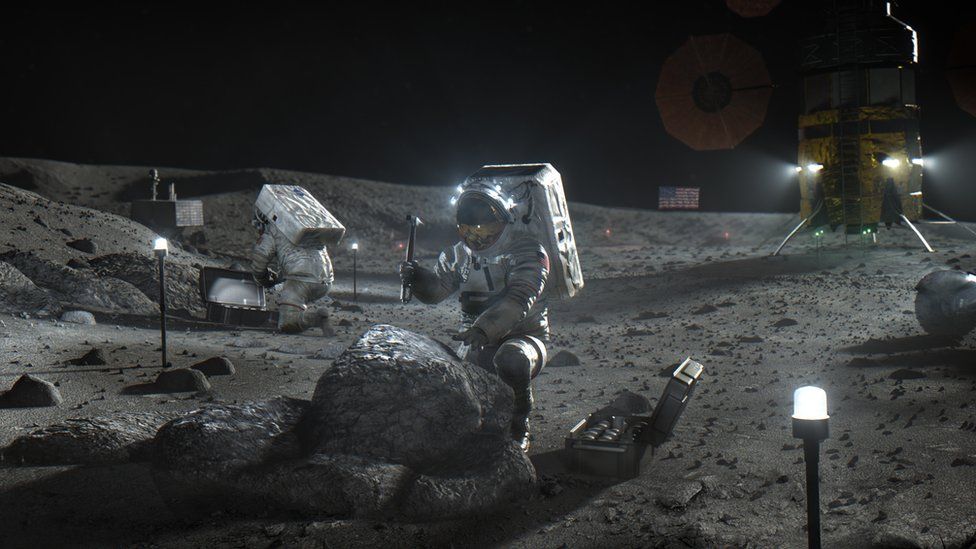
Image: https://ichef.bbci.co.uk/news/976/cpsprodpb/A2D5/production/_114558614_hls-eva-apr2020.jpg

Tuesday, May 21, 2024

MINING THE ASTEROIDS Part 14: Another Player “Believes”!

Initially, I started this series because of the 2021 World Science Fiction Convention, DisCON which I WOULD have been attending in person if I felt safe enough to do so in person AND it hadn’t been changed to the week before the Christmas Holidays…HOWEVER, as time passed, I knew that this was a subject I was going to explore because it interests me…


“We [at Karman+] want to mine space resources from near-Earth asteroids to provide abundant, sustainable energy and resources in space and for Earth.”

Whew! Bold words!

Karman+ is the most recent company to throw its helmet into the hype-filled sea of speculative asteroid mining. They DO note that asteroid mining has “lived at the intersection of scientific research and popular culture for decades, with as many academic papers published as there are books, TV shows and movies about it.”

That being said, everyone knows that the ULTIMATE reason to start mining the asteroids is because what metals that are left on Earth have been mined practically to the bare rock walls. And even MORE ultimately, the mining concerns are facing the possibility of the total depletion of their cash cows.

I live in Minnesota. During World War II, “Minnesota nearly depleted its immense supply of high-grade iron ore to help the Allies win World War II, providing much of the crucial raw material behind America's tanks, warships, guns and ammunition…”

But how MUCH is “much”? “SEVENTY percent of the iron ore that America devoted to the war came from Minnesota…333 million tons, according to Pam Brunfelt, a retired Vermilion Community College faculty member and historian.” She added, “without the Iron Range, we would not have won the war…[Today], our resources-driven growth faces a massive existential challenge, with climate change, ecosystem degradation and resource depletion demanding a complete reset. Humanity needs to shift global transportation, manufacturing, construction and energy onto a sustainable path.”

There are a growing number of companies who are talking a BIG TALK about mining asteroids; just as there are a number of individuals who live in total doubt that something as ridiculous as “mining asteroids” will EVER take place. From these early, serious attempts to realize, these modern day space pirates are intent on sinking any serious discussion or intention to realize any alternatives to mining in space by insisting that Earth is the ONLY PLACE WE WILL EVER GET THE METALS WE NEED TO CONTINUE TO BUILD OUR SOCIETY. (see: 
MINING THE ASTEROIDS The Final Post: Maybe THESE Are The REAL Space Pirates? ~ Stupefying Stories Magazine)

Fortunately, there’s another new company willing to do more than talk. The “Karman+” and logo come from the concept of the Kármán line, established in the 1960’s, “a proposed conventional boundary between Earth's atmosphere and outer space set by the international record-keeping body FAI (Fédération Aéronautique Internationale) at an altitude of 100 kilometers (also: 62 miles or 330,000 feet) above sea level.”

There’s no measurable change in the characteristics of the atmosphere across it, but it IS important for legal and regulatory purposes. Anything flying above it is considered a spacecraft; anything below it is just an airplane, no matter how fancy.

Those two types of vessels are subject to different jurisdictions and legislations. It IS a lot higher than we can reach with a regular jet or a high altitude balloon. But it’s also the point at which a satellite in orbit around Earth will inevitably fall out of the sky.

Karman+ believes in something called “the Regolith Age, powered by abundant space resources, is an inevitability that we can accelerate.” Because they don’t offer ANY kind of definition, I’m somewhat suspicious of their mission…though I think I can parse it reasonably well:

Regolith: “regolith, a region of loose unconsolidated rock and dust that sits atop a layer of bedrock and serves as a source of other geologic resources, such as aluminum, iron, clays, diamonds, and rare earth elements. It also appears on the surfaces of the Moon, other planets, and asteroids. The word is the Greek term for “blanket rock.” So, we expect to not actually DIG into asteroids, but merely swoop in and scoop up the regolith and either refine it in orbital facilities and what? Drop down slugs of iron, steel, gold, frankincense, and myrrh?

Either that or ship raw regolith back to the surface in…space shuttles? Heat-shielded “drop capsules”? [NOW THERE’S AN IDEA! Pack a drop capsule full of unrefined regolith. Send it on a one-way fall into the ocean with some kind of floater ring. Provide a vent in the top of the dropper, and voila, the capsule will be full of partially smelted metal even before Humans get their hands on it.] But wouldn’t it kind of be bad if one of these dropper companies sent a ship down with regolith that shows a high concentration of gold, platinum, or other desirable metals – and some mean, old fashioned PIRATE pirates grabbed it and make off with it?]

Hmmm…Karman+ points out that there have been baby steps made in the returning of samples to our surface from other bodies: from the various rocks returned on the original Apollo Lunar landings (“Between 1969 and 1972 six Apollo missions brought back 382 kilograms (842 pounds) of lunar rocks, core samples, pebbles, sand and dust from the lunar surface. The six space flights returned 2200 separate samples from six different exploration sites on the Moon. In addition, three automated Soviet spacecraft returned important samples totaling 300 grams (approximately 3/4 pound) from three other lunar sites.” (https://curator.jsc.nasa.gov/lunar/)

“That last step has been advanced through the Hayabusa and Hayabusa2 missions run by JAXA, both of which also returned sample material back to earth. This will be expanded in the coming years with the NASA-run OSIRIS-REx mission, taking our total count of asteroid sample return missions to 3. As well, AstroForge did some experiments on asteroid mining earlier this year. (https://faithandsciencefiction.blogspot.com/2023/05/mining-asteroids-part-13-new-kid-in.html)

So, despite the nay-sayers, doom-layers, and plain haters, the possibility of mining the asteroids is moving forward, albeit slowly. Consider, however, how many years it took between Goddard’s first rocket experiments and Apollo 11’s historic landing on the Moon – forty-three years between his first liquid fuel rocket launch, and “One small step for man; one giant leap for mankind.”

Since then, we haven’t stopped and the exploration of space has included virtually every nation with launch capability – or the wherewithal to buy a place in space.

I think our “negativity experts” have chosen to stand in stubborn surety on the WRONG side of Human history.

New Source: https://karmanplus.com/; https://en.wikipedia.org/wiki/K%C3%A1rm%C3%A1n_line ;
Resources: https://en.wikipedia.org/wiki/List_of_asteroid_close_approaches_to_Earth, https://www.pharostribune.com/news/local_news/article_7fcd3ea5-3c14-533f-a8d5-9bf629922f34.html, https://www.fool.com/investing/2022/04/29/like-asteroid-mining-be-careful-what-you-wish-for/, https://www.nps.gov/wrbr/learn/historyculture/theroadtothefirstflight.htm, https://hackaday.com/2019/03/27/extraterrestrial-excavation-digging-holes-on-other-worlds/, https://www.planetary.org/space-missions/every-small-worlds-mission
Image: https://ichef.bbci.co.uk/news/976/cpsprodpb/A2D5/production/_114558614_hls-eva-apr2020.jpg

Sunday, January 14, 2024

MINING THE ASTEROIDS: Part 13 The REAL Objection To Mining The Asteroids

Initially, I started this series because of the 2021 World Science Fiction Convention, DisCON which I WOULD have been attending in person if I felt safe enough to do so in person AND it hadn’t been changed to the week before the Christmas Holidays…HOWEVER, as time passed, I knew that this was a subject I was going to explore because it interests me…

I've done lots of reading on the Human mining of the asteroids, and the single most frequent objection I run across is that it will be far too dangerous. The TECHNOLOGY is here; now. NOT refined to the point that Earth's mining industry has it today - but as it BEGAN on Earth a long time ago.

OK – I’m going to run with this theme for a few pieces and I’m going to take a step back. One of the biggest objections to mining the asteroids is that “it’s going to be hard; maybe even impossible”.

I’d like to use a different template to this. I live in Minnesota; iron mining has been (and still is!) a large part of our state’s character and history.

Some of you reading this may roll your eyes and mutter, “Who the heck cares about iron mining? That’s a dead issue! Even in your ‘special’ state, your iron is pretty much played out. The whole idea of mining is so passe as to be pretty much irrelevant!”

I might point out to you that without Minnesota’s mining and manufacturing history – both past and CURRENT – your personal life would be quite different. First of all, “Minnesota's rich iron deposits were a vital component of America's [World War II] war effort. About 70% of the iron ore that America devoted to the war came from Minnesota, amounting to more than 333 million tons.” I believe it might be safe to say that without the iron from Minnesota, there wouldn’t have been much of an American response to the Nazis and the Emperor of Japan.

Secondly, in case you missed it, a company that formed out of Minnesota’s iron mining was Minnesota Mining and Manufacturing.

You know the company? No? Are you SURE you have no idea what stupidly obscure company I’m referring to? Maybe it’s other name would jog your recognition: 3M…you know a couple of their totally irrelevant products – PostIt Notes; Scotch Brand Tape…well, I’ll stop as they manufacture some 60,000 products.

“I think we’d live without paper products!” you snap with irritation. I’ll point out that among those products, there is at least ONE that conceivably saved countless lives of Humans on Earth: “The N95 respirator mask was developed by 3M and approved in 1972. Due to its ability to filter viral particulates, its use was recommended during the COVID-19 pandemic…the U.S. government asking 3M to stop exporting US-made N95 respirator masks to Canada and to Latin American countries…President Donald Trump invoked the Defense Production Act to require 3M to prioritize orders from the federal government.” (https://en.wikipedia.org/wiki/3M)

So let’s move on. “Historically, much of the iron ore utilized by industrialized societies has been mined from predominantly hematite deposits with grades of around 70% Fe. These deposits are commonly referred to as "direct shipping ores" or "natural ores". Increasing iron ore demand, coupled with the depletion of high-grade hematite ores in the United States…” read there, 70% of the iron ore available to the world prior to WWII came from Minnesota.

The iron mined in Minnesota didn’t spring out of the earth in fully formed iron ingots.

It had to be dug out. “On the Cuyuna Iron Range…mining began in 1907. In the early 1880s, federal surveys noted magnetic anomalies near what would become the Cuyuna Range. No visible outcrops of iron ore were present at the surface…buy surveyors suspected the anomalies could be buried iron ore deposits. By 1902, Adams began seeking outside investors to develop mines…in June 1907, the Rogers–Brown Ore Company opened the first active iron mine on the Cuyuna Range. Around 1910, immigrants from northern and southern Europe settled into newly built mining communities with the hope of finding work at mines.”

“Demand for iron ore in the United States surged during World War I. Over thirty iron mines were operating at that time; most were underground operations. After the war, many of these Cuyuna Iron Mines closed. The few new mines of the 1920s were open pits that used large earth-moving equipment rather than shafts and tunnels to reach the ore. By the early 1930s, the economic woes of the Great Depression affected mining in the Cuyuna Range [which held] manganese-rich iron ores important for making very hard steel. The Cuyuna Range held the largest domestic supply of this ore. Demand for iron and steel continued throughout World War II and the Korean War. In 1953, production on the Cuyuna Range reached its highest point, at a little over three-and-a-half million tons. The early 1960s saw a rapid decline in iron ore from the Cuyuna Range as seventeen mines closed between 1961 and 1965. By 1982, the last reported shipment of iron ore from the Cuyuna Range was made, ending the period of active mine operations in the district.” (https://www.minnpost.com/mnopedia/2016/04/very-brief-history-mining-cuyuna-iron-range/?gad_source=1&gclid=CjwKCAiA44OtBhAOEiwAj4gpOSt0UhiZ2WaXl-6EI4yaEdcj89-g1Nd0qdvanbAhe1BaUYtMibg-LhoCHHYQAvD_BwE)

“There is evidence that meteorites were used as a source of iron before 3000 BC, but extraction of the metal from ores dates from about 2000 BC. Following the discovery of high-quality iron on the island of Elba, iron became an important commodity of Roman Empire.”

How many people died attempting to develop the technology for extracting metal ore from underground? Apparently that’s a virtually unknown number. Recently, all I can get are general numbers: “Although there are no accurate figures, estimates suggest such accidents kill about 12,000 people a year.” https://www.bbc.com/news/world-latin-america-11533349. That’s for 2023…

If the argument against mining the asteroids is that too many people will die…I suggest to you that since underground mining started…well, that number isn’t available, either. So, let’s just start with 1900-2023. If 12,000 people a year die in mining accidents, that means in the past 123 years, 1,470,000 humans (mostly males) have died; that is, from the beginning of the Industrial Era to the Colonization of Space Era, a million plus people have died.

Why do we think that mining in space will be ANY EASIER? Objecting to mining is space based on an imaginary “injury report” is…not entirely rational – and if that is the objection, then perhaps we should stop mining on Earth altogether.

No?

“12,000 lives – and some of those are probably just slaves! – is the price we have to pay in order to have the way of life we do.” And what about some of those other specialized metals the Western Climate Mitigation People need? How many deaths have there been while lithium for electric car batteries have occurred? We don’t know: https://www.cbc.ca/radio/asithappens/as-it-happens-tuesday-edition-1.5399491/tech-giants-sued-over-appalling-deaths-of-children-who-mine-their-cobalt-1.5399492 BTW – in the event that your argument is that “we don’t have mining accidents any more. We’re technologically advanced!”, I suggest you follow this link: https://www.mining-technology.com/features/featureworld-worst-mining-disasters/?cf-view

My premise is that using “it’s dangerous” as an excuse to refrain from mining the asteroids carries little weight. The technology itself is making rapid advances, plus we’re not talking about sending asteroid miners to the farthest reaches of the Solar System. Asteroids swing by Earth all the time. We have the technology to support life in space – the ISS has been “live” for the past 24 years. We have ways to reach space that are gradually getting both easier and more accurate. “We don’t have any mining machines!!!”

Obviously we can’t use diesel-powered machinery! How about battery powered? Maybe take a few of those lithium batteries and repurpose them?

I’m just saying: mining the asteroids isn’t impossible – and every member of the IPCC, every democrat in the US, and Green Party members everywhere, should be backing asteroid mining programs EVERYWHERE!

New Source: https://cowboystatedaily.com/2024/01/06/wyoming-could-be-a-space-pioneer-when-not-if-we-start-mining-asteroids/
Fundamental Resource: (A general Wikipedia post detailing what the authors currently know about asteroid mining: https://en.wikipedia.org/wiki/Asteroid_mining)
Noted Resources: https://en.wikipedia.org/wiki/List_of_asteroid_close_approaches_to_Earth, https://www.pharostribune.com/news/local_news/article_7fcd3ea5-3c14-533f-a8d5-9bf629922f34.html, https://www.fool.com/investing/2022/04/29/like-asteroid-mining-be-careful-what-you-wish-for/, https://www.nps.gov/wrbr/learn/historyculture/theroadtothefirstflight.htm, https://hackaday.com/2019/03/27/extraterrestrial-excavation-digging-holes-on-other-worlds/, https://www.planetary.org/space-missions/every-small-worlds-mission; https://www.earthsystems.com/history-mining/ 

Saturday, July 8, 2023

MINING THE ASTEROIDS Part 12: Maybe THESE Are The REAL Space Pirates?

Initially, I started this series because of the 2021 World Science Fiction Convention, DisCON which I WOULD have been attending in person if I felt safe enough to do so in person AND it hadn’t been changed to the week before the Christmas Holidays…HOWEVER, as time passed, I knew that this was a subject I was going to explore because it interests me...

For those of you interested, my time of posting essays on Stupefying Stories has come to its natural end. We all come here for STORIES (it says so right in the blog's name!) My essays served a purpose to bridge a time of social upheaval. That time has passed (more-or-less) and so I'll leave you with this one last essay -- because it has the potential to spark ALL KINDS OF STORY built right in it! If you're interested in reading my essays, feel free to stop by my blog, POSSIBLY IRRITATING ESSAYS (https://faithandsciencefiction.blogspot.com/) I'll be continuing both the MINING ASTEROIDS and the CREATING ALIEN ALIENS essays indefinitely!

So long, I've had a really grand time! (PS -- I've got some stories coming up here in the future...so there you go!)


WEBSTER’S DICTIONARY defines it like this: “the status quo noun: the current situation : the way things are now [as in] ‘He's content with the status quo and isn't looking for change.’” Surprisingly, in a Physics.org article in the January 2023, by Juliana Segura-Salazar and Kathryn Moore, state in various parts of the article (with grave and great authority):“…mining in space won't save the Earth”

“Our research casts doubt on many of them…”

“Whether mineral deposits lying beyond Earth are commercially viable has not yet been proven.” [The remains of asteroid strikes apparently are NOT any kind of proof of not only present but commercially viable: “The largest meteorite found on Earth is the Hoba meteorite discovered in Namibia in 1920. The Hoba meteorite weighs roughly 54,000 kilograms (119,000 pounds). The Hoba meteorite is so big, and so heavy, it has never been moved from where it was found! I’d emphasize “found” and “1920”; 15 seconds later, I found this: “Meteorites Were the Origin of All Things Iron Predating the Iron Age”…]

“…research suggests that, except for platinum group elements, the concentrations of most metals in space materials may be lower than on Earth.”

“To date, there are no regulations or adequate waste management plans for mining off-Earth. Space mining has a lot to learn from the best practices and missteps of mining on Earth.” [Did the authors read this statement out loud? Mining on Earth takes place in a living, breathing environment. In space there IS no environment; they also make the statement: “we know space debris already falls to Earth quite frequently.” [HOW frequently? Thirty seconds of research gave me this: “Although most debris burns up in the atmosphere, larger debris objects can reach the ground intact. According to NASA, an average of one cataloged piece of debris has fallen back to Earth each day for the past 50 years. Despite their size, there has been no significant property damage from the debris.”]

“But the technology for accessing these minerals is still a long way off (if it happens at all). But the renewable energy transition must happen urgently—and for now, the minerals will be extracted on Earth.” While the continued extraction of ores from this planet will absolutely continue, I am unsure how two highly intelligent physicists can write a sentence like this. In 1955, the technology to put anything into space was “a long way off”; in 1962, JFK’s challenge to land a Human being on the Moon was still “a long way off” – turned out “long way off” was seven years. What’s this supposed to mean, anyway?

Are these writers TRYING to use their intelligence and authority to derail a step off of Earth? Are they attempting to use the weight of their degrees as proof of authority that mining the asteroids is not only useless, economically non-viable, not even possible because the metal others say are there ISN’T, “it’s unregulated”, and guaranteed to be dangerous (with two examples of exactly HOW dangerous it will be!) to both Humans on Earth AND the environment. [BTW – this is biology: my undergraduate field]

Are they intentionally trying to steal the future of Humanity – pirating the future of the our whole world with weakly supported claims of virtually certain failure? Worse, are they suggesting that we should not even bother trying?

If a social scientist made a definitive statement regarding physics, it seems likely that these two scientists would laugh at them – but they predict, without a shred of evidence or academic verity that: “The current space race reflects a colonial mindset in which the powerful rush to stake a claim in new territories—and whoever gets there first gets the riches. This narrative is one of ‘techno-futurism’, where progress is measured by wealth generation, which in turn relies on technology development. Should this gold-rush style bonanza prove viable, only a small proportion of people would pocket the profits. The gap between the very rich and the rest of society would only widen.” [Hmmm, now THERE'S a story idea...]

Finally, they write: “Look down, not up. Viable and responsible space mining is a very distant prospect. But climate change is an urgent problem that needs solutions right now. Despite the many downsides, mining on Earth remains essential to the transition to a low-carbon energy economy[!?!?!] Rather than space mining, positive environmental and social outcomes on Earth are better achieved by ensuring terrestrial mining is done in the most sustainable way possible.”

The fact is that after we deplete the mineral resources of Earth – or more likely make it nearly impossible to dig out what’s left…we will need to get those minerals from SOMEWHERE…even the lithium used in electric cars is extremely rare. Copper that (rarely mentioned and NEVER explicitly stated) winds the core of EVERY electrical generator on Earth, including the ones foisted on us to generate “green energy from the wind”…which, of course necessitates tearing the ground up to find more and more deposits of copper, which most likely, will result in toxic leaching…

I don’t know, this just seems to be a (perhaps) unintentional attempt to pirate EVERYONE’S future – because it is undeniable (maybe they don’t see this???) that you need COPPER (and everything that mining of copper entails, they seem to be of the mindset that if we recycle it, it covers over the sins of the devastation the mining wrought in the FIRST place.)

Despite their coherent arguments, I’m still convinced that asteroid mining is BOTH needed and possible. I just hope these space pirates don’t take out too many of the messengers of hope…

New Sources: https://phys.org/news/2023-01-hype-world-space-wont-earth.html, https://www.nasa.gov/sites/default/files/atoms/files/osiris_rex_factsheet5-9.pdf, https://tvtropes.org/pmwiki/pmwiki.php/Main/SpacePirates, https://en.wikipedia.org/wiki/Space_debris, https://www.haaretz.com/archaeology/2017-12-05/ty-article/all-iron-artifacts-from-pre-iron-age-made-of-meteorite-metal/0000017f-f71f-d460-afff-ff7f1ae80000, https://iea.blob.core.windows.net/assets/24d5dfbb-a77a-4647-abcc-667867207f74/TheRoleofCriticalMineralsinCleanEnergyTransitions.pdf, https://federalmetals.ca/how-does-copper-mining-affect-the-environment/#:~:text=Often%2C%20the%20water%20surrounding%20a,fish%2C%20wildlife%2C%20and%20farmland.
Resources: https://en.wikipedia.org/wiki/List_of_asteroid_close_approaches_to_Earth, https://www.pharostribune.com/news/local_news/article_7fcd3ea5-3c14-533f-a8d5-9bf629922f34.html, https://www.fool.com/investing/2022/04/29/like-asteroid-mining-be-careful-what-you-wish-for/, https://www.nps.gov/wrbr/learn/historyculture/theroadtothefirstflight.htm, https://hackaday.com/2019/03/27/extraterrestrial-excavation-digging-holes-on-other-worlds/, https://www.planetary.org/space-missions/every-small-worlds-mission
Image: https://ichef.bbci.co.uk/news/976/cpsprodpb/A2D5/production/_114558614_hls-eva-apr2020.jpg

Saturday, June 24, 2023

MINING THE ASTEROIDS Part 11: Eco-Airs Building Asteroids into Rotating Space Settlements?

Initially, I started this series because of the 2021 World Science Fiction Convention, DisCON which I WOULD have been attending in person if I felt safe enough to do so in person AND it hadn’t been changed to the week before the Christmas Holidays…HOWEVER, as time passed, I knew that this was a subject I was going to explore because it interests me…


There has been some “new thinking” on how to mine the asteroids – certainly a method that will be less dangerous to Humans; certainly it will cost less in the long-run because you don’t have to feed robots nor house them, nor make accommodation for them in any way. Even if you have prisoners as miners (an ancient and hardly-vanished tradition in practice for thousands of years (even up to today-as-you-read-this), it presents problems of its own.

“Gerard K. O’Neill proposed building enormous rotating space settlements at the Earth-Moon Lagrange points back in the 1970s.”

The first and worst problem is that he based such an effort on the use of “cheap” space-shuttle flights, never imagining that the Shuttle would be abandoned after two explosions destroyed not only the Shuttles but the crews – and they proved horrendously expensive. The Space Shuttle would never carry the amount of “stuff” he envisioned at anything even approaching economical and profit-making amounts…

He also figured that “hundreds of people would be working under weightless conditions in space to fabricate the settlements.” Experiments on the ISS as well as its 20-year continued occupancy (and it's STILL only a yard shy of being as long as a football field, barely able to house a handful of astronauts – and CONSIDERABLY less-well-funded than even a pair of Stadia like the US Bank in Minneapolis (where I live) and the Lucas Oil in Indianapolis (the next nearest one to me) – have shown that working under weightless conditions for extended periods of time is detrimental to Human health. The record stay in the ISS is 328 days for a woman; and a tied record at 355 days for a man. This doesn't promote any kind of creation of a routine that would be sustainable for any kind of mining of an asteroid. We'd need at least half standard G in order to remain healthy.

So…what then? This new idea, creatively named “autonomous conversion of asteroids into rotating space settlements” or more simply, ACOAIRSS...or, I think I’ll just pronounce it “Eco-Airs”...uses an asteroid as a point of rotation, then, utilizing robotic mining of the asteroid and initial manufacture of component parts, the robots assemble the pieces into a station that would spin up the asteroid and attached station parts until the entire thing is spinning under “gravity” created by centrifugal force (if you’re not sure if I used the right word: https://www.wired.com/2009/04/centripetal-vs-centrifugal-word-origins/#:~:text=Centripetal%20force%20is%20the%20force,something%20flee%20from%20the%20center.&text=Rhett%20Allain%20is%20an%20associate%20professor%20of%20physics%20at%20Southeastern%20Louisiana%20University.) The Eco-Airs would then be habitable by Human crews who would be able to stay for extended periods and make the Eco-Airs a going concern, mining ore for export down to Earth.

My personal opinion: the investment required – not to mention the technology and even the robotic brain power (or a AI capable of running such an affair without the protection of an atmosphere to protect it during solar flares) is problematic at best.

Humans, especially INCARCERATED Humans have always proved cheaper and more efficient miners than any kind of robotic machine – if robots were cheaper and better, there would be substantially fewer than some 700,000 people employed by the mining industry in the US alone. (I was unable to find any site where the number of miners were employed anywhere but here. HOWEVER, one report notes that “…51% of the mapped mining area is concentrated in only five countries: China, Australia, the United States, Russia, and Chile. Another ten countries account for 30%, and the remaining countries add up to 19% of the total mapped mining area.” (https://www.nature.com/articles/s41597-020-00624-w))

Rest assured, while we protest otherwise, CHEAP is the siren call of every effort on Earth to produce ANYTHING -- from hamburgers to jumbo jets. Cost will, as always, drive both technology and development of newer ways to use it more cheaply.

Speculating on this, my GUESTIMATE would be that there are some 10,000,000 miners on Earth. Let’s postulate then that we can, indeed capture a target asteroid. We can move it – which we know is POSSIBLE (https://www.nasa.gov/feature/nasa-s-dart-data-validates-kinetic-impact-as-planetary-defense-method), so we WILL do it if the profit margin is high enough. I’ll also grant that while we could probably move it into a stable Earth orbit, and given the possibility of using that ability to drop the rock on Earth as a weapon, the asteroid will most likely be moved into a stable Lunar orbit.

Using a variation of the technology even now devised for capturing small asteroids that could be scaled up after a few successful captures, we seed the space inside the carbon-fiber “bag” with micro-robots that actually begin the process of mining. Once enough material is unearthed, it can be used to build a programmed habitat large enough for a skeleton crew. From that point onward, Humans would work both themselves and with the robots to create a larger and larger habitat that could in turn, begin to feed off of more asteroids that have been brought into the Lunar orbit and "fed" to the growing station.

Finally, with the construction of either a new kind of freight shuttle or even independent, robotic re-entry vehicles, refined ore might be shipped back to the surface and used to bolster dwindling supplies on Earth.

A thought occurs to me that rather than building some sort of “super shell” or Dyson sphere or Ring World around the Sun, a sure sign of a technologically advanced civilization MIGHT be hundreds, maybe even thousands, of Kafka (or CArbon Fiber Collapsible Asteroid Halo (CAFCAH = “Kafka”) breaking down asteroids to provide the raw materials needed for manufacturing an endless number of products both back on the surface of the homeworld, in orbit, and eventually on the Moon, Mars, and eventually the entire Solar System.

New Source:
https://spacesettlementprogress.com/autonomous-conversion-of-asteroids-into-rotating-space-settlements/?fbclid=IwAR2PAUZDmstEO-q6vwC0OVE9STbuN5zE-y5ncTFUfs5m1xP9jwVayF_oo7M,
https://www.nature.com/articles/s41597-020-00624-w, carbon fiber collapsible asteroid halo (CFCAH – “Kafka”)
Resources: https://en.wikipedia.org/wiki/List_of_asteroid_close_approaches_to_Earth, https://www.pharostribune.com/news/local_news/article_7fcd3ea5-3c14-533f-a8d5-9bf629922f34.html, https://www.fool.com/investing/2022/04/29/like-asteroid-mining-be-careful-what-you-wish-for/, https://www.nps.gov/wrbr/learn/historyculture/theroadtothefirstflight.htm, https://hackaday.com/2019/03/27/extraterrestrial-excavation-digging-holes-on-other-worlds/, https://www.planetary.org/space-missions/every-small-worlds-mission
Image: https://ichef.bbci.co.uk/news/976/cpsprodpb/A2D5/production/_114558614_hls-eva-apr2020.jpg

Saturday, June 10, 2023

MINING THE ASTEROIDS Part 10: What If We Prepared To Exploit Asteroid NEAR-MISSES?

Initially, I started this series because of the 2021 World Science Fiction Convention, DisCON. As time passed, I knew that this was a subject I was going to explore because it interests me. For MORE interesting articles on a number of subjects – and to follow my MINING THE ASTEROIDS essays as well as BUILDING ALIEN ALIENS series, and my other essays on various subjects as well as "free" writing prompts, try my blog at https://faithandsciencefiction.blogspot.com/.

The inspiration for this week: https://www.kare11.com/article/news/nation-world/asteroid-close-to-earth-near-miss/507-219d2b34-b0a7-42fa-a87a-1a5c00ab6479 , https://today.tamu.edu/2022/09/28/nasas-dart-mission-and-the-future-of-human-space-exploration/

“According to the Chemical and Engineering News organization in 2018, less than one milligram of mined asteroid material has been successfully returned to Earth. However, when you consider that asteroids were discovered in 1801, the first crewed heavier-than-air flight was in 1903, and here in 2022 we are planning on going to the Moon and on to Mars, my faith in human ingenuity informed by science and engineering tells me we will be able to successfully mine asteroids in the next 25 years.” – Patrick Suermann, Dean, Executive Vice President, Provost, School of Architecture at Texas A&M University

“DART (Double Asteroid Redirection Test) was a NASA space mission (with additional support from the Italian Space Agency), aimed at testing a method of planetary defense, designed to assess how much a spacecraft impact deflects an asteroid by hitting the asteroid head-on. Launched on 24 November 2021 collided on 26 September 2022. It was considered a success.” (https://en.wikipedia.org/wiki/Double_Asteroid_Redirection_Test)

Obviously, mining the asteroids will take planning.
Obviously, it will take money.
Obviously, it will REQUIRE innovation and invention.

But we’ve done it before. Let me put it into perspective:

It’s been 1300 years since Vikings from Eurasia reached Vinland.

Central and South America had advanced civilizations from 3000 BC until the final collapse of the Aztecs in the 1520’s. (https://www.thoughtco.com/top-ancient-american-civilizations-169511)

There were several ascendant Native American civilizations between the Rockies and the East Coast, ranging from the Comanche to the Ojibwe and of, course, the Haudenosaunee (we know them by a rather dry name, the Iroquois, from whom the fledgling United States coopted parts of its Constitution).

So, from 3000 BC to 2000 AD; five thousand years, there were several extant, advanced civilizations on Earth. (There were dozens on the African continent, on the South American continent, and of course, China has had advanced sciences and culture since 1500 BC. There are, of course countless other ancient civilizations.

But, space travel, after its joyous infancy as fireworks invented in China, was an offshoot of Western Civilization ignited as it was by the work in Europe of Goddard and countless others during World War II.

It’s about time the Space Age’s childhood and early adolescence matures. Perhaps, rather than brief explorations of the Moon, Mars, surveys of other planets, and a bit of peeking around the neighborhood, it’s time to move out of Mom and Dad’s place and get down to the serious business of making the Solar System the Home of Humanity.

Launching spacecraft from the depths of Earth’s gravity well is incredibly expensive and a real waste of resources – plus it limits WHO can get into space. Thus far, NASA is the only organization that has landed Humans on the Moon. Fabulous programs in Russia and China ARE aiming to do that, but haven’t yet. The biggest advance in the US is that NASA has competition, primarily from SpaceX…Blue Origin CAN get people up there, but haven’t actually made it “into space” yet. SpaceX sends astronauts, cosmonauts, and guest astronauts from several countries – at the same time excluding Chinese taikonauts…[Editorial Insertion: What were the idiots thinking? “Let’s be rude to China because we’re so fabulous and they’re so stupid they’ll NEVER figure out how to get into space!!! Cause Western Science is SOOOOOOOOO much more advanced! We’ll rule in Space FOR-EVAHHHHHHH! BWAHAHAHAHAHA!”

We’re screwed and now at odds with a China that has absolutely NO REASON to cooperate with us on deepening our knowledge of living in space and exploring the Solar System. We WILL rue the day we decided to make space an extension of America and Europe. Even India has pulled out of the ISS with the intent of building its OWN space station…

The only way that will happen is if we start to mine the asteroids. To mine the asteroids, we need to start sharing technology and techniques.

And:

Instead of trying to shoot spacecraft from Florida or Baikonur or Jiuquan Satellite Launch Center – we need to land several robotic craft on a near-miss asteroid that will cross Earth’s orbit in a relatively short period. It can assemble a small, habitable station and ALL OF US can send Astro/cosmo/taiko-nauts there and initiate mining operations. Better yet, how about Elon Musk sponsoring a landing on such as asteroid with the makings of a BOTH a robotic and crewed station that can begin experiments on mining. If there’s wealth there, so much the better, but this would be primarily a Test Of Concept. Maybe even use organic garbage crashed there to 3D print bioplastic parts for a habitat? Who would live there? By preference, maybe it could go like this:

“An American, a Russian, a Huaren, and a Bharata landed on an asteroid…”

Resources: https://en.wikipedia.org/wiki/List_of_asteroid_close_approaches_to_Earth, https://www.pharostribune.com/news/local_news/article_7fcd3ea5-3c14-533f-a8d5-9bf629922f34.html, https://www.fool.com/investing/2022/04/29/like-asteroid-mining-be-careful-what-you-wish-for/, https://www.nps.gov/wrbr/learn/historyculture/theroadtothefirstflight.htm, https://hackaday.com/2019/03/27/extraterrestrial-excavation-digging-holes-on-other-worlds/, https://www.planetary.org/space-missions/every-small-worlds-mission , https://tech.hindustantimes.com/tech/news/dangerous-asteroids-comets-that-threaten-earth-can-be-exploited-71660051735227.html, https://spacenews.com/asteroid-mining-startup-astroforge-to-launch-first-missions-this-year-2/ ; https://arstechnica.com/science/2022/05/astroforge-aims-to-succeed-where-other-asteroid-mining-companies-have-failed/; DART Mission: https://europeanastrofest.com/planetary-science-the-dart-mission/
Image: https://ichef.bbci.co.uk/news/976/cpsprodpb/A2D5/production/_114558614_hls-eva-apr2020.jpg

Friday, May 19, 2023

MINING THE ASTEROIDS Part 9 – FINALLY! Serious Discussions About the Complexities of Asteroid Mining!

Initially, I started this series because of a presentation at the 2021 World Science Fiction Convention in Washington DC, DisCON which I WOULD have been attending in person if I felt safe enough to do so in person AND it hadn’t been changed to the week before the Christmas Holidays…HOWEVER, as time passed, I knew that this was a subject I was going to explore because it interests me…So, I’m going to make this an occasional feature of my blog…

It seems that Humans have taken a huge step toward mining the asteroids – instead of eye-rolling, pointing to such (now defunct) companies like Planetary Resources and Deep Space Industries, or crying FOUL! about allocating resources to mining in SPACE!! when there are problems here on Earth that need the money far more than we need to be playing with spaceships and pretending we’re Star Wars/Star Trek/whatever Fantasy world you want to live it…What about Minneapolis bull-dozing homeless encampments???? We need to house them all! (https://www.kare11.com/article/news/local/homeless-encampment-near-quarry-shopping-center-closure/89-9ee415ae-73a8-49b1-b83b-2128a41440e2)...

Individuals and companies seem to be talking about not only SOLUTIONS, but also about environmental issues (not in order to ban mining the asteroid) in order to make certain we don’t just carry current mining practices and problems into space and create problems for “future generations” to deal with. It appears we’re seriously discussing all of the issue above!

For example, where both PR and DSI seemed to be interested in building the industry from the ground up, one company is considering using technology that’s already on the shelf: “AstroForge is another company that believes space mining will become a reality. Founded in 2022 by a former SpaceX engineer and a former Virgin Galactic engineer, AstroForge still believes there is money to be made in mining asteroids for precious metals…To keep costs down, AstroForge will attach its refining payload to off-the shelf satellites and launch those satellites on SpaceX rockets…There’s quite a few companies that make what is referred to as a satellite bus. This is what you would typically think of as a satellite, the kind of box with solar panels on it, a propulsion system being connected to it…we didn’t want to reinvent the wheel…”

It's interesting that one of the articles I read was titled, “The Problems With Space Mining No One Is Talking About”. “The United Nations takes the view that space exploration should be done for the benefit of all. It is reasonable for society, which is being asked to fund investment in enabling technologies, to ask in return not only for a lack of harm from asteroid mining but for an equitable share of the positive benefits gained.” There’s sound philosophy and deep intent to avoid expanding “ ‘the mindset of colonialism to a truly cosmic scale.’ This mindset of colonialism is deeply intertwined with many of the stated motivations for resource exploitation in space and its ability to equip human expansion into the Solar System.”

Philosophers suggest that “ethics and anticolonial practices are a central consideration of planetary protection.” They recommend the space science community consider the ethics “short-term impact of largely unrestrained resource extraction on wealth inequality...This legacy of colonialist decision-making harming Indigenous people throughout history has left a stain on the profession of mining — a legacy space miners would do well to avoid.”

As well, “Weighing…ethical issues may become necessary in the face of climate change and ecosystem collapse. Planetary scientist Philip Metzger argues space mining will allow solutions to Earth’s increasing energy demands that are not currently feasible, such as beaming solar energy via microwave to Earth…there is little doubt that a human presence in space will entail harvesting resources from Near Earth Asteroids…a team of researchers from the University of Nottingham in Ningbo, China, examined the potential impact of asteroid mining on the global economy…market forces, environmental impact, asteroid and mineral type, and the scale of mining, they show how asteroid mining can be done in a way that is…for the benefit of all humanity.”

It also avoided one of the issues I’m curious about: with the ability to mine, refine, and transport the raw product, comes the ability – if not the practical methods and hardware – to MOVE an asteroid. If an entity like a government, company, or even individuals have a clearly demonstrated WAY to move an asteroid, what will prevent them from AIMING an asteroid at either a belligerent nation, island, or even a location and dropping it on that belligerent if they continue to refuse to give the “asteroid controller” what they want?

Obviously, rocks fall from space on Earth all the time. It’s also clear the SIZE of the object impacting Earth determines the degree of destruction. From the asteroid that slammed into the Yucatan Peninsula 65 million years ago and sealed the demise of the dinosaurs, reshaped the planet, its environment, and initiated the rise of mammals; it also gave rise to the phrase “extinction event” – but a meteorite strike doesn’t HAVE to be an “extinction event! On February 15, 2013 a meteorite slammed into the city of Chelyabinsk, Russia. While it injured over a thousand people, and damaged property, “The blast was stronger than a nuclear explosion, triggering detections from monitoring stations as far away as Antarctica. The shock wave it generated shattered glass and injured about 1,200 people.” (https://www.youtube.com/watch?v=gRrdSwhQhY0 )

While Chelyabinsk was clearly a natural event, what would prevent disgruntled asteroid miners from doing the math (just because they’re miners doesn’t mean they’re stupid!), targeting a rock and sending it down to land in the laps of a particular group – or Board of Directors of the controlling corporation, for example?

All the philosophizing aside, THIS might be an issue we deal with sooner rather than later…

I’ll be looking at the other articles and mining (so-to-speak) an idea for my next post on this subject!

Resources: https://www.cnbc.com/2022/10/09/space-mining-business-still-highly-speculative.html ; https://impakter.com/the-problems-with-space-mining-no-one-is-talking-about/; https://phys.org/news/2022-11-asteroid-world-economy.html; https://www.researchgate.net/publication/360895801_Asteroid_Mining_Opportunities_and_Challenges; https://tech.hindustantimes.com/tech/news/untold-riches-from-asteroid-mining-the-problem-no-one-is-talking-about-71662979594608.html ; https://theconversation.com/can-we-really-deflect-an-asteroid-by-crashing-into-it-nobody-knows-but-we-are-excited-to-try-190865

Saturday, May 6, 2023

Mining the Asteroids PART 8: Asteroid Mining and the Global Economy...Tales of Flying Mountains

Using the Programme Guide of the 2021 World Science Fiction Convention, DisCON III, which I WOULD have been attending in person if I felt safe enough to do so in person AND it hadn’t been changed to the week before the Christmas Holidays…I "attended" the session called "Asteroid Mining and the Global Economy". Fascinating discussion by people knowledgeable and interesting. I summarized their points, and if you've been reading my series, you'll know how several of the ideas I've been exploring came from!


Panelists:
Geoffrey A. Landis: NASA, John Glenn Research Center, aerospace engineer, writer
Bob Vernon: Air Force, Department of Defense work
Peter N. Glaskowsky: computer architect, space elevator author, inventor
Keith Gremban: robotics, Department of Defense work

A long-time interest of mine has been mining the asteroids. I wrote a story that involved it, but haven’t been able to interest anyone in it yet.

I watched this session with lots of interest.

I’ll be grouping each person’s comments on the subject and add in anything else I think of at the end!

GEOFFREY LANDIS:
- [Are these] resources for EARTH, or resources in SPACE? Who’s there?
- Do we send Humans, robots, or both?
- Geological metals, soluble in iron. Platinum is dissolved in iron; metal ores; what about Psyche (asteroid in the Main Belt). Iron is mixed with rare-earths on the surface. Catalysts – catalytic converter. “All cars will be obsolete by 2032.” Gigatons will be used, highly abundant NOT on Earth. By refining the iron, nickel, and cobalt from the asteroids, we remove the “impurities” from 98.998% of the iron – about 25 parts per billion. That’s reasonable. Don’t go to carbonaceous chondrites = carbon, CO passed over iron and nickel = volatile gas. Transport: return to CO = rare metals, ferrous metals – bringing them to Earth would be too expensive. A PLATINUM FACTORY = that would be HUGE! Pl, Fe, Ni all come out pure. Economical – we do it on Earth, can we fo it in space?
- What else? H2O, carbon, precious metals, mining for space colonies, LUNAR mining?
- Science fiction gets asteroid and Lunar mining wrong
- The Moon’s short on carbon (a crazy writer, Asteroid Mega-Novel) Allow people to move out, mine iron, assemble for Earth. BUILD in space, drop onto Earth.
- Economical value of space junk? How about the little guy who can skip orbits? PROPELLANT BUDGET.
- Junk is boosted into GRAVEYARD ORBIT (???? Idea for a story title???)
- Telerobotics – but people still have to be NEAR. But Phobos controls them…

BOB VERNON:

- It’s hard, but it WILL happen. Should do: spinoffs to GET there; develop technology from the spinoffs
- once the volatiles are gone, take the iron
- Robotic prospecting, someone in a spacesuit pulling their robot “mule” behind them
- Legal aspects of space mining? “it’ll be the wild, wild west”, you just can’t land settlers on the ground
- TOURISM! BUT, you’ll need infrastructure in place.
- Build equatorial Earth colonies in space: L5, O’Neill, WITH RADIATION SHEILDING (maybe the waste scavengers sell the leftovers processed into a slurry, sort of like “space cement” that’s quick, cheap, and easy to do???)
- It WILL produce more resources than we can EVER USE (Hmmm…that’s what logging companies said about the giant White Pines along the St. Croix – they logged it out in 22 years, then headed West, leaving behind brush, weeds, and a devastated land…)[Picture from my personal files]
- Military will want to clean up junk (maybe like the old Works Projects/Progress
Administration or the Civilian Conservation Corps????)
- can use ground-based, industrial lasers because they can’t focus very far out.
- can also use propellant to deorbit the smaller garbage
- we CAN’T do it with the tech we have. We need a Human mind closer to the stull. Drones have to have a Human to control them in the loop [DThomsen?]
- EFFORTS give us hope; robotics are advancing and we’re (supposedly????) moving toward AI.

PETER GLASKOWSKI

- We can and WILL mine asteroids, but for the purpose of argument: 99% of the stuff left over from mining will be thrown away. But we should use it in space…
- Rare Earths, metals, Platinum, radiation guns (that Jewelers use???)
- Carbon, H2O and H for propulsion
- Moons are covered with ice; the “ice line” [story title!] = rock on the outside, frozen water on the inside
- Asteroid Mining Winters – no longer interested; “bitcoin companies” are dead; “TransAsteroid Corporation”, talking about it. Economics are NOT “bullish”, thought they could get ahead
- Company that actually tries to do it…
- have to have BOTH asteroid and Lunar mining
- Trying to entertain, “Robot Mule” – Good story! BUT miner bots don’t TEACH people how to do it…
- How big are diamonds? What part of the world economy? Refining in space, eliminate pollution; create technology to refine without waste! CO resource…
- Move off for INCENTIVE might create a market for companies to IMPORT from space. What’s the environmental cost [My thought: WHY aren’t Climate Changists talking about moving industry off Earth? Why are they constantly talking about “give up, give up, do with less, do with less!” Why not get rid of the Chicken Little attitude?]
- Tethers Unlimited, Rob Hoyt ( https://www.youtube.com/watch?v=yLjxoscCi0A ), make a big ball of crap, with sticky stuff; poisons for industrial processes???

KEITH GREMBAN

- Economics of it SHOULD do; spinoffs to get there, develop the tech from the spinoffs.
- ROBOTS! NOT HUMANS!!! Need economic incentives to include Humans
- Mining the MOON provides resources to mine the asteroids
- can use Far Side mining to create radio telescopes funded by universities…
- focus on interesting BIG problems, we don’t look at small ones!
- refine metals, etc, IN SPACE
- We CAN get robots to do it, but WE want to be there!
- mining the asteroids is inevitable, but ROBOTICS is the key and competition is NECESSARY

So, there you go, the experts have weighed in, and the fact is that this is going to go into a series I’ve been writing on mining the asteroids. I suppose I should have led off with this, but I didn’t, so…there you go. You might want to check the previous posts in this series.

Saturday, April 15, 2023

MINING THE ASTEROIDS Part 7 – Mining the Asteroids With ROBOTS! Of COURSE! Why Didn’t We Think Of That BEFORE?!?!?!?!?

They say you have to learn to WALK before your can FLY, so before we start driving asteroids around the Solar System (and I can’t believe that Russia, China, the EU, India, Brazil, and the United States will give a happy thumbs up to that action (which just put in my mind that MOVING asteroids into Earth orbit will have to be a true, multi-national effort with multi-national crews…which, of course, will lead to incredible stress and possible conflict…)) let’s look at how we’ll start walking…
Humans have been taking pictures of asteroids, and doing flybys for twenty or more years. Recently, we’ve started landing on asteroids:
https://en.wikipedia.org/wiki/List_of_landings_on_extraterrestrial_bodies#Asteroids

So, let’s say, “We can do it!” (Make sure you wear ruby slippers and click your heels together with your eyes closed...)

We’ve heard lots of talk about mining the asteroids with robots. Seems to be a great idea! Sound thinking! Cheap labor, no cost in Human life, an no need for pesky things like air, food, water, and living quarters.
Seems like a no-brainer, right?

OK – first question: how many successful off-Earth, robotic mining ventures have there been? Answer = none

OK – let’s make it easier: how many successful ON-Earth, robotic mining ventures have there been? There it is! March 15, 2022!!! Robotic gold mining in Australia! Obviously a success story that will give us a jumping off base for creating an effective off-Earth robotic mining program!

Oops…it’s a “proof of concept”. A slow scan of articles touting robotic, surface mining bring up…um…nothing. (https://www.zdnet.com/article/giant-robot-trucks-are-now-mining-gold/)

OK – how about the bottom of the ocean? According to one source (see below, May 2013), approximately $150 TRILLION in metals are waiting to be mined from the ocean floor. Great! Show me where to sign up! When’s the bonanza expected to start?

Uh…perhaps in this case “hold your horses” should be amended to “at a glacial pace”… The USGS is pretty clear on this: “To date, there is no mining of deep-sea minerals. In Areas Beyond National Jurisdiction, any marine mining is governed by the International Seabed Authority, which is currently drafting exploitation regulations. The Global Marine Mineral Resources project has provided scientific advice to the U.S. State Department and has served as a member of the U.S. delegation to the International Seabed Authority as an Observer Nation for the last 20 years. Japan completed equipment testing offshore of Okinawa in the fall of 2017, recovering 4 tons of metal sulfide. For comparison, it has been suggested that an economic seafloor massive sulfide (SMS) mine would recover on the order of 1 million tons of metal sulfide minerals. There is one permitted mine for copper, gold, and silver offshore Papua New Guinea, on 0.1 square kilometer of seafloor; and the Cook Islands are revising regulations for manganese nodules mining.”

Um….so…well then…

“Mitch Hunter-Scullion is describing a six-legged robot called Scar-e, the Space Capable Asteroid Robotic Explorer, which he aims to send to an asteroid to drill for precious metals such as iron, nickel and platinum.

“As well as being increasingly essential for phones, laptops and cars, some metals like platinum will also be needed to help produce hydrogen as we transition to greener energy.

“With only a finite supply of them on earth - people are increasingly looking to space to meet this increased demand. That's where Scar-e comes in. Its powerful claw, designed in partnership with Tohoku University in Japan, should grip on to an asteroid in space to stop it from floating away. It has been inspired by the way tarantulas hang on to walls.”

Nice…so, when will we begin launching the rockets to land the spiders to start picking up stuff from asteroids?

People have, as usual, leaped over the technological concerns – which, by the way seem (to me at least) insurmountable based on the fact that thus far, Humans haven’t used robots to mine ANYTHING ANYWHERE! Yet plans are proposed, touted, and trumpeted far an near that we’re well on our way to mining the asteroids with robots…

As far as I can tell, we also don’t have a true Artificial Intelligence yet. This article (https://spectrum.ieee.org/artificial-intelligence-index) starts off well, assessing various challenges face and aspects of progress toward true AI. But as for looking at the SCIENCE? Not so much.

Plateaus in computer vision, logical reasoning accuracy in this article are the only science aspects that it’s concerned with. It begins by looking at investments, international relations, and patent law, shifting to AI law, the number of college students taking computer science advanced degrees (really??? Have they asked these graduate students if the main reason they got their degree is to design computer games or become a really rich YouTuber??? My grandson doesn’t think he needs to go to college – he’s going to be a YouTuber! How many of them are interested in the uses of AI in advancing space exploration? I’d be HAPPY to bet that that number is a big fat ZERO! Really!); segues into women and POC in the field, , and concludes with climate change.

I am not encouraged about our ability to mine the asteroids with robots if we can’t even mine the AUSTRALIAN outback with retrofitted vehicles that ALREADY mine gold…

Ya know, I started this Slice of PIE with high spirits, expecting to find lots to hope for and I’ve reached a point now where I’m not even sure we’ll be able to mine our OWN planet for all of its resources! In fact, when I think about the shrill whining by the “Save The Earth” groups, I realize abruptly that they’re not particularly concerned about saving the PLANET…they just want to save the part that they live on – and not even to be sarcastic, but the total surface area of Earth that HUMANS live on is actually miniscule…

I figured that this would be an easy number to look up, but it’s INCREDIBLE how many websites go all squooshy about it! Not one has a straight-up answer. Here’s what I mean: “14.6% of the world's land area has been modified by humans, according to research.” (https://www.weforum.org/agenda/2021/10/human-impact-earth-planet-change-development/) So WHAT exactly does that mean?

Earths land area (just straight up, not “modified”, not “habitable”, not “arable”. Just. Land. That number: 196,900,000 million square miles (Wikipedia “Earth” It’s right there) So, if that is true: there are going to be 8 billion people by the end of this year. (https://www.worldometers.info/world-population/world-population-projections/)

So: simple math can calculate, how many Humans are there on land? 196,900,000 / 8,000,000,000 = 4 people per square mile. OK – makes us look terrifically insignificant. But that doesn’t serve the agenda of doomsayers, so we won’ think of that because climate change is caused primarily by the extremely wealthy. Ten percent of the world has nothing to do with destroying the planet, in fact, about 60 percent of the world has less than $10000 to use each year.

But that also has nothing to do with mining the asteroids.

It DOES have something to do with how Humans think: mining the asteroids with robots is “right around the corner”, though we haven’t actually DONE anything to demonstrate that it’s possible (except scooped up a couple of ounces of Moon, Mars, and (but I may be mistaken) Venus, and a bit more from various asteroids (that we actually retrieved).

There are, in fact, only 4 Humans per square mile of LAND. THAT’S NOT COUNTING THE OCEANS.

So, when you talk about Earthy habitation and robotic mining of the asteroids, it looks like it’s probably not going to happen any time soon – at least not until we can mine our own land or the bottom of the ocean…

Of course, we CAN live in space for extended periods and we CAN reach asteroids with our technology. Have we MINED a space body? Not yet – but in my THOUGHTFUL opinion, we’re closer to a Human mining an asteroid than a ROBOT mining an asteroid…

RECENT: May 2022 – https://www.bbc.com/news/technology-61421787
Ocean floor mining: https://worldoceanreview.com/en/wor-1/energy/marine-minerals/; May 2013 – https://www.theneweconomy.com/energy/deep-sea-mining-could-provide-access-to-a-wealth-of-valuable-minerals, June 2022 – https://www.usgs.gov/centers/pcmsc/science/global-marine-mineral-resources
Resources: https://en.wikipedia.org/wiki/List_of_asteroid_close_approaches_to_Earth, https://www.pharostribune.com/news/local_news/article_7fcd3ea5-3c14-533f-a8d5-9bf629922f34.html, https://www.fool.com/investing/2022/04/29/like-asteroid-mining-be-careful-what-you-wish-for/, https://www.nps.gov/wrbr/learn/historyculture/theroadtothefirstflight.htm, https://hackaday.com/2019/03/27/extraterrestrial-excavation-digging-holes-on-other-worlds/, https://www.planetary.org/space-missions/every-small-worlds-mission
Image: https://ichef.bbci.co.uk/news/976/cpsprodpb/A2D5/production/_114558614_hls-eva-apr2020.jpg

Friday, March 31, 2023

MINING THE ASTEROIDS Part 6 – "Dedicated to something Greater Than Themselves" Will Be the Factor Driving Asteroid Mining

They say you have to learn to WALK before your can FLY, so before we start driving asteroids around the Solar System (and I can’t believe that Russia, China, the EU, India, Brazil, and the United States will give a happy thumbs up to that action (which just put in my mind that MOVING asteroids into Earth orbit will have to be a true, multi-national effort with multi-national crews…which, of course, will lead to incredible stress and possible conflict…)) let’s look at how we’ll start walking…

Humans have been taking pictures of asteroids, and doing flybys for twenty or more years. Recently, we’ve started landing on asteroids:

So, let’s say, “We can do it!” (Make sure you wear ruby slippers and click your heels together with your eyes closed...)

I was surprised to see “The Believers Shall Inherit the Solar System” in the May/June 2022 issue of my favorite magazine, ANALOG Science Fiction and Fact, NOT because of its conclusions, but because of the fact that I’ve been thinking about this very idea.

I’ve been writing about how Humans might effectively mine the minerals since November of 2021. After reading it, I first thought I’d totally missed the boat. After some thought, I realized that there are parallels between Raymund Eich’s solution to the challenge of feasibly mining the asteroids. (Eich has a B.A. and a Ph.D. in biochemistry, from Rice University. He currently files patent applications. In a typical day, he may talk with biochemists, electrical engineers, patent attorneys, and rocket scientists.)

I proposed tapping prisoners who had been sentenced for life-without-parole and creating a captive workforce to mine the asteroids (a timeless solution to mining dangerous ore or in dangerous conditions), but offering them freedom if they successfully reach their goals and removing their influence and “contamination” from the surface of Earth.

He suggests that “Whether in service to God, nation, or historical forces…colonist are dedicated to something greater than themselves.”

Diametrically opposed forces, “For God/Ideology vs Self Serving Egocentrism”, I’ve been wondering if they could be harnessed together and form an even more potent force.

In a note (on an envelope) I’d written to myself in November of last year, I said, “Mining asteroids might breed separatist communities; essentially hollow asteroids that might be repurposed into new worlds – places where Humanity might start to change. One of them the Confluence of Humanity (one of a pair of Human governments in direct opposition to each other in a universe with NO ALIEN SAPIENTS) who grow designer Humans to fit virtually any environment and splice ANY DNA into Human DNA, as well as creating artificial genes. Results are evaluated and any that don’t work out as planned are euthanized as per procedure. The Empire of Man is convinced of the superiority of unaltered Humans (less than 65% Human DNA (as referenced against the Human Genome Project 2022: "officially launched in 1990. It was declared complete on April 14, 2003, and included about 92% of the genome. Level "complete genome" was achieved in May 2021, with a remaining only 0.3% bases covered by potential issues. The final gapless assembly was finished in January 2022.), and is mechanically technologically advanced.

A Confluence ship, in orbit around Jupiter designs Humans to work in the Jovian atmosphere, “prospecting and mining H3”; they also mess around with organic ambulances as high tech ones are prohibitively expensive. They begin to design people low-g Humans – but they are forever unable to return to Earth. They become true citizens of space.

Eichs postulates that making money isn’t enough of a motivation to leave Earth, given the massive investments required to start an off-Earth mining colony versus the expected return. He also has to throw in a couple of imaginable-but-undeveloped technological advances that are little more than ideas and inklings right now. He firmly believes that the driving factor for the colonization of the Solar System (including mining the asteroids and the other planets) is UNCHANGED from all of Human history. He writes, “The details of their causes varied, but all these [pre-America] colonization movements have in common a cause greater than individual self-interest. Whether in service to God, nation, or historical forces, the colonists were dedicated to something greater than themselves.”

In my scenario, where prisoners form the base of forced labor, the stick is the asteroid; the carrot is not only freedom, but the possibility of turning their skills from valuable to the state, to valuable to themselves; ie, the will get paid for their work as miners once they complete a one-year orbit around the Sun.

What if I combined the two? What if the prisoners are selected on the basis of their dominant ideology? Place prisoners who tend toward Buddhist beliefs together. Capitalists can be grouped together – it might make a rather interesting story if you selected con artists serving time. Sort of like “Oceans 11” in space…but who would they be conning? Hmmm…Other combinations might work as well. I postulate that the prisoners – all of them serving life sentences – will be drawn from multiple countries, multiple prison systems. Maybe group their crimes together, but intentionally induce a sort of Babylon (NOT Babylon 5!) effect. None of them speak the same language – how do they learn to communicate. Your average asteroid would carry an extensive library (devoid of the POLITICAL SCIENCE, heavy on engineering, science, agriculture, animal husbandry, genetics, and other subjects that wouldn’t help them break out.

So, the asteroids would be particular mixes of prisoners…

Eich mentions one other thing: “A spiritual leader. [The phrase] might raise alarms…but all gurus and spiritual guides look like madmen to outsiders. And without a leader’s ability to create a ‘reality-distortion field’, who would cut ties with family and friends and go on a months-long, one-way journey, at the end of which wait years of toil to turn a lifeless planet or asteroid into a home?” My idea of using forced labor makes the “incarceration” limited – a year or so in orbit around the Sun, drop off the mined ore, and if it was a successful orbit, then the survivors are allowed to go free. Of course, I could add a “vote” – the forced labor could indicate which of their comrades deserve freedom. Lazy workers or those who only “took up space” would be locked up during the transfer, and released once the asteroid was on its way again.

There are a number of possibilities, nuances, and more importantly, STORY IDEAS here! Another one I thought of while writing this, a mystery: an asteroid mining facility returns empty. No sign of the prisoners. No sign of any life at all. And no bodies. What happened to them? Only time will tell. As Eich concludes: “…hundreds more possibilities to both entertain and make us thing as only science fiction can do.”

Extras to the article in ANALOG Science Fiction and Fact: https://raymundeich.com/my-controversial-article-in-the-latest-issue-of-analog/, https://www.analogsf.com/current-issue/table-of-contents/
Resources: https://en.wikipedia.org/wiki/List_of_asteroid_close_approaches_to_Earth, https://www.pharostribune.com/news/local_news/article_7fcd3ea5-3c14-533f-a8d5-9bf629922f34.html, https://www.fool.com/investing/2022/04/29/like-asteroid-mining-be-careful-what-you-wish-for/, https://www.nps.gov/wrbr/learn/historyculture/theroadtothefirstflight.htm, https://hackaday.com/2019/03/27/extraterrestrial-excavation-digging-holes-on-other-worlds/, https://www.planetary.org/space-missions/every-small-worlds-mission,
Image: https://ichef.bbci.co.uk/news/976/cpsprodpb/A2D5/production/_114558614_hls-eva-apr2020.jpg