Showing posts with label writing advice. Show all posts

Friday, July 7, 2023

Talking Shop: Royal Road and Success • By Eric Dontigney

So, Bruce mentioned to me that some people were asking about how I managed to make a go of turning a web novel on Royal Road into a (relative) Patreon success. I’ll warn you now that if you’re here looking for a recipe you can follow to duplicate what I did, you’re probably going to be disappointed. There are some steps you can follow, but there are also parts of the process that nobody can account for. So, let me start with the things that you can conceivably duplicate in some way.

Know your platform. Royal Road caters to a pretty specific crowd, although I understand that the exact crowd/crowd tastes do slowly evolve over time. At the moment, Royal Road heavily favors cultivation and LitRPG novels. I figured this out the hard way when I started testing out an Urban Fantasy novel and got almost zero traction. I also have a space opera ongoing on Royal Road (Rinn’s Run) that is showing some signs of life after 30+ chapters and some crossover readership from my Unintended Cultivator novel. The takeaway here is that different web novel platforms cater to different audiences. You can either find one that caters to the audience you want, or you can write a novel that at least somewhat caters to the audience that exists. I went with option B. I started writing and posting a cultivation novel.

Something else that you can at least partially control for is the cover. You need a cover that conforms, at least a bit, to the expectations of the audience. I went out and found art that has at least some surface similarities with some other popular titles in the cultivation field. I don’t know that the cover helped, but I suspect that it did. Get or make yourself a cover that at least superficially resembles the covers of similar kinds of books. It helps people put your book in the right mental box. If you’re thinking that your book is for everyone, take that idea out back and beat it to death right now. Your book is not for everyone. It can’t be. It’s for a particular audience, which means you need to meet some of that audience’s expectations in terms of the look and feel of your cover.

Speaking of meeting expectations, most web novels are genre novels. Genre novel readers have expectations about the use of tropes and genre conventions in the book. There is some wiggle room there. You don’t have to use every trope or every convention, but you must use some of them. In other words, if you’ve never read any cultivation novels or LitRPG novels (or whatever genre is popular on a specific platform), you better go out and read a few dozen of them before you try to write one. I just happened to have read a bunch of cultivation novels, so I knew some of what I was getting into.

Now, Royal Road has made it pretty easy for you to connect your Patreon page with your Royal Road account. Sadly, connecting those accounts is going to be the easier part of the process. When it comes to Patreon, you have a lot of decisions to make, and I can provide only general guidance. Patreon functions on a tier system. Each tier needs to offer one or more benefits to the patron. You also get a LOT of flexibility with how much you charge for each tier. What benefits you offer at each tier level will do a lot to determine how much you can reasonably charge for those tiers. Ultimately, that pricing is something you have to weigh for yourself. It’s on you to decide how much you think those benefits are worth. Then, you test that assumption against what people are willing to shell out each month.

Now, we come to the parts of the process that make it difficult-to-impossible to duplicate. When I first started posting Unintended Cultivator, I was averaging two chapters per day for a total of around 3000-4000 words per day. And I was doing it 7 days a week. I’ve since modified that to posting one chapter per day on Royal Road (most days). Here’s the thing, I still post two chapters a day over on Patreon…7 days a week. Right now, I’m averaging about 3500-4500 words a day. I also have the luxury of treating writing fiction as my day job. I’m in an exceedingly tiny minority of people who can say that. Even among writers who can and do treat it as their day job, 4000 words a day is a pipe dream for most of them. Beyond that, doing it 7 days a week isn’t sustainable for most people. Yes, I’m kind of a freak because that writing pace doesn’t bother me, and I don’t mind writing 7 days a week. While I can’t prove that my writing pace contributes to my overall success on Patreon, I’m willing to bet that it does. After all, my upper-tier Patreon audience can say that they get an entire 100,000+ word novel in June. Now, if you can duplicate that writing pace, and maintain general writing quality, and not go absolutely insane from working all the time, I say go for it.

The next thing that you cannot control for is simple luck. I got lucky, plain and simple. The right people read the early chapters, recommended the book, wrote reviews, and gave it ratings. All of that let the book get onto the front page of the site. That got the book in front of a lot more eyes. That, in turn, exposed a lot more people to the existence of my Patreon page and prompted people to sign up. It all happened organically without me paying for advertising or really doing much of anything beyond writing a lot of chapters. Having that happen makes the book and my experience kind of a unicorn. Granted, there were a lot of factors at play, but they all had to come together just right for that “success” to happen. 

______________


Eric Dontigney is the author of the highly regarded novel, THE MIDNIGHT GROUND, as well as the Samuel Branch urban fantasy series and the short story collection, Contingency Jones: The Complete Season One. Raised in Western New York, he currently resides near Dayton, OH. You can find him haunting obscure sections of libraries, in Chinese restaurants or occasionally online at ericdontigney.com.


SHAMELESS ADVERT: If you like Harry Dresden or John Constantine, you’ll love THE MIDNIGHT GROUND. READ IT NOW!

ANOTHER SHAMELESS ADVERT: If you want to get an early look at Eric’s latest work, READ THIS POST NOW!


Monday, August 1, 2022

Talking Shop: The Fourth Wall • By Eric Dontigney

Most people are familiar with the concept of the fourth wall, even if they don’t recognize it by name. It’s essentially a convention of performances (theater, television, and film) that an invisible wall exists between the audience and the performers. The audience can see through this wall, allowing them to participate vicariously in the action, but the characters remain unaware of the audience, thereby preserving the integrity of the false reality they inhabit. While violations of this rule are fairly common in ancient Greek theater right on up through Shakespeare (Hamlet’s soliloquy, anyone?), the practice of breaking this fourth wall fell out of favor starting in the 19th century and throughout the 20th century. It is also, not surprisingly, a basic convention of fiction writing.

There are some notable exceptions. Deadpool is one high-profile example of a character who not only addressed the audience (often for comic value) but is also full cognizant that he is a fictional character occupying a fictional universe both in the comics and onscreen. Bugs Bunny, Monty Python, and the British and American incarnations of House of Cards, all deploy violations of the fourth wall to varying degrees of effectiveness. You even see it in literature with The Princess Bride as a prime example. Terry Pratchett arguably violated the fourth wall with his footnotes in the Discworld books, although that’s a gray area. Readers could theoretically ignore the footnotes to avoid interrupting the narrative. On the whole, though, it’s a rule that most writers adhere to without giving it much thought. Why? Is there a good reason to avoid breaking the fourth wall?

There is at least one good reason to avoid breaking the fourth wall: the delicacy of suspension of disbelief. Even in visual media, where verisimilitude is arguably easier to achieve, it doesn’t take much to break suspension of disbelief. You only need one character to do something or use something that doesn’t fit with the established reality to bring the whole house of cards tumbling down. Maintaining it with books or short stories is, in theory, even harder because the connection between the narrative and the audience is carried on the much more tenuous thread of naked text. Shatter that suspension of disbelief and there is a good chance that the reader will simply put the book down in favor of something easier or more immediate, like surfing the Internet or updating their social media profiles.

Beyond that basic concern, there is also a practical element for the author. Violating the fourth wall means that the author must disengage from the existing narrative while writing to put in that authorial aside. Some authors may find it simple to dive right back into the narrative, but other writers may struggle to reacquire whatever flow they achieved while working on the narrative in the first place. Given that breaking the fourth wall generally provides only limited value, it makes sense that authors typically avoid it on principle.

So, is there ever a time when violating the fourth wall does make sense? There are a handful of times when this tactic can make sense and provide some value. Books written in the first person (a common conceit in genres like urban fantasy and mystery novels) tolerate breaking the fourth wall pretty well. The reader accepts that the story is being related after the fact in some fashion. A detective may be preparing case notes or a magical hero might be relating the tale in some manner of journal. The exact method of the retelling isn’t usually made explicit, but that it is a retelling underpins the first-person approach. That allows the narrator to address the reader without necessarily acknowledging the reader. The hero is only explicitly addressing whatever in-universe audience they expect to hear or read the recounting. That allows the narrator to break from the retelling momentarily to, for example, challenge the in-universe audience member and reader by proxy to try something if they think it sounds easy.

The only other time it really works and provides value is when it’s an established element of the storytelling from the outset, à la Terry Pratchett’s footnotes. This is a more dangerous move because, frankly, you risk alienating readers who expect a more traditional narrative approach. It can work, but you should go into that approach with the expectation that you’ll get pushback from some readers. On the whole, though, your best bet is to reserve breaking the fourth wall for narrative situations that tolerate it well, such as the first-person narrative.

________________

Stupefying Stories is supported by the generosity of readers like you. If you appreciate the kind of programming we’re bringing you, please show it by clicking this link or the button below to make a donation today. All major credit cards are accepted, and all donations go directly towards paying the authors and artists who create the content that you’re enjoying on this site. Literally, all donations go straight into the PayPal account from which we pay our authors and artists.

 __________________________________________________

Eric Dontigney is the author of the highly regarded novel, THE MIDNIGHT GROUND, as well as the Samuel Branch urban fantasy series and the short story collection, Contingency Jones: The Complete Season One. Raised in Western New York, he currently resides near Dayton, OH. You can find him haunting obscure sections of libraries, in Chinese restaurants or occasionally online at ericdontigney.com.


SHAMELESS ADVERT: If you like Harry Dresden or John Constantine, you’ll love THE MIDNIGHT GROUND. READ IT NOW!


Wednesday, April 27, 2022

Talking Shop: Character Description • By Eric Dontigney

Description is a tricky beast for all fiction writers. That goes double for character description. We’ve all read that book where the characters are described in such exacting detail that we’ve lost the thread of the story by the time the writer wraps it up. On the opposite end of the spectrum are those books with characters so thinly described that they only exist in our imaginations as ghostly specters with one or two defining characteristics. While you can argue that there is no Right level of description, I’m in the camp of people who believe in a minimalist approach to character description.

Readers will fill in a lot of details without your assistance. Let me prove it to you.

Sandy and Paul sat at the table and chatted while they waited for their pizza. Paul idly played with the red pepper and parmesan shakers that sat on the checked red tablecloth.

In those two sentences, I gave you a wafer-thin description. Yet, I bet you conjured up a pretty clear image of the table the two of them were sitting at. I suspect some of you imagined a four-legged table, while others imagined a pillar table. I didn’t describe the chairs at all, but I expect some of you pictured slat-backed wooden chairs. Others probably imagined those aluminum piping style chairs with the vinyl seat cushions. I only mentioned the shakers, but I bet you imagined those squat glass shakers with the metal tops. Did you see the napkin holder in your mental image? Maybe a waiter in the background talking with other customers? Were there booths? Did you see bright lighting or was it a low-key place with mood lighting?

My point here is that you can imply and let people’s imaginations fill in a lot of the details. Unless those details are crucial to the story, there is no reason to expend paragraph upon paragraph describing them. The same holds true when you’re dealing with character descriptions. Yes, you need to provide some details. You don’t need to paint a picture so detailed that the reader sees exactly the same character that you see. In fact, it’s counterproductive if you do. Letting the reader fill in some of the details helps them invest in the imaginative process. So, what kind of details do you need?

You need the obvious stuff. Are they male or female? Tall or short? Athletic, average, going to seed? As a rule, most people will toss in a few other salient details like eye color, hair color, and identifying marks. Does your character have a prominent scar? You should mention that. Do they wear their hair long or short? Sure, toss that in. Once you get beyond those kinds of details, though, you risk impinging on the reader’s ability to layer their own ideas onto the picture you’re drawing. Instead of going into extensive detail, give the reader a direction.

You can say something like: “He was handsome in a rough-hewn way,” or “She had a dancer’s body.” Rough-hewn and dancer’s body will mean different things to different people, and that’s where the magic lies. They can imprint their version of rough-hewn or dancer’s body onto the frame that you’ve built for them. Suddenly, they become the reader’s characters, instead of your characters. While it’s not enough on its own to keep readers invested, it’s one way you can invite readers into the creative process and get a little more of their psychological buy-in with the story.

________________

Stupefying Stories is supported by the generosity of readers like you. If you appreciate the kind of programming we’re bringing you, please show it by clicking this link or the button below to make a donation today. All major credit cards are accepted, and all donations go directly towards paying the authors and artists who create the content that you’re enjoying on this site. Literally, all donations go straight into the PayPal account from which we pay our authors and artists.

 __________________________________________________

Eric Dontigney is the author of the highly regarded novel, THE MIDNIGHT GROUND, as well as the Samuel Branch urban fantasy series and the short story collection, Contingency Jones: The Complete Season One. Raised in Western New York, he currently resides near Dayton, OH. You can find him haunting obscure sections of libraries, in Chinese restaurants or occasionally online at ericdontigney.com.


SHAMELESS ADVERT: If you like Harry Dresden or John Constantine, you’ll love THE MIDNIGHT GROUND. READ IT NOW!


Thursday, April 21, 2022

Tips from a Pro: Eric Dontigney - The Writer’s Mindset

It’s an odd sort of thing to think of oneself as a professional in the world of writing. There are few, if any, clear lines of demarcation. After all, consider all the novelists who moonlight as college professors, lawyers, or scientists…wait, maybe I’ve got that relationship inverted. Oh well. The point is that it’s hard to know when you’re a pro. Writers don’t really get licenses or certifications the way you see in other professions. Frankly, that’s a real problem in the credential societies that most developed world countries have become. 

At best, you get writing adjacent certifications. Copywriters can take courses around certain kinds of writing or skills that support their writing. Maybe you head over to HubSpot Academy and get certified in their Content Marketing course. For speculative fiction writers, maybe you try to snag a spot in one of the big workshops, like Clarion, Taos ToolBox, Gotham Writers’ Workshop, or Odyssey. If you love capital L literature, you get yourself an MFA at the low, low price of lifelong debt. 

Yet, none of these degrees, certifications, or workshops actually make you a professional writer. They might help you skill up in certain ways, and there is value in that. Honing your craft is part of the process. But…but, the primary difference between the amateur and professional writer is what I think of as the Writer’s Mindset. There isn’t anything mystical or magical about the writer’s mindset. You don’t need a guru to get there. You don’t even need to firewalk to get it. In fact, it’s almost hideously mundane. 

The Writer’s Mindset is about treating your writing career as a career. It involves annoying things like going to work every day. You must check your email and reply to clients or editors in a prompt manner. You meet deadlines. I know, I know, that sounds a lot like work and almost nothing like that Romantic Ideal of sitting around on a couch and waiting for the muses to strike you with brilliance. Yet, if you look at people who make a successful go at writing for a living, in any area of writing, this is how they handle their business. 

Stephen King talks about it in his memoir, On Writing, with his 2000 words per day goal. Kevin J. Anderson, the author of something like 150 books, advises people to not make excuses and get on with the writing. David Badalucci talks about setting goals and developing good habits, like blocking out time every day for writing. In other words, professional writers don’t treat their writing like a hobby. As a general rule, people take time for their hobbies. They make time for their careers. You can blow off your hobby as often as you want, but you can’t blow off your job very often before you won’t have it anymore. 

Feeling discouraged, yet? If not, good for you. It means you’re at least open to the idea that writing professionally is work, and you’ll have to make some sacrifices along the way. If you are feeling discouraged, it means you probably bought into some of that Romantic Ideal thinking, but all hope is not lost. You can adapt how you think about things. That’s the miracle of neural plasticity at work. Of course, I’ve been talking about all of this in general terms. I can hear you saying, “Great generalizations. But give us specifics, Dontigney!”

Okay, that’s fair. Here are some specifics that can help you adopt the Writer’s Mindset. 

  1. You must set a writing schedule.
  2. You must keep to your writing schedule, barring a genuine emergency. I’m talking blood spurting, house on fire, we must go to the bomb shelter because bombs are literally falling from the sky right now, kinds of emergencies. The kind of emergencies that you would leave a day job to go handle. If it doesn’t rise to that level, it’s probably an excuse. 
  3. The phrase “writer’s block” must leave your vocabulary. Every other kind of professional does their job on demand, which means that you can as well. 
  4. You must investigate your industry. This is for fiction writers, so think things like agent preferences, editor preferences, and industry trends. This information may not alter your current writing projects, but it may inform subsequent projects.
  5. If you get a (reasonable) deadline from an editor, meet it. Meeting deadlines makes you the “no-hassle” writer. People like working with the “no-hassle” writer. Nobody likes working with a prima donna. (Caveat: this does not apply to film-to-book adaptations. Read about Bruce’s experience with that here.)
  6. Accept that not every writing day is going to be fun. It will feel like work sometimes, maybe often, and you need to keep doing it anyway. 

Now, mind you, this advice is aimed specifically at people who want writing as a career. It’s okay to treat writing as a hobby. A lot of people do. The tradeoff you make with that choice is that very few people ever manage to make a living at their hobby. Making the transition means incorporating some of the less pleasant aspects of day jobs into what was your cool, fun hobby. If you can come to terms with that, you have a shot at becoming a professional writer. 

__________________________________________________

Eric Dontigney is the author of the highly regarded novel, THE MIDNIGHT GROUND, as well as the Samuel Branch urban fantasy series and the short story collection, Contingency Jones: The Complete Season One. Raised in Western New York, he currently resides near Dayton, OH. You can find him haunting obscure sections of libraries, in Chinese restaurants or occasionally online at ericdontigney.com.


SHAMELESS ADVERT: If you like Harry Dresden or John Constantine, you’ll love THE MIDNIGHT GROUND. READ IT NOW!

Tuesday, March 15, 2022

Talking Shop: Embracing the Anti-Hero • By Eric Dontigney

There is a terribly thin line between an anti-hero and a straight-up villain. It’s a line that Craig Schaefer admirably straddles in his Daniel Faust series. Faust is our protagonist in the books, and he reads a bit like a knock-around hero at first. As time goes by, though, you realize that this guy is no kind of hero. He’s a magic-fueled criminal. And he’s not some soft-shoe criminal who only commits crimes that don’t hurt anyone.

He’s a sometimes grifter, sometimes street hustler, sometimes thief, and occasionally a thug for hire. He’s routinely violent, up to and including murder. In other words, this is the guy you expect your hero to fight. So, how do you take a guy with his moral compass pointing due west and make him a protagonist? Just as importantly, why would you want to?

Making a guy like this sympathetic takes a bit of dancing in terms of plotting and character development. The antagonist or antagonists in the story must be demonstrably worse than him. Their demonstrable worse-ness must generally happen on the page. Their goals must either be sufficiently evil in themselves or require a level of evil that makes your protagonist’s misdeeds pale in comparison. In essence, you need to set up the conflict in such a way that readers look at the protagonist and think, “Yeah, I wouldn’t want to invite that guy to a barbecue, but I would gladly dump high-proof liquor on the people he’s squaring off against if I saw them on fire.”

The trickier question for a lot of writers is why you would want a central character like that in the first place. Why not pick a more traditional hero? It comes down to latitude. Book and film storytelling has progressed enough over the decades that we’re generally willing to accept a certain level of violence from heroes. Heroes can beat people up. If necessary, heroes can even kill. On the whole, though, we expect a certain degree of restraint from heroes.

With a small handful of exceptions, Superman could kill most of his antagonists out of hand. Giving him that extraordinary level of power means balancing it out with an extraordinary level of restraint. If he just offed every bad guy he ran across, he’d look abusive and tyrannical. We wouldn’t see him as a hero. That dramatically circumscribes the range of actions available to him. It also limits the ways a writer can resolve the central problem in the story.

When your protagonist would be the bad guy in literally any other story, those limitations largely vanish. Your character can be charming and even kind in some ways, but you can also have them shoot out someone’s kneecaps to get information without violating the reader’s expectations. You can have them throw someone off a building as an object lesson. They can commit crimes for personal enrichment as part of the plot and readers will just nod along with it because, hey, he is a criminal.

It also frees up the protagonist to say things that you just cannot have a legitimate hero say. If someone is rude to a hero, we expect them to just take it or try to defuse the situation. An anti-hero, on the other hand, can shoot off at the mouth with something like, “If you speak to me that way again, I’m going to gut you with a nine iron.” It’s kind of amusing, kind of horrifying, and upends the expected social conventions. Plus, it’s sort of entertaining for writers to dream up these kinds of lines. In short, using an anti-hero as your protagonist creates opportunities that you don’t get with more traditional good guys.

__________________________________________________

Eric Dontigney is the author of the highly regarded novel, THE MIDNIGHT GROUND, as well as the Samuel Branch urban fantasy series and the short story collection, Contingency Jones: The Complete Season One. Raised in Western New York, he currently resides near Dayton, OH. You can find him haunting obscure sections of libraries, in Chinese restaurants or occasionally online at ericdontigney.com.


SHAMELESS ADVERT: If you like Harry Dresden or John Constantine, you’ll love THE MIDNIGHT GROUND. READ IT NOW!


Monday, February 7, 2022

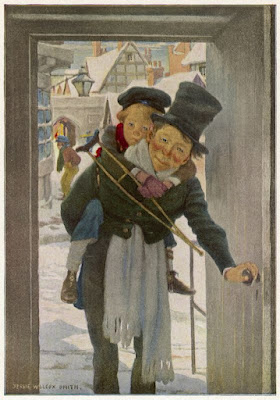
I Don't Hate Tiny Tim. Really! • by Melissa Mead


Poor Tiny Tim.

I’m not saying that because he has a disability. I’m saying that because everyone, from his readers to his creator, pities him because he has a disability. He doesn’t pity himself, though! He joins in his siblings’ games whenever possible, and they cheerfully take him along with them. And while his father calls him “good as gold,” he’s not a perfect saint. When his father insists that the family drink a toast to his hard-hearted boss, Ebeneezer Scrooge, “Tiny Tim drank it last of all, but he didn’t care twopence for it.”

As someone who’s also familiar with braces and crutches, yes, the line “He told me, coming home, that he hoped the people saw him in the church, because he was a cripple...” makes me want to “spit nickels,” as my mom says. “The C-word” gets on my nerves, especially. But Dickens did one thing that I’ve appreciated more and more as I get older.

He tells us that Tim “Did NOT die.” He doesn’t say that Tim was cured. People often assume he was, but Dickens doesn’t say so.

It’s called “the Miracle Cure.” It’s so common I had a hard time coming up with examples where the protagonist isn’t rewarded for their bravery, virtue, etc. by being “made whole.”

Again and again, like some literary Jesus, authors make their lame characters walk and their blind characters see. It’s so pervasive I’ll bet most readers don’t even think about it, or if they do, simply nod. After all, how can the hero have a real Happily Ever After if they’re still “broken?”

Imagine what this says to a real-life kid who can never be “brave enough” or “good enough” to make their disability go away.

Sorry, kid. Glass slippers don’t come with orthotics. Castles have sweeping staircases, not wheelchair ramps. Wizards don’t write their spellbooks in Braille. People like us are only in books to be pitied, martyred, or cured.

Mostly.

In 1875, 32 years after A Christmas Carol, another book came out. The Little Lame Prince, by Miss Mulock, is about Prince Dolor, who, because of an injury as a baby, doesn’t walk, but gets around with “active froglike leaps.” When I read this, and saw the illustration of Prince Dolor with his atrophied legs, I shouted “He has CP like me!”

Now, this was the 1800s, so the C-word is still in there, but Miss Mulock gave kids like me a huge gift with her ending:

“Thus, though he never walked in processions, never reviewed his troops mounted on a magnificent charger, nor did any of the things which make a show monarch so much appreciated, he was able for all the duties and a great many of the pleasures of his rank.”

King Dolor is a real king. He works. He governs. People complain about him. He deals with it. And he lives about as happily ever after as anyone can expect to.

Books like this helped confirm that you can have a disability and still be a whole person. A writer, even! My characters have Cerebral Palsy, Acromegaly, paraplegia, quadriplegia, blindness, deafness, mental illnesses, Down Syndrome, and whatever else fits their character. Some things get cured, but not as a reward for virtue. Most don’t.

So will you join me? If you’re a writer, build your “castles in the air” with ramps and elevators. Readers, seek out books where the heroine packs her antidepressants along with her other quest supplies, and the Prince and Princess hand-sign “I do” before they kiss.

And we’ll ALL live Happily Ever After.

_______________________


Melissa Mead
lives in upstate New York with the imaginary people in her head. Her web site is here: https://carpelibris.wordpress.com/

Friday, November 19, 2021

Talking Shop: Turning Bad Ideas into Good Ones • By Eric Dontigney

Yesterday’s post focused on what geek queen Felicia Day refers to as “chocolate fountain” people. That is, creative types for whom ideas flow like a chocolate fountain. For those people, the problem is never having or coming up with ideas, it’s sorting out the really good ideas from the not-so-great ideas. What about people who don’t have that idea machine in their brain? What if you’re one of those people for whom the very occasional idea is the only idea you get? If you can’t count on a steady stream of ideas and the one idea you do have isn’t awesome, what’s the next step? In other words, can you turn bad ideas into good ones?

The good news is that, yes, you largely can turn not-so-great ideas into better ones. Case in point. Legend has it that Jim Butcher’s Codex Alera books started out life as a challenge that he could write a good book from two bad ideas. The bad ideas were Pokemon and the mythical Roman Lost Legion. For anyone who hasn’t read the books, here’s a very brief precis.

The books follow Tavi, a young man raised on a farm in the hinterlands of a very Roman Empire-esque society. The people of Alera (a major continent on the alien world of Carna) bond with furies – elemental spirits – that grant them magical powers. As Tavi grows, he becomes more deeply enmeshed in the political strife afflicting the Aleran Empire.

On the surface, this sounds like a textbook coming-of-age fantasy series. So, what did Butcher do to elevate the bad ideas into something more interesting? First things first, he made Tavi the only person in all of Alera who didn’t have a Pokefury. This let him make his main character a natural outsider and something of a freak in the eyes of the rest of society. That allows for the main character to provide an audience-friendly perspective on the culture.

It also creates lots of ground for character development across the books. The main character simply faces challenges that no one else faces. For example, if everyone else uses fury-magic to turn on the lights, what is your lead character supposed to do? How does the main character handle conflict if the standard method of settling disputes is a Pokefury fight? What kind of occupation can he have if all occupations rely on Pokefury magic?

Next, Butcher built a world that had some conflict designed into it. Since this is based on the Lost Legion, the Alerans are transplants to this alien world. They had to displace someone when they arrived. That gave Butcher some history to weave into the story. There are still extant native species on the planet. They don’t necessarily love the Alerans. This sets the stage for either low-level or higher-order military conflict.

By doing all of that, Butcher gave himself a lot of advantages in turning a couple of ho-hum ideas into a story that people would want to read. How can you do the same with your speculative fiction idea?

“What if” questions are your friend. What if I gave my main character a real or perceived major flaw? What if I change the setting? What if I make the bad guys superhuman or supernatural? What if I make the bad guys sympathetic? What if I make the good guys less sympathetic?

The answers to those what-if questions prompt more and more specific questions. What if I make the bad guys sympathetic prompts questions like:

  • How do I make them more sympathetic?
  • How do those sympathetic features alter their culture/society?
  • How do those sympathetic features alter their interactions with the main characters?

Now, look at the question of what if I make the good guys less sympathetic. That prompts questions like:

  • Can the good guys instill loyalty in the main character?
  • How far will that loyalty really go?
  • What factors might prompt an apparent betrayal by the main character?

The big takeaway here is that the devil is in the details. The more questions you ask about the characters, culture, good guys, and bad guys, the more details you get to work with in the story. By the time you get done mixing and matching those pieces, you’ll often find that your not-great idea has turned into something much more interesting.

__________________________________________________

Eric Dontigney is the author of the highly regarded novel, THE MIDNIGHT GROUND, as well as the Samuel Branch urban fantasy series and the short story collection, Contingency Jones: The Complete Season One. Raised in Western New York, he currently resides near Dayton, OH. You can find him haunting obscure sections of libraries, in Chinese restaurants or occasionally online at ericdontigney.com.


SHAMELESS ADVERT: If you like Harry Dresden or John Constantine, you’ll love THE MIDNIGHT GROUND. READ IT NOW!

Thursday, November 18, 2021

Talking Shop: The Idea Machine • By Eric Dontigney

The subject of creativity is a popular one in the writer set. Given the central role that creativity plays in the fiction profession, it’s no wonder that writers obsess about it. I’ve met some writers who agonize over coming up with ideas for any kind of writing. It’s a legitimate struggle they face, and I feel for them. Not having ideas when you want to create is awful.

Yet, I suspect, at least half of the writers out there struggle with the opposite problem. They have too many ideas. Way, way, way too many ideas to ever execute on all of them. Granted, not every idea is a good idea. I’ve got some complete short stories that will never see the light of day to attest to that. They aren’t terrible stories. They hang together okay, but they don’t have that special something. Sometimes, my execution was subpar, but the idea usually was just b-grade stuff.

Unfortunately, plenty of ideas are good ideas. When you start layering on years of experience, even some of those b-grade ideas can be elevated into something better because your execution of the idea is so much better than it was say five or ten years ago. Beyond that, you start training your brain to think in terms of narrative. These days, I find that I have to avoid opening up a new file on my computer for an idea because I won’t just jot down the idea. I’ll start writing. Then, all of a sudden, I’ve got a partially completed short story or, more often these days, the first couple chapters of a book that I’m pretty confident has legs.

There’s a reason why I’ve got like four series in progress, six partially completed novels, and something like another 15 books just to wrap those up those series. Plus, there will be new ideas. There will always be new ideas. Before I finished the first draft of Rinn’s Run, I had ideas for at least three or four more books in that series. I could probably make it 10 if I sat down and worked at it.

So, the question I always face is: “How do I sort through the ideas and pick the ones to work on?”

Historically, I didn’t pick. I just tried to work on everything. See above, six partially completed novels. These days, I’m more selective. Now, I’m about to say the least writer-y, least artistic thing you can possibly say about creative endeavors.

Rule One: Be pragmatic.

If you’re 19 and only answerable to yourself, you’ve got a lot of freedom about how you spend your time. For most people, there are adult concerns that vie for your attention. You’ve probably got a job, maybe a spouse, and maybe kids. You’ve definitely got bills. Sure, you may have an idea for a 7-part, epic fantasy series, but do you have the time to work on it? Will you still want to be working on it 10 years from now if you can only devote 45 minutes a day to working on it? If you’ve got 3-5 hours a week to write around all your other responsibilities, you probably want to focus on short stories and novellas. It’s not that short fiction is easier to write well, but it’s less time-consuming in the execution.

Rule Two: Phone a Friend

You’ll get a feel for what ideas are gold and which ones aren’t, but it’s not foolproof. You will get excited about ideas that aren’t top-shelf. If you’re thinking about sinking some real time into a writing project, especially at the expense of other writing projects, run the idea by a friend whose reading judgment you trust. Ask them if that’s a story they’d want to read. They can help you pick out the wheat from the chaff.

Rule Three: Finish What You Start

Almost every writer has partially completed short stories or partially completed novels sitting in a drawer or sitting on their hard drive. Don’t do that. Finish what you start. There are lots of teaching reasons to do that. You’ll still learn things about plotting, characterization, and world-building from those failed attempts, but that’s not my main reason for advising this. Have you ever had an unfinished task or a task that you knew you needed to do that you kept putting off? Ever notice how that task starts taking up more and more brain space. Partially completed stories and books are just like that. They take up psychic space as they compete for your attention. Finishing, even if it’s not great, frees up that psychic space for the next project.

Rule Four: Ignore Me

So, with all that being said, you should ignore me. I’m not saying you shouldn’t try those rules, because you should. I’m saying that if you give those rules a real try and they don’t work for you, drop them. For the record, one attempt isn’t a real try. Six months or a year is a real try because the timeline for writing can prove long.

_______________________________________________

Eric Dontigney is the author of the highly regarded novel, THE MIDNIGHT GROUND, as well as the Samuel Branch urban fantasy series and the short story collection, Contingency Jones: The Complete Season One. Raised in Western New York, he currently resides near Dayton, OH. You can find him haunting obscure sections of libraries, in Chinese restaurants or occasionally online at ericdontigney.com.


SHAMELESS ADVERT: If you like Harry Dresden or John Constantine, you’ll love THE MIDNIGHT GROUND. READ IT NOW!

Friday, October 29, 2021

Talking Shop: Eric's Writing Challenge Update 16

To date, I've written about 82150 words toward the 87,500 word goal. That puts me about 94% of the way toward meeting the goal. I wrote about 4500 words on the urban fantasy over the last couple of weeks. That works out to about 2250 word each week or around 320 words per day.

Yeah, the writing challenge update is lot less exciting now that the first draft of Rinn's Run is complete. Still, I expect that people are wondering about the drop-off in productivity. There are practical and psychological factors in play. Let's dissect those a little. 

Finishing the first draft of Rinn's Run and being so close to meeting the writing challenge goal has taken a lot of the mental pressure off. Before, people were waiting for a completed book. I had tens of thousands of words to write. I was doing it all publicly. Now, the draft is done. I've written most of the tens of thousands of words. Unless I get hit by a bus or lightning or some other terrible and unforeseeable thing happens (knock on wood), hitting the writing challenge goal is a forgone conclusion. It's a lot harder to keep churning out 500 or 1000 or 2000 words a day without some of that pressure bearing down on you. There's probably a lesson in that for me and anyone else who procrastinates.

On the more practical side, moving directly from a novel you just completed to a partially completed novel in a completely different genre and told from a different POV is a bit of an adjustment. I ended up killing some time going back to check earlier chapters for details I thought I remembered. Then, I stopped doing that and just went back and read what I had from the beginning to help recapture the voice and remind myself of the plot threads I had going on. Honestly, it's been more work than I expected, which slowed things down. It also gave me a pretty clear picture of how much revision is in store. Perspective and a few years of practice means things that seemed good before seem only acceptable now. 

At this point, though, finishing it has become something of a point of pride for me. I will finish that book come hell or high water.

 _______________________________________________

Eric Dontigney is the author of the highly regarded novel, THE MIDNIGHT GROUND, as well as the Samuel Branch urban fantasy series and the short story collection, Contingency Jones: The Complete Season One. Raised in Western New York, he currently resides near Dayton, OH. You can find him haunting obscure sections of libraries, in Chinese restaurants or occasionally online at ericdontigney.com.

Tuesday, October 26, 2021

Talking Shop: About False Starts


An aspiring writer asks (truncating and paraphrasing now):

People always say, ‘Go with your gut feeling.’ But what if my gut feeling tells me to trash the whole stupid thing and start over?

It sounds like you’ve run into the “pantser” vs “plotter” dichotomy. Ask yourself, how do you begin to write a new story? 

Do you just have an idea spring semi-formed into your mind, and then you park your butt somewhere and start writing, trusting that you’ll figure out where the story is going eventually if only you keep beating on it long enough? Or do you begin by first developing some rough concept of the plot and where it’s going, and then start writing to put flesh on the bones?

If you write “by the seat of your pants,” you’re going to produce a lot of false starts that end up going nowhere. The trick is to produce an enormous number of them, and to learn to recognize very quickly when a story idea is going wrong, when it’s not worth your time to try to fix it, and when you’re better off just dropping it and moving on to your next idea.

Think of it in biological terms. Some species are successful because they produce thousands of offspring, only a few of which to survive to adulthood. Others produce very few offspring, but invest a tremendous amount of time and energy into raising each one. 

Both strategies work. Which analogue better suits your talent and temperament? 

Personally, I began as a pantser, but over time evolved into a plotter. My best stories—in terms of being the ones I’m most proud of, the ones that were most commercially successful, and the ones that were written with the least amount of floundering and flailing around—were the ones where I began with the ending, and then worked backwards chronologically to sketch out a plot that led to and supported that ending. Then I began to write the story proper, to flesh out and develop the plot. 

I didn’t always reach exactly the ending I’d started out for. Sometimes the characters hijacked the story while it was in progress, said in unison, “This is stupid!” and took the story off in a new direction, arriving at a completely different and much better ending than the one I’d initially had in mind. But I sold and saw published every story I wrote this way.

One warning: where you’re a pantser, there is a tremendous compulsion to save every false start you’ve made in hopes that someday you’ll return to it, figure out what went wrong and how to fix it, and buff up that piece of old junk until it becomes a bestseller. 

Don’t do this. Once you discard a false start, discard it. Otherwise you’ll end up like me, with filing cabinets and hard drives filled with decades of accumulated false starts that began with great promise and then fizzled out.

For the record, I have never had an old half-finished manuscript suddenly germinate in the dark and become a successful story. I have, however, wasted an ungodly amount of time looking for one false start or another, only to eventually find it and realize that I remembered it as being much better than it actually was. In every case I’d have been better off if I’d started over from scratch with what I remembered as being the good bits in the original story idea, not the manuscript I’d actually written.

Submitted for your consideration,
Bruce Bethke


Wednesday, October 20, 2021

Think Before You Kill • by Marie Brennan

Some authors really enjoy killing characters, and some kinds of story practically require it. But any time you start offing people in a tale, you run the risk of yanking away one of the main supporting beams of the audience’s interest. Many of us engage with the mystery or threat through the conduit of one or more characters, and once those characters are dead, we find ourselves with little reason to care anymore.

So how do you get away with a high body count—and more, how do you make that effective? It’s easy enough to bump off nameless mooks, but also pretty meaningless. We can tell who’s cannon fodder, and we don’t bother getting attached to them. But when you’ve got an ensemble cast of developed characters, and you then start picking them off, it can be powerful storytelling…assuming you don’t lose your audience along the way.

Three principles may help. 

  1. The first is to make it clear to the audience what kind of story you’re telling. Sometimes genre alone will do this for you: if your novel or film is advertised as a war story or slasher horror, then we can guess going in that not everyone will survive to the end. There’s still a risk that our favorite characters will die too early, but at least we won’t be blindsided when it happens. When it comes out of nowhere, too often it feels like the author was going for pure shock value, which is rarely as effective as those authors seem to think.

    When genre alone isn’t enough to wave the flag, it’s worth looking for other devices to signal what’s coming: a frame story, a reference to a prior massacre under similar conditions, an ominous prediction by one of the characters, or anything else that cues the audience’s expectations.

  2. Second, think carefully about who you’re killing. There are some unpleasant patterns around who tends to die early, predictable enough that they’ve been mocked by countless parodies: the Black friend, the gay guy, the girl who’s had sex, and so forth. If you repeat those patterns, there’s a portion of your audience who will quit. They’ve seen it before, and they’re beyond tired of it.

    But this principle isn’t just about the unfortunate habit writers have of tossing in a few diversity tokens and then whacking them. Lots of stories still have Generic McStoicson as their main lead, on the theory that he, as an “everyman,” is relatable to everybody. In practice, though, that guy is often thunderously boring. What life and flavor the story has comes from the characters around him. Once the curtain has dropped on the rest of them, the audience is left with nothing but the protagonist-shaped piece of cardboard, and they start wondering why this guy gets to survive while all the more interesting people die.

  3. And finally, give careful thought to how the characters die. If you’re felling them in mass quantities, then obviously the story won’t have room for the kind of impact—the shock and grief and mourning—that can follow on a single death. The members of your ensemble may go out quite quickly, and sometimes they’ll go out senselessly, because not everyone gets an ending full of meaning and moral.

    Still, you can and should bear in mind what the audience wants for those characters, and not thwart that desire without good reason. Both the page and the screen have far too many examples of intelligent, capable, ferocious women who turn helpless and pathetic the moment their demise is required to further the hero’s story. Don’t ignore someone’s strengths because it’s more convenient that way. And distribute the senseless deaths with a sparing hand; if we’re invested in a character, losing them for no better reason than “it ups the stakes” or “it shows that death can strike at any time” will be deeply unsatisfying. It calls to mind the reaction of the grandson in The Princess Bride: “Jesus, Grandpa, what did you read me this thing for?!”

    In some ways, the most satisfying deaths can be the ones that go in the other direction. The character who’s been helpless and pathetic all along, but who finds a moment of unexpected strength right before the end? That speaks to us. So does the moment of bonding or support between two characters who have loathed each other all along. Those deaths are memorable because they add something to the narrative, instead of merely taking something away. They leave us feeling like we’ve gotten a return on our emotional investment.

Even with these principles in mind, though, a story that reaps its cast like grain at the harvest still won’t work for everybody. Not all readers or viewers are on board with a story that will slowly whittle the ensemble down to a lucky (or unlucky) few survivors. Some are on board…right up to the moment when their favorite exits stage left, and even if the exit is a good one, that wound proves too much for them. No matter how hard you try to make your whole cast well-developed and interesting—including your central character—you’ll never catch all readers in your net.

That’s all right. Not every story is for every reader. And there are no doubt good stories that violate all the principles above and still manage to work, at least for some portion of those along for the ride. But keeping an eye on these guidelines will increase the chance of keeping your audience to the end.

_____________________

Marie Brennan is a former anthropologist and folklorist who shamelessly pillages her academic fields for inspiration. She recently misapplied her professors' hard work to The Night Parade of 100 Demons and the short novel Driftwood, and together with Alyc Helms as M.A. Carrick, she is the author of the Rook and Rose epic fantasy trilogy, beginning with The Mask of Mirrors. The first book of her Hugo Award-nominated Victorian adventure series The Memoirs of Lady Trent, A Natural History of Dragons, was a finalist for the World Fantasy Award. Her other works include the Doppelganger duology, the urban fantasy Wilders series, the Onyx Court historical fantasies, the Varekai novellas, and over sixty short stories, as well as the New Worlds series of worldbuilding guides. For more information, visit SwanTower.com, her Twitter @swan_tower, or her Patreon at www.patreon.com/swan_tower.


cover art for THE NIGHT PARADE OF 100 DEMONS by Marie Brennan


Monday, October 18, 2021

Talking Shop: And Then…After the First Draft • By Eric Dontigney

Photo by Suzy Hazelwood from Pexels

As most of you know, I spent the last few months writing a space opera novel by the name of Rinn’s Run. I chronicled that adventure with my almost weekly Writing Challenge updates. As novels go, that book was written pretty fast. I wrote the bulk of it in about 90-100 days. When you’re writing that fast, a first draft can become somewhat all-consuming. You think about it all the time, even when you’re doing other things. I’d plot out scenes while I was making dinner, or vacuuming, or giving my cat her mandatory 20 minutes of daily affection. I’d toy with phrasing in the back of my head while I was doing my day job writing. I’d think about symbolism while…nah, just kidding. I never think about symbolism. The point is that the book bleeds into every part of your life, if only by simmering in the background.

Then, one fine day, you type “The End” and it’s over. At least, that all-consuming creative push that drove you to write the book in the first place is over. Now, for some writers, there’s a kind of mental staggering that happens after you finish a draft. There is this big gaping hole in your brain where that book used to live. You’re not really done with the book, yet, because editorial notes, revisions, and new drafts are in your future. The key phrase there is “in your future.” Between turning in that draft and getting back the first round of notes, there’s a good chance that you’re treading water and feeling at wit’s end. You feel like you ought to be doing something, but there’s nothing to do.

In that respect, I’m lucky. I had tentative plans for what I’d do next when I first started writing Rinn’s Run. I know there will be a follow-up (or several) to Rinn’s Run. I’ve got a pretty good idea about what happens in the next book. I have 50,000+ words already written on an urban fantasy novel that I need to finish. I have partially completed short stories for my next Contingency Jones book. I have a novella started that I really want to finish before Christmas. I’ve got plenty to do to keep me occupied. The question I’m up against is this: Which project do I focus on next? There is a big part of me that wants to jump straight into writing the next Kalan Rinn book. In fact, I may write the first chapter or two just so I have somewhere to start when I do sit down to write it. It won’t, however, be my next big project. You may be asking yourself a very reasonable, “Why?”

It’s because I know that I have editorial notes and revisions coming my way in the near future. I sincerely doubt that I could knock out a complete draft of the next book before I get those notes. I asked myself if I wanted to be writing the second book while I was trying to polish the first book. The answer is no. They’re too closely entwined. I’d inevitably wind up dragging my editor brain for book one into my writing sessions for book two. You need perspective to do good revisions. You need creative fire to power through a first draft. The two do not mix well. Once I settled on that, the question became what writing would I work on over the next few months. I settled on the mostly completed urban fantasy novel. Again, you could quite reasonably ask, “Why?” Won’t I have the same problem with dragging my editor brain into my writing process?

I don’t think I will. The space opera and the urban fantasy have a couple of fundamental differences that will help me maintain the necessary disconnect. The space opera is told primarily from a third-person perspective. The urban fantasy is told as a straight-up first-person narrative. That alone will do a lot to keep the two processes fundamentally separated in my brain. Second, aside from a couple of tropes common to space operas (FTL, blaster guns, sentient AI), Rinn’s Run doesn’t knowingly break with the laws of nature. Mind you, my knowledge of those laws might have failed me in some way in writing the book, but I did my best to keep it grounded. The urban fantasy, by nature, deals with violations of the laws of nature all the time. I reasoned that, given those differences, the urban fantasy was the safest choice for the next project. Even if finishing it does overlap with the rewrites on the space opera, switching between them should prove a workable situation. 

_______________________________________________

Eric Dontigney is the author of the highly regarded novel, THE MIDNIGHT GROUND, as well as the Samuel Branch urban fantasy series and the short story collection, Contingency Jones: The Complete Season One. Raised in Western New York, he currently resides near Dayton, OH. You can find him haunting obscure sections of libraries, in Chinese restaurants or occasionally online at ericdontigney.com.


SHAMELESS ADVERT: If you like Harry Dresden or John Constantine, you’ll love THE MIDNIGHT GROUND. READ IT NOW!

Friday, October 8, 2021

Talking Shop: Eric's Writing Challenge Update 15

Okay, I'm basically on time with the update this week. So, let's jump right in with the writing challenge update.

To date, I've written approximately 77,650 words toward the 87,500 word goal. That puts me at about 89% done. I wrote about 9000 words this last week. That averages out to a little under 1300 words per day across 7 days. 

Now for the Rinn's Run Update

Total Words Written: 84,000

Total Chapters Completed: 40

Percentage complete: 100% (first draft)

So, I finished the first draft of the space opera. It's about 9000 words longer than I expected, but editing usually trims down the word count. So, I'm not too worried. 

It's always exciting to finish the first draft of a novel, but it also comes with a certain kind of weariness. I've been living with these characters almost full time for the last three or four months. Tomorrow, I don't have to keep them in my head. It's a bit like un-clenching a muscle you've had clenched for a long time. 

I'll do what I usually do with first drafts and let it sit for a while. A few weeks minimum, before I jump into editing. I need to let it cool off, so I can come at it with more objectivity. 

However, this writing challenge wasn't just about writing the space opera. It was also about productivity. So while the Rinn's Run updates will go away now, the Writing Challenge updates will continue on for a little longer. Next up, I go back to work on a mostly finished urban fantasy novel titled Jericho Lott.

Friday, October 1, 2021

Talking Shop: Eric's Writing Challenge Update 14

So, I missed last's week update entirely (more on that below). Let's jump right in with the writing challenge update.

To date, I've written approximately 68650 word toward the 87500 word goal. That puts me about 76% of the way toward the finish line. I wrote about 6250 words over the last two week. I'm not sure what the week by week breakdown was, but it works out to about 450 words per day. 

Now, for the Rinn's Run Update

Total Words Written: 75000 words (approximately)

Total Chapters completed: 35 and change

Percentage completed: Around 94% (theoretical out of 80,000)

Okay, so why did I miss last week's update and why is my word count low? I've been pushing myself pretty hard the last 5 or 6 months. There were a lot of 14-16 hour days in there, which translates to 18 hour days when you add in all the non-work stuff we all need to do. I don't take many days off, unless you count the days that migraines keep me from doing anything. Long story short, I hit a fatigue wall. Obviously, I didn't go comatose since I made progress on the book, but my body had had enough.

I spent most of last week sleeping 12, 14, sometimes 16 hours a day. As you might imagine, that pretty effectively obliterated my routines. I was operating at about 40 percent of the productivity level I was before that. This week, it was better. I'm hoping that next week will get back to something resembling normal. I'm generally of the mindset that you can power through most days with enough willpower and caffeine. That's usually true in my experience, as far as it goes. That said, there are limits to how long and hard you can push the body in the wake of a growing sleep deficit. For me, it seems that number is five or six months. Lesson learned.

On the good news front, though, I think there's a good chance I'll finish the first draft of the space opera this week. 

 _______________________________________________

Eric Dontigney is the author of the highly regarded novel, THE MIDNIGHT GROUND, as well as the Samuel Branch urban fantasy series and the short story collection, Contingency Jones: The Complete Season One. Raised in Western New York, he currently resides near Dayton, OH. You can find him haunting obscure sections of libraries, in Chinese restaurants or occasionally online at ericdontigney.com.