
Showing posts with label Creating Alien Aliens by Guy Stewart. Show all posts

Sunday, January 7, 2024

CREATING ALIEN ALIENS: Fermi’s Paradox, Alien Nations and the Past, Present and Future of Humanity

Five decades ago, I started my college career with the intent of becoming a marine biologist. I found out I had to get a BS in biology before I could even begin work on MARINE biology; especially because there WEREN'T any marine biology programs in Minnesota.

Along the way, the science fiction stories I'd been writing since I was 13 began to grow more believable. With my BS in biology and a fascination with genetics, I started to use more science in my fiction.

After reading hard SF for the past 50 years, and writing hard SF successfully for the past 20, I've started to dig deeper into what it takes to create realistic alien life forms. In the following series, I'll be sharing some of what I've learned. I've had some of those stories published, some not...I teach a class to GT young people every summer called ALIEN WORLDS. I've learned a lot preparing for that class for the past 25 years...so...I have the opportunity to share with you what I've learned thus far. Take what you can use, leave the rest. Let me know what YOU'VE learned. Without further ado...


Fermi’s Paradox: “the apparent contradiction between high estimates of the probability of the existence of extraterrestrial civilizations and the lack of evidence for, or contact with, such civilizations…”

One of my favorite movies was DISTRICT 9. The immediacy, intensity and the sheer audacity of aliens picking a nation to hover over that WASN’T a super power made it one of my favorites.

But my all-time favorite in the category of Aliens Who “Crash Land” On Earth And Have To Be Integrated Into Human Society movie is ALIEN NATION. For me, both the movie and TV show were revolutionary in concept and fascinating in execution.

D9 and AN dealt with very similar issues from utterly different points of view. With arguably different intent, the two movies illustrate the same sad-but-true perception of Humanity: given aliens in need, we’ll accept them with open arms then tie them up in red tape until they have no choice but to become us (ALIEN NATION) or revolt and break free of the tape (DISTRICT 9).

And how is this any different from the rest of Human history? During World War II, it’s what Americans did to anyone who was even remotely suspect of having Japanese heritage following The Day That Will Live In Infamy? Even if they were second generation, born and bred Americans, they were suspected of being Japanese sympathizers and needed to be locked away.

What about the red-headed Irish refugees fleeing the Potato Famine of 1845-1852: “One honest immigrant wrote home at the height of the potato famine exodus, ‘My master is a great tyrant, he treats me as badly as if I was a common Irishman.’ The writer further added, ‘Our position in America is one of shame and poverty.’ No group was considered lower than an Irishman in America during the 1850s.” (http://www.kinsella.org/history/histira.htm).

It's what happened to African slaves when they were brutally captured or bought from other African tribes who had captured them during intertribal conflict. They were put away on plantations and legislated out of Humanity and into the realm of tractors and land – possessions to be bartered with as the “owner” saw fit.

Virtually every society has oppressed women at some time or another, freed them then oppressed them again. Islam is NOT unusual in this on-again-off-again granting of women’s rights: India, Europe, Iran, Britain, the United States, Mexico, Sweden, Japan, Arabia, and Germany have all extended then retracted rights at some time or another.

Then there’re those Greeks and Romans, “The Paragons And Inventors Of Freedom And Democracy”…

During the reign of Greece, “Thucydides recalls that 7,000 inhabitants of Hycarra in Sicily were taken prisoner by Nicias and sold for 120 talents in the neighboring village of Catania. (http://en.wikipedia.org/wiki/Slavery_in_ancient_Greece);

“The institution of slavery in ancient Rome reduced those held to a condition of less than persons under their legal system. Stripped of many rights, including the ability to marry, slaves were the property of their owners.” (http://en.wikipedia.org/wiki/Slavery_in_ancient_Rome)

The thing is, is that it isn’t any different from the rest of Human history. What is frightening is that we in the 21st Century believe that First Contact will be a happy event and SHOULD happen and that POOF! the aliens will be welcomed with open arms and a new Golden Age will ensue as we solve all our problems because we know that we are no longer alone.

What might happen though is that our Visitors will be tied up in red tape so thick they won’t know what hit them. Hopefully they won’t have seen the ENTERPRISE episodes that take place in the Mirror Universe (http://www.youtube.com/watch?v=Rkp-MI5hxVw&feature=related). We often bemoan the Fate of those alien civilizations – in face scientists no less great than Carl Sagan, Stephen Hawking, and science fiction writer David Brin, have expressed real doubt about whether contact with alien civilizations will lead to anything but disaster for Humanity: “"One day, we might receive a signal from a planet like this," Hawking says in the documentary, referring to a potentially habitable alien world known as Gliese 832c. "But we should be wary of answering back. Meeting an advanced civilization could be like Native Americans encountering Columbus. That didn't turn out so well." (https://www.space.com/34184-stephen-hawking-afraid-alien-civilizations.html

But what about the OPPOSITE point of view – I’ve honestly never read a story or article or seen a movie or TV series pondering what WE would do to “THEM” if aliens were to land on Earth. Would we lure them in with sweet words and deals, then turn on them, enslave them, and steal their technology.

Where are the stories in which HUMANS enslave the ALIENS? Maybe we’d be such perfect predators and slave masters – as indicated by our history of enslaving each other given half a chance…

Then again, if They have read our history, seen our TV shows and watched our movies – maybe Fermi’s Paradox isn’t a paradox. Maybe aliens are afraid of us…

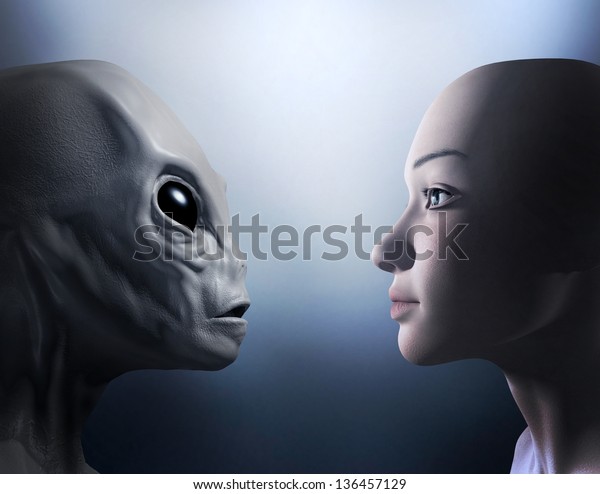
Sources: https://theconversation.com/blasting-out-earths-location-with-the-hope-of-reaching-aliens-is-a-controversial-idea-two-teams-of-scientists-are-doing-it-anyway-182036 Image: https://image.shutterstock.com/image-illustration/alien-human-600w-136457129.jpg

Sunday, December 31, 2023

Creating Alien Aliens by Guy Stewart: Aliens As Crystalline Colonial Organism -- Biology Today, Thought Next Time

Five decades ago, I started my college career with the intent of becoming a marine biologist. I found out I had to get a BS in biology before I could even begin work on MARINE biology; especially because there WEREN'T any marine biology programs in Minnesota.

Along the way, the science fiction stories I'd been writing since I was 13 began to grow more believable. With my BS in biology and a fascination with genetics, I started to use more science in my fiction.

After reading hard SF for the past 50 years, and writing hard SF successfully for the past 20, I've started to dig deeper into what it takes to create realistic alien life forms. In the following series, I'll be sharing some of what I've learned. I've had some of those stories published, some not...I teach a class to GT young people every summer called ALIEN WORLDS. I've learned a lot preparing for that class for the past 25 years...so...I have the opportunity to share with you what I've learned thus far. Take what you can use, leave the rest. Let me know what YOU'VE learned. Without further ado...


Crystalline life forms…if there were such a thing…which there’s not. Though there is a fringe of Humanity that believes that crystals have mystic powers: https://www.oprahdaily.com/life/health/a26559820/healing-crystals/. Certainly the mirror (which is, of course made of glass, aka crystalline silicon (NOT “silicone”, which is a human-made plastic) in Snow White would be considered sentient.

The question I’d pose here is why would the mirror cares what a bunch of Humans were doing, no matter how ravishingly beautiful they were? Fact is that: the mirror; the crystalline silicon being, would find Human affairs dull and boring.

So, what if crystals WERE a sapient life forms in themselves – or when the right number of them are gathered together, could “come to life”? What if what we see as physical reactions, are instead the reactions of a life form I wouldn’t recognize as a lifeform?

In a book I’m reading, A ZOOLOGIST’S GUIDE TO THE GALAXY (obviously riffing off of HITCHHIKER’S GUIDE TO THE GALAXY), zoologist and author Arik Kershenbaum writes: “The book argues that the evolutionary processes that are observed operating on Earth are universal, and a necessary requirement for the presence of complex life on any planet. As a result, many aspects of animal behavior are likely to be present in the equivalent lifeforms on alien planets. This includes certain features of social behavior, communication, and movement, the evolutionary origin of which on Earth is underpinned by universal processes.”

On the other hand, Carl Zimmer in his recent book, LIFE’S EDGE, writes this near the end: “Instead [of defining life] scientists should be working towards a theory that explains life…‘assembly theory’…calculates the number of steps it takes to build something…a living organism needs far more [than one step to form]: materials made by living things…are exquisitely complex…’ Life is a state of matter that can spontaneously make things with a lot of assembly steps.’”

“One of the originators of this theory of life is a chemist, Lee Cronin, who has devised an ingenious experiment to test the theory…’The idea is that some of the droplets [that form] will spark complex reactions, creating new compounds that can store information – a condition of life. Cronin’s droplets may even, one day, be declared alive. ‘I’m pretty sure we will crack the origin-of-life problem in the next few years,’ he says. ‘But then everyone will go: ‘Oh, that was easy.’”

I’m not sure yet why Kershenbaum believes that biological laws (which even on Earth) are regularly and spectacularly contradicted, must be Universal everywhere else in Physical Reality.

Associate professor Kevin J Mitchell, at Trinity College in Dublin (Ireland) wrote this: “By taking what is essentially an engineering and computational perspective, we can simplify our view of the functional architecture of living systems. For example, we can recognise that some set of components interacting in a certain way acts as a filter, or a switch, or a coincidence detector, and so on. And when we put several of them together just so, we make an oscillator or a homeostatic regulator or an evidence accumulator. This provides a way to go beyond simply describing what is happening to actually understanding what the system is doing.” Zimmer holds that once we can “calculate the number of steps it takes to build something”, we will if nothing else, be at the beginning of understanding life on Earth – and presumably life among the countless exoplanets.

To summarize: one author believes that all life in the universe will be some understandable riff off of the life on Earth (which, while in its wild variety, is UNDERSTANDABLE), and therefore all aliens will be UNDERSTANDABLE (Kerschenbaum); again, that we will be able to UNDERSTAND alien life, no matter where we find it. “We will use the laws of biology just as we would use the laws of physics and chemistry.”

Mitchell from Trinity expects that once we recognize the components that interact in particular ways, we will understand life on Earth and elsewhere.

What I understand my reading thus far, is that there SHOULD be a “theory/theories of biology” that is as succinct to apply as Newton’s Third Law of Motion: Force = mass x acceleration. Yet all three of these writers – all at the cutting edge of their fields – can’t state one of the Laws of Biology with anything even approaching the elegance of Newton’s Third Law, F=ma.

So, there are currently 5040 confirmed exoplanets in some 3876 star systems. A FORBES online magazine article suggests that one third of these confirmed exoplanets may be in their star’s habitable zone. (https://www.forbes.com/sites/jamiecartereurope/2023/05/29/a-third-of-the-most-common-exoplanets-may-host-life-say-scientists/?sh=580cdc972400), so approximately 1,663 of them would be in their star’s HABITABLE ZONE (aka the “Goldilocks Zone” (or, “Goldilocks went upstairs into the bed chamber and first she lay down upon the bed of the great, huge bear, and then she lay down upon the bed of the middle bear and finally she lay down upon the bed of the little, small wee bear, and that was just right.” The Zone would be JUST RIGHT for…Humans…right?)

Dr. Kershenbaum is writing (thus far), he seems certain that life on other worlds will be no more amazing that life on Earth – which is no mean feat, spanning Humans and elephants to Bacillaria and Black Smokers…It almost seems that he’s limiting life to what we both know and understand…

So what does that do to my story?

If life could evolve from regular, everyday single-celled organisms, what’s to stop it from evolving from Bacillaria? It is an organism that is both unique and difficult to explain. Bacillaria paxillifer is a colonial diatom whose members live in colonies and slide along each other, rather like slippery rectangular microscope slides.

The question of WHY they behave this way is essentially unanswerable. The majority of diatoms float freely; though not all of them, and we might as well include my Siphonophoria “alien” based on one of the colonial “jellyfish” recently observed off the coast of Australia. How would a sapient lifeform, descended from paxillifer THINK?

Maybe it would be easier to start with a “single-celled” crystalline organism like the mirror I postulated above? In the movie starring Julia Roberts as the Evil Queen, the crystalline mirror DOES actually have an opinion. It tries to communicate that opinion, which the Queen ignores until the end and the sentient crystal says, “Ready to learn the price for using magic?” and a dark movie actually becomes darker as the crystalline entity exacts its vengeance by allowing the Evil Queen to age to her true age – a wizened and aged crone who can barely walk or talk.

Next time though, I’d like to skip over the philosophy above and look at how I see a crystalline entity behaving – especially looking at how it would perceive the world and wondering how Mirror got trapped into being a simple looking-glass in an ancient kingdom…

Source: https://aliens.fandom.com/wiki/Category:Crystalline_Species
Reference: STAR TREK: TNG – “DataLore”; “Silicon Avatar”; 
https://blogs.stockton.edu/blogstock/2022/01/20/shhhh-listen-do-you-hear-the-sound-of-crystals/#:~:text=These%20vibrations%20are%20produced%20due,temperature%2C%20light%2C%20or%20vibration.; https://en.wikipedia.org/wiki/Bacillaria ;

Sunday, December 24, 2023

One Point of View: Stars of WONDER, "Star of Royal Beauty, Bright" Christmas 2023

Stars.

The foundation of science fiction is a journey to the stars. I remember as a kid searching for book titles with “star”, “planet”, “moon” or “alien” on the cover or the book spine.

One of Arthur C. Clarke’s most famous short stories is titled simply, “The Star” (Infinity SF, 1955). (If you never read it, try it here (it's short) https://sites.uni.edu/morgans/astro/course/TheStar.pdf

Christmas lights.

What’s the connection between stars and Christmas lights? Most sources point to the practice of lighting Christmas tree candles or putting candles in the windows of homes as a measure of “pushing back the night” of long, dark winter nights and having lifted various pagan religious practices in the process. Sites that are brutally honest say that Christians stole lighting, trees, yule logs, and holly for the nefarious reason of subjugating all other traditions and belief systems to their own.

Others less brutal note that the reason for hanging lights at Christmas is at best unclear and at worst, disappeared like a ghost into Christmases past.

So I’m going to throw my own theory out there.

We do Christmas lights to add more stars to the universe we live in so that one particular star on one particular night might stand out even more than it already does. Adding stars to the universe – even imaginary ones on green coated electrical wire – seems somewhat silly when you consider that cosmologists number the stars in the observable universe at some thirty sextillion (30 followed by twenty-one zeroes). Others opine mathematically that the universe is infinite so that there are an infinite number of stars.

Cool! Ain’t God great?

OK, so rather than theorize why “we” put up Christmas lights, I’ll tell you that I like to put up Christmas lights in an infinite universe to mimic stars.

On that first Christmas night – whether it was December 25 or August 12 – a Star shone brightly in the night sky. It so outshone its usual companions that the star watchers or astrologers or magi of the Great Cultures at the time of the Christ’s birth – Ptolemaic Egypt, Carthage, Aksumite Empire in Ethiopia, Persia, Indus Valley Chera/Chara/Suaga/Satavahana, the Han Dynasty, Rome, Armenia, Scythia, the Three Kingdoms of Korea and Teotihuacan – made pilgrimage to where this bright star led them.

Three of them made it to Bethlehem in time for the Birth. (Never thought about what a story this might make...)

The strings of lights I put up are to celebrate the Star of Bethlehem. This celestial object seemed to hang over the City of David. The Roman Emperor had called for a census and Joseph and a very pregnant Mary had gone to their hometown for it. She had her Son, God Incarnate who came to Earth to solve the problem of Original Sin of humanity against God’s Sovereignty – because God loved the entire population of humanity everywhen so much that God chose to send the Son to redeem them with the only thing humans clearly understand: blood.

Jesus was born in Bethlehem as the unique Savior of all humanity – all of whom are free to accept that they are in need of saving or pass on the offer.

I choose to believe that I am in need of saving; I choose to accept Jesus as the Christ. I choose to believe that unlike what Arthur C. Clarke opines in his story, God did not capriciously wipe out a kindly advanced civilization to suit His own, cold whim. God used a cosmic celestial event to mark a cosmic spiritual event; and I use Christmas lights to remind me (and anyone who sees my lights) of the Bethlehem Star.

Someday, I want to write a story that responds to Clarke's -- not a vicious attack; not a mean-spirited diatribe; rather a gentle alternative to the one of an exploding star destroying a peaceful civilization of intelligences. I’ll let you know when my story, “The Winter Star” is done, but until then, in the words of Hub Pages columnist and fellow Minnesotan, Kika Rose: “These are my views. Attack me if you will, but I will believe what I will believe, and you can’t change my mind for me.”

A Few Links To Follow:
http://en.wikipedia.org/wiki/Observable_universe
http://www.esa.int/esaSC/SEM75BS1VED_extreme_0.html
http://en.wikipedia.org/wihttp://www.esa.int/esaSC/SEM75BS1VED_extreme_0.htmlki/Christmas_lights
http://answers.yahoo.com/question/index?qid=20071209222932AAaEltD
http://kikarose.hubpages.com/hub/Christmas-Just-where-did-all-those-traditions-come-from
http://larryfreeman.hubpages.com/hub/How-long-do-empires-last
Image: https://www.inspiringlivesmagazine.com/wp-content/uploads/2021/12/image-2-e1639268944963.jpeg

Sunday, December 17, 2023

Creating Alien Aliens: How Would Intelligent Reptiles Think and Behave?

Five decades ago, I started my college career with the intent of becoming a marine biologist. I found out I had to get a BS in biology before I could even begin work on MARINE biology; especially because there WEREN'T any marine biology programs in Minnesota. 
Along the way, the science fiction stories I'd been writing since I was 13 began to grow more believable. With my BS in biology and a fascination with genetics, I started to use more science in my fiction.

After reading hard SF for the past 50 years, and writing hard SF successfully for the past 20, I've started to dig deeper into what it takes to create realistic alien life forms. In the following series, I'll be sharing some of what I've learned. I've had some of those stories published, some not...I teach a class to GT young people every summer called ALIEN WORLDS. I've learned a lot preparing for that class for the past 25 years...so...I have the opportunity to share with you what I've learned thus far. Take what you can use, leave the rest. Let me know what YOU'VE learned. Without further ado... If this were a sapient alien, how would it THINK? WHAT The Heck would it think???

Scientists have been tracking this turtle among several dozen others. What I want to think about is if these creatures grew to become sapient – or were a primitive form of a sapient alien we might one day meet – what would they be LIKE? How would they behave? How would we be able to communicate with them?

My depiction would hardly be the first time writers tried to figure out what a sapient turtle would be like – behavior, speech, thought, and scientific advancements. One is THE SINGERS OF TIME by Frederich Pohl and Jack Williamson; shell-less alien turtles from Laserblast!; snapper aliens from Stellaris’ Let’s Play Happy Turtles; Turgle from Star Wars Jedi; the Chelonians from several episodes of Doctor Who; Star Citizen’s Xian; the Clutch Turtles of Sharon Lee and Steve Miller; and lastly, the Teenage Mutant Ninja Turtles – though they can’t count as aliens because they are still from Earth, though mutants…

A serious study "Given the Cold Shoulder: A Review of the Scientific Literature for Evidence of Reptile Sentience"
(https://www.ncbi.nlm.nih.gov/pmc/articles/PMC6827095/), looks at the evidence of what they call reptile sentience. I'll draw more on that later, but for now, let's keep going.

Most of the examples above seem to create “aliens” who, while they look like turtles, behave like Humans in funny suits – which is what the “aliens” from Star Wars, Star Trek, Guardians of the Galaxy, and countless other movie depictions that are supposed to show us “alien life forms”. On Earth, turtles – which include Galapagos Tortoises, Painted Turtles, Alligator Snappers, and Sea Turtles and are wildly different animals that might spark wildly different sapient life forms.

So, what are the characteristics of the turtles and tortoises?

· Shell size can range from about 3 inches up to about 8 feet
5 ounces to 1,800 pounds
· They mature between 5 to 25 years
· lay anywhere from a few or over 100 eggs, hatchlings will be from 1 to 3 inches
aquatic species can live up to 70 years while some of the land tortoises can live 150 years or more.
· quiet, shy, and harmless yet display intelligence
· very sensitive to loud noises, vibrations, and sudden bright lights
· quick to frighten if they feel threatened; most will withdraw their head, legs, and tail into their shells; aquatic turtles will first try to swim quickly away.
· Those with less shell have developed other defense mechanisms; like the snappers who have an extremely strong mouth, the musk turtles which can emit a rather distasteful odor, and some that have strong claws or extreme agility. Once they have withdrawn, they are often very slow to re-emerge.
· content being single.
· Mostly fine with community, there can be territorial tension, especially when in breeding mode.
· Some tortoises have been known to ram and even kill other tortoise species.
· Water (mostly freshwater, some brackish water, only sea turtle are salt) species, usually have webbed feet for swimming. Basking Turtles: These climb onto a log or a rock to sun themselves; Non-basking Turtles: These bask at the surface of the water or on top of floating vegetation.
· Aquatic turtles notorious as carriers of the salmonella bacteria which can be transmitted to humans and a potential health hazard.
· Terrapene (4 species) the familiar box turtles, and Cuora, the Asian box turtles,
Tortoises (tortoise): Tortoises are exclusively land bound. With only a couple exceptions they have highly domed shells. The burrowing species have spade-like flattened front feet; can get very big; very specific temperature and humidity requirements; subject to more serious health problems; very long lived
· turtle or tortoise has a specific type of environment that it needs: aquatic turtles, the semi-aquatic turtles, land turtles, box turtles, and tortoises
· All turtles and tortoises thermoregulate their body temperature by sunning themselves. A general rule of thumb is that Chelonians will be most content in daytime temperatures between 75 - 85° F plus a cool secluded area to sleep.
· aquatic turtles often sleep submerged, but near to the surface around twigs or vegetation. Semi-aquatic turtles will sleep burrowed into grassy areas or a sphagnum moss substrate. Land turtles and tortoises will do well with a small shed or bushy area.
· Aquatic turtles eat vegetable matter, but also insects and worms; adults becomes primarily a vegetarian, eating dark green leafy plants.
· Land turtles are omnivorous their whole life, eating many kinds of vegetables and fruits as well as earthworms and even occasional bits of dog food.
· Tortoises are primarily vegetarians, wide variety of vegetables and some fruits

OK – now to pick the aspects of turtles, land turtles, and tortoises that would make interesting characters…

I’m going to stay away from aquatic turtles for the time being as it doesn’t seem likely that they would develop a technology I would recognize, being a land animal myself. Tortoises are the larger of the two land Chelonians, so let me pull out the characteristics of wild Chelonians:

· Shell size can range from about 3 inches up to about 8 feet, 5 ounces to 1,800 pounds
· They mature between 5 to 25 years
· lay anywhere from a few or over 100 eggs, hatchlings will be from 1 to 3 inches; land tortoises can live 150 years or more.
· quiet, shy, and harmless yet display intelligence
· very sensitive to loud noises, vibrations, and sudden bright lights
· quick to frighten if they feel threatened; most will withdraw their head, legs, and tail into their shells.
· Those with less shell have developed other defense mechanisms; like the snappers who have an extremely strong mouth, the musk turtles which can emit a rather distasteful odor, and some that have strong claws or extreme agility. Once they have withdrawn, they are often very slow to re-emerge.
· content being single.
· Mostly fine with community, there can be territorial tension, especially when in breeding mode.
· Some tortoises have been known to ram and even kill other tortoise species.
· Tortoises are exclusively land bound. With only a couple exceptions they have highly domed shells. The burrowing species have spade-like flattened front feet; can get very big; very specific temperature and humidity requirements; subject to more serious health problems; very long lived
· tortoise has a specific type of environment that it needs.
· All turtles and tortoises thermoregulate their body temperature by sunning themselves. A general rule of thumb is that Chelonians will be most content in daytime temperatures between 75 - 85° F plus a cool secluded area to sleep.
· Land turtles and tortoises will do well with a small shed or bushy area.
· Tortoises are primarily vegetarians, wide variety of vegetables and some fruits

Narrowing further: huge shell, takes 25 years to mature, lay 5+ eggs, smart, but quiet/shy, sensitive to extreme light/sound, quick to frighten and withdraw to shell, strong mouth, emit strong musk, long claws, (shockingly) agile, OK with single life, can become territorial, especially during breeding time, will ram, kill other tortoises, specific natural environmental requirements, primarily vegetarians...

FINALLY: I’ll call them the Chelonians. These have become bipedal by necessity, but function just fine on four feet. Their forward feet have fingers that fold into a tough pad when on four feet; but the fingers are agile and they move quickly – despite how they look (slow-and-steady; these aliens embody the aphorism: “Slow and steady wins the race”), they CAN be startled fairly easily – hence they are extreme “planners” and orchestrate the direction they personally take as well as a civilization. They do everything to make CERTAIN there are no surprises. Their ships are uncomfortably warm to Humans, but within our tolerance – Humans from civilizations that grew in high temperature/humidity regions of Earth adapt most quickly to Chelonian ships and worlds; they have health problems (some are health COMPLAINERS, others talk about their health like “little old Earthmen”), long-lived and VERY particular about their environment and homes – they are fanatic art collectors, though no one has been able to figure out WHAT Chelonians view as art – or WHY, thermoregulated, almost exclusively vegetarian, though certain Chelonian cultures have peculiar NON-vegetarian delicacy choices, can and DO become territorial unexpectedly

That’s it for today. I need to get this posted. However, next time, I’m going to play with a Human-Chelonian interaction…and I’ll be thinking about it…and I'll be using the information in the article above as well.

Source: https://hasanjasim.online/how-butt-gas-drugs-and-incredible-memories-lead-to-this-odd-turtle-photo/?fbclid=IwAR0_G2K5R_mE5wbqD4QVl1MvIFFztYhdHSYWVa5b3h2ZTRHKb0oK4g15nb4
Image: https://hasanjasim.online/wp-content/uploads/2023/02/turtlewithearthonback-750x420.jpg

Tuesday, November 28, 2023

Creating Alien Aliens: Does How Aliens SENSE Their World REALLY Make Them Alien: A Thought Experiment With SOUND…

Five decades ago, I started my college career with the intent of becoming a marine biologist. I found out I had to get a BS in biology before I could even begin work on MARINE biology; especially because there WEREN'T any marine biology programs in Minnesota.

Along the way, the science fiction stories I'd been writing since I was 13 began to grow more believable. With my BS in biology and a fascination with genetics, I started to use more science in my fiction.

After reading hard SF for the past 50 years, and writing hard SF successfully for the past 20, I've started to dig deeper into what it takes to create realistic alien life forms. In the following series, I'll be sharing some of what I've learned. I've had some of those stories published, some not...I teach a class to GT young people every summer called ALIEN WORLDS. I've learned a lot preparing for that class for the past 25 years...so...I have the opportunity to share with you what I've learned thus far. Take what you can use, leave the rest. Let me know what YOU'VE learned. Without further ado...

All right…I want to start doing some experimenting with creating aliens based on the information in Dr. Robert Freitas, Jr’s book, XENOLOGY (link below). So, first the facts/observations and concept: 
ACOUSTICAL SENSES: Two Dimensional

“For instance, water striders…Much like the kinesthetic sensors in human bodies which provide continuous positional and velocity data for each limb (called Proprioception), water striders can detect the slightest disturbance traveling across the surface of the water…one species conducts its entire courtship display using complex patterns of modulated surface waves…”

“[some] spiders are known to use surface wave communication by] strumming the webs they weave in specific rhythms and patterns…between mother and offspring…Desert scorpions can also detect compressional and surface waves in sand to locate prey…”

“…the universe inhabited by such creatures [using] two-dimensional waves [would create a world of] ‘persistence messages’. 3-D acoustical waves pass an observer…one time, never to return again…oscillations in 2-D media die away only very slowly from frictional forces. The entire surface space is set in motion by such stimuli, and damping is often very weak. The media continues to ‘wave’ for a long time after[wards]…[it would sound like] they were in an echo chamber. Words would have a peculiar drawn out quality, persisting long after they have been spoken. And since the higher frequencies always travel faster than the lower ones, each repetition of the echo will sound distinctly different. The word will stretch itself thin, the higher pitched treble notes bunching together at the beginning of the sound and the progressively lower bass tones trailing behind.’”

BTW: this concept has already been PERFECTLY explored in Adrian Tchaikovsky’s, winner of the Arthur Clarke Award in 2016 and nominated for a similar award in France and Germany, CHILDREN OF TIME details a millennia-long Human mission to seed Humanity on another world gone horribly wrong that creates a civilization of intelligent “spiders”. If you haven’t done so, read it for a fascinating story – and an explanation of this form of communication.

I’ll play around with this in my own way: say I’m a First Contact specialist, and there is an obviously sapient civilization on a world that is made up. The atmosphere is going to have to be exceptionally dense, so I’m going to postulate that the world is, while NOT a water world, has an atmosphere that Humans would describe as incredibly HUMID. “If the relative humidity is 100 percent (i.e., dewpoint temperature and actual air temperature are the same), this does NOT necessarily mean that precipitation will occur. It simply means that the maximum amount of moisture is in the air at the particular temperature the air is at.”

I’m going to add a denser atmosphere on this world as well. How do my aliens sense vibrational waves in this dense, wet atmosphere? I’m going to give them long bristles – maybe rigid, protective spines surrounded by a “bush” of delicate, sensitive fibers. Do I have to have them be spiders or other creepy-crawly things? Nah, I’m going to make them a bit like large echidna…spiny anteaters. Not small enough to “step on”; large enough to both hold a complex brain somewhere in their bodies…let’s say in the CENTER of the body mass, well-protected by bone, and equidistant from the surface of “spines and bushes” – plus I’m going to raise them off the ground by giving them four longish motivation limbs, jointed so that movement in any direction is easy. They’ll have a “manipulation limb” between each “leg” – so four legs, four arms, a brain in the center…

They’ll need something to see with…above each arm, an eye, roughly equivalent to a Human eye…nah, how about more like a land snail’s eyes (and nose – they typically have two tentacles with eyes, two tentacles below them that “smell”. So the body is ringed with eight eyes and eight “noses”…

I’m also going to give them fur, though not as boring as Human fur. About half of the fur is a sort of extension of the sensory “bush” and can change color somewhat as well as compress and extend. It’s shorter than the spines, the bush, and the eye and snorf-stalks.

OK, there I am on the Home World of the Echidnates – which is what they’ll end up being called in the Human-Alien Contact records for all time…

How do I talk to them? How do I even approach them?

Approach is easy – they see and smell all around them (BTW, I’m excluding predators and disease at this point to keep the thought experiment easier…) They’ll see me as slightly taller than they are; though very weirdly…spindly and incredibly balanced on two legs – they’re smart enough to be able to recognize Human legs as a version of their own legs. Eyes same thing – smart ones will look at us, see the big knob on top and make a serious connection that OUR sensory organs seem to be clustered on a single tentacle – the legs and arms, while two of each seems to be courting a life of constant falling over, are at least recognizable.

Now for sound. I’m going to give the Echidnate Home World an atmosphere that is, while uncomfortably humid for us, breathable, though the O2 level is higher and the CO2 level is lower. There are some nasty fungi and other microorganisms in the air, though it appears that they can’t gain much foothold in Humans. However, the world around us is less…rigid than our own world.

Trees seem to be limited to Ginko-type plants, maybe palms, lots of hardwood. In fact, from what we can see, there’s not much in the way of “wood stuff” around. Structures appear to be stone, though the main construction material appears to be a sort of “land-based” coral. We don’t seem much in the way of metal tools; though stone, the coral, and other “nonmetals” appear to be used as Humans would use metal. We DO know that they have radio communication minimally, but it seems that LASERS are predominant…

I lift up my hand, and I speak a version of a language we’ve picked up from several of their laser coms. My target Echidnate stops and turns so that two pairs of eyes and noses are aimed at me. One leg forward, the other three back, forming a stable-looking tripod. Two side-arms swing forward, and the third, forward arm hangs, slightly coiled straight at me. “We come in peace,” I say, hoping that we’ve parsed out the words correctly. The landing of our own spacecraft was never hindered by the spacecraft we discovered exploring their star system.

The spines-and-bushes on the Echidnate’s back vibrate and my host opens a thin-lipped mouth above the eye and scent stalks and speaks. The sounds are surprisingly high-pitched, more child-like than what I expected. Suddenly understanding that the higher-pitched sounds will facilitate speedier communication than my lower-pitched male voice, I gesture and one of the women on the First Contact team who steps up and repeats our message of greeting…I also wonder if they have four mouths as well. I make a mental note to talk with our xenobiologist – what and how they eat will be another interesting aspect of these new sapient beings.

We recall that, somewhat like Humans, the Echidnate sense their world in a more-or-less single dimension. We also notice that the one we’re trying to contact stands in front of a curved wall of solidly-grown coral colored bright blue. I can hear the fain echo of our voices, as if the Echidnate is standing at the focal point of a parabola…

OK – there you go. Using the information I had and extrapolated, I now have a totally new alien; one I’d never imagined…

Next Time: ACOUSTICAL SENSES: Three Dimensional

Source: http://www.xenology.info/Xeno/13.3.1.htmhttp://www.xenology.info/Xeno/13.3.2.htm
Image: https://image.shutterstock.com/image-illustration/alien-human-600w-136457129.jpg

Saturday, June 17, 2023

LONELY PLANETS: The State of Life in the Solar System and Exoplanets (In 2003)

NOT using the panel discussions of the most recent World Science Fiction Convention in San Jose, CA in August 2018 (to which I be unable to go (until I retire from education)), I would jump off, jump on, rail against, and shamelessly agree with the BRIEF DESCRIPTION given in the pdf copy of the Program Guide. But not today. This explanation is reserved for when I dash “off topic”, sometimes reviewing movies, sometimes reviewing books, and other times taking up the spirit of a blog an old friend of mine used to keep called THE RANTING ROOM…

I know I’m a few years behind, but I just checked out a copy of LONELY PLANETS: The Natural Philosophy of Alien Life (2003) by David Grinspoon. He does, of course, have a “doctor” in front of his name, but it appears that he doesn’t use it very often. He also has the endorsement of Neil deGrasse Tyson – the quintessential new face of astronomy and the immediate successor to Carl Sagan.


Tyson said of Grinspoon’s book “…brings together what has never before been synthesized…he is a planetary scientist as well as dreamer, born of the space age.”

As is apparent to anyone who reads my blog, I LOVE aliens! I write about aliens! I do (guardedly) believe that there is intelligent life “out there, somewhere” – HOWEVER, I don’t believe that we have any real proof yet and that it is, at this point, an intellectual and philosophical exercise.
Be that as it may, I’ve only read the first 20 or so pages of Grinspoon’s book and skimmed his website (http://funkyscience.net/), but I find myself looking forward to following this guy for some time to come!

I’m a bit over halfway through the book now (page 198) and I’ve placed an order for my own copy through a Half-Price Books near me. I’m even (*gasp*) dog-earing my Library copy for later transfer to the book when I get it.

Couple of things I noticed thus far: the book is old. Published in 2003, it was most likely written in 2002. This was substantially BEFORE the Kepler Telescope was launched into an Earth-trailing heliocentric orbit in 2009. Six years later, Kepler celebrated the discovery of its 1000th confirmed exoplanet. Another three years followed Kepler sweeping more and more prizes into its discovery bin. Then “On October 30, 2018, after the spacecraft ran out of fuel, NASA announced that the telescope would be retired. The telescope was shut down the same day, bringing an end to its nine-year service. Kepler observed 530,506 stars and discovered 2,662 exoplanets over its lifetime…” (Anyone else hear a faint echo of “…its five year mission, to explore strange new worlds, to seek out new life and new civilizations, to boldly go where no [one] has gone before!”?)

Despite the age of the book and now that I’ve read half of its 416 pages, I’m puzzled by Grinspoon’s not mentioning “hot Jupiters”. With statements like: “In the hot regions near the Sun, it snowed flakes of metal and rock. Farther out, around the present orbit of Jupiter, it was cold enough for ices to form: both the familiar snowflakes of water ice that adorn winter on Earth and more exotic snow of frozen methane and ammonia.” (page 82); and “The initial segregation of material by temperature, which made metal and rock near the Sun, and ice farther out, has been preserved.” (page 83).

Why is that? He DOES mention the discovery that the star 51 Pegasi had a planetary companion. That happened in 1995 (embarrassingly, this story doesn’t start until page 209 and as I mentioned, I’ve only just today reached page 198!). After this account, Grinspoon goes on to marvel at the discovery of some hundreds of extrasolar planets (!), having only a faint idea that Kepler would soon blow that number out of the water.

My other trouble is that when discussing Venus, he makes virtually no mention of the fact that it has a retrograde rotation when compared to the rest of the planets (I don’t count Uranus among those having a retrograde rotation. That gas giant’s rotation is retrograde only because its “north” pole is actually south of its “equator” (the Solar Equator, if you will. That is, the planets and minor planets orbit the Sun orbit in the same direction on pretty much the same plane. Confused? OK, this is how I explain it to my astronomy classes. Imagine your head is the Sun. If you stick your arms out and start to torn slowly in (ignoring the direction at this time) and stuck ball bearings of increasing sizes on your arms with duct tape at increasing distances from your head, you would have a basic illustration of the Solar System as it turns in space. Imagine then, that each of the ball bearings are turning the same direction: except for Venus. It rotates in the opposite direction of everyone else – and it turns VERY, VERY slowly. When you reach Uranus, let it keep spinning in the same direction, but tip its north pole 98 degrees (90 degrees is like a “90 degree angle” or as you may remember from geometry or trigonometry, a “right angle”.) Uranus is tipped MORE than that…but it’s still rotating the same direction as it did when it was upright…but now it’s spin, relative to the other planets, is backwards (aka “retrograde”).

At any rate, Dr. Grinspoon talks about what it is that has created Venus’ hellish conditions and while he does include its location (closer to the Sun than Earth), the fact that the Sun is brighter and hotter today than it was when the Solar system formed), and a peculiar venology (it can’t be “geology” and “aphrodology” just sounds weird…) that includes a sort of cyclical disruptive plate tectonics (pages 171-173); he doesn’t mention the slow, retrograde rotation. By slow, I mean that a “day” on Venus is 243 Earth days; and the Sun would rise in the west and set in the east…eventually.

It could be that I haven’t reached those pages yet, so we’ll see.

Perhaps the biggest “kick-in-the-teeth” is that he clearly lays out what happened to alter our Solar system longer ago than 65,000,000 years: “As the planets approached their final sizes, giant also-rans, the contenders that could have been planets, came hurtling down to Earth (and Mercury, Venus, etc.) at speeds of tens of thousands of miles per hour. These final giant impactors left a trail of destruction throughout the solar system, stripping Mercury of its outer rock mantle, leaving Venus spinning backward, and knocking Uranus on its side And in an event as propitious for us as it was random, a Mars-size protoplanet smacked into the young, still-forming Earth, splashing a massive ring of vaporized rock into Earth orbit, which quickly condensed to make out singular, giant Moon.” (page 82)

If any of you ever read the first book of my proposed series HEIRS OF THE SHATTERED SPHERES: Emerald of Earth (which might be serialized here https://stupefyingstories.blogspot.com/ starting in January or so…), I have a slightly more fantastic explanation for the current state of the Solar system. Emerald Marcillon’s mother, Nhia Okon, explains to a group of high-ranking military brass:

“The evidence we’ve gathered so far clearly indicates that a massive object, probably a microscopic black hole, grazed Uranus and tipped it on its side….A fleet of invading interstellar warships, using black-hole-energy technology probably experienced a disastrous explosion shortly thereafter. Debris swept through the solar system, probably missing Saturn but raining down on Jupiter and setting off the Great Red Spot hurricane…The worst was yet to happen…Mars had shallow oceans that teemed with microscopic life forms. A large rock, possibly an asteroid knocked from a stable orbit and carried on the shockwave of the explosion, slammed into the planet, blowing away much of its air allowing the oceans to boil away under low pressure…Another asteroid carried on the shockwave struck off the coast of what would one day be the Yucatan Peninsula. The dinosaurs and thousands of other life forms, already environmentally and genetically stressed, were launched into extinction…This is the world of an alien, probably sauroid intelligence native to the planet we now call Venus. They were aggressive and powerful. Spreading through our solar system, we have evidence that they conquered beyond it. The invasion fleet had come to put a stop to it….But the accident that destroyed the fleet and saved the sauroids from certain invasion, next threatened them with the mindless destruction of chance…An object nearly large enough to split Venus in half hit the sauroid moon, knocking it cleanly out of Venus’ orbit, where it drifted until the sun captured it again, the molten scar on its surface glowing red hot for nearly a century. The world we call Venus was pounded by meteorites sleeting through the vacuum of space. A second monstrous object was large enough to reverse Venus’ rotation…The solar system had been reshaped and the intelligences on the new, second planet of the shattered star system were extinct. We are the heirs of those shattered spheres. We are the ones who must piece together the details. We are the ones who must find the bits of technology that we can use to go to the stars...”

I’ll leave you with this, and I’ll continue next time, hopefully I’ll have finished the book!

Image: https://blogger.googleusercontent.com/img/b/R29vZ2xl/AVvXsEjI9Xux7rOM2ANiyGZCCul0CBpWVEKT3RWjklAKy3-u7yMJMYLubVvNd7YnDQ5s4gvWopskYV2pbX2CkGNWwQgMvNea88o4Zwxd5dG8ls_5LnpQ6fJLL_IPnb0BOfIPGbFvVHsVVDCgT0M/s1600/Unknown-4.jpeg

Saturday, June 3, 2023

Creating Alien Aliens: Philosophy, Aliens, Galileo, and Other Stuff Necessary For World-Building

NOT using the panel discussions of the most recent World Science Fiction Convention in San Jose, CA in August 2018 (to which I be unable to go (until I retire from education)), I would jump off, jump on, rail against, and shamelessly agree with the BRIEF DESCRIPTION given in the pdf copy of the Program Guide. But not today. This explanation is reserved for when I dash “off topic”, sometimes reviewing movies, sometimes reviewing books, and other times taking up the spirit of a blog an old friend of mine used to keep called THE RANTING ROOM…


I know I’m a few years behind, but I just checked out a copy of LONELY PLANETS: The Natural Philosophy of Alien Life by David Grinspoon. He does, of course, have a “doctor” in front of his name, but it appears that he doesn’t use it very often. He also has the endorsement of Neil deGrasse Tyson – the quintessential new face of astronomy and the immediate successor to Carl Sagan. Tyson wrote that Grinspoon’s book “…brings together what has never before been synthesized…he is a planetary scientist as well as dreamer, born of the space age.”

As is apparent to anyone who reads my blog, I LOVE aliens! I write about aliens! I do (guardedly) believe that there is intelligent life “out there, somewhere” – HOWEVER, I don’t believe that we have any real proof yet and that it is, at this point, an intellectual and philosophical exercise. Be that as it may, I’ve only read the first 20 or so pages of Grinspoon’s book and skimmed his website (http://funkyscience.net/), but I find myself looking forward to following this guy for some time to come!


My main reason for noting him today is that he fully and completely believes that science and faith don’t HAVE to be at war. In fact, he blithely pops the balloon that many, many, many, many science-oriented-Humans float use as proof that science is smart and faith is unintelligent.

Let me go back a few years (…well, more than a few), when I was an 8th grade Earth science teacher. At the beginning of my last two years and then for the next 11 years, I showed an old, old, old (1997) video tape called, "Junk Science: What You Know That May Not Be So", by “mild shock jock”, John Stossel. It was my attempt to get eighth graders (and later, ninth graders) to THINK and challenge their beliefs.

Later on, we also watched a movie called “Galileo: The Challenge of Reason” – it was frequently used when middle school and early high school science classes looked at the philosophy of science. "There are lots of things philosophers of science study...how science differs from other human activities, what grounds its body of knowledge, what features are essential to scientific engagement with phenomena, etc. This means that...trying to find the line between science and non-science, the logic with which scientific claims are grounded...the relation between theory and empirical data, and working out the common thread that unites many disparate scientific fields -- assuming such a common thread exists." (https://blogs.scientificamerican.com/doing-good-science/what-is-philosophy-of-science-and-should-scientists-care/)

I'd also engage the kids in astronomy classes (all of which I taught at one point or another (“from 5th grade to physics” is what I would tell people, or “from astronomy to zoology”). The particular film I used, available through our school’s media department as a film (in the late 80s and through the 90s), was very hostile to the Church of the time and painted Galileo as a hero of reason and the Church the enemy of intelligence. I tried to point out that even in the movie, Galileo wasn’t tried just because he found planets. He was tried because he challenged the political authority of the political Church of the time.

I walked a lonely road for a long time, but Grinspoon offers some evidence that backs what I’ve always believed: “Galileo caught hell from the Church. In what has become a modern myth of science’s collision with biblical authority, he was brought before the Inquisition, forced to recant his Copernican beliefs, and lived out his days under house arrest (p 14)…Nicolas of Cusa, a German ecclesiastic, wrote OF LEARNED IGNORANCE, a widely celebrated book that exuberantly rejected Aristotle’s hierarchical, Earth-centered cosmology, advocating in its place, a universe bustling with life on every star…Cusa was made a cardinal.

So why did the Church celebrate Cusa and, 150 years later, condemn Galileo?

It's a problem that American politics has recently dealt with in our own government. So the Church faced something similar because, “Galileo was a tactless boor…he seemed to go out of his way to piss off the Church authorities with his know-it-all comments on Scripture…in his DIALOGUE CONCERNING THE TWO CHIEF WORLD SYSTEMS…the character who played the role of doubting the Copernican system was a pompous ass…name[d] Simplico…who gave voice to the views of Pope Urban VIII…[making] his claims when the Church was threatened by the Reformation…[and] before the ashes of…a Dominican friar monk…had cooled…[who] believed in an infinite cosmos filled with life virtually everywhere. He is often mentioned in the same breath with Galileo as another martyr for Copernicanism and science in general…[though that] was a minor offense compared to his sorcery, pantheism, and denial of Christ’s divinity…” (page 16)

All of this to make a couple of points.

First, there are a number of issues that currently appear to be science versus “stupid”. Among them, climate change, vaccination, organic foods, nuclear power, and “the opioid addiction epidemic”. I might tackle all of them if I decide to write a series, but for now I’ll stick with one.

For now, I want to point out that each of the subjects above have served to divide the people who live in a technologically advanced civilization and its scientists. I'll call them the "livers".

The engineers who regularly produce the scientific and technological advances that create the small slice of the world that holds a technologically advanced civilization inhabits, I'll call "creaters" (NOT creators in this particular instance.).

Grinspoon attempts to shine a bit more light on what at first seems to be a simple situation of the irrational Church lashing out against the Truth of Science in the issue of the centricity of Humanity in the universe.

I’m going to apply this attitude liberally to climate change. First, I will say that “Of course Humans have an impact on the planet, contributing to global warming. However…I don’t think Humanity has CAUSED it.” I think we give ourselves far too much credit. Fact: when in sunlight, there is no visible evidence of Humans on Earth from orbit. Night is a different story; and there is abundant evidence that “something” is here on the EM spectrum.

Many in the scientific community attribute the “livers” with stupidity, claiming that they must take the words of “creaters” as unadulterated Truth because "livers" don't know as much as "creaters" do. "Creaters" like Galileo, dismiss their own attitude as having any sort of impact on Science.

Proponents of AGW dismiss their own impact on climate change by repeatedly making the UN Climate Change Conferences indistinguishable from parties. They are most often held in world class cities (the list:

While I am sure that they are held in these cities because they are easily accessible, some of the places – Kyoto, Buenos Aires, Bali, Cancun, and Paris are ALSO well-known vacation spots. If I can ask this question (I’m no PhD, just a science middle school and high school teacher; and in case you were wondering, a labor union member since I was 16), I’m sure others can think of it: why is the IPCC holding its conferences in the vacation-spots-of-the-world? They could, for lower cost, hold them in Fargo, North Dakota; Mumbai, India; Hiroshima, Japan (what BETTER way to make a statement?)

Another question that leaps to mind is, “How did they get there and what was the carbon footprint of the COP/CMPs?” At a bare minimum, the Paris conference hosted two individuals who appeared there after flying in private jets. None of the participants addressed their own impact on the environment – it appeared (at least to me) that because they were so concerned about AGW, their actions were excused. Perhaps one of the challenges scientists face is similar to the challenge the Church faces as well: they believe their methodology and proclamations are unassailable by anyone outside of their group.

The fact that the creaters community has maintained and promoted the fiction that Galileo was persecuted by the Church for no reason except his evidence that the Sun was the center of the Solar System and not God/the Church, holding him up as a hero of science and identifying him with whatever cause they wish to.

It seems to me however, that we science TEACHERS have done our jobs too well. Whenever we did an experiment in my science class, I insisted that observation and evidence was of paramount importance. Speculation was welcome as far as it provided questions for them to answer. But once the experiment was over, EVIDENCE was supposed to either support or NOT support the theory.

If the creaters spent more time presenting evidence and less time suggesting that livers couldn’t understand the real evidence, we might have come a lot farther (I was told by a once-popular science fiction writer who also had a PhD, that because I wasn’t convinced that AGW was Science, and HE UNDERSTOOD THE MATH, that I was supposed to take his word that it was Science Truth, and that was that.)

Flying back to aliens, Grinspoon has taken the time to EXPLAIN and PATIENTLY TEACH, then asking readers to consider his information and draw their own conclusions. He is funny and relaxed; and at this point, he appears to be one of the best kinds of teachers. He seems to count himself as not ONLY a creater, but also a liver…he doesn't change that aspect of his presentation from first word to the last and as a result, his presentation is convincing.

Saturday, May 27, 2023

Creating Alien Aliens, Part 26: I Made A REALLY Weird Sapient Alien…What Do YOU Think?

Five decades ago, I started my college career with the intent of becoming a marine biologist. I found out I had to get a BS in biology before I could even begin work on MARINE biology; especially because there WEREN'T any marine biology programs in Minnesota. Along the way, the science fiction stories I'd been writing since I was 13 began to grow more believable. With my BS in biology and a fascination with genetics, I started to use more science in my fiction. After reading hard SF for the past 50 years, and writing hard SF successfully for the past 20, I've started to dig deeper into what it takes to create realistic alien life forms. In the following series, I'll be sharing some of what I've learned. I've had some of those stories published, some not...I teach a class to GT young people every summer called ALIEN WORLDS. I've learned a lot preparing for that class for the past 25 years...so...I have the opportunity to share with you what I've learned thus far. Take what you can use, leave the rest. Let me know what YOU'VE learned. Without further ado...

I’ll be expanding on Creating Alien Aliens Part 15 – you can read it here: https://faithandsciencefiction.blogspot.com/2022/05/writing-advice-creating-alien-aliens.html

I’m going to assume that if you want to follow along with my process, you’ll read that first – I did before I tried this. I also at least SKIMMED the links I found, too. The most important point in this exercise is this: “The biggest difference between Humans and Sapient Jellyfish is that one Jellyfish is an entire world. The parts of the Jellyfish ARE NEVER ALONE! They are always together; always experiencing each other. Would they even understand the IDEA of the alien? I think Humans get it because anyone outside of us is an alien. You don’t know what I’m thinking; I don’t know what you’re thinking. And even with my very dearest friend, my wife…I truly have no idea what she is thinking.”

“An Intelligent Jellyfish would never be alone because it would be aware of all of its parts…”

So…The boat pulls alongside the spiral, careful not to keep the motor going. I’m trying to make first contact with something that I’ve never even seriously considered being sapient and chopping it into little bits wouldn’t be a particularly effective opening contact. I look down into the water, then in a suit, I slip in. No tech to start with, no wetsuit, just a mask, snorkel, and flippers, I recall an observation from the article: “This gelatinous, stringy siphonophore is composed of millions of tiny cloned organisms called zooids. Many of the smaller components are equipped with lethal stinging cells that stun and kill the bizarre animal's intended prey. Those specialized organisms connect into a coiled string that cooperate together as a team.” And then, “Witnessed in a saucer-shaped feeding position, the fragile organism floats in the fathomless depths searching for food like some otherworldly phantom. It’s made of millions of interconnected clones. There are about a dozen different jobs a clone can do in the colony, & each clone is specialized to a particular task. THIS animal is massive. AND not just massive, the colony is exhibiting a stunning behavior: it’s hunting.”

According to research and a dab of speculation, we know that the Siphonophoroid would have zooids that are either polyps (stick to things) or medusae (move around like tiny jellyfish – or as a groups, they would amplify what an individual would do; nectophores assist in the propulsion and movement in water and can coordinate the swimming of colonies or work in conjunction with reproductive structures in order to provide propulsion during colony detachment. Others zooids like bracts protect the colony and maintain neutral buoyancy; gastrozooids are polyps that assist in feeding; palpons regulate the circulation of gastrovascular fluids; pneumatophores are gas-filled floats that help the colonies maintain their orientation in water and assist with flotation and in some, function to sense pressure changes and regulate chemotaxis in a direction corresponding to a gradient of increasing or decreasing concentration of a particular substance.

Lemme abbreviate that: they can stick to stuff or move; coordinate movement of different parts of the organism; detach parts of the colony; protect the colony; eat; circulate what was eaten; stay in a particular orientation; sense pressure changes and concentrations of chemicals in the water.

Once in the water, the Siphonophoroid…ugh! Let’s call them Sipho – because the sapient isn’t a creature like us. It’s a colony. If it does something, maybe it has to agree to do something. I sort-of understand that – I only have a limited number of parts of me that can act independently. I’m sure you can think of some, but I’m going with my heart – not doing anything exciting, it beats nice and steady. When I see a Blue or Bull or Hammerhead or Great White, but heart uncontrollably begins to beat faster! Theoretically, Sipho can ALL act independently.

So why doesn’t it? Why does this alien creature choose to stick together when any single part of it can take a vacation and no one would care? One advantage: so OTHER predators won’t eat it. Together, they make a rather intimidating creature – it certainly weirds me out, there swimming inside a huge coil of literally trillions of organisms!

I think I have enough to begin to “think like an alien”. This is first contact, so what does the sapient Sipho think?

There is unexpected movement near Us. Not the smooth movement of the usual creatures of our world – the sleek rush of a shark, not interested in anything like us; though the electrical activity of its neuron clusters are minor and mostly organized along simple response to environmental stimulation. The longer tendrils that might mean longer thoughts are not present.”

Even the larger Swimmers, while their electrical activity is long, it feels…slow. Content. Stay too long in their breeding waters, and We fall asleep! When we drift down where the pressure flattens us and there is no sense whatever of the shortened stimulation of the electromagnetic spectrum that amuses us. But we only look at the Deeps to see its differences. We bathe in the glory of the closeness of the light above the water.

The Unexpected startles the parts of us nearest and a highly coordinated pulse of EM races from one end of us to the other. The impulses of the Unexpected are long indeed – though not because it is long as we are. It is COILED impulse, as if the fizzing we speak with from one end to the other instead spins frantically in a very small space. It contemplates as we do, yet its thoughts are frantic; as if fearful.

The colony mostly decides to investigate. As we close the colony around the Unexpected, we form a tube, not touching it, but around it. We can now taste it – many tastes are the same, but some? Some are both unknown and startling. It is more solid than we are as well; we subject ourselves to the worldwide currents, drifting sometimes even into the near-freezing waters where the EM waves grow long; lazy; and the fluids must concentrate in us to avoid freezing solid. But the Unexpected is…entirely alien; like nothing…

Pause, some of the colony are clustering. Shortly we know that the Unexpected isn’t Unknown! Some have felt and tasted something like this. The Unexpected moves like we do, but…it is not like us. One part of it remains above the world, in the Above where we go to die; but it plunges into the water, and it’s as if the water around it lights up!

The part now in the water fizzes like the water in the highest storm or the deadliest struggle between the largest of the water’s inhabitants. It is stunning in the intensity of the fizzing. It nearly matches ours when we coil tightly to explore new parts of the world…

THAT is what we are reminded of! Our body, when we draw so close together, one of the sleek swimmers finds it worth their effort to hunt us. Then we must waste the fizzing on protection rather than experiencing. So little time passes and the Unexpected vanishes. There was no warning. It didn’t not swim quickly like the sleek ones. It is gone, as if only a dream. We decide to sacrifice a group of chemical tasters and move the memories of the Unexpected to one place.

Perhaps we will taste them again; feel their fizzing clusters again? Is it truly a “they” as we are? Might they be somehow less than Us? THAT is an strange thought…we begin to compose the memory.

What kind of Human-Sipho story could I create with this? What kind of conflict? Sipho would be familiar with being prey; Humans are academically familiar with being prey – probably what keeps more people from wilderness camping or swimming with sharks or hunting lions. We’d just as soon not find ourselves on the menu.

I will say it was a…strange experience trying to…feel alien…Later…

My alien: https://www.syfy.com/sites/syfy/files/styles/blog-post-embedded--tablet/public/2020/04/creature.jpg
Resources: https://en.wikipedia.org/wiki/Siphonophorae (basic background on the lifeforms and their characteristics); https://www.syfy.com/syfy-wire/deep-sea-predator-millions-clones (article is more informative on the Siphonophore discovered a bit over a year ago off the coast of Australia), the larger YouTube on the bottom is a more general survey of the creatures (colony????), the Tweet is just a 30 second clip from the larger video…); https://theconversation.com/it-feels-instantaneous-but-how-long-does-it-really-take-to-think-a-thought-42392 (how fast does a nerve impulse travel?)

Saturday, May 13, 2023

Creating Alien Aliens, Part 25: Does How Aliens SENSE Their World REALLY Make Them Alien?

Five decades ago, I started my college career with the intent of becoming a marine biologist. I found out I had to get a BS in biology before I could even begin work on MARINE biology; especially because there WEREN'T any marine biology programs in Minnesota. Along the way, the science fiction stories I'd been writing since I was 13 began to grow more believable. With my BS in biology and a fascination with genetics, I started to use more science in my fiction. After reading hard SF for the past 50 years, and writing hard SF successfully for the past 20, I've started to dig deeper into what it takes to create realistic alien life forms. In the following series, I'll be sharing some of what I've learned. I've had some of those stories published, some not...I teach a class to GT young people every summer called ALIEN WORLDS. I've learned a lot preparing for that class for the past 25 years...so...I have the opportunity to share with you what I've learned thus far. Take what you can use, leave the rest. Let me know what YOU'VE learned. Without further ado...

All right…I want to start doing some experimenting with creating aliens based on the information in Dr. Robert Freitas, Jr’s book, XENOLOGY (link below). So, first the facts/observations and concept: ACOUSTICAL SENSES: Two Dimensional...

“For instance, water striders…Much like the kinesthetic sensors in human bodies which provide continuous positional and velocity data for each limb (called Proprioception), water striders can detect the slightest disturbance traveling across the surface of the water…one species conducts its entire courtship display using complex patterns of modulated surface waves…”

“[some] spiders are known to use surface wave communication by] strumming the webs they weave in specific rhythms and patterns…between mother and offspring…Desert scorpions can also detect compressional and surface waves in sand to locate prey…”

“…the universe inhabited by such creatures [using] two-dimensional waves [would create a world of] ‘persistence messages’. 3-D acoustical waves pass an observer…one time, never to return again…oscillations in 2-D media die away only very slowly from frictional forces. The entire surface space is set in motion by such stimuli, and damping is often very weak. The media continues to ‘wave’ for a long time after[wards]…[it would sound like] they were in an echo chamber. Words would have a peculiar drawn out quality, persisting long after they have been spoken. And since the higher frequencies always travel faster than the lower ones, each repetition of the echo will sound distinctly different. The word will stretch itself thin, the higher pitched treble notes bunching together at the beginning of the sound and the progressively lower bass tones trailing behind.’”

BTW: this concept has already been PERFECTLY explored in Adrian Tchaikovsky’s, winner of the Arthur Clarke Award in 2016 and nominated for similar awards in France and Germany. CHILDREN OF TIME details a millennia-long Human mission to seed Humanity on another world gone horribly wrong that creates a civilization of intelligent “spiders”. If you haven’t done so, read it for a fascinating story – and an explanation of this form of communication.

I’ll play around with this in my own way: say I’m a First Contact specialist, and there is an obviously sapient civilization on a world that is made up. The atmosphere is going to have to be exceptionally dense, so I’m going to postulate that the world is, while NOT a water world, has an atmosphere that Humans would describe as incredibly HUMID. “If the relative humidity is 100 percent (i.e., dewpoint temperature and actual air temperature are the same), this does NOT necessarily mean that precipitation will occur. It simply means that the maximum amount of moisture is in the air at the particular temperature the air is at.”

I’m going to add a denser atmosphere on this world as well. How do my aliens sense vibrational waves in this dense, wet atmosphere? I’m going to give them long bristles – maybe rigid, protective spines surrounded by a “bush” of delicate, sensitive fibers. Do I have to have them be spiders or other creepy-crawly things? Nah, I’m going to make them a bit like large echidna…spiny anteaters. Not small enough to “step on”; large enough to both hold a complex brain somewhere in their bodies…let’s say in the CENTER of the body mass, well-protected by bone, and equidistant from the surface of “spines and bushes” – plus I’m going to raise them off the ground by giving them four longish motivation limbs, jointed so that movement in any direction is easy. They’ll have a “manipulation limb” between each “leg” – so four legs, four arms, a brain in the center…

They’ll need something to see with…above each arm, an eye, roughly equivalent to a Human eye…nah, how about more like a land snail’s eyes (and nose – they typically have two tentacles with eyes, two tentacles below them that “smell”. So the body is ringed with eight eyes and eight “noses”…

I’m also going to give them fur, though not as boring as Human fur. About half of the fur is a sort of extension of the sensory “bush” and can change color somewhat as well as compress and extend. It’s shorter than the spines, the bush, and the eye and snorf-stalks.

OK, there I am on the Home World of the Echidnates – which is what they’ll end up being called in the Human-Alien Contact records for all time…

How do I talk to them? How do I even approach them?

Approach is easy – they see and smell all around them (BTW, I’m excluding predators and disease at this point to keep the thought experiment easier…) They’ll see me as slightly taller than they are; though very weirdly…spindly and incredibly balanced on two legs – they’re smart enough to be able to recognize Human legs as a version of their own legs. Eyes same thing – smart ones will look at us, see the big knob on top and make a serious connection that OUR sensory organs seem to be clustered on a single tentacle – the legs and arms, while two of each seems to be courting a life of constant falling over, are at least recognizable.

Now for sound. I’m going to give the Echidnate Home World an atmosphere that is, while uncomfortably humid for us, breathable, though the O2 level is higher and the CO2 level is lower. There are some nasty fungi and other microorganisms in the air, though it appears that they can’t gain much foothold in Humans. However, the world around us is less…rigid than our own world.

Trees seem to be limited to Ginko-type plants, maybe palms, lots of hardwood. In fact, from what we can see, there’s not much in the way of “wood stuff” around. Structures appear to be stone, though the main construction material appears to be a sort of “land-based” coral. We don’t seem much in the way of metal tools; though stone, the coral, and other “nonmetals” appear to be used as Humans would use metal. We DO know that they have radio communication minimally, but it seems that LASERS are predominant…

I lift up my hand, and I speak a version of a language we’ve picked up from several of their laser coms. My target Echidnate stops and turns so that two pairs of eyes and noses are aimed at me. One leg forward, the other three back, forming a stable-looking tripod. Two side-arms swing forward, and the third, forward arm hangs, slightly coiled straight at me. “We come in peace,” I say, hoping that we’ve parsed out the words correctly. The landing of our own spacecraft was never hindered by the spacecraft we discovered exploring their star system.

The spines-and-bushes on the Echidnate’s back vibrate and my host opens a thin-lipped mouth above the eye and scent stalks and speaks. The sounds are surprisingly high-pitched, more child-like than what I expected. Suddenly understanding that the higher-pitched sounds will facilitate speedier communication than my lower-pitched male voice, I gesture and one of the women on the First Contact team who steps up and repeats our message of greeting…I also wonder if they have four mouths as well. I make a mental note to talk with our xenobiologist – what and how they eat will be another interesting aspect of these new sapient beings.

We recall that, somewhat like Humans, the Echidnate sense their world in a more-or-less single dimension. We also notice that the one we’re trying to contact stands in front of a curved wall of solidly-grown coral colored bright blue. I can hear the fain echo of our voices, as if the Echidnate is standing at the focal point of a parabola…

OK – there you go. Using the information I had and extrapolated, I now have a totally new alien; one I’d never imagined…

Source: http://www.xenology.info/Xeno/13.3.1.htmhttp://www.xenology.info/Xeno/13.3.2.htm
Image: https://image.shutterstock.com/image-illustration/alien-human-600w-136457129.jpg
Saturday, April 29, 2023

Interstellar Speculation: James Thurber, O. Henry, M*A*S*H & Science Fiction by Guy Stewart

James Thurber was a well-known cartoonist and humorous short story writer. Most of his work was published in the New Yorker. Today, he’d be best known for his short story “The Secret Life of Walter Mitty”, which was recently released as a film starring Ben Stiller. He is still celebrated by “the annual Thurber Prize [which] honors outstanding examples of American humor”.

O. Henry is the pen name of William Sydney Porter. He chose the name – the choosing of which has three different tales – when he began writing humorous short stories while he was in prison for embezzlement. He kept it and went on to write some 381 other short stories. He is still celebrated by “The O. Henry Award...a prestigious annual prize named after Porter and given to outstanding short stories”.

What does this have to do with speculative fiction – science fiction in particular?

Unfortunately not much.

From ANALOG, Stan Schmidt collected a few shining examples of humorous SF in ANALOG’S LIGHTER SIDE and BEST OF collections – most notably “The Dread Tomato Addiction”, though it wasn’t strictly a short story and it turned on the idea that you can make statistics say whatever you want them to say. Written by Mark Clifton, it was published in ASTOUNDING in 1958, and when I read it for the first time in left a deep impression on me.

Kelvin Throop was the star of several ANALOG short stories in the 1960s through the 80s and had numerous sayings attributed to him. Invented by R.A.J Phillips, several writers wrote stories about him and he became a sort of fall back for snarky sayings that were space fillers.

The website BestScienceFictionStories.com has 78 stories that they consider “Funny” – http://bestsciencefictionstories.com/category/funny/. I just discovered it when I started looking for humorous SF. Other recent forays into speculative short fiction humor come from a writer I first came across in an online writer’s group I’m a member of, CODEX’s Alex Schvartsman. The third UNIDENTIFIED FUNNY OBJECTS anthology is due out later this year and I’ve got a story I may submit there.

So I KNOW humorous short stuff is being written – but it doesn’t seem that there are many writers who have become closely associated with it any more. Gordon R Dickson and Poul Anderson wrote the Hokas series, Asimov’s sporadic funny stuff, even Haldeman wrote “A !Tangled Web”, Mike Resnick – but no one seems to have emerged as a regularly humorous writer – and it seems “everyone” has written funny short stories as evidenced by Resnick’s THIS IS MY FUNNIEST: SCIENCE FICTION WRITERS PRESENT THEIR FUNNIEST STORIES EVER volume one and two.

Yet it doesn’t seem that the awards come to humor. An old friend of mine who is a prolific writer of YA humor has never once been up for a Nebula, a Hugo, a Newbery, a Printz, Morris, Globe-Horn, or ALA Best...because none of the committees believe that serious issues can be dealt with humorously.

I think that this may also be the problem with speculative short fiction as well. When it comes time for the awards to be handed out, people say to themselves, “Wow! That was funny! But serious can’t be funny, so I’d better not nominate/vote for/write something funny because no one will take me seriously.”

Of course, we need only look at the accolades showered on the King of Television Dramedy, M*A*S*H: 12 Emmys, a Golden Globe, a Peabody, a Director’s Guild of America, several Humanitas Prize and Writers Guild of America nominations, an exhibit in the Smithsonian, and one of the highest ratings in the history of the Neilson’s for its final episode.

So where is science fiction’s short fiction version of M*A*S*H, O. Henry, or James Thurber, eh?

Thoughts welcome, as is conversation. POSSIBLY IRRITATING ESSAYS:  https://faithandsciencefiction.blogspot.com/

Saturday, April 22, 2023

Creating Alien Aliens Part 24: “What Is It with Desert (and Ocean) Planets, ANYWAY?”

Using the Programme Guide of the 2022 World Science Fiction Convention, ChiCON 8, which I WOULD have attended in person if I had disposable income, but I retired two years ago, my work health insurance stopped, and I’m now living on the Social Security and Medicare…Enough of my woes! I'll be using the Programme Guide to spark ideas for my overly fertile imagination. My opinions may bring glad hearts to some, or cause others to wish to stomp me into the muddy ground of Lilydale Park shortly after a long rain…

Dune: desert planet. Endor: forest moon. Cachalot: water world...

Science fiction is full of planets with only one biome. Why is a habitable ocean planet feasible but a desert planet isn’t? Think about planetary ecologies you've run across in fiction, as informed by the biomes on the planet we know...

Every summer for the past 25 years, I’ve taught a class to gifted and talented young people called ALIEN WORLDS. (You may be seeing something a bit more methodical in a future series here!) As a retired science teacher (from elementary through high school, I have taught every (school) science from Astronomy to Zoology!), I teach my alien worlds class STRICTLY from the point of view of SCIENCE. For example, when the students create their “alien intelligence”, they have to not only be part of the ecology of the world they make, but ALSO, they have to have descended from a primitive form of life which still exists on the planet.

As I DO teach fourth graders through high school sophomores, I can, in one week, only touch on the rudimentary rules of evolution. BUT, most of the kids get it.

As well, prior to allowing the evolution of life on their alien worlds, they have to HAVE an alien world! A Power Point slide I leave up and come back to several times during the all-day, week-long class is this: “NO FOREST MOONS OF ENDOR, DESERT PLANETS OF JAKKU, JUNGLE PLANETS OF DAGOBA, OR ICE PLANETS OF HOTH!!!!!” I don’t even allow the World City of Trantor…um…I mean CORRUSCANT…

I spend time teaching that no single world will have (in fact, I use that rarely-used word, “impossible”) a single biome and that George Lucas and Stephen Spielberg have led them wrong (ever since seeing the original STAR WARS (when it was the ONLY Star Wars!) during its opening week, in the theater, in 1977…and I was a newly-turned 20 years old and had just finished two years at a Lutheran junior college – where the two biology professors taught evolution...I've been fascinated by world building -- mostly because when you begin to create the aliens that LIVE on a world, the conditions there ARE the driver of what kinds of intelligences might develop.)

The likely phenomenon that all planets will have multiple biomes is apparently what this session a session at one of the World Science Fiction Conventions was all about.

BUT, it was the rider that intrigued me: Why is a habitable ocean planet feasible but a desert planet isn’t?

My off-the-cuff answer is that an ocean world can’t NOT have variable biomes. As well, water and air have totally different properties. Perhaps the most important is that when air is heated, the heat dissipates fairly quickly – living in Minnesota, we see this obviously after an excessively hot day (Minnesota’s highest recorded temperature was 115 deg. F on July 29, 1917 in a town named Beardsley (one of the western-most points of the state (in the “bump”) cools off dramatically. Once the sun is down, as long as the humidity isn’t excessive, the temperature drops fairly quickly. We even experienced this wild shift of temperature last week, when over a period of four days, the temperature tumbled from Wednesday's dry 87 F (30.5 C) to Sunday's HIGH of 33 F (0 C). 

But bodies of water are heat sinks, and we live within a three hour drive of one of the largest freshwater heat sinks on Earth - Lake Gichigami. In addition to being on the edge of the Great Plains with wild temperature swings (record: 72 degrees F, 1970). Gichigami contains 10% of Earth’s surface fresh water; that mass of water (along with the other Great Lakes) “…acts like a heat sink that moderates the temperatures of the surrounding land, cooling the summers and warming the winters. The lakes also act like giant humidifiers, increasing the moisture content of the air. In the winter, this moisture contributes to heavy snowfall known as “lake effect” snow.”

Even strictly speaking, Humans and all other land life are confined to only 25% of the surface of the planet – practically speaking, Earth already IS a water planet. If you want to get REALLY picky about, all life starts in water of varying viscosity – I had an amniotic sack around me until just before my mom “broke water”. I scramble a good half dozen water sacks for birds every week…

At any rate, the response to why you can’t have a world that’s entirely desert – is that CHEMISTRY NEEDS WATER TO HAPPEN.

And if you raise the flag of Arrakis at me, I’ll just drop a rock on it – Arrakis is no more a “desert world” than Sahara is a dry desert – the sand may be dry, but try as you might, you can’t eliminate the fact that Sahara exists on a planet that is 71% WATER…and while we all pretend that there’s no water on Dune – there IS water on Dune. It’s how the Fremen survive – and water has to come from the HUMAN component of Dune in order for the still suits to work…

Minimal water on Dune – absolutely. But except for some very rare cases, I doubt life could have evolved there. The fact that Shai Hulud is made of flesh and not rock is proof that Dune has water and while water isn’t ABUNDANT, it is there – strongly suggesting that you can’t have a totally dry planet.

All planets are water planets. H2O is essential for the activity of cells as we know them. ANDROMEDA STRAIN aside, life as we know it has water in it in some amount.

THAT’S why you can have all-water worlds, and a true, totally dry desert world would be impossible.

Oh, a quibble that bothers me every time I watch it? In Episode VI: The Empire Strikes Back? Hoth CAN’T BE AN ICE MOON/PLANET/WHATEVER: Seventy-one percent of the oxygen we breathe comes from algae IN THE OCEAN. Twenty percent more comes from Prochlorococcus, a cyanobacterium, or a blue green bacteria – so there’s 91% of the oxygen comes from…plants in water. The rest? Soil and rocks, plus atmospheric free oxygen created through radiation and occasionally lightning.

SO: you CAN have a life-bearing oceanic world (you live on one); but you CAN’T have a life-bearing desert one…and while Hoth is technically an "ice planet", just as Earth was essentially an ice planet and our dear Mommy Earth was also one for a time -- https://www.livescience.com/64692-snowball-earth.html, though apparently the water cycle started up again eventually!

The rest of those alien worlds would have to be somewhere in between – dryer or wetter than Earth; and maybe with LOTS of deserts (and there you’d have to define your TYPE of desert – some are cold, some hot, some are Antarctic, and some are Sahara. And you have the driest place on this planet: “The Atacama (west of the Andes on the coast of Bolivia) is the driest place on earth, other than the poles. It receives less than 1 mm of precipitation each year, and some areas haven’t seen a drop of rain in more than 500 years.”

So, THAT'S why a true "Desert Planet of Dune" or the "Desert World of Tatooine" would, however disappointingly, unlikely in the extreme. And even if they WEREN'T, life as we know it would be VERY different from their depictions in DUNE and STAR WARS!

Then again, it's an infinite universe, so SOMEWHERE, there may be a TRUE desert planet. What would the life there be like, and WHERE THE HECK WOULD IT HAVE COME FROM?

You know, I don’t think I’m done with this whole planet thing...Later!

For more of my essays, visit POSSIBLY IRRITATING ESSAYS at  https://faithandsciencefiction.blogspot.com/