Showing posts with label TV and Film. Show all posts

Tuesday, November 23, 2021

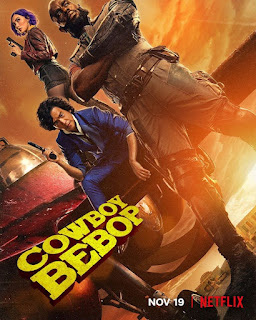
Cowboy Bebop (live action) Review • By Eric Dontigney

So, the live-action Cowboy Bebop show finally dropped on Netflix to a wholly unsurprising bashing by professional critics. To that, I say, you people take yourselves too damn seriously. Unfortunately, that also meant that you took this show too damn seriously. More surprising were all the viewers who took issue with it for reasons that, honestly, I’m struggling to fathom. Most of the complaints I’ve seen are just generalized statements of anger or disappointment. So, here’s my mostly spoiler-free review.

The live-action Cowboy Bebop is a hell of a lot of fun to watch. Unlike the critics, the show doesn’t take itself too seriously. This is a good thing because the original anime didn’t take itself too seriously. Let us all recall that the original anime shamelessly, joyously, took a kitchen sink approach that meant any given episode might take its inspiration from film noir, 50s westerns, Kung-Fu movies, gangster movies, science fiction, and even horror. One of the most reliable sub-plots of the anime was Spike being hungry. A feature I was delighted to see carried over into the live-action version.

The show does adopt a more serialized approach than the anime, but it’s a loose serialization. It was also, I think, a necessary evil for a western audience that has grown accustomed to highly-serialized shows over the last decade or two. That means you see more of some of the supporting players like Vicious and Julia. It also means that where plotlines from the anime overlapped with plotlines in the live-action show, you also get more coherent explanations for why things are happening. In essence, the live-action version depends less on happenstance and deus ex machina. True, that dials down the random a little, but that’s not necessarily a bad thing for the show.

One of the fair complaints leveled at the show is that some of the action sequences didn’t really come off. In some cases, it was because the show tried to replicate the over-the-top style of the anime. That never works out because, you know, human bodies don’t work that way. In other cases, it just seemed like the choreography was off or maybe the actors didn’t get enough time to practice those fight sequences. These issues seemed to resolve themselves in later episodes.

The overall look of the show does a creditable job of recapturing the culture-mashing, socially deteriorating, haves vs have-nots dichotomy that marked the anime. It couldn’t reasonably replicate the same scale because live-action has a budget and sets are expensive, but it captures the overall vibe. High luxury coexists with abandoned vehicles and decaying buildings. High technology coexists with rust and corrosion.

The true joy of the show is the cast. John Cho is glorious as Spike, the ex-gangster hitman turned lazy, perpetually hungry bounty hunter in a blue leisure suit. It’s a testament to John Cho’s skill that he can pull off the devil-may-care attitude of Spike the bounty hunter and the lethally serious attitude of Fearless (Spike’s gangster name) when confronting Vicious. Mustafar Shakir is outstanding as the grumpy, grizzled, ex-cop Jet Black. He puts his soulful gaze to good use in suggesting a man with a deep, complicated inner life. Daniella Peneda excels in her role, bringing the brash attitude of amnesiac Faye Valentine to life, but counterpointing that with an almost visceral desperation to uncover her past.

No, the live-action Cowboy Bebop isn’t a perfect show. It has real flaws. Some subplots don’t work particularly well. Some elements feel shoehorned in for no particularly good reason. Some action sequences don’t come off. That being said, I stand by my original statement. This show is a hell of a lot of fun to watch. The trick, as is true with all adaptations, is to take the show on its own merits. Treat it as its own animal. If you go in expecting a scene-by-scene recreation of the anime, you will be disappointed. If you go in expecting it to make an effort to capture the spirit of the anime, you should enjoy the ride.

__________________________________________________

Eric Dontigney is the author of the highly regarded novel, THE MIDNIGHT GROUND, as well as the Samuel Branch urban fantasy series and the short story collection, Contingency Jones: The Complete Season One. Raised in Western New York, he currently resides near Dayton, OH. You can find him haunting obscure sections of libraries, in Chinese restaurants or occasionally online at ericdontigney.com.


SHAMELESS ADVERT: If you like Harry Dresden or John Constantine, you’ll love THE MIDNIGHT GROUND. READ IT NOW!

Monday, October 18, 2021

My sense of empathy is being tested


We print fiction writers have a longstanding love/hate relationship with Hollywood. We love the insane amounts of money we can make from having our works adapted to become a successful film or television series. We hate the horrible things Hollywood screenwriters and industry executives do to our brainchildren in the process of turning them into visual media products. 

Over the course of my career I have known at least several dozen writers who have had their books or short stories adapted to become films, and of them all, the only one who was completely happy with the way the film turned out was the one who told me, “They gave me a check for a hundred thousand dollars and took my name off the credits. Their check cleared the bank, so I’m happy.”

Recently though comes this news from Hollywood. The WGA apparently is in crisis, as despite Federal law and lawsuit settlements to the contrary, there is still shameless age discrimination going on in Hollywood! It’s an outrage!

WGA West Career Longevity Committee Demands “Inclusion And Equity” For Older Writers

(“Yeah, tell me about it,” mutters the 40-year-old actress.)

Now, normally I wouldn’t pay any attention at all to what’s going on with the WGA—they are strange and alien people over there—but then this article showed up in my feed this morning:

How to Make Money and Thrive as an Older Screenwriter

It’s an article by a screenwriter, writing for screenwriters, discussing strategies for making money in the face of the systemic age discrimination in the film industry. Some of his suggestions made me laugh—e.g., “Take that original script you can’t sell and turn it into a novel”—yeah, right, you think there’s more money to be made in writing novels

But then this one caught my attention. Paraphrasing now:

Find an older piece of IP that you can option for little or no cost up front, and then get yourself attached to the project as a writer-producer or executive producer. Even if the film never gets made, you (meaning the screenwriter) by WGA rules must be paid a significant amount of cash plus the requisite WGA Health and Pension benefits [emphasis added] for writing the unproduced script.

Oh, boy. That one got my hackles up. I have been on the “original author” side of that transaction before, and what a low- or no-cost screenplay rights option or “shopping agreement” means is that the original author of the intellectual property in question makes nothing until the screenplay actually gets greenlighted and goes into production, or sometimes not even until after the film is finished and released. (And yes, films do get finished and then go into the can, to be released years later, or perhaps never. It happens more often than you think.)

Meanwhile, thanks to the WGA, the screenwriter who adapted the original writer’s IP to become a script most definitely does get paid for the work, at Guild rates, and with health and pension benefits as well.

Hmm. No wonder I’ve been seeing so much interest in my back catalog lately from people claiming to be in the film industry: interest that invariably evaporates as soon as I give them my agent’s name and contact info and tell them that I have absolutely no interest in signing a no-cost rights option or “shopping agreement.”  I will gladly pay you Thursday for a hamburger today. Yeah. Right. Sure.

I’m trying to be empathetic to their plight—after all, even Hollywood screenwriters were humans, once—but I can’t help but find the comments on the linked articles amusing. They break right along the age line. The older readers form a Greek chorus, singing, Yes, absolutely, this is exactly what we need! while the younger readers deliver the antiphon, Ah, shuddup, die, and get out of the way already, Boomer!   

Makes me want to get a big bucket of popcorn, sit back, and watch how this plays out.

—Bruce Bethke

___________________________________

SHAMELESS ADVERT:  If you’re an out-of-work Hollywood screenwriter looking for a book that would make a brilliant film, check out THE MIDNIGHT GROUND! READ IT NOW!


Friday, August 6, 2021

A View from the Geek: Masters of the Universe: Revelation - Swing and a Miss • By Eric Dontigney

So, let’s talk about that Masters of the Universe: Revelation. I’ve steered clear of it so far because there has been what is becoming standard issue polarization around the subject. On one side are hard-core purists who hate it. On the other side are people who adore it. Unfortunately, those battle lines also seem to “shockingly” correspond with two all-too-familiar demographics of the speculative fiction community. The hard-core haters either are or are being painted as the same misogynistic d-bags who drove the Gamergate controversy. The adoring fans are or are being painted as the progressive wing of the community.

There is an element of truth to those characterizations. It is, however, a pretty incomplete picture of the reactions to Masters of the Universe. If you consider the basic distribution on a bell curve, those two camps make up the most vocal 5% of the community. Everyone else is somewhere inside that middle 95%. So, yes, it’s possible to dislike Masters of the Universe and not be a misogynistic, repressive douche who thinks that anything with a female lead is crap. I know, because I’m one of them. I intensely disliked Masters of the Universe and it had nothing to do with He-Man not being in the lead for most of the first five episodes. It had a lot to do with the stupidity of how they wrote Teela in the first episode.

One of the major plot points of the first episodes is Teela’s promotion to Man-at-Arms. In the context of the He-Man universe, she’s being promoted into an officer’s rank in their standing army. Her father gives this little monologue about how proud he is of her and how she’s become this master strategist and warrior. All of that implies that before that promotion, Teela was essentially a foot soldier. Maybe she was some kind of non-commissioned officer like a sergeant, but a foot soldier, nonetheless.

Then, there is Prince Adam, the sometimes hero known as He-Man. You could argue that He-Man’s actual identity is probably the single greatest military and national secret in all of the lands. There are also very good reasons to keep that secret as tightly held as possible. While He-Man might prove all but unassailable, Prince Adam is far more vulnerable. Just as importantly, he likely spends far more time as the vulnerable Prince Adam while he eats, sleeps, attends state functions, and interacts with citizens. Adam’s safety is precarious at the best of times.  

By keeping the circle of people in the know very small, Adam has deployed a basic operational security measure called compartmentalization. That information was kept to the people who, in the INFOSEC parlance, had a “need to know.” If there’s anything that soldiers understand, it’s that not all information is available to all parties. They’re trained on information security. They get the importance of “need to know.” You can’t disclose to the enemy -- a terrifying, skull-headed death mage, in this case -- what you don’t know.

That brings us back to Teela, the professional soldier, the supposed master strategist. What happens when she finds out that Adam is also He-Man? She loses her shit because the people around her were “lying.” Despite the fact that she’d been a foot soldier up until literally that day, she apparently believed that she had a right to the biggest military secret in the land. A piece of information so personally dangerous to Adam that he’d issued royal commands that the information not be revealed. Information that was so dangerous that Adam kept it from his own father, someone who arguably did have both the right and need to know. Then, she rage-quits from the army.

A real master strategist and professional soldier would have grasped how desperately vulnerable Prince Adam was whenever he was out of his He-Man persona. They would have grasped why that information was held back from a foot soldier. They would have understood the absolutely critical need for compartmentalization and information security around this topic. They wouldn’t have to necessarily like it, but they would get it. This wasn’t some secret that Adam was keeping about a crush or a surprise party. This was information that could easily cost him his life. Plain and simple, Teela didn’t need to know. If she was half as competent as her father thought she was, she would have accepted it.

Instead, she whined and quit her job. It made her look entitled, petulant, and stupid. To put it in context, it’d be like a corporal screaming at a general for not sharing details about a classified mission that launched from the base the corporal happened to be stationed at. After seeing that, I didn’t really care what Teela did next. Why? The odds were good that if they wrote her that way in the first episode, we could expect more of the same in the episodes that followed. Big shocker, that’s exactly what we got. That certainly isn’t the only problem with the episodes to date, but it is an example of the kind of terrible writing that marked the show.

 _______________________________________________

Eric Dontigney is the author of the highly regarded novel, THE MIDNIGHT GROUND, as well as the Samuel Branch urban fantasy series and the short story collection, Contingency Jones: The Complete Season One. Raised in Western New York, he currently resides near Dayton, OH. You can find him haunting obscure sections of libraries, in Chinese restaurants or occasionally online at ericdontigney.com.


Monday, April 19, 2021

Separating the Toxic Creator from Their Work • by Eric Dontigney

The speculative fiction community has had a rough go of it in recent years with so many beloved creators being outed as everything from jerks to outright sexual predators. I’ve steered clear of this topic because I’ve long been a champion of Joss Whedon’s short-lived, much-beloved Firefly (and the film Serenity). I’ve also been somewhat disheartened by the general approach of damning anyone who gets accused of misconduct. When revelations of misconduct first starting happening, the reactions struck me as being very much, “Guilty, no matter what comes next.”

That never sat right with me. It’s not that I doubted that abuses took place. I was pretty confident that most of the allegations held water. My problem was that the whole thing took on the character of a witch hunt. I doubt there has ever been a witch hunt in which perfectly innocent people didn’t get their lives destroyed. If the general assumption is that every accusation is true, a person with an axe to grind can level an accusation and watch a well-meaning mob rip someone apart. Hell, this is why we have due process. 

Of course, there is also this idea in the law called “preponderance of evidence.” It’s a term used in civil trials that correlates with, but isn’t identical to, “beyond a reasonable doubt” in criminal law. My understanding of preponderance of evidence is that it essentially means that one side offers better evidence on which to judge a claim. It’s not necessarily about more evidence but the more meaningful evidence. This brings us back to Whedon.

Like a lot of Whedon fans, I took a dismissive attitude toward some of the early claims. The earliest public crack in the Whedon edifice was probably when his ex-wife Kai Cole wrote an open letter about his infidelities. I won’t lie. I read it as petty character assassination with an intent to publicly damage her ex’s career by exposing private matters. At the time, Whedon still had a lot of feminist cred and the golden glow of having written/directed/produced so many works that meant so much to so many people. I was making a cardinal mistake.

There is this principle in psychology called the Halo Effect. No, sadly, it has nothing to do with Master Chief. The Halo Effect is when someone makes a positive impression on you very early on. Once you form that opinion, it tends to become your default position when evaluating anything related to that person. So, let’s say that the first time you meet someone, they help you in some meaningful way. That makes you think they’re a good person. After that, you’re WAY more likely to ascribe good intentions or look for explanations that minimize bad intent when that person does things that you’d otherwise read as unacceptable behavior.

It’s even worse when that person is someone you don’t know personally. My only interactions with Joss Whedon came through his work, which I and so many others held very dear, and public accounts that tended to treat him as a nerd god and good guy. Of course, I was a hell of lot younger and knew a hell of a lot less about how things like press tours, interviews, and career preservation worked when I was watching/reading those things. I formed my perception of Whedon based on unreliable sources and narrative content that don’t really tell you anything about a person’s character. Once I formed that opinion, though, it stuck.

So, instead of giving Kai Cole’s open letter a fair read, I read it with a jaundiced eye. I just knew Whedon was a good guy. Okay, maybe he had some fidelity problems, but he wasn’t airing his dirty laundry in public. He wasn’t talking about all the bad stuff that his ex-wife surely did over the course of their relationship. Without even realizing it, I was trying to mentally minimize the bad intent of Whedon’s unacceptable behavior. No matter what, I rationalized, these were private failures that had nothing to do with his work. If that open letter had been the last of it, I probably would have cheerfully continued on in my little bubble of denial and never given it another thought. Except, as we all know now, that wasn’t the end of it.

Account after account of Whedon’s crappy on-set behavior have come out over the last couple of years. I might have discounted even these, except there was a sick consistency to the accounts. When you boil them all down, they basically tell the same story. Whedon acts like a capricious, if not malicious, and abusive petty tyrant toward the people who work on his shows and movies with women as frequent targets for his behavior. If the accounts were scattershot, detailing wildly random stories of different kinds of off-putting behavior, you could chalk it up to Whedon having the occasional bad day. It’s the rare person who has never taken out their bad mood on a co-worker or subordinate. They exist, but they’re rare.

When every account reinforces the nature of the behaviors, though, both the volume of evidence and the preponderance of evidence seem to sit with the accusers. So, where does that leave fans of the work that Whedon leaves in his wake? The problem that many fans have is that Joss Whedon does make good and often complex TV shows and films. Buffy really was one of the first shows that did anything meaningful in terms of female empowerment on TV, though I have issues with the exact kind of empowerment offered on the show. Firefly and Serenity played with ideas about family, guilt, and survival that you don’t see that often in science fiction TV. The Avengers was a good, if flawed, film.

For fans of these works, the implicit message from cancel culture is that we must disown all of these shows and films because Whedon is a bad-faith actor. While I don’t have an ethical problem with Whedon suffering career damage or even career implosion at this point, disowning all his prior works seems like throwing out the baby with the bathwater. By boycotting all Whedon’s prior works, we also boycott the work of everyone else who worked on those shows and films. Did some of those people know about the problems and choose to do nothing? Yeah, probably. Are they, then, also morally responsible? Maybe so. Should we also boycott everything they ever worked on? Should I not watch Nathan Fillion’s The Rookie just because he worked with Whedon in the past? Do you see the problem?

Unlike a novel, which generally has one primary author, TV shows and films are inherently collaborative efforts. Someone like Whedon gets the lion’s share of the credit, but his creative output involved hundreds or thousands of people in the final analysis. There were writers, actors, directors, second unit directors, producers, special effects artists, camera-people, makeup artists, key grips, set builders, production assistants, editors, and countless other jobs that I can’t name off the top of my head. I’d be willing to bet that most of those people showed up to work every day with no bad intentions. In fact, most of them probably showed up and worked really hard to do a good job. Why? Because people have bills and mortgages and working in Hollywood is still a job. While all of us have worked with people who are jerks or creepy, most coworkers sit somewhere on the spectrum of basically normal with normal personality flaws. Most people show up for work and do their jobs without going out of their way to be abusive dicks. You don’t fire the entire accounting department because Jessie never learned how to play well with others. You just fire Jessie.

Boycotting Whedon’s entire body of previous work is like firing the entire accounting department. It accomplishes little to nothing useful in the long run. Maybe you deprive him of a couple of bucks if you won’t buy new copies of his old films and shows, but that’s about it. It’s a moral stand with no strength in it. He’s already made most of the money he’ll ever see off of those works. It doesn’t hurt him. It ultimately fails to make a useful separation of the toxic creator from his work. The real problem isn’t Buffy the Vampire Slayer, or Angel, or Dollhouse, or Firefly, or Serenity, or The Avengers. Liking those shows and films isn’t the real problem.

Whedon himself is the problem. It’s not your relationship with his past works that’s going to change anything. It’s what you do in relation to his future works that will change things. That's where boycotting can have a real effect. Don’t tune in to his new shows. Don’t buy tickets to his new movies. Raise a stink if some studio hires him or makes him a showrunner. He does damage when he’s given authority over others. Do your best to make giving him power over others unprofitable for studios. If his works stop making money, people will stop hiring him.

Refusing to watch old projects of his because they’ve got his name on them only deprives you of something you love. It also negates all of the hard work of everyone else involved in those projects. So, I say, separate the toxic creator from the work. If you love Firefly, keep loving Firefly. Boycott Whedon’s new works instead. Make it clear to studios that you won’t support someone who behaves so badly on set. Encourage others to do the same. That is the way you can effect real change in the now.


Eric Dontigney is the author of highly regarded novel, THE MIDNIGHT GROUND, as well as the Samuel Branch urban fantasy series and the short story collection, Contingency Jones: The Complete Season One. Raised in Western New York, he currently resides near Dayton, OH. You can find him haunting obscure sections of libraries, in Chinese restaurants or occasionally online at ericdontigney.com.

Wednesday, May 2, 2018

A little something for the weekend...

Public Service Announcement • “Avengers: Infinity War,” by Bruce Bethke •


This is not a movie review. It’s a warning. If you’re determined to see this movie without any preconceptions, stop reading right now—but don’t say you weren’t forewarned.

Friday, April 20, 2018

A Little Something for the Weekend

• "Waving Goodbye to The Librarians" By Eric Dontigney

___________________________________________________________

The Librarians 
Science fiction and fantasy are genres dominated by darkness. It’s inevitable. If you want to raise the stakes and create tension, you need a serious threat. If you’re writing a series, you must progressively double down on the threat level. Yet, as a viewer of SF&F films and TV, the escalating grimdark of it all does one of two things to me. It either wears me down or breaks my suspension of disbelief by turning silly in a non-humorous way.

I cannot binge watch the rebooted Battlestar Galactica without starting to feel depressed. I’ve abandoned all the CW superhero shows because they’ve tipped into un-funny silliness. My solution to this problem for a long time was to watch the show Eureka. It was basically a family-friendly sci-fi show. That meant there was some silliness baked right into the DNA of the show.

Colin Ferguson, who played everyman Jack Carter, vacillated between stunned confusion and physical comedy. There were occasionally dark episodes and themes, but the show never took itself too seriously. It was fun without being condescending. So, naturally, it got canceled. Warehouse 13 tried to capture that same magic, but never quite found it. It leaned progressively more and more into grimdark as it wound its way toward cancellation.

Then, TNT of all networks greenlit a quirky fantasy show called The Librarians. It was a spin-off of the Noah Wylie-fronted Librarian films from the same network. What surprised me, though, was that they beefed up the humor in the show. They very consciously aimed at a family audience and hit the mark more often than not. In a sea of gritty procedurals, here was a show that cast Bruce Campbell (of Evil Dead fame) in a guest role as the actual Santa Claus. It was hilarious and brilliant.

Noah Wylie excelled in his role as the moderately unhinged Flynn Carson, the titular Librarian. Here was a guy who’d been saving the world solo from magical threats for a decade. It took a toll, but they played it for laughs more often than not. He was damaged, but not irretrievably, and driven by an essentially kind nature. The conceit of the show was that what this guy needed was a family, even if it was an ad hoc family thrown together by circumstance in the pilot episode. So they surrounded him with characters as offbeat as himself.

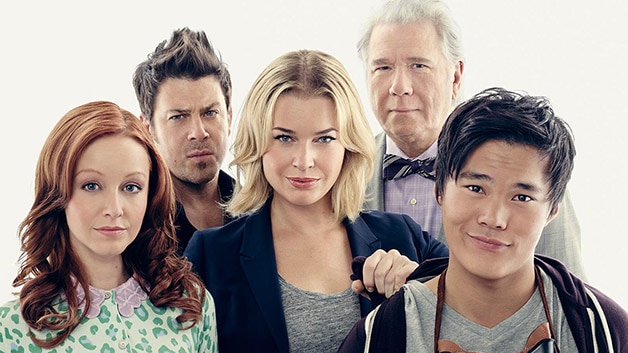
The moral heart of the show was Eve Baird, a NATO commando played by Rebecca Romijn. She was tasked with training and protecting the JV librarians with a combo of tough love, practical advice, and fierce maternal instincts. This job was not made easier by those placed under her care. A morally bankrupt thief named Ezekiel Jones, played to comic perfection by John Harlan Kim. A flighty mathematician and synesthete named Cassandra Cillian, played by Lindy Booth. Rounding out the JV team was oil rig worker and art history genius Jacob Stone, played by Christian Kane. The final member of this odd little family unit was Jenkins, the cranky caretaker of the Library played by the inestimable John Larroquette.

The disparate natures and life experiences of this group did a lot of the comedic heavy lifting and, when all else failed, they could just have John Larroquette toss off an acerbic remark. What this show also did that made me so forgiving of its shortcomings was not taking itself too seriously. When you’ve got a physical powerhouse like Christian Kane on set, it would have been all too easy to turn the show into a dark action show that focused on him. They never did that and here’s why.

The other primary conceit of the show, one that’s almost anathema to contemporary scriptwriting, was that knowledge was the source of power. Physical confrontations were there to keep things exciting. They weren’t solutions, though. Solutions always came out of a character’s understanding of history, art, science, mythology, mathematics, or some combination of the characters’ knowledge. The show elevated being smart into a kind of superpower and it did it without being condescending. When ignorance led to a crisis, the librarians were horrified or frustrated, but never cruel or judgmental.

So, naturally, the show was canceled last month after four seasons and 42 episodes. Granted, that’s a pretty good run for a show about smart people solving problems by being smart. It still makes me a little sad. It’s one less advocate for intelligence in a television landscape that seemingly values brute force solutions above all else. It’s one less show that serves a family audience with lighthearted fare. It’s another victory for an often wearying grimdark aesthetic. My one consolation is that it will survive on DVD and streaming video. So, if you need a break from grimdark and haven’t seen The Librarians, I highly recommend it to you.

________________________________________________

Eric Dontigney is the author of the Samuel Branch urban fantasy series and the short story collection, Contingency Jones: The Complete Season One.  Raised in Western New York, he currently resides in Memphis, TN. You can find him haunting obscure sections of libraries, in Chinese restaurants or occasionally at ericdontigney.com.

Eric’s last appearance in our pages was “Memory Makes Liars of Us All,” in Stupefying Stories #13, his next will be “Lenses,” in Stupefying Stories #21, and later this year we’ll be releasing his paranormal mystery novel, The Midnight Ground. Watch for it! 

________________________________________________