Showing posts with label food for thought. Show all posts

Friday, July 7, 2023

Talking Shop: Royal Road and Success • By Eric Dontigney

So, Bruce mentioned to me that some people were asking about how I managed to make a go of turning a web novel on Royal Road into a (relative) Patreon success. I’ll warn you now that if you’re here looking for a recipe you can follow to duplicate what I did, you’re probably going to be disappointed. There are some steps you can follow, but there are also parts of the process that nobody can account for. So, let me start with the things that you can conceivably duplicate in some way.

Know your platform. Royal Road caters to a pretty specific crowd, although I understand that the exact crowd/crowd tastes do slowly evolve over time. At the moment, Royal Road heavily favors cultivation and LitRPG novels. I figured this out the hard way when I started testing out an Urban Fantasy novel and got almost zero traction. I also have a space opera ongoing on Royal Road (Rinn’s Run) that is showing some signs of life after 30+ chapters and some crossover readership from my Unintended Cultivator novel. The takeaway here is that different web novel platforms cater to different audiences. You can either find one that caters to the audience you want, or you can write a novel that at least somewhat caters to the audience that exists. I went with option B. I started writing and posting a cultivation novel.

Something else that you can at least partially control for is the cover. You need a cover that conforms, at least a bit, to the expectations of the audience. I went out and found art that has at least some surface similarities with some other popular titles in the cultivation field. I don’t know that the cover helped, but I suspect that it did. Get or make yourself a cover that at least superficially resembles the covers of similar kinds of books. It helps people put your book in the right mental box. If you’re thinking that your book is for everyone, take that idea out back and beat it to death right now. Your book is not for everyone. It can’t be. It’s for a particular audience, which means you need to meet some of that audience’s expectations in terms of the look and feel of your cover.

Speaking of meeting expectations, most web novels are genre novels. Genre novel readers have expectations about the use of tropes and genre conventions in the book. There is some wiggle room there. You don’t have to use every trope or every convention, but you must use some of them. In other words, if you’ve never read any cultivation novels or LitRPG novels (or whatever genre is popular on a specific platform), you better go out and read a few dozen of them before you try to write one. I just happened to have read a bunch of cultivation novels, so I knew some of what I was getting into.

Now, Royal Road has made it pretty easy for you to connect your Patreon page with your Royal Road account. Sadly, connecting those accounts is going to be the easier part of the process. When it comes to Patreon, you have a lot of decisions to make, and I can provide only general guidance. Patreon functions on a tier system. Each tier needs to offer one or more benefits to the patron. You also get a LOT of flexibility with how much you charge for each tier. What benefits you offer at each tier level will do a lot to determine how much you can reasonably charge for those tiers. Ultimately, that pricing is something you have to weigh for yourself. It’s on you to decide how much you think those benefits are worth. Then, you test that assumption against what people are willing to shell out each month.

Now, we come to the parts of the process that make it difficult-to-impossible to duplicate. When I first started posting Unintended Cultivator, I was averaging two chapters per day for a total of around 3000-4000 words per day. And I was doing it 7 days a week. I’ve since modified that to posting one chapter per day on Royal Road (most days). Here’s the thing, I still post two chapters a day over on Patreon…7 days a week. Right now, I’m averaging about 3500-4500 words a day. I also have the luxury of treating writing fiction as my day job. I’m in an exceedingly tiny minority of people who can say that. Even among writers who can and do treat it as their day job, 4000 words a day is a pipe dream for most of them. Beyond that, doing it 7 days a week isn’t sustainable for most people. Yes, I’m kind of a freak because that writing pace doesn’t bother me, and I don’t mind writing 7 days a week. While I can’t prove that my writing pace contributes to my overall success on Patreon, I’m willing to bet that it does. After all, my upper-tier Patreon audience can say that they get an entire 100,000+ word novel in June. Now, if you can duplicate that writing pace, and maintain general writing quality, and not go absolutely insane from working all the time, I say go for it.

The next thing that you cannot control for is simple luck. I got lucky, plain and simple. The right people read the early chapters, recommended the book, wrote reviews, and gave it ratings. All of that let the book get onto the front page of the site. That got the book in front of a lot more eyes. That, in turn, exposed a lot more people to the existence of my Patreon page and prompted people to sign up. It all happened organically without me paying for advertising or really doing much of anything beyond writing a lot of chapters. Having that happen makes the book and my experience kind of a unicorn. Granted, there were a lot of factors at play, but they all had to come together just right for that “success” to happen. 

______________


Eric Dontigney is the author of the highly regarded novel, THE MIDNIGHT GROUND, as well as the Samuel Branch urban fantasy series and the short story collection, Contingency Jones: The Complete Season One. Raised in Western New York, he currently resides near Dayton, OH. You can find him haunting obscure sections of libraries, in Chinese restaurants or occasionally online at ericdontigney.com.


SHAMELESS ADVERT: If you like Harry Dresden or John Constantine, you’ll love THE MIDNIGHT GROUND. READ IT NOW!

ANOTHER SHAMELESS ADVERT: If you want to get an early look at Eric’s latest work, READ THIS POST NOW!


Thursday, May 18, 2023

The Grand Experiment • By Eric Dontigney

Hey everybody! Eric here. It’s been a while since I wrote a blog post for the Stupefying Stories blog. I actually meant to do one a while back, but things have been a little hectic lately. So, here’s what’s been going on.

Starting a month or two back, I started running an experiment. I began writing and publishing a Xianxia-inspired cultivation fantasy novel called Unintended Cultivator on a site called Royal Road. Okay, for everyone who just nodded their way through that last sentence in complete understanding, skip to the next paragraph. For everyone else, Xianxia is a fantasy genre that has its roots in Chinese Wuxia fiction. Cultivation novels are an offshoot of Xianxia. Rather than provide a long explanation of Wuxia, Xianxia, and cultivation, I’ll refer to the blog post I wrote that already does that. The one-sentence explanation is that cultivators use magical techniques to harness natural energies in a bid to achieve immortality. Royal Road is a website where you publish fiction a chapter at a time. So, with those basics out of the way, forward.

Much to my surprise and delight, Unintended Cultivator has taken off in a big way on the site. When I last checked on it, it was in the top 20 best rated books on the site, had racked up close to 200,000 views, and was on the front page of the website in at least two different places. Long story short, people there like it. So, I chatted with Bruce to see if this might be a book that Rampant Loon wanted to publish, you know, when I actually finish writing it. Assuming I don’t crash and burn in the third act, that’s tentatively what’s happening.

Given that I have some traction on Royal Road right now, we’re running a second experiment with Rinn’s Run. While the first draft is more or less complete, it can still do with some editorial feedback and revisions. So, this is where all of you come in. If you’ve ever read and book and thought, “Man, if I’d seen an early draft of that I could have totally saved them from that plot hole, terrible characterization moment, or (insert your failure of choice here),” this is Your Moment. You will have a chance to directly influence the final version of not one, but two books.

If all goes to plan, I’ll be wrapping up Volume One of Unintended Cultivator in about a month or so. I’ll also be publishing chapters of Rinn’s Run over that same period. You can read these chapters as I write and post them and leave comments there, or here, letting me know about typos, flagrant grammar errors, or serious plot holes you spot.  

If this sounds like your cup of tea, you can find the book pages at the following links:

Unintended Cultivator

Rinn’s Run

Of course, if you like the books and want to leave ratings or reviews on Royal Road, I’d appreciate them. They help push the book up in the rankings, which helps them build an audience. If you think one rating or review doesn’t matter that much, I can tell you from watching the numbers that they matter a lot.

The long-term goal, of course, is that both books will get published in final, edited forms as print books and ebooks. The hope is that by building a core audience on Royal Road first, some of that audience will buy the final versions of the books and help make them successful with the wider audience on sites like Amazon.

So, there you have it. That’s what I’ve been up to recently and will be up to over the next month or so. And, if nothing else, it’s an opportunity to quite literally watch me write a book chapter by chapter. There has to be some entertainment value in that, right?

Friday, March 3, 2023

THE SIOUX SPACEMAN (Beware the Horseman of the Stars) (1960) by Andre Norton –Part Two of a Review

On rare occasions here, I've reviewed movies. On even rarer occasions, I've review books. When I do either, I'm usually fairly certain someone will take exception with my essay. That's good, because if you take exception, then I've managed to "speak to you" through the written word. Other times I take up the spirit of a blog Bruce used to host called THE RANTING ROOM. THAT blog I enjoyed! So, it's in the spirit of the old Ranting Room, that I take on this incredibly hot potato...


Andre (Alice Mary) Norton’s THE SIOUX SPACEMAN is an adolescent space adventure story – duh. It’s what she wrote, from her first novel, THE PRINCE COMMANDS (“a straight-up adventure novel” – Lin Carter [an American author of science fiction and fantasy, as well as an editor, poet and critic…influential as a critic of contemporary fantasy and a pioneering historian of the genre…an editor for Ballantine Books…he sponsored the Gandalf Award…” Wikipedia], from the profile of Norton in the first edition of THE SIOUX SPACEMAN.

She did have some Native American heritage: “A common theme in the books is the presence of sympathetically presented feudal and tribal cultures. In several books Native American tribes and their various analogues are given a chance to be more successful than they were in actual American history. (Norton often told friends that she was proud of her little bit of Native American ancestry.) Nonhuman creatures and cultures are usually presented sympathetically, with human protagonists sometimes supporting them against oppressive human authorities. In contrast, several books present technological and mechanized cultures as negative or even positively evil.”

So – what do I think? I think she was daring. In an era when “America” was everything – it was the BEGINNING of the civil rights movement – she dared to posit a world where white Americans had killed each other off: “Norton doesn't give many specifics, but we learn that on Earth, the white Western civilization bombed itself into extinction. When civilization rebuilt itself, the Federation of Tribes emerged as a leader in a world dominated by Native Americans, Africans, Latinos, and the Chinese.”

As a former teacher and now a counselor in a diverse near-urban high school, these are the kids I see most often (though, instead of Chinese, we have a large population of Hmong – again, people driven from their original lands by the Han migration of Chinese settlers during the Qing Dynasty in the late 19th Century). We also have a large number of Liberian, Somalian, and Ethiopian students as well as students from Mexico, Ecuador, and Guatemala. This future isn’t very hard for me to imagine. Also, though we don’t have many students from South Korea, I was there for three weeks this summer and I can see a future where South Korea is a far larger player than most people would think (how about this: Kia, Hyundai, Samsung, and SK Electronics…as a point of reference, my spell checker didn’t indicate that any of those are misspelled).

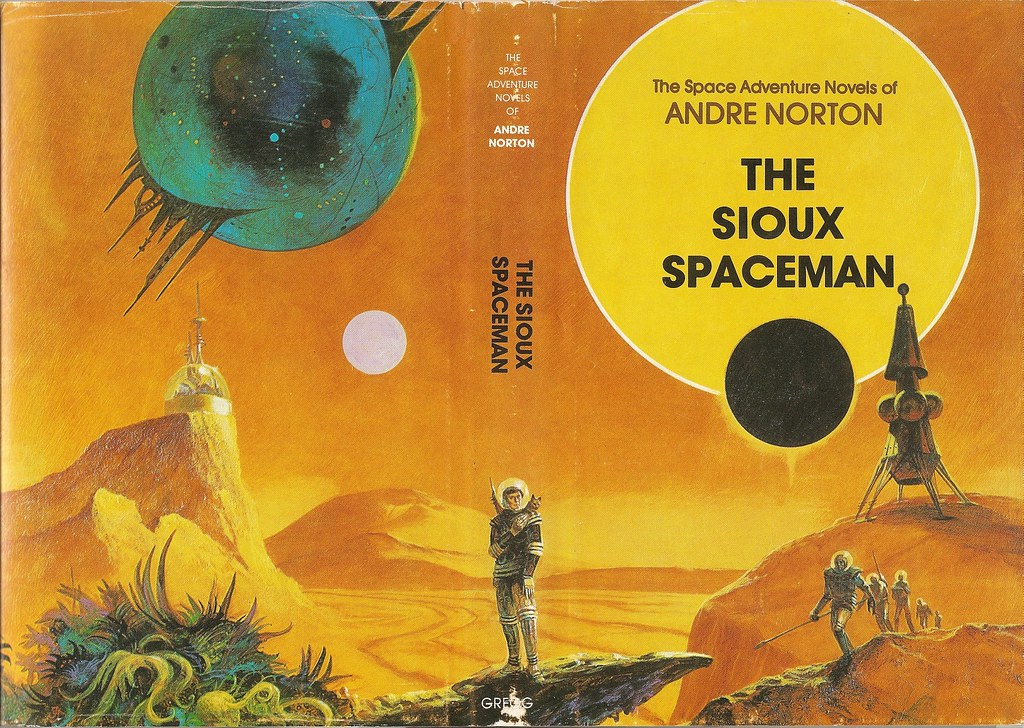
Kade Whitehawk is far out of the stereotype (though the cover of the books – except for the German edition I have above – do absolutely nothing to break the “injun” bias of the time, go so far as giving Kade the winged-hawk-beaked-jingle-bell-helmet/thingy on the cover of the first edition) that prevails in the US today. Politicians who claim to have Native American heritage -- unless they have clear and unequivocal proof of that ancestry -- will not impress ANYONE, where men and women who actually grew up in the culture and with the languages of indigenous peoples can perhaps move all of us toward kinder, gentler world.
At the time the SPACEMAN was written, it was far, far out of the expectations and images of Native Americans – even today in the second decade of the 21st Century. (http://time.com/3916680/native-american-hollywood-film/) Native Americans STILL have to stand in the shadows as white Americans play the parts of THEM – “…Hollywood mainstream has cranked out a fledgling resurgence of Westerns with (mostly panned) movies such as Cowboys & Aliens (2011) and The Lone Ranger (2013). In these projects, Native American actors have been restricted to background roles…”

As I said before, I think some company – preferably a publishing company owned by Native Americans – buy the rights to SPACEMAN and then continue the series, developing both Kade and the Confederation on Earth. I think it would be fascinating…

But given the current political climate, Native Americans have virtually no visibility in politics – starting with the 2019 Congress, there will be “…four Native Americans. When their terms begin, Davids and Haaland will become the first two Native American women with documented tribal ancestry to serve in Congress.”
From the first in 1817, to the present, twenty-two Native Americans have served as senators or representatives. [For those interested in such things: R=8; D=12; R/D = 2]
 (https://en.wikipedia.org/wiki/List_of_Native_Americans_in_the_United_States_Congress)

We have a long, long way to go before we reach a place where Native Americans (in particular) play a natural role in fiction, but I believe Andre (Alice) Norton made a solid start.

If you like what you read here, I also blog on multiple topics including writing for young people, reports on sessions from the past three or four WorldCon Science Fiction Conventions, writing SF, plus I throw out an Idea on Tuesday every week. I've had SF in ANALOG Science Fiction and Fact, CAST OF WONDERS, SHORELINE OF INFINITY, and the old PERIHELION; and kids stories in CRICKET and CICADA. *Warning! I'm also an evangelical Christian* If you're OK with that, stop over at POSSIBLY IRRITATING ESSAYS at https://faithandsciencefiction.blogspot.com/

Monday, February 13, 2023

RFP: Big Ideas in Science Fiction

CALL FOR SUBMISSIONS.

There, that ought to get your attention. Actually, this is a Request For Proposals, or if you prefer, Pitches. As we work to reanimate Stupefying Stories, one thing I’ve been pleased with and would like to develop further has been Guy Stewart’s series of non-fiction posts on topics like Creating Alien Aliens and Mining the Asteroids and the like. For as long as I’ve been in this business—and that’s been nearly 50 years now—science fiction has always claimed to be “the literature of ideas.” It purports to be the one field of literary endeavor that is unafraid to examine the big ideas about science and the future of humanity, to ask the questions no one else dares to ask, to present the most dangerous visions, to boldly go—

When I look at what’s being published, though, the genre as a whole seems to come up way short of its stated ambition. (And don’t even get me started on the evident paucity of imagination in video-media SF.) Considered more dispassionately, print-media science fiction might more honestly be described as “the literature of tropes,” stuck in a ±40-year time loop between the Astounding of the late 1930s and the Asimov’s of the early 1980s, churning back and forth through the same old ideas with only very slight variations with each new iteration. Robots, aliens, space ships, utopia, dystopia, more robots, weirder aliens, better spaceships, lather, rinse, repeat… Except for steampunk, which began as a Great Leap Backward to reboot the genre all over again with Jules Verne but ended up producing only another tired and clichéd fashion motif for cosplayers.

As it happens, in addition to science fiction, I also read Science News. And the further we progress into the real future while simultaneously retrogressing back to John Campbell in our entertainment, the more it bothers me that the gap between science fiction writers and real science is becoming an unbridgeable chasm.

Perhaps this is a stupid idea. Perhaps the denizens of SF fandom will be happier, and thus we will be better paid for our work, if we stick to recapitulating ideas that were already old when they were adapted to become Star Trek scripts in the 1960s. Another dispassionate look at the realities of the current SF marketplace would seem to support that assertion. But seriously, is this all modern science fiction has to offer? Remakes of what was successful in the past, only with slight variations to suit the conceits of the contemporary audience?

Hence this RFP. I would like to start running a weekly series of short* but fairly serious think pieces examining the conceits and assumptions that underlie our genre, with an eye towards what still works, what desperately needs to be updated or replaced, and which honored old tropes of the genre should be taken out to the edge of the camp, shot, beheaded, their corpses burned, and the ashes buried in unmarked graves, to ensure that they never rise to trouble the living again.

Does this sound like something you’d like to be a part of? I’m not looking for finished articles now, just pitches for what you might like to write about. If you have an idea, drop me a line at stupefyingstories@gmail.com. Target length and payment rates are TBD at present, as I’m still trying to gauge the level of interest in this concept. 

Introspection is a scary thing, I know, but I sure hope there is more to this genre than the same old $#!+. I don’t want to be publishing stories about @#*($&*ing crashed flying saucers forever. Even if the USAF is shooting down UFOs over Lake Huron right now.


* Target length is a real issue. While I’m inclined to equate serious thinking with longer articles, here in ADHD World, anything over 250 words long seems to seriously tax the readers’ attention span. Is that also part of the problem? Modern readers can’t stay focused long enough for the writer to develop a new idea and a coherent argument, so we skip to recycling old tropes and writing in cinematic shorthand? E.g.,

[EXTERIOR, DAYLIGHT, BLUE SKY, SCATTERED CLOUDS: An F-22 Raptor sweeps into view. Zoom in on the pilot, USAF Captain Melissa Strongwill (she/her), who is intently staring ahead. Cut to 3/4 view from behind her, showing what she's seeing.]

STRONGWILL: I have a solid radar lock.

CONTROL: (crackly voice over radio) Weapons free. You are cleared to engage.

STRONGWILL: Fox One!

[Missile streaks out from F-22, impacts briefly glimpsed octagonal UFO, big explosion, UFO veers down and right, trailing smoke and obviously out of control.]

STRONGWILL: Got it! The target is going down! Repeat, the target is going down!

CONTROL: That’s confirmed. We’re tracking it. It’s going to splash about ten miles offshore. The Coast Guard has been alerted.

[etc., etc., proceed with Standard Plot #7. UFO crashes, sole occupant is rescued and imprisoned in secure facility, STRONGWILL is brought in to meet and interview alien, comes to realize that this was all a terrible mistake, the alien is humanoid, intelligent, peaceful, ambiguously gendered but very beautiful in an exotic way, STRONGWILL helps alien escape, engages in a mix of fish-out-of-water comedy, rom-com misunderstandings, chase scenes with menacing men-in-black type agents, in thrilling final reel chase scene helps alien make rendezvous with rescue craft and escape in the nick of time, and is left standing in a wheat field, pining for the hermaphroditic pansexual alien who has won her heart and opened her mind, while the MIB agents watch helplessly as the craft soars away.]

AGENT: (talking into radio) The alien got away. (radio garble) Captain Strongwill? Yes, we caught her.


STRONGWILL: (turns around to face agent) (in voice that's almost a growl) My pronouns... are they and them.

[MUSIC UP: David Bowie, "Starman"]

[ROLL CREDITS]

C’mon, admit it. Haven’t you already paid to see this movie at least three times? Wouldn’t you pay to see it again, if this time the script played up the alien’s gender fluidity and wry amusement at “primitive” human sexual morality?


Friday, February 10, 2023

THE SIOUX SPACEMAN (Beware the Horseman of the Stars) (1960) by Andre Norton, Part 1 of a Two Part Review

On rare occasions here, I've reviewed movies. On even rarer occasions, I've review books. When I do either, I'm usually fairly certain someone will take exception with my essay. That's good, because if you take exception, then I've managed to "speak to you" through the written word. Other times I take up the spirit of a blog Bruce used to host called THE RANTING ROOM. THAT blog I enjoyed! So, it's in the spirit of the old Ranting Room, that I take on this incredibly hot potato...


I’m not certain where the negative reviews came from of Andre (Alice Mary) Norton’s SIOUX SPACEMAN. There ARE cautiously positive ones though:

“Having each member of the trading team come from a different race/ethnicity…not to mention putting Africo-Venusian…in charge of the base, was probably a pretty bold move in 1960…her Chinese character…doesn’t really get the chance to break out of stereotype…Norton also fails to have any women of note; women are mentioned mainly in the context of battle spoils….A lot of authors would have written a book in which Kade would end up as central to the Big Plan; in this book, he’s just a guy who, if he is lucky, might get to be a cog in someone else’s shiny machine.” – James Nicoll (https://jamesdavisnicoll.com/review/the-cover-is-misleading)

“…Norton thought that Native Americans could be employed in such ventures because their ancestry as nomads only a few generations earlier would enable to them to relate to primitive races on other worlds…This is an idea that, as Norton presents it, strikes me as racist…Yet, I know that some Native Americans remain very much in tune with their ancestral customs and traditions, and there might be some way of capitalizing on that — in a non-racist way. In addition, there was a version of this employed in World War I and World War II — the “code talkers” who used Native American languages in transmitting coded messages.” Patrick T. Reardon ( https://patricktreardon.com/book-review-the-sioux-spaceman-by-andre-norton/ )

“Norton doesn't give many specifics, but we learn that on Earth, the white Western civilization bombed itself into extinction. When civilization rebuilt itself, the Federation of Tribes emerged as a leader in a world dominated by Native Americans, Africans, Latinos, and the Chinese…And it works. Sort of. For reasons I wasn't clear about, the Styor lords decide to slaughter the horses and murder the human Traders…he's let into a secret: despite the official Policy of overlooking Styor brutality, there is a centuries-long Plan to undermine the Styor empire…Would he like to join and spend his life working for the eventual downfall of the Styor Empire and the freedom for mankind and for all the peoples of the galaxy? Of course he would.” Stranger Than SF (https://strangerthansf.com/reviews/norton-siouxspaceman.html
)

Andre Norton was “the first woman inducted into the Science Fiction and Fantasy Hall of Fame, among other awards (twice nominated for Hugo awards). She wrote for over 70 years having over 300 titles published. I also found it interesting that like another woman author S. E. Hinton, she was advised to publish under a male’s name to increase her marketability to young boys, the main consumer of fantasy…I found that it was well written, with excellent main character development and well worth my investment of time for an enjoyable read of older works of science fiction…The plot is, well, just a bit juvenile (after all it was written with that reader in mind), but is sufficient to keep the reader engaged.” Jacob at Red Star Reviews (https://redstarreviews.com/2017/05/11/a-word-from-the-father-andre-nortons-the-sioux-spaceman/)

Between Norton, Nourse, Heinlein, Wollheim, Christopher, Asimov, and others; I started my journey into science fiction (actually, I started with SPACESHIP UNDER THE APPLE TREE and THE WONDERFUL FLIGHT TO THE MUSHROOM PLANET, and MISS PICKERLE GOES TO MARS but I’ve already written about those here: https://faithandsciencefiction.blogspot.com/2012/11/possibly-irritating-essay-how-science.html and here: https://faithandsciencefiction.blogspot.com/2016/09/possibly-irritating-essay-gateway.html.

I fell in love with these writers and I work at pulling their books from the shelves of “withdrawn” books whenever I can, as well as ordering some from online sources.

My question today is “Would these books pull today’s teens into SF?”

My unequivocal answer is: “I’m pretty sure it could!”

The most recent cover of the book is this one from 1978: https://c1.staticflickr.com/7/6115/6246120042_254ebb243b_b.jpg 

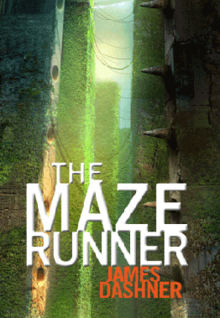
It’s generic and while it was intended to be the fifth book in a series, all of which had similar covers, it doesn’t particularly grab you the way these two do:

https://www.scholastic.com/content5/media/products/28/9780439023528_mres.jpg

https://upload.wikimedia.org/wikipedia/en/thumb/d/db/The_Maze_Runner_cover.png/220px-The_Maze_Runner_cover.png

So, "branding" would be necessary.

HOWEVER, the story holds up. I just finished it and to tell you the truth, I think whoever owns the estate could easily find a new author to complete the story with this as first in the series. It’s a fast, powerful read and despite the fact that there were no females in it AT ALL (Human, Styor, or Ikkinni – at least as far as we know of the aliens), there’s no reason to think that all females in the universe are dead or that Norton was embarrassed of being female. (The WITCH WORLD books argue strongly to the contrary). She was writing to “get boys to read”.

In 2016, a Guardian headline read, “[Boys] Read Less – And Skip Pages” (https://www.theguardian.com/education/2016/oct/22/the-truth-about-boys-and-books-they-read-less-and-skip-pages). The trend began – you guessed it – in the 1960s. (https://www.greatschools.org/gk/articles/why-so-many-boys-do-not-read/)

I’m going to end here now, but I’ll back at this next weekend.

Oh, one thing from the 21st Century: the issue now is cultural appropriation. I don't think that Norton was attempting to do that. She was showing diverse characters doing the same things as the non-diverse characters were doing in her stories. There are some who would cry FOUL! and insist it's impossible for a white woman to write about characters descended from the Dakota. However, Norton was TRYING to do something about a disturbing trend. Kids were reading less. I can say that she DID capture me and turned me into a lifetime reader – of science fiction. 

She was also trying to do something radical for the time – deliberately including NON-white characters in her science fiction. She was very far ahead of her time.

Those who insist that this book is a cultural appropriation and that it was offensive that she wrote it might be interested in this story: "A few years ago, I stumbled across a series of interviews and articles that led me to Nisi Shawl and Cynthia Ward's workbook, Nisi Shawl and Cynthia Ward, authors and workshop leaders. After following various leads, articles, and commentaries by other writers, I reached their “workshop book” WRITING THE OTHER, A Practical Approach. She relates this story introducing the book: 'In 1992, at the Clarion West Writers Workshop, “One of our classmates opined that it was a mistake to write about people of different ethnicities: you might get it wrong. Horribly, offensively wrong. Better not to even try.”(WRITING THE OTHER: A Practical Approach, Aqueduct Press, 2005; p 6)

“Amy closed her mouth, and mine dropped open. Luckily, I was seated when my friend made this statement, but the lawn chair must have sagged visibly with the weight of my disbelief. My own classmate, excluding all other ethnic types from her creative universe! I think this sort of misguided caution is the source of a lot of sf’s monochrome futures. It seemed to Ms. Shawl 'to be taking the easy way out.' This led her to write the essay, “Beautiful Strangers: Transracial Writing for the Sincere” (Speculations, October 1999; retrieved from: https://www.sfwa.org/2009/12/04/transracial-writing-for-the-sincere/)

I've worked the book twice through now and while I haven't been brave enough to introduce too wildly obvious non-white charters, I'm working on doing that in my YA/MG fiction...

This is as far as I'm going on this post, So, for now…later!

Resource: WRITING THE OTHER: A Practical Approach, Aqueduct Press, 2005


If you like what you read here, I also blog on multiple topics including writing for young people, reports on sessions from the past three or four WorldCon Science Fiction Conventions, writing SF, plus I throw out an Idea on Tuesday every week. I've had SF in ANALOG Science Fiction and Fact, CAST OF WONDERS, SHORELINE OF INFINITY, and the old PERIHELION; and kids stories in CRICKET and CICADA. *Warning! I'm also an evangelical Christian* If you're OK with that, stop over at POSSIBLY IRRITATING ESSAYS at https://faithandsciencefiction.blogspot.com/

Monday, September 20, 2021

A View from the Geek: Do Your Own Research Vs. Do Your Research • By Eric Dontigney

As a fiction writer, you must strive for verisimilitude. It’s the gold standard, that appearance of or resemblance to truth or reality. It’s even more important when you delve into speculative fiction. The more outrageous the story you plan to tell, in terms of breaks from understood physics, the more time you must spend grounding and cloaking the rest of the story in the garments of truth. It’s why writers spend so much time on the details. Mind you, they don’t need to be familiar details. Science fiction and fantasy thrive on building new worlds. The catch is that the details must make sense. They must be consistent.

Maybe it’s all the years of striving for verisimilitude in my fiction. Maybe I just had better-than-average teachers. Maybe it was all those years studying philosophy with its unusually rigorous demands for arguments that make sense. Maybe it’s all of those things that make me want to do physical violence on people when I see the phrase, “Do your own research,” bandied about on the Internet. It would take more words and space than is practical here to unpack everything that underlies that phrase, so I’m just going to hit the highlights.

The underlying assumption of that phrase is that you cannot trust the things that so-called authorities tell you. At best, those authorities are misguided. At worst, they’re actively engaged in a national or even global conspiracy to deceive you into doing something that is not in your best interest.

And people say that speculative fiction writers push the edges of plausibility. Let’s pause and consider how well people keep little secrets. On the whole, people who aren’t sociopaths are terrible at it. It’s routinely obvious when someone is keeping a secret, even if you don’t know about exactly what. Half the time, the person keeping the secret winds up telling someone else the secret and then swearing that person to secrecy. Considering how well person one kept that secret, it’s sort of baffling that they think person two will do a better job. These are for small, non-dangerous secrets.

So, let’s consider how likely it really is that the employees of the 200 or so governments in the world are successfully keeping a conspiracy under their hats. How likely is it that every last one of those millions of people is actively lying to everyone they know on daily basis and doing it successfully? How likely is it really that not a single one of those people have been struck by a crisis of conscience and released definitive evidence of the conspiracy to a news outlet? Yeah, it’s about as likely as you winning the lottery. Actually, you have about a one in fourteen million chance of winning the lotto on average. On balance, you probably have better odds of winning the lotto than the odds of a global conspiracy being kept secret for any length of time.

Setting aside that there is about zero chance of a global conspiracy staying secret, let’s look at how you’re supposed to deal with these lying conspiratorial authorities.

The apparent explicit cure to this problem is to “do your own research.” Yet, no one really digs into what that entails. Let’s take something like, oh, I don’t know, vaccinations against a global pandemic as our case in point. How does one “do their own research” about vaccinations for a global pandemic? I don’t have a multimillion-dollar laboratory at my disposal. Do you? I also don’t have a Ph.D. in biology, chemistry, biochemistry, or an MD. So, even if I did own a private laboratory by some fluke, I wouldn’t know what to do with it. I wouldn’t know how to test vaccines or how to interpret the results if, by some science magic, those results simply appeared. I have zero expertise in epidemiology. So, I have no way to correlate the result I do not have, from research I cannot conduct, in the expensive laboratory I do not own to said pandemic.

Of course, the “do your own research” crowd doesn’t actually mean that you should do your own research. What they mean is that you should go out and find a source, any source, no matter how unreliable that source, that confirms your existing position. That is not doing your own research. That’s nothing more than proactively confirming your assumptions.

Doing your research means that you find reliable sources. In our society, that generally means you rely on the actual research conducted by people who are actual experts in their fields. Yes, that does put you on somewhat shaky ground in terms of pure logic. Relying on expert opinions is a logical fallacy known as appeal to authority, but it’s the best we can do until everyone can master every subject. No, your high school and/or college biology and chemistry classes do not make you an expert on things like vaccinations…unless you’re an actual biologist or chemist or doctor engaged in vaccination research. But, if that’s the case, you’ve become an authority and we’re all bickering about how you either are or aren’t a sadistic conspirator trying to wiretap our brains with the nanotechnology you’ve embedded in those dastardly vaccinations. (Yes, it hurt my soul to write that last sentence.)

“What about when there’s dissenting research?” Screeches someone from the slathering horde. “That’s proof, PROOF, that the authorities are lying!” 

Yeah, it’s not. Science and medicine don’t operate in the realm of absolute, unassailable truth. That’s philosophy. Specifically, it’s a reference to the ideas of Platonic realism that assert that there are pure forms of things that exist in some abstract realm. These Platonic forms, assuming they exist at all, are absolute, unassailable truth. They are the thing perfected, but only as an abstract idea. Contravening research certainly doesn’t carry the weight of a priori knowledge that you can demonstrate as true sans any reference to experience and through logic alone. Science and medicine are a posteriori ventures. They literally accumulate knowledge through experience. They investigate the observed effect to determine the cause. It’s imperfect, but not insidious on the whole. 

That means that when there is dissenting research, you must weigh that research against the whole body of similar research. If 99% of the research performed with good experimental controls all come up with similar conclusions, that dissenting research is probably wrong or accidentally measuring an aberration. That’s what doing your research looks like. It means you listen to what the actual experts on a topic say. You consider the weight of evidence supporting their claims. Then you act on the best information available. Taking that 1% of research as proof that everyone else is lying doesn’t make you smart, or a rebel, or dedicated to freedom. It’s just evidence of ignorance.

  _______________________________________________

Eric Dontigney is the author of the highly regarded novel, THE MIDNIGHT GROUND, as well as the Samuel Branch urban fantasy series and the short story collection, Contingency Jones: The Complete Season One. Raised in Western New York, he currently resides near Dayton, OH. You can find him haunting obscure sections of libraries, in Chinese restaurants or occasionally online at ericdontigney.com.


Friday, August 6, 2021

A View from the Geek: Masters of the Universe: Revelation - Swing and a Miss • By Eric Dontigney

So, let’s talk about that Masters of the Universe: Revelation. I’ve steered clear of it so far because there has been what is becoming standard issue polarization around the subject. On one side are hard-core purists who hate it. On the other side are people who adore it. Unfortunately, those battle lines also seem to “shockingly” correspond with two all-too-familiar demographics of the speculative fiction community. The hard-core haters either are or are being painted as the same misogynistic d-bags who drove the Gamergate controversy. The adoring fans are or are being painted as the progressive wing of the community.

There is an element of truth to those characterizations. It is, however, a pretty incomplete picture of the reactions to Masters of the Universe. If you consider the basic distribution on a bell curve, those two camps make up the most vocal 5% of the community. Everyone else is somewhere inside that middle 95%. So, yes, it’s possible to dislike Masters of the Universe and not be a misogynistic, repressive douche who thinks that anything with a female lead is crap. I know, because I’m one of them. I intensely disliked Masters of the Universe and it had nothing to do with He-Man not being in the lead for most of the first five episodes. It had a lot to do with the stupidity of how they wrote Teela in the first episode.

One of the major plot points of the first episodes is Teela’s promotion to Man-at-Arms. In the context of the He-Man universe, she’s being promoted into an officer’s rank in their standing army. Her father gives this little monologue about how proud he is of her and how she’s become this master strategist and warrior. All of that implies that before that promotion, Teela was essentially a foot soldier. Maybe she was some kind of non-commissioned officer like a sergeant, but a foot soldier, nonetheless.

Then, there is Prince Adam, the sometimes hero known as He-Man. You could argue that He-Man’s actual identity is probably the single greatest military and national secret in all of the lands. There are also very good reasons to keep that secret as tightly held as possible. While He-Man might prove all but unassailable, Prince Adam is far more vulnerable. Just as importantly, he likely spends far more time as the vulnerable Prince Adam while he eats, sleeps, attends state functions, and interacts with citizens. Adam’s safety is precarious at the best of times.  

By keeping the circle of people in the know very small, Adam has deployed a basic operational security measure called compartmentalization. That information was kept to the people who, in the INFOSEC parlance, had a “need to know.” If there’s anything that soldiers understand, it’s that not all information is available to all parties. They’re trained on information security. They get the importance of “need to know.” You can’t disclose to the enemy -- a terrifying, skull-headed death mage, in this case -- what you don’t know.

That brings us back to Teela, the professional soldier, the supposed master strategist. What happens when she finds out that Adam is also He-Man? She loses her shit because the people around her were “lying.” Despite the fact that she’d been a foot soldier up until literally that day, she apparently believed that she had a right to the biggest military secret in the land. A piece of information so personally dangerous to Adam that he’d issued royal commands that the information not be revealed. Information that was so dangerous that Adam kept it from his own father, someone who arguably did have both the right and need to know. Then, she rage-quits from the army.

A real master strategist and professional soldier would have grasped how desperately vulnerable Prince Adam was whenever he was out of his He-Man persona. They would have grasped why that information was held back from a foot soldier. They would have understood the absolutely critical need for compartmentalization and information security around this topic. They wouldn’t have to necessarily like it, but they would get it. This wasn’t some secret that Adam was keeping about a crush or a surprise party. This was information that could easily cost him his life. Plain and simple, Teela didn’t need to know. If she was half as competent as her father thought she was, she would have accepted it.

Instead, she whined and quit her job. It made her look entitled, petulant, and stupid. To put it in context, it’d be like a corporal screaming at a general for not sharing details about a classified mission that launched from the base the corporal happened to be stationed at. After seeing that, I didn’t really care what Teela did next. Why? The odds were good that if they wrote her that way in the first episode, we could expect more of the same in the episodes that followed. Big shocker, that’s exactly what we got. That certainly isn’t the only problem with the episodes to date, but it is an example of the kind of terrible writing that marked the show.

 _______________________________________________

Eric Dontigney is the author of the highly regarded novel, THE MIDNIGHT GROUND, as well as the Samuel Branch urban fantasy series and the short story collection, Contingency Jones: The Complete Season One. Raised in Western New York, he currently resides near Dayton, OH. You can find him haunting obscure sections of libraries, in Chinese restaurants or occasionally online at ericdontigney.com.


Tuesday, July 6, 2021

A View from the Geek: Do SFF Authors Have a Moral Obligation? • By Eric Dontigney

Photo by Nathan Cowley from Pexels

I recently ran across this article that makes the argument, gently perhaps, that science fiction authors have an obligation to address climate change. As someone with a philosophy background, I found the thesis a little dubious. So, I considered the argument and decided to abstract away from the issue of climate change and ask a broader question.

Do science fiction or speculative fiction authors have a moral obligation to address the pressing issues of their time in their fiction?

I want to stress that “in their fiction” part because that’s a very different question than whether authors as individuals have moral obligations to address pressing issues as they carry out their personal lives. Depending on what theology or morality you ascribe to, the answer to the question of whether or not people owe moral obligations to not be awful, destructive, and abusive to their fellow human beings and the planet is almost always yes. Yes, they do have those moral obligations. There are some exceptions, but they aren’t considered mainstream moral codes, so I won’t dig into them.

The question of whether those obligations extend into authors’ professional lives in terms of their fiction is another matter entirely. The very question of what, if any, obligations an author has is pretty nebulous beyond putting words on the page. Even that “words on the page” thing is pretty loosely interpreted. After all, Harper Lee was called an author and she only published two books in her entire life. Specific kinds of authors have some additional obligations. Non-fiction authors are, in theory, obligated to stick with the facts as they are known at the time. Religious authors are generally obligated to stick within the parameters of their religions. But what about SFF authors? There are some general guidelines about good writing in genre fiction, but obligations? Not so much.

In fact, beyond writing a book that will hopefully generate revenue for themselves or their publishers, I’m hard-pressed to find any obligations (moral or otherwise) that you can ascribe to SFF authors. When you get right down it, authors aren’t even obligated to write a good story. It’s bad for sales and their careers, but they aren’t obligated. So, where does this idea that SFF authors are obligated to write about pressing issues come from? Authors aren’t doctors or lawyers who take on binding, professional ethical obligations.

I think what’s happening is actually a couple of related problems. First up, is an inversion of Kant’s famous formulation that “ought implies can.” In its original formulation, this means that to be obligated to perform an act, one must first be capable of performing an act. So, I cannot be morally obligated to dive into deep water to save a drowning child if, for example, I do not know how to swim myself. What seems to be happening here is a belief that “can implies ought.” Basically, since SFF authors can write about pressing issues, they are morally obligated to write about them. To express how stupid an idea this is, let me give you a corollary. Since you can give away all the money in your bank account, you are morally obligated to give away all the money in your bank account. Can does not imply ought.

There also seems to be a pretty fundamental category error going on here. A category error happens you ascribe properties belonging to one thing to another thing. In this case, it’s an issue of individual moral obligations and professional moral obligations. People are saying that the kinds of personal ethical obligations most people have are actually an author’s professional obligations. In other words, people conflate authors’ personal obligations to other people or the planet with a professional obligation to talk about the problems of other people or the planet.

I’ve also seen supposed moral arguments that anytime someone has the power to affect change and doesn’t, that they have failed some moral test. There are all kinds of flaws with that line of reasoning. One of the biggest problems is the idea that SFF authors have the power to affect change. It’s just not so as a general rule. First of all, there is an implicit assumption there that every SFF novel can affect change with no consideration given to the readership of said novel. There is another implicit assumption that every SFF author has the skill to talk about pressing issues in a meaningful way that isn’t condescending. There is a third implicit assumption that every SFF author has in-depth knowledge about a pressing issue. There is a fourth implicit assumption that every SFF author has the skill to weave that discussion into a fictional framework without detracting from the story. None of those implicit assumptions will hold up to scrutiny. There are probably hundreds, if not thousands, of SFF novels out there that try to talk about pressing issues inside the context of the story and fail spectacularly.

Beyond all of that, there is the question of whether or not SFF authors have moral obligations to themselves. What if, for example, a SFF author simply doesn’t want to write about pressing issues? What if they find joy in writing about benevolent space rogues rescuing princesses and toppling monolithic evil empires? What if trying to write about pressing issues negatively affects their mental health? While some level of self-sacrifice is standard issue in moral systems, it’s a very damn demanding system indeed that mandates you put a metaphoric bullet into the head of your professional quality of life and/or damage your mental health. It’s so demanding, in fact, that few rational people would sign on for it. It’s certainly too demanding for a group as heterogeneous and amorphous as SFF authors.

No, this claim that SFF authors somehow owe it to the world to write about pressing issues is not only absurd, it’s irrational. While there might be some public benefit when SFF authors elect to write about pressing issues, it should be left to those authors who want to write about issues and have the skill to do it well.

_______________________________________________

Eric Dontigney is the author of the highly regarded novel, THE MIDNIGHT GROUND, as well as the Samuel Branch urban fantasy series and the short story collection, Contingency Jones: The Complete Season One. Raised in Western New York, he currently resides near Dayton, OH. You can find him haunting obscure sections of libraries, in Chinese restaurants or occasionally online at ericdontigney.com.

Friday, June 25, 2021

Talking Shop: Eric's Writing Challenge Update

As promised, I'm checking in with an update on the writing challenge, which is also an update on the space opera I'm working on for Bruce. So, writing challenge first.

As of Thursday night, I've written 5875 words, give or take a small rounding error. That means I'm averaging a little under 850 words per day. I'm not destroying that 500 words daily goal, but I am meeting it. In reality, the word count is a lot more variable than the average suggests. Some days I write almost exactly 500 words. Yesterday, I wrote close to 1500 words. I took one day off. All in all, though, the experiment is working. I've churned out nearly 6000 words worth of novel that didn't exist last week. I'm also about 2400 words ahead of my target. There's a fair to midland chance some of the words are even good. Fingers crossed.

Now, to put that in context, I've been working exclusively on the space opera, which we're tentatively calling Rinn's Run. At present, here's where that stands.

Total word count: 14,150

Complete chapters: 11

Percentage complete: Approximately 14%, based on a completely hypothetical 100,000 words for a complete draft. 

If you're wondering how I do it, this is the best explanation I can muster. First, I always start from the basic assumption that I can find 500 words to write that will forward the story. I might have to work for the words, but they are there for the finding. Second, I decide that I'll do it. I think the decision to sit down and write is just as important as believing that I've got the words inside me to put on the page. It's been my experience that once you sit down at the computer, open the file, and make yourself start writing, the process moves along pretty smoothly. You might write a couple of bad sentences before your imagination and hard-won writing skills really kick in, but they will kick in.

I hope this helps inspire anyone who's struggling with getting the words on the page. You can do it. It might be a struggle some days, but you can do it. Now, to shamelessly crib from Stan Lee:

 "Excelsior!"


Friday, June 18, 2021

Talking Shop: Quantity, Quality, and Fiction Writing • By Eric Dontigney


Lately, I’ve been giving a lot of thought to the question of quantity in fiction writing. The long-standing argument is that quality takes time when you’re writing a book. It takes a lot of time. It can take a year, two years, even five or ten years if you happened to be named Thomas Harris. You can’t rush genius, so they say. I’ll grant you that genius works at its own pace. For that maybe half-percent of writers who qualify for the genius accolade, I hereby excuse you from the rest of this blog post. For everyone else, myself included, I’m forced to wonder what the hell is holding things up.

Let’s do a little math. Wait. Wait! Just hang in there with me for a little longer. I’ll do all the actual calculations. Let’s say your average writer works a day job, which holds true for almost all working writers. I’ll assume that your average productivity for a day is 500 words. I’ll also assume you only write about 300 days per year. After all, there are holidays, sick days, and “I’m blowing off work and taking my kids somewhere fun” days. I’ll also assume you’ll spend some of those non-writing days editing whatever you’re working on. So, 300 days per year at 500 words is 150,000 words per year.

Unless you’re writing Brandon Sanderson-level, Stormlight Archives-length novels, that’s at least a book a year. Depending on your genre and audience expectations, that might even be two books. Mind you, this is with the very conservative numbers of 500 words per day at 300 days per year. I can’t speak to anyone else, but I can crank out 500 words of fiction in an hour most days. It’s closer to half an hour on days when I’m bringing my A-game. Let’s assume that I write faster than average. Let’s say that writing 500 words takes you 1.5 hours. What must you give up in a day to make those 500 words happen? For most people, that means giving up one episode of something and cutting back on their Reddit or Facebook scrolling for 30 minutes a day. If that sounds like a big ask, writing books probably isn’t ever going to turn into a full-time occupation for you.

What about people who write books as their full-time job? I believe that those people ought to be able to manage 1000 words a day. If they’re writing at Eric-pace, they can knock that out before lunch. If they’re writing at half my normal pace, they can still knock that out before lunch. Assuming everything else stays the same, that’s 300,000 words per year. That’s absolutely two finished first drafts and could stretch into three. If you write short novels, it could be four. So, I’m forced to wonder, where are all the books?!

Now, for all the people who are about to start yelling at me about quality, 1000 words a day is a pretty leisurely pace if you write books as your job. There is no real excuse for not writing a very clean first draft. It shouldn’t take endless rounds of extensive revision to get to a pro-quality level final draft. If you’re in the 500 words a day club, the same probably holds true for you. More to the point, you can outsource a whole lot of that editing process. It’s not all on the writer’s head.

Now, over the past nine years, I’ve published five books. If I’d been writing 300 days a year at the 500 words per day pace, a pace that ought to be achievable by almost anyone, I should have written about 1.35 million words of fiction in those 9 years. Even if we assume that editing sheared about 200,000 words of fluff from that number, it still leaves 1.15 million words worth of books. My books trend a little longer, so let’s says my average book length is around 100,000 words. That’s 11-ish books. More than double the number of books I’ve actually published. When I consider that number, I start asking myself hard questions. Questions like:

“How are you spending your time, Eric?”

“Are you getting maximum value from your days?”

“Where are the books, Eric?”

I don’t have good answers to those questions. I suspect that most writers don’t have good answers for questions like that. The truly unsettling part is that some people consider me a fairly productive novel writer because I’ve published five books in a decade. They clearly haven’t done the math that I just did. I have no explanation aside from bad time management. I’ve allowed myself to fall into the traps that so many part-time fiction writers fall into. Writing takes time. You can’t rush the process. Etc. Etc. Etc. In other words, I let myself off the hook for getting words on the page.

Those are excuses. They’re the same kinds of excuses that let people drift through their careers without getting promoted or scoring substantial raises. They’re the same kinds of excuses that let people fantasize about their dream home but never actually build or buy it. At a certain point, you just need to look at yourself and say, “The problem here is me. I’m not putting in the necessary time and effort.” Unlike making big progress in your career or toward your dream home, putting in the necessary time and effort for fiction writing is comparatively easy. It’s an hour or so a day. That’s it. All you have to give up is an episode or two of television, sit down, and write.

So, I’m throwing down the gauntlet to myself (and anyone else who feels suddenly guilty about their fiction production levels) to meet the base level of production for the rest of the year. There are about 200 days left in the year. So, I’m going to put myself on the hook for 175 days’ worth of writing. That’s 87,500 words between now and the last day of the year. Since the book that I’m currently working on is a space opera for Bruce, I’ll make periodic updates here and more frequent updates on my own blog and social media profiles. If you happen across one of my profiles, feel free to hold me accountable and ask me about my current word count. If you’re buying what I’m selling here, sound off in the comments below from time to time with your own progress.


Eric Dontigney is the author of the highly regarded novel, THE MIDNIGHT GROUND, as well as the Samuel Branch urban fantasy series and the short story collection, Contingency Jones: The Complete Season One. Raised in Western New York, he currently resides near Dayton, OH. You can find him haunting obscure sections of libraries, in Chinese restaurants or occasionally online at ericdontigney.com.


Wednesday, November 4, 2020

Talking Shop: MacGyver, Mood Congruence, and Building Good Characters • by Eric Dontigney


So, I was reading about MacGyver (the 1980s incarnation) the other day because that’s the kind of thing you do if you’re thinking about Swiss Army Knives, you’re American, and you remember anything about 80’s pop culture. One of the things they mention in the article is that he displays something called mood congruence. The basic explanation of mood congruence is this: a person’s (or for our purposes, a character’s) emotional state shows consistency with the broader situation. For example, MacGyver gets sad when faced with a personal loss.

It seemed like a trite sort of observation at first blush. I mean, obviously, characters’ emotions should reflect the situation they are in within the bounds of their roles. Except, it’s not so obvious. In fact, characters in books, films, and TV shows routinely fail to show emotional congruence. It’s especially bad among “heroes.” How often do we see heroes blithely waltz through absolutely lethal situations with a pithy comment on their lips? How often do we see these characters shrug off the horror of some tragedy with no ill effect?

Don’t get me, wrong. A little gallows humor is a perfectly acceptable coping strategy for characters…in the moment. Compartmentalization is a perfectly acceptable coping strategy for characters…in the moment. Yet, these coping strategies presuppose some emotional awareness on the part of the characters. Without that emotional awareness, you’ve just got an emotional zombie pantomiming the actions of a hero.

The more I thought about it, the more I realized how important something like mood congruence is to building good characters. Now, novelists have it a lot easier than people making movies or TV shows. It takes an uncommonly skilled actor or actress to convey that inner awareness and inner turmoil without recourse to clumsy dialogue or even clumsier narration/voiceover work. As novelists, we can explore that ground with relative ease. The real question is why so many of us don’t. It’s pretty common to find protagonists with inner monologues as blasé about pain, suffering, and tragedy as their exterior posturings project.

I’m not advocating that every author must plumb the depths of their characters’ emotional states. That would get tedious, especially in action-driven genre fiction. What I am suggesting is that having characters exhibit a bit more mood congruence, if only in their internal musings, would create better characters. A good character is one that the reader can relate to on some level. We all cheer for Superman because he’s superhuman and accomplishes superhuman feats. But, in the end, he’s not especially relatable. We admire Batman because we can understand and relate to him on some level. Most of us have felt fury at some injustice. We can think to ourselves:

“If I had billions of dollars, I might have gone that way.”

We love MacGyver because he’s a direct reflection of us. He might be smarter than most of us, but that’s it. He’s not made superhuman by solar radiation or afforded the force multiplication of billion-dollar technology. He’s a smart guy who feels the things we expect we’d feel in the same situations. Then, he pushes through those feelings as best as he can to get the job done. When it’s over, though, he’s affected by what he’s seen. He doesn’t shrug it all off like nothing happened. It’s that mood congruence that lets us invest in him in ways that we never can with those emotional zombie “heroes.”

Friday, August 21, 2020

Opinion: Learning from Now - On Using Current Events in Your Fiction • by Eric Dontigney


Photo by Adam Nieścioruk on Unsplash
As a semi-regular participant in writers’ conversations on social media forums, there has been a lot of talk lately about whether or not to incorporate the Coronavirus Pandemic into novels and short stories. As a general rule, I’ve discouraged this idea. It’s not because pandemics necessarily make for bad fiction. Pandemics often form the core or background of post-apocalyptic or dystopian fiction.

What makes those pandemics work, however, is that they’re usually vague or based on a historical precedent. You can say that a mutated flu virus or Ebola virus or smallpox virus wiped out 90% of the human population and most people won’t blink an eye. Why? Because we know that those viruses killed a whole lot of people in the past. So, it’s not a stretch to think that a mutated version would lead to mass death on a global scale.

The Coronavirus is a different beast. Yes, it has killed a lot of people. Around 760,000 have died from it globally at the time of writing. While that is a chilling number of deaths, the 1918 influenza pandemic killed an estimated 50 million people globally. Yet, the 2.5% mortality rate of the 1918 influenza pandemic is lower than the current 5% mortality rate of the Coronavirus pandemic. (For an interesting look at why mortality rate calculations vary so widely during a pandemic, check out this article from the World Health Organization).

The 2014-2016 Ebola epidemic death tolls aren’t as dramatic at around 11,300, but the overall mortality rate was a staggering 40% overall. Mix into consideration the especially grisly manner of death and it’s not hard to see why people consider it so frightening. Smallpox, which plagued humanity since time immemorial, had a mortality rate of around 30% with that rate going up dramatically for children. An estimated 2 million people died from it in 1967 alone before immunization all but eradicated smallpox by around 1980.

So, what makes the Coronavirus a bad candidate for inclusion in contemporary novels? For one, it’s not over yet. Including an ongoing pandemic in your fiction is a great way to render your fiction dated and/or inaccurate. Take a quick look back at fiction from the 80s. It’s peppered with novels and short stories featuring AIDS stand-ins that brought the world low with their death tolls. While AIDS is serious, the lack of information available at the time renders most of that fiction borderline silly. After all, the main solution to that particular apocalypse is having safe sex during random hookups.

Another thing that makes the Coronavirus a poor choice is that it doesn’t scare people the same way other historical pandemics have scared people (even if it rightly should). Those 80s AIDS stories worked because the virus frightened people. The Coronavirus doesn’t even scare people enough to make everyone wear a mask in public. So, unless your whole novel is about isolation and ennui, the Coronavirus doesn’t pack a great emotional punch. Plus, most writers lack the in-depth knowledge about virology and epidemiology to write well about an ongoing pandemic. This isn’t to say that you can’t cherry-pick some useful general information to include in current or future novels.

You can use the US government response to the pandemic as the basis for how a fictional, science-hostile administration fumbles the ball in response to a pandemic. You can use the responses of other nations as the basis/comparison for how to handle a pandemic well. You can use the sometimes hostile US public response to any kind of preventative measures as the basis for how education or, more critically, gutting education funding creates a populace of people wholly incompetent to face a pandemic. You can drill down even further into this one and explore how not giving people a solid science education undermines their ability to even function as adults in the contemporary world. You can use what’s happening now as the basis for exploring the global financial implications of a pandemic. After all, predictions for the global cost of the pandemic range from $3.7 trillion (in a best case scenario) to $87 trillion (in a worst case scenario).

You should use information you glean about governments, economies, societies, and education in relation to a pandemic as fodder for your work. You shouldn’t be basing anything around the Coronavirus Pandemic specifically. The fear response is too nebulous or non-existent, so there isn’t a good emotional hook. It’s ongoing, which means anything you write now could be wrong in two weeks and probably will be wrong in two years. As Bruce Bethke often advocates, you should extrapolate from what you see now and build fiction around that extrapolation.

________________________________________________

Eric Dontigney is the author of the Samuel Branch urban fantasy series and the short story collection, Contingency Jones: The Complete Season One.  Raised in Western New York, he currently resides near Dayton, OH. You can find him haunting obscure sections of libraries, in Chinese restaurants or occasionally at ericdontigney.com.

Eric’s last appearance in our pages was “Lenses,” in Stupefying Stories #21, and his paranormal mystery novel from Rampant Loon Press, The Midnight Ground. 


________________________________________________