
Showing posts with label cult of personality. Show all posts

Wednesday, December 6, 2023

Remembering the Future: “Requiem for the Space Age” • by Bruce Bethke


This morning I learned that after 33 years in orbit, the Hubble Space Telescope has gone offline, due to the failure of one of its three remaining gyroscopes

Gee. What a shame we don’t have some sort of reusable, crewed, orbital launch vehicle—let’s call it a “space shuttle”—that we could use to fly a repair team up there, to perform the sort of in-orbit maintenance the Hubble was expected to need and designed to accommodate.

I’m speaking sarcastically, of course. I’m well aware that we had a space shuttle, and also well aware that those first-generation Enterprise-class brick airplanes were retired for good reason, after they killed two crews in in-flight accidents. The second-greatest failure of the shuttle program wasn’t the design of the ship, though. It was the decision by someone in the NASA hierarchy to pretend the shuttle was not an extremely dangerous experimental aircraft, and instead to try to sell the thing to the public as a flying magic school bus. As a consequence schoolchildren nationwide got to watch in horror as Ms Frizzle and the crew of the Challenger were blown to bits on live TV.

Still, the greatest failure of the shuttle program was not the loss of the Challenger, or even the loss of the Columbia. It was that those ships were not merely first-generation craft; they were the only generation.

Whatever happened to learning from tragedy and trying again?

§

I grew up on the Space Age. I grew up with the Space Age. I watched the Mercury, Gemini, and Apollo programs unfold as news, not history, and followed aerospace news and the X-plane programs the way other kids my age followed major league baseball. I was that nerdy kid off in the corner with a hand-me-down copy of Aviation Week & Space Technology (what, didn’t everyone grow up with aerospace engineers and rocket scientists for family friends?), with my feet on the Earth but my head in the stars. Long before Star Trek ever went on the air, the idea of the Final Frontier had its hold on me. Western Civilization had already gone as far west as it could go. Now the only choices were to go down, into the oceans—yech, too cold and wet for me; maybe it would have seemed like a better idea if I’d lived somewhere where there were porpoises, not carp, and the water wasn’t about five degrees above freezing year-round—or else up, into space.

Besides, we had to get to the Moon before the Russians did. If they got there first, they might claim it as Russian territory! And put atomic bombs up there!

§

In retrospect, perhaps things would have been better if the Soviet Union had gotten there first. In the sober light of day, the idea of putting a nuclear missile base on the Moon is ridiculous. There would be no way to hide the visible signature of a missile launch. 

[“But what if they put it on the dark side of the Moon?!” my inner ten-year-old argues.

[“Even if they could somehow hide the light emitted by the launch burn,” my adult self answers, “and even if they could hide the launch vehicles from ground-based radar as they came out from behind the Moon, our entire defense industry would be working overtime to find some way to detect such a launch as soon as it happened. And given that it takes at least three days for a spacecraft to make the transit from the Moon to the Earth, by the time their warheads finally arrived here, the war would be over and the Soviet Union would be a smouldering radioactive wasteland.”

[“But… what if they used faster missiles?”

[“If they were launched from the dark side and had to slingshot around the Moon to get pointed in the right direction, it would still take at least three days. Because physics. Specifically, orbital mechanics.

[“Remember, the point of a nuclear deterrent is to have it close to your enemy, so they don’t have much time to react. If you’re going to give your adversary three days’ advance warning, you may as well not launch at all. That was why we were so alarmed when the Soviets tried to put nuclear-capable intermediate-range ballistic missiles in Cuba—and why the Soviets were so willing to give up their plan to put IRBMs in Cuba in exchange for our quietly withdrawing our Redstone missiles from Turkey a few months later. Both launch sites were too close; they were oops close. Neither side wanted to start Armageddon by accident.”

[“Huh—what? But I thought the Cuban Missile Crisis…”

[“Never mind. I’ll explain later.”]

Think it through, though. If  the Soviets had gotten to the Moon first and established any kind of presence there, there is no way our government would not have moved Heaven and Earth, and perhaps a little bit of Hell, too, in order to establish an equal-but-opposite presence on the other side, just to keep an eye on the Russians. What great advances in space exploration and a permanent human presence in space might have grown from that deep mutual mistrust!

Instead, we got there first, and discovered, in the immortal words of Earl Holliman in Forbidden Planet:

“Another one of them new worlds. No beer, no women, no pool parlors. Nothing. Nothing to do but throw rocks at tin cans, and we gotta bring our own tin cans.”

So we went back to the Moon—and back again—and pretty soon the public lost interest, and the TV ratings dropped, and the Apollo program was canceled prematurely, like the last season of Babylon 5. I never got him to explain exactly what his personal connection was, but Dr. Jerry Pournelle was at times known to wax quite profane at the idea that his Saturn V—it was supposed to be either Apollo 18 or 19—never flew, but ended up as a museum piece, corroding away in the rain on the lawn of the Johnson Space Center.


I look at that sad sight and think of 1421, which is when (it is claimed) a Chinese fleet under the command of Admiral Zheng He discovered and explored the western coast of North and South America—and then, finding nothing of particular interest or value here, Zheng turned around and went back to China, never to return.

§

Back in the 1960s, we all knew that Wernher Von Braun’s vision of strapping astronauts into capsules perched on the noses of ballistic missiles was just a stopgap; an expedience; it was what we had to do to beat the Russians to the Moon. The Thor, Redstone, Atlas, and Titan launch vehicles that were the muscle of the Mercury and Gemini programs were all originally designed to deliver nuclear weapons to Russia. Only the Saturns were designed from the drawing-board up as manned space exploration vehicles, with no nuclear warhead payload. The real future of manned space exploration, we all knew, would evolve from the X-plane program.

For now, yes, brave men sitting in tin cans bolted onto the noses of giant bombs built by the lowest bidder; that will have to do. But in the future we will fly up to space, in proper hypersonic aircraft, live and work in space in comfortable giant orbital bagels, and then, when it comes time to return to Earth, we will fly down to a controlled and comfortable landing in a conveniently accessible place.


The obvious next step then was to build a space shuttle, designed to do exactly that, and to fly that mission profile. I remember following with great interest the arguments that were raging circa 1970 over which of the competing design concepts would be the best way to build a craft that could achieve those objectives. 

And then, because NASA is a government agency, they settled on a ceramic glider bolted onto the side of a giant bomb, with the initial liftoff thrust to be augmented by a couple of Minuteman missiles strapped onto the sides of the fuel tank. And all this to be built by the lowest bidder.

What could possibly go wrong?

§

The story of human progress is the story of risk. From the day our first proto-human ancestor thought, hey, maybe it would be a good idea to climb down from this tree and try walking upright, every step of progress has come with the risk of disaster. Sometimes it’s disaster for an individual; sometimes for an entire group. Sometimes the sabre-toothed cat gets you; sometimes you wind up wearing its pelt and discovering that it’s good to be warm and not naked. It may be possible to live a life that is completely without any risk at all, but I have to think such a life would be a stultifying, boring, and very nearly meaningless.

In the long run, I think it would even be an irrelevant life. The ones who chose not to take risks are still up in the trees, searching for fruits and insects to eat and hoping not to be eaten by jaguars. They aren’t our ancestors.

Our ancestors were the ones who came down from the trees. Our ancestors were the lucky ones, who took risks, prospered from their good choices, survived their bad mistakes, and learned from their experiences. Being social animals, the even-luckier ones were those who developed the ability to learn from observing the good choices and bad mistakes of others, and then to pass on what they had learned to their offspring. We are the product of 4.5 million years of hominid evolution, all of which seems to have come together to produce a creature unique in its ability to say, “Okay, that didn’t work. What else can we try?”

Note that I did not say the end product. I don’t believe evolution is done with us just yet. But it does seem to me as if evolution has taken a brief pause just now, as if to catch its breath, before we take our next great leap.

§

As we stand today we are biological learning machines, shaped by millions of years of evolution to be creatures willing and able to explore our world, to try to comprehend it as best we can, and to figure out how to either adapt to its conditions or to modify its conditions to better suit our needs. We are creatures designed to find new frontiers, and then to wonder what lies beyond them. We are explorers. We are learners. We are problem-solvers.

Yet here we stand, on the threshold of space, hesitant and seemingly afraid to take the next step. Okay, the brick airplane didn’t work. What else can we try?

I look at NASA and see an enormous bureaucracy that lacks a vision and a purpose, beyond the sad purpose of perpetuating the continued existence of the bureaucracy and all those well-paid government jobs. I look at the EAS and see about the same thing, only smaller and with less money. I look at Roskosmos and try not to laugh: we were afraid of them

I look at Virgin Galactic and don’t understand what I see. Is this a serious space exploration company? An expensive publicity stunt? A really bad music video? 

I look at SpaceX and admire their chutzpah, at Boeing’s Starliner and hope it pans out, at Lockheed Martin’s Orion and hope that after 26 billion taxpayer dollars spent it actually flies some day. But of all three I think, great, cool, we’re almost back to where we were when the Apollo program was canceled, nearly 50 years ago.

Now what about flying into space, and flying back from it? Sixty years later and we still haven’t figured out a better way to get into space than by putting a capsule on top of a giant bomb and lighting the fuse, nor a better way to come back down from low-Earth orbit than by popping a bunch of parachutes and hoping we don’t hit the ocean too hard? We are by nature problem-solvers. Isn’t anyone working on a way to solve these two problems? 

§

I don’t remember doing this, but apparently my father thought it was so cute that he wrote it down, and I found it in his notes as we were cleaning the house after he died. When I was very young, someone asked me if I wanted to be the first person to go to the Moon. I said no, I wanted to be the first person to come back from going to the Moon.

I no longer believe that’s going to happen. I’m getting too old. This body of mine is wearing out. When I was young not only did I believe I might someday actually go to the Moon, I believed the manned exploration of Mars was only a few decades away and something I would see happen in my lifetime.

I no longer believe that, either.

What I do believe is this: that as a society, we face a choice. We can either let this be 1421 all over again, or we can take the next step, and go back up and even further out into space. Even if it involves great risk. Even if missions fail. Even if sometimes entire ships and crews are lost. 

I believe that we were not made to stay put forever on this good planet Earth. I believe that we were made to explore, to learn, and to come back if we can, to tell the tales of the strange and wonderful places we have seen. We were made to be voyagers, sailing on the sea of stars.

Not me. Not now. My time has passed. But perhaps my grandchildren, or my grandchildren’s children, will be the ones to take those next steps. Evolution isn’t done with us yet. I believe we are on our way to becoming something new; something better. Call our descendants Homo astronauta, or Homo cosmicus, or Homo stellaris, or whatever you will.

Whoever they are, they’re going to be fantastic. I wish I could be there to meet them. Even if it means my being on the wrong side of the unbreakable glass in the Monkey House, in the primate wing of the Intergalactic Zoo… 

Just, please don’t lose your nerve and go 1421 on me. We’re meant to be better than that.

__________________

In science fiction circles Bruce Bethke is best known either for his 1980 short story, “Cyberpunk,” his Philip K. Dick Award-winning novel, Headcrash, or as the editor and publisher of Stupefying Stories. What very few people inside the SF/F fiction bubble have known until recently is that he spent most of his career in software R&D, doing things that were fascinating to do but almost impossible to explain. What even fewer people have known is that he actually got his start in the music industry, as a composer, performer, and a member of the design team that developed MIDI, among other things, and he has an enormous repertoire of stories that begin, “This one time, this band I was in…” all of which are far too raunchy to tell in any medium his children or grandchildren might someday read.

Yes, he still has his 50-year-old cherry red Gibson SG with P-90 pickups, as well as his original 1971 ARP 2600, and he fully intends to get back to doing music, one of these days…
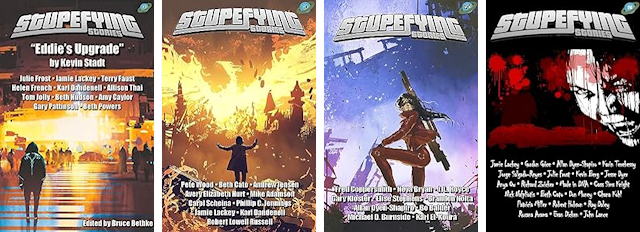


Have a Kindle? Find out what you’ve been missing!
Buy the four latest issues with just one click!

(Or buy just one, if that’s what you’d really prefer.)

Saturday, September 2, 2023

A Labor Day Memory • by Bruce Bethke


Welcome to Labor Day Weekend, the last full cup of summer. We here at Rampant Loon Press have been really busting chops for the last few weeks getting STUPEFYING STORIES 25 finished and released, THE PRINCESS SCOUT launched on Kindle Vella, and the FSPRC* back up and running again, but with all that work done and SS#25 now out and selling both on Kindle and in paperback and THE PRINCESS SCOUT already a Top Faved title on Vella, we’re going to kick back and take a well-deserved weekend off. SHOWCASE returns to its normal daily publishing schedule on Tuesday. Until then, I want to leave you with this little memory of what Labor Day means to me, personally. 

See you Tuesday,
Bruce Bethke
Stupefying Stories | Rampant Loon Press

* The FSPRC is the Fearless Slush Pile Reader Corps. Now that we are open to submissions again, we are also looking for a few new sacrificial victims eager recruits to help us pan for gold nuggets in the flowing slush stream. It’s not a job for everyone, but if you think you’d like to give it a try, let’s talk about it... next week, not now. I’m taking the weekend off.

_______________

Way back before the dawn of recorded time, my home town had a jobs program for disadvantaged youth that provided minimum-wage entry-level summer jobs in the city’s parks department. Despite our city's rather alarming poverty stats they could never find enough disadvantaged youths willing to fill all the budgeted positions, though, and so every June a second frantic call went out, for any high-school-aged kids willing to work in their local neighborhood park. This is how I wound up in the program.

It was, I will admit, a pleasantly stupid way to earn a few bucks over the summer. This was way back in time, before the advent of the ubiquitous “Would you like fries with that?” job, as well as (thankfully) before the invention of gas-powered weed-whackers or leaf blowers. So my crew worked outdoors most days, from 7:30 a.m. to 4 p.m., schlepping hoses, watering lawns, picking up litter, moving picnic tables around, and otherwise performing similarly arduous and intellectually demanding tasks.

One morning when we clocked in, though, our foreman told us we had a new challenge. The park had a bandshell, and our job was to assemble the temporary stage risers needed for the concert that night. He drove over to the bandshell—and I do mean drove, while we trotted along behind; I don't think I ever saw him get his fat carcass out of that golf cart or without a cigarette in his mouth all summer long—pointed to the backstage door, and told us the riser parts were inside and being a bunch of smart kids, we should be able to figure out how to put it together. Someone asked how long the job would take.

He said, “The union work rules say it takes a full crew four hours to assemble those risers.” Then he putt-putted off.

Four hours? Of course we took that as a challenge! We dove into it, found the rudimentary instructions, figured out how to assemble the thing—it was no mystery to anyone who’d ever played with Tinkertoys or an Erector Set—whipped it together in under an hour, and were just smug as could be when our foreman came back to check on our progress.

He took one look at it and said, “You did it wrong. Tear it down and do it over.” Somebody protested that there was no possible way we could have put it together wrong, but he repeated, “The union work rules say it takes a full crew four hours to assemble those risers. You obviously did it wrong. Now tear it down and do it over.” Then he putted off again.

Okay, maybe, just maybe, we might have missed something. So we disassembled the risers, and then, working carefully and double-checking our work every step of the way, we reassembled them again in about two hours.

When our foreman came back at lunch time to check up on us, he was furious. “You dumb @#&$^#s! Didn’t you @#($*&ing LISTEN? You did it wrong AGAIN!” Somebody tried to explain to him that we were sure we’d done it right this ti— 

“Listen to me! The union work rules say it takes a full crew FOUR hours to assemble those risers! Now you will @*&^ing well TAKE four @#*&ing hours to put those @#*&ing things together or I will @#@(#$*&ing @#(*& your @#^&*$ @#(*&es!"

Oh. Well, when you explain it that way…

We ate our lunches. Someone had a Frisbee. We threw that around for a while. Those that smoked, did. Me, I found a trashy pulp novel* someone had left on top of an electrical box backstage and read most of it. Along about 2:30 or so, some overachiever decided it was time to get going on the risers again, and we did—very slowly—such that we were just finishing it up when our foreman came back to check on us at about five minutes before quitting time.

This time when he looked at it, he was smiling. “Good job. I hope you boys learned something today.”

As a matter of fact, I believe I did.

—Bruce Bethke

______________

I think the book was Ten Years to Doomsday, by Chester Anderson and Michael Kurland. The cover art seems very familiar. A bunch of Medieval warriors in helmets and chain mail, armed with pikes and swords, are squaring off to fight against the who- or whatever is about to emerge from that huge silver Hugo Award-like spaceship that’s obviously just landed—

Except for one guy who is in the foreground to us but behind all the rest of the Medieval warriors, so they don’t see him. He has sheathed his sword, whipped out his BFG 9000, and is drawing a bead on the alien spaceship.

The story seems really familiar. I know it wasn’t The High Crusade, because I would have remembered that one. But the plot was the basic “people from Earth infiltrate Medieval-style society to jump-start their technological evolution so that they can fight the oncoming alien horde that is threatening the entire galaxy.”

If you can find a copy, you may find Ten Years to Doomsday to be worth a look. There’s no characterization to speak of, it’s just plot, plot, plot, plot racing along at breakneck speed, but the idea is pretty clever. An alien horde is coming. If they’re not stopped or slowed they’ll reach Earth in about ten years. The Terran Federation figures they need about 15 years to be ready, so they send a covert team to this planet that’s between Earth and the horde to get the primitive natives ready to fight a space war. The natives aren’t expected to win, or even to survive, they’re just expected to slow the alien horde down long enough to buy the Terran Federation the extra time it needs to be ready for the oncoming war.

Unfortunately, the primitive natives prove to be a little too intelligent and adaptable, and the covert team does its job a little too well. In the end, Earth’s meddling produces a space-faring war-ready culture that not only defeats the alien horde, it’s now ready to launch a full-on Crusade to bring their one true religion to the ignorant heathens in the Terran Federation.

Kinda makes me wonder if the authors of this book ever worked for the US State Department, or maybe the CIA.

Wednesday, August 16, 2023

Remembering the Future: 40 Years with “Cyberpunk” • by Bruce Bethke


“Cyberpunk” bookends my life. 

I’ve tried to ignore it, to turn my back on it and forget it, but its wires and filaments thread through and wrap around my life, and it keeps pulling me back inside. Here in the late summer of 2023, as we approach the 40th Anniversary of the original magazine publication of “Cyberpunk,” I can’t help but be philosophical about it, and perhaps even a bit maudlin. 

The other day a news article popped up in my feed, touting the newest Rocketbook Pro as being just the right new tech gadget for students this fall. In “Cyberpunk” I gave all my student characters a gadget that looked and behaved very much like a Rocketbook. When I wrote the story, I figured I was describing events set in a world that was about 40 years in the future. I’m pleased to see that the future is arriving right on schedule.

The question here for SF writers is: okay, posit that our students now all have Rocketbooks. We know what it’s designed to do and how it’s supposed to be used. Now, how will our characters misuse it, for things they aren’t supposed to do?

That, to me, remains the core question of cyberpunk. What makes a technology disruptive isn’t using it in the way the people who created it intended it should be used. Those people can only think of the right way to use a thing. The disruption comes later, when the people who grew up living with that technology start thinking of all the wrong ways to use it. When this happens, they come up with misuses the creators never dreamed might be possible, because the creators lack the fluency of someone who has grown up speaking the language of the thing.

So in 1980 I asked myself: in this bright and shiny high-tech future that’s coming in fast and hard, how are socially maladjusted younger people—let’s call them “punks”—living at the bottom of the socioeconomic food chain but possessing a technological fluency their elders can only begin to imagine, going to misuse this tech to rebel against society and get an edge over the eloi living above them?

Then I wrote a story that tried to explore one possible answer to this question. 

[Sidebar: Do I really need to explain again how between 1980 and 1982 this story was read and rejected by every short-fiction editor then working in SF publishing, and it most often came back with the standard, “Nice try kid, real close,” quasi-personal brush-off so often given to young and unknown writers who have written something good enough to make it all the way to the editor in chief, but whose name on the cover won’t sell magazines?]

Cyberpunk science fiction blossomed brilliantly and failed rapidly in the late 1980s to early 1990s, because the same thing happened to cyberpunk as happens to every other successful new thing in any branch of pop culture. At first it was a wonderful breath of fresh air into a stale and dying genre, as scores of new people with new talents and new ideas flooded into writing SF. Then publishers fixated on the commercial success of Neuromancer, and in a few short years cyberpunk fiction went from being something unexpected, fresh, and wildly original to being a trendy fashion statement—to being the flavor of the month—to being a hoary trope, complete with a set of stylistic markers and time-honored forms as immutable as an IEEE standard, to which one must pay heed if one is to write True Cyberpunk. It became, for the most part, Neuromancer fanfic, and the market was soon glutted with an enormous amount of “me too” work that copied the style of the genre’s pioneers but added nothing new to the vocabulary. 

Whereupon cyberpunk fiction, as a genre, suffocated on its own vomit and died. 

§

About ten years ago I wrote-up and shopped around a proposal for a book project I called Cyberpunk 2.0. My idea was that we were then coming up on the 30th Anniversary of the first publication of “Cyberpunk,” and it was time to toss out the original code base and start over. Cyberpunk fiction as I saw it was still stuck hopelessly in 1985, and still largely either Neuromancer fanfic, Blade Runner fanfic, or worse, anime and video game fanfic. It was all style, with nothing new to say, because it was based on the conceits, assumptions, and flawed grasp of technology of people who were working in genre publishing in 1980.

That book proposal obviously went nowhere, because, as I was told, either a.) cyberpunk was dead, or b.) rehashed 1985 sells very well, thank you. (And if you’ve ever read or seen Ready Player One, you must admit, the people who said that had a point.)

Then life overtook me, and I had far bigger things to worry about than a science fiction genre that was still preoccupied with 1985.

§

Now it’s 2023, and the 40th anniversary of the first magazine publication of “Cyberpunk” is fast approaching. It feels necessary to do something to mark the occasion, so right now we’re reading submissions for an all-cyberpunk issue of Stupefying Stories. No grand ambitions, this time. No book proposals. To do something like Cyberpunk 2.0 now would require either the backing of a major publisher, which I’m unlikely to get, or a Kickstarter campaign the likes of which I have neither the time, patience, or knowledge to run. Even if we were to start working on it right now, we couldn’t possibly have Cyberpunk 2.0 finished and released before the summer of 2024.

So a special issue of Stupefying Stories it is, then. And what I would truly, deeply, dearly love to see in my submissions inbox are at least a few stories that don’t try to recapitulate the 1980s vision of cyberpunk, but instead start fresh, from the baseline of now

The core notions of cyberpunk fiction remain. It’s an invitation to think seriously about ourselves, our society, and our relationships with our technologies. It’s an opportunity to consider how we interact with, and in turn are transformed by, the things we create. It’s a chance to cast a somewhat jaundiced and cynical eye on the near-term future and really think about what new technologies mean, not just for the lucky eloi living up in their shiny bright towers, but for we poor punks living down on the street. Cyberpunk fiction is an opportunity to get serious.

At least, I thought it would be.

Thus the meta-question: does cyberpunk in 2023 actually have anything new, original, and relevant to say, or is it a fossil form, forever trapped in the 1980s like an insect in amber? Has it become just another style?

I want to believe cyberpunk fiction still matters, but need to see proof that this is true.  

Ergo, it’s the 2020s. Technology and society have changed a lot in the past 40 years. Show me what you have to say that’s new.

__________________


Stupefying Stories 27 submission guidelines

Thanks for your interest. Stupefying Stories 27 is now closed to submissions.


__________________


In science fiction circles Bruce Bethke is best known either for his 1980 short story, “Cyberpunk,” his Philip K. Dick Award-winning novel, Headcrash, or as the editor and publisher of Stupefying Stories. What very few people inside the SF/F fiction bubble have known until recently is that he spent most of his career in software R&D, doing things that were fascinating to do but almost impossible to explain. What even fewer people have known is that he actually got his start in the music industry, as a composer, performer, and a member of the design team that developed MIDI, among other things, and he has an enormous repertoire of stories that begin, “This one time, this band I was in…” all of which are far too raunchy to tell in any medium his children or grandchildren might someday read.

Yes, he still has his 50-year-old cherry red Gibson SG with P-90 pickups, as well as his original 1971 ARP 2600, and he fully intends to get back to doing music, one of these days…


Have a Kindle? Find out what you’ve been missing!
Buy the four latest issues with just one click!

(Or buy just one, if that’s what you’d really prefer.)

Saturday, September 3, 2022

A Labor Day Memory • by Bruce Bethke


Welcome to Labor Day Weekend, the last full cup of summer. In honor of the holiday I am going to be mostly offline this weekend. Before I log off, though, I wanted to leave you with this little memory of what Labor Day personally means to me.

_______________

Way back before the dawn of recorded time, my home town had a jobs program for disadvantaged youth that provided minimum-wage entry-level summer jobs in the city’s parks department. Despite our city's rather alarming poverty stats they could never find enough disadvantaged youths willing to fill all the budgeted positions, though, and so every June a second frantic call went out, for any high-school-aged kids willing to work in their local neighborhood park. This is how I wound up in the program.

It was, I will admit, a pleasantly stupid way to earn a few bucks over the summer. This was way back in time, before the advent of the ubiquitous “Would you like fries with that?” job, as well as (thankfully) before the invention of gas-powered weed-whackers or leaf blowers. So my crew worked outdoors most days, from 7:30 a.m. to 4 p.m., schlepping hoses, watering lawns, picking up litter, moving picnic tables around, and otherwise performing similarly arduous and intellectually demanding tasks.

One morning when we clocked in, though, our foreman told us we had a new challenge. The park had a bandshell, and our job was to assemble the temporary stage risers needed for the concert that night. He drove over to the bandshell—and I do mean drove, while we trotted along behind; I don't think I ever saw him get his fat carcass out of that golf cart or without a cigarette in his mouth all summer long—pointed to the backstage door, and told us the riser parts were inside and being a bunch of smart kids, we should be able to figure out how to put it together. Someone asked how long the job would take.

He said, “The union work rules say it takes a full crew four hours to assemble those risers.” Then he putt-putted off.

Four hours? Of course we took that as a challenge! We dove into it, found the rudimentary instructions, figured out how to assemble the thing—it was no mystery to anyone who’d ever played with Tinkertoys or an Erector Set—whipped it together in under an hour, and were just smug as could be when our foreman came back to check on our progress.

He took one look at it and said, “You did it wrong. Tear it down and do it over.” Somebody protested that there was no possible way we could have put it together wrong, but he repeated, “The union work rules say it takes a full crew four hours to assemble those risers. You obviously did it wrong. Now tear it down and do it over.” Then he putted off again.

Okay, maybe, just maybe, we might have missed something. So we disassembled the risers, and then, working carefully and double-checking our work every step of the way, we reassembled them again in about two hours.

When our foreman came back at lunch time to check up on us, he was furious. “You dumb @#&$^#s! Didn’t you @#($*&ing LISTEN? You did it wrong AGAIN!” Somebody tried to explain to him that we were sure we’d done it right this ti— 

“Listen to me! The union work rules say it takes a full crew FOUR hours to assemble those risers! Now you will @*&^ing well TAKE four @#*&ing hours to put those @#*&ing things together or I will @#@(#$*&ing @#(*& your @#^&*$ @#(*&es!"

Oh. Well, when you explain it that way…

We ate our lunches. Someone had a Frisbee. We threw that around for a while. Those that smoked, did. Me, I found a trashy pulp novel somebody had left on top of an electrical box backstage and read most of it. Along about 2:30 or so, some overachiever decided it was time to get going on the risers again, and we did—very slowly—such that we were just finishing it up when our foreman came back to check on us at about five minutes before quitting time.

This time when he looked at it, he was smiling. “Good job. I hope you boys learned something today.”

As a matter of fact, I believe I did.

—Bruce Bethke

Tuesday, October 5, 2021

Family Matters (Reprise)


When I wrote “Family Matters” two weeks ago, it was not meant to be a standalone cri de cœur. The plan was to give it a few days soak time and then to jump into a series of very serious think-pieces on the general subject of how to balance the desire to be a writer with living life in the real world.

Then that plan went wildly off the rails, as has pretty much everything else in these past three months.

It’s a rare morning now when I manage to get into my office and get to work before noon. I have tried writing the next morning’s column very late the night before, but that doesn’t work for me. I am a different writer after dark, at the end of a long day. I am a much brighter, more imaginative, and more positive writer when I can do my writing first thing in the morning. The world doesn’t need to see who I am after midnight.

I also write better when I can have at least an uninterrupted hour or two to do so. I’ve known writers who could create while sitting in noisy, crowded coffee shops, cranking out paragraphs in 15-minute chunks of concentration. I’m not one of them. I need quiet time; focus time; development time: it’s probably why I always hated open office floor plans so much. They’re great for people with the attention span of a gnat but obstructive to doing any work that requires actual thinking. If the COVID pandemic ends up exterminating open office floor plans, it will have done humanity a great service.

Uninterrupted time has become very rare for me lately. In the past three months I’ve produced a lot of notes, fragments, and starts at things: “plans that either come to naught, or half a page of scribbled lines.” For example, today’s column was meant to segue from “Family Matters” into a serious discussion of the concept of Opportunity Cost as applied to writers.

However, time’s up. I instead need to click the Publish button right now and get on to my next urgent priority for this day.

To be continued...

—Bruce Bethke


Wednesday, September 22, 2021

Family Matters

“Cyberpunk” has been much on my mind lately, or more accurately, in my face. I’ve received the usual batch of fall semester queries from students writing papers, a few more requests from various publishers seeking reprint and/or translation rights—one of which was worth taking seriously, so I did, and I’ll have more to say about that book when we get closer to the publication date—and one request from an incredibly dedicated fan who had turned up a nice clean copy of the November 1983 issue of Amazing Stories and wanted me to sign it, specifically in the white space at the top of page 94.

Oh. That means I have to look at page 94 again.

Here, for your reference, is what the top of page 94 looks like. Note the introduction that George Scithers wrote nearly 40 years ago for the original magazine publication of the story. Please read it closely.


And now, the story that some of you have heard or read before, but most probably have not. 

___________________________

I no longer remember the name of the con. It was somewhere around thirty years ago and I want to say it was a WorldCon, but I really don’t remember. What I do remember is that I was with a bunch of other mid-list, mid-life, and mid-career pros, we were in the professional SF/F writer’s natural habitat—the hotel bar—and we were having just a great old time, drinking heavily and swapping divorce horror stories. My first wife, Nancy, had just kicked me out, changed the locks, and filed for separation, and to be honest, I deserved it. In those days I was Bruce Bethke, Semi-Famous Science Fiction Writer, and I was a real jerk.

What struck me at the time was how casually everyone there took the news. It was as if it was a rite of passage, or an occupational requirement, or perhaps even a milestone on the road to success. “Okay, you’ve just sold your fifth novel. Time for your first divorce.” “Ha ha, SFWA: we put the fun in dysfunctional!” Ben Bova gave me a signed copy of his book, Survival Guide for the Suddenly Single. The then-editor of the SFWA Bulletin asked me to write an article on how to protect your intellectual property rights in a divorce. A certain editor who shall remain nameless, assuming I was broke and desperate for cash, tried to talk me into a book deal, ghostwriting for a certain well-known media personality who had a burning desire to see his name on the cover of an SF novel but no actual time to write, knowledge of writing, or discernible writing talent. It was a wonderful evening of back-slapping camaraderie.

Later, when I sobered up, it began to disturb me. It wasn’t just that being a writer seemed to be toxic to marriage and family: it was how readily the writers I knew (and at the time, being on the SFWA board of directors, I knew hundreds of successful writers) accepted this toxicity. I realized I could count on my fingers all the writers I knew who had intact first marriages and functional families. By and large my peers were women whose cats were their surrogate children; women who had had one or two children with male gametes supplied by one or more long-gone donors; men who would never get married and father children because they just didn’t swing that way; or worst of all, really successful male writers who had been married, but were now perfectly content to let their children be raised by their ex-wife’s next man. Or woman. Or whatever.

That’s when it struck me. The problem wasn’t that being a writer is somehow toxic to marriage and family. It was a matter of selection bias. My peer group was composed of divorced SF/F writers because we were all, every one of us, people who believed it was more important to our careers for us to be there, at that con, drinking with our fellow writers and editors in a hotel bar, than at home with our wives and families.

This, in turn, explained a nascent trend I at first thought I was only imagining I was seeing. The world of SF/F—at least, the social, con-going, dedicated fandom part of it—was not just family-neutral, but in the process of turning actively family-hostile. And the problem wasn’t just with passing trends in genre fiction, or the idiosyncrasies of the current batch of editors who bought it, or the greedy bastard publishers who printed it. The problem was the writers.

¤

It was too late to save my first marriage. The best I could hope for was to try to have a good post-marriage for the sake of my daughters. Later I remarried, and added a step-son and another son to the family. I worked—really worked—at being a good husband and father, and quit going to cons, unless I could go with my family. The last major con we went to was Dragon Con, and we went as a family.

Emily would have loved Dragon Con. She grew up to be a costumer, a crafter, and a devoted fan of all things Harry Potter. We lost Emily in late September of 2009—suddenly, from a natural cause that was undiagnosed, unpredictable, unpreventable, and apparently had been waiting years for the opportunity to kill her.

People often ask why I don’t try to put together a complete collection of all my short stories from the 1980s and 1990s. That photo at the top of this column is the reason. Whenever I try to do it, I get as far as the introduction George Scithers wrote for the original magazine publication of “Cyberpunk” and then I grind to a stop. Other people look at my publication credits and see a bunch of short stories, some of them pretty good, some Nebula-nominated, some even world famous. What I see is all the time I stole from my daughters’ childhoods and all the damage I did to my first marriage, chasing the mirage of being Bruce Bethke, Semi-Famous Science Fiction Writer.

¤


A few people know that in 2010, when we went to Dragon Con, it was between the time Karen (my second wife) was diagnosed with breast cancer and the first round of what’s turned out to be an eleven-year odyssey of surgery, chemotherapy, radiation treatments, and then more of the same. Karen has beaten the odds so far: when she was first diagnosed she was told to expect that she had two more years, five tops, and eleven years later she’s still here and still in the fight.

What even fewer people have known until recently is that in December of 2012, my first wife, Nancy, was diagnosed with renal cell carcinoma. After a five-and-a-half year battle, she left this world in August of 2018.

For those of you who have asked why I don’t go to WorldCon anymore or why I really don’t give a crap about any of the many cat-fights and pissing contests that are forever going on inside the world of SF/F writing and fandom: seriously, are you kidding? You think that stuff is important?

¤


Thirty-eight years later, we know some of the answers to the questions George Scithers posed in his introduction to “Cyberpunk.” Nancy and Emily now sleep for eternity, side-by-side in a small churchyard cemetery in rural Minnesota.

As for me? You can’t fix yesterday. But you can learn from experience, and try to pass on what you have learned.

This was my experience. Learn from it.


Tuesday, September 7, 2021

It must be September...

It must be September. The geese are flocking up in the cow pasture and beginning to work out their migration formations. The cranes and egrets have already left. The vegetables in the garden are ripe and ready for harvest, some of the more highly stressed trees are already beginning to turn colors and shed leaves, and the first of this semester’s new crop of “Dear Mr. Bethke” messages have already begun to show up in my email inbox. 

There is a certain charmingly naïve sameness to them. “Dear Mr. Bethke,” they all begin, “I am a [academic major] student at [insert school name here] and I am writing a paper on…”

Don’t tell me! Let me guess!

Yeah, that’s what I thought.

Okay, “the time has come,” the Walrus said—or was it “Goo Goo G’joob?” I must confess now to not having paid nearly as much attention to walrus vocalizations over the years as I perhaps should have—

The time has come, to finish this damned book.

I’ve been puttering with this one for years. Never finishing it, because I’m not as interested in my own history as other people seem to be, but it’s time to admit that if I don’t finish it now, I probably never will. This book was always intended to be the definitive text of the original short story, as first published in Amazing in 1983; the complete text of the Baen-damaged novel that grew from the original short story and its cycle of sequels, some published and some not; and then a rather longish coda that explains how the story came to be in the first place, what went wrong with the novel, and then attempts to make some sense of what it’s meant to me personally to have spent the past forty years—forty! Holy Crap, where did the time go?—being known all over the world as “the guy who wrote ‘Cyberpunk’.”

The problem with this book has always been that the coda keeps growing beyond control, much like that anise hyssop patch in the northeast corner of my backyard. 

Ergo, the time has come. Let’s put a stake in it. Let’s finish this thing. This is your big chance: if you’ve ever had a question you wanted to ask me about the c-word, ask it now. Ask me anything. No question is off-limits, although I can’t promise I’ll answer. Ask me a really good question that provokes an interesting response and I’ll give you a shout-out in the Acknowledgements section.

Oh yeah, and you probably want to know how to contact me. You can either post your questions in the comments here, tag me on either the Bruce.Bethke or StupefyingStories facebook pages, or by email to brb [at] rampantloonmedia [dot] com. I suppose you could also post them on the Stupefying Stories Twitter thingie, but I can’t guarantee I’ll see it there. I continue to have a loathe/hate relationship with Twitter. 

So, ready? Then let’s get this thing wrapped up.

Thanks,
Bruce Bethke

Tuesday, August 31, 2021

Another day, another query


Waiting for me in this morning’s inbox…

Oh, never mind the details of it, it’s always roughly the same. Increasingly, my reply is becoming rote and reflexive as well.

“Dear [name redacted],

“Thank you for your kind words recognizing my contribution to popular culture and asking me to contribute [something that will take me some significant amount of time to do] to [your thing]. I appreciate your generous offer to reward me for my contribution to [your thing] with further recognition of my contribution to popular culture.

“Unfortunately, given that Chase Mortgage does not accept ‘recognition’ but instead insists that I make my house payments using ‘money,’ I’m afraid I must decline your offer.

“Sincerely,
Bruce Bethke”

_______________


Thursday, August 19, 2021

Status Update • 19 August 2021


Three weeks now since my wife was discharged from the hospital. Since then we’ve had an almost-constant stream of doctor’s appointments, follow-ups, hospital out-patient procedures, and various nurses and therapists parading in and out of the house, all while sticking to her every-eight-hours infusion regimen. I’ve gotten pretty good at handling the equipment and performing the procedure and can now do it without waking her. Still, it takes roughly an hour to prep, do the infusion, and clean up afterward, so there go three hours out of every day. 

I remain amazed by the sheer volume of plastic waste modern medicine produces. That’s something to factor into your next post-Apocalyptic novel. There will be a lot of people checking out in the first days after The End of the World As We Know It, as they won’t be able to get their perishable medications and disposable medical supplies. On top of everything else, because her meds must be kept in a carefully temperature-controlled state, each week we get a new one-cubic-foot Styrofoam cooler packed with the coming week’s supplies. I’m hanging on to all of the coolers, as in a few more weeks I figure I’ll have enough to pass on to the grandkids, and then they can play Minecraft in real life.

In the meantime, everything else here at Stupefying Stories and Rampant Loon Press is taking a back seat to the medical situation and I’m running on about 4~5 hours of sleep daily, so here’s a picture of a cat.

—Bruce Bethke

Saturday, June 5, 2021

Notes towards a manifesto • 3


In one of my recent web conferences I was asked, “What one piece of advice would you give to new writers?”

That one caught me a bit flat-footed. I tap-danced around the point and eventually gave my usual flippant reply, but seriously, I don‘t know that I can distill it down to one piece of advice. 

I have a lot of advice I could give, that I usually find it best to keep to myself. The reason is that it’s all based on my experiences as a beginning and developing writer in the land of long ago and far away, and that world doesn’t exist anymore. 

You, writing now, are trying to build your careers in a new world, one very different from the one in which I planted and grew my own writing career. For one thing, it is truly a world now, not just a single country on a single continent. 

When I was a short story writer in the 1980s, there were around a half-dozen genre magazines in the U.S. that paid “pro” rates to authors and sold around one hundred thousand copies each, every month. (The numbers were continuously in flux as new magazines were being launched and old magazines being put out of their misery all the time.) 

More significantly to me, it was overwhelmingly an American market. Due to the requirement that would-be contributors had to type and mail paper manuscripts to submissions editors, UK, Australian, and European writers were pretty much excluded from the American market, so there were far fewer writers competing for those publication slots. Editors couldn’t just stick to buying stories from well-known big-name authors, either. There simply weren’t enough well-known big-name authors writing new SF/F short stories to keep the magazine publication pipelines full…

Because all the well-known big-name authors were off writing novels, as that’s where the real money was.

The novel market then was very different, too. Back then there were at least a dozen major publishers with healthy lines of hardcovers and mass-market paperback originals, all competing for shelf space in the indie and chain bookstores. This led to a standard career progression almost every genre writer followed: 

  1. Write short stories until you break into the “pro” magazine market.
  2. Write and sell more short stories until you became a well-known name.
  3. Sign the standard “Rich & Famous” contract with a book publisher.
  4. Graduate to writing novels and never look back!

Again, this was overwhelmingly an American market. There was another world out there, of foreign publishers and translations and reprint rights and all that—and to tell the truth, there were years I made a lot more money off foreign translations and reprints than I did off new American sales—but still, the business of SF/F publishing was overwhelmingly an American genre.

But that’s all gone now.

So that’s the first piece of advice I would give to new writers. Never forget: it’s a world market now. 

...to be continued...

—Bruce Bethke

_________________________________________


SEX! DRUGS! ALIENS! ROCK ‘N’ ROLL! ALL THIS AND MORE FOR JUST $0.99, OR FREE FOR KINDLE UNLIMITED SUBSCRIBERS!

JIMI PLAYS DEAD

b/w “Buck Turner and The Spud from Space”

 Exclusively on Kindle  (for the moment)


Friday, June 4, 2021

Notes towards a manifesto • 2


In the process of learning how to run a small-press publishing company and produce a decently professional-looking product, it seems I’ve lost sight of a key detail. The original mission of Rampant Loon Press in general and Stupefying Stories in particular was to use the attention people wanted to pay to me, because of some stuff I wrote back in the 1980s and 1990s, to get them to pay attention to new writers who are up and coming now

To some extent we’ve succeeded. I do feel a certain pride whenever I see the name of someone who we were the first to publish, or one of the first to publish, now appearing on the cover of a major magazine, or on the shortlist for a major award, and or in a press release announcing their new novel. 

Along the way, though, I’ve neglected to continue to cultivate the Bruce Bethke® brand, and that plot has gotten a bit weedy and overgrown lately. The point was driven home to me during one of my recent web-ins to a panel at a con. Once the other people on the call realized who I was and what I’d done, the conversation pivoted—and for a few minutes it was fun, but then all the questions started to take on the form of beginning with, “Back in your day…”

The snark is strong in me. It took a great deal of willpower for me not to begin to answer questions like that with, “Well, kid, back in my day, we didn’t have those fancy-shmancy computers! We had typewriters! And slide rules! And we were happy to have them! We put men on the Moon with slide rules!

Actually, one of my best friends from high school (and my roommate for a year in college) now has some kind of post-PhD degree and works for NASA, doing AI. His software is still crawling around inside rovers on the surface of Mars. Back in “my” day we used to sit up till the wee hours, shooting the bull about the future and imagineering what might come from having real functional artificial intelligence, or at least the ability to get time on the mainframe to debug code without having to stay up until 2 AM to do it.

But why ruin a good story! Get off my lawn, ya whippersnappers!

There is a distinctly generational aspect to a writer’s career. At first we write to impress our parents and teachers, and we learn to write what pleases and impresses them. Later, when we get a little older and try to move out into the bigger world, we transfer this appeal-to-adult-authority sort of writing to editors and publishers, as we’re still writing to try to please and impress people older than ourselves, because they control the futures of our careers.

Later still, assuming the writing has been working, we shift over to writing to please and impress our contemporaries. This is usually where most writers’ careers peak, as we tell stories to amuse and impress our friends. Make no mistake, there is a great deal of success to be found in doing this.

But…

But, writers age. Our contemporaries fade away. The audience turns over, and shifts to becoming ever younger. Eventually you find yourself writing to please and impress people much younger than yourself, and it’s a challenge. They don’t speak quite the same language you do. They don’t have the same cognitive mappings. Things that you think are brilliant, clever, and profoundly meaningful are Dad Jokes to them. If you are really lucky, you can make the transition to being one of the adult authority figures whose approval they seek. 

For most writers, though, this is where the career peters out, and they wander off, muttering about diminishing sales, lack of publisher support, what’s the hell is wrong with the market these days, and how all the new stuff hitting the bestseller lists lately is total crap.

Creative careers—all creative careers, it doesn’t matter whether you’re a writer, an artist, a musician, or whatever—have three distinct stages. First you imitate. Then you innovate. Then, if you’re lucky enough to stick around that long, you can instruct. But what comes after being an instructor?

“I know!” my wife says brightly. “You become an influencer!”

Oy vey. Must I?

—Bruce Bethke

______________________________


While you’re pondering the answer to that horrible question, influence this!
Available now in paperback, on Kindle, and free for Kindle Unlimited subscribers!

Do you miss Firefly? Do you like The Expanse? If so, then The Privateers of Mars is exactly what you need. [...] Structured as three loosely interconnected short stories, it reads like three episodes of a great science fiction show that you wish someone would make.”

—Amazon reader review


Thursday, June 3, 2021

Notes towards a manifesto • 1


Truth be told, I don’t miss SF/F cons. I used to attend quite a few of them, not because I enjoyed the experience so much as because I felt it was a necessary thing to do to help promote my writing career. Doing a con always left me feeling drained, though.

At first I attributed it to the travel schedule, the late hours, and, let’s be honest, the drinking. Did you know that when you are a semi-famous science fiction writer, the fans will provide you with all the alcohol you can possibly drink? There was this one particular WorldCon where I ended up in a private party with a bunch of Japanese fans, who decided the author of “Cyberpunk” really needed to learn how to drink sake the right way, and he needed to keep practicing until he got the hang of it…

Decades later, the memory of my hangover the next morning still gives me a headache.

Eventually, though, after eliminating the drinking and trying to change all the other variables and still not fixing the problem, I came to the conclusion that it wasn’t the travel, the hours, or the overindulging: it was the con experience itself that I found exhausting. It was the having to be on, for hours on end and days at a time, all the entire while that I was at the con. 

My epiphany came when I once again found myself talking to a bunch of aspiring writers about how I made the transition from being a musician to being a writer, and how the great thing about writing fiction is that you don’t have to book a venue and rehearse and perform your stories. As a musician I loved working in the recording studio; I could spend hours in the studio trying to get the perfect three minutes down on tape and at the end of the session feel completely energized by the experience. But at the same time, I came to realize that I hated performing in front of a live audience, because no matter how well it went, the experience always left me feeling keyed up, while at the same time disappointed and drained.

Ooh. Little light bulb suspended in mid-air over head flicks on. When I’m at a con, I’m not being me. I’m on a sort of a stage, performing the role of Bruce Bethke®, Semi-Famous Sci-Fi Writer, for the duration of the con. That’s why I can never seem to get the con over with and get out of there fast enough. 

¤     ¤     ¤

There are introverts and extroverts, and people who land in all kinds of different places along the spectrum. Generally I’m an introvert, as are most writers, but I’m that odd duck that psychologists label an outgoing introvert. I can switch it on and fake being an extrovert, for a few hours, but the transformation burns a lot of energy and all too often I wind up waking up the next morning in the wolf pen at the local zoo, wondering how the Hell I got there.

So, here’s an unexpected benefit of the COVID-19 pandemic: it’s pretty much killed off the con scene. As an adaptation people have begun holding virtual cons, using various sorts of Internet teleconferencing software, and now that I’ve done a few of them, I find them a vast improvement. I’d be happy to do more.

Admittedly, as you can see from the photo, my current teleconferencing setup looks a bit… silly. I do have a really first-class HD web cam, but it hogs a lot of bandwidth. By putting this laptop on top of a stack of disused monitor stands I instead put the laptop’s good-enough camera at eye-level, thus avoiding that chronic crick in the neck I get whenever I have the laptop at desk height, and as an unexpected bonus I get remarkably good audio quality. I did a series of test recordings using various headsets—I have six or seven of them, I think—and was very surprised to find that I got the best voice quality from the laptop’s built-in mic. 

Hmm. Maybe I don’t need to buy that USB mic I was eyeing up after all. Darn. I love new toys.

¤     ¤     ¤

My most recent virtual meeting was with the Chalk Scribblers, a writer’s group based in London, and it was done using Google Meet, a platform I’d not used before but that I found worked much better than Zoom. I had an interesting time, and they asked a lot of good questions, some of which caught me flat-footed and thus remained stuck in my mind and provoked further thought. For example, one writer asked if I had any suggestions for how to maintain a work/life balance.

Honestly, that’s something I’ve never been much good at. I’ve always been a sort of work/work person, who has a great deal of trouble switching off Bruce Bethke® long enough to just relax and enjoy life.

And that, as I thought about it more, became my suggestion: 

Throw out all that stuff you were taught in school about finding your “inner voice” and expressing the real you and all that. Adopt a pseudonym. View your writing career as a piece of performance art. Perform the character of Famous Writer You®. Create a strong barrier between Writer You and Real You, so that you can stop performing that character 24x7.

Remember, Writer You is a greedy parasite, and if you don’t find a way to keep it safely sealed up inside a terrarium, eventually it will devour all of your time and energy, leaving nothing left for anyone else in your life. 

Submitted for your consideration,

—Bruce Bethke

_________________________________________


SEX! DRUGS! ALIENS! ROCK ‘N’ ROLL! ALL THIS AND MORE FOR JUST $0.99, OR FREE FOR KINDLE UNLIMITED SUBSCRIBERS!

JIMI PLAYS DEAD

b/w “Buck Turner and The Spud from Space”

 Exclusively on Kindle  (for now)


Friday, May 28, 2021

Ask Dr. Cyberpunk • with your host, Bruce Bethke


In lieu of a column, an invitation: why don’t you join me this evening at Balticon 55, where I will be talking (briefly) about—well, whatever it is the audience wants to talk about.

Balticon 55 is a virtual con this year, so admission is free, but you do need to pre-register if you want to attend any of the Zoom sessions. If you have the time I recommend it, as there are loads of good things on the con schedule: https://schedule.balticon.org/

I’m booked for the Cyberpunk Open Discussion, which starts at 7pm EDT, 6pm CDT, 4pm West Coast time—sorry, Kevin, I have no idea what the start time in Seoul would be; it’s already Saturday over on your side of the planet, isn’t it?—and to pre-register, all you need to do is click this link:

https://balticon-org.zoom.us/meeting/register/tJcqceqoqj8tE9L37tY-C5HEvSqn32gvo8SZ

Come on! Join me! It’ll be fun!

~brb

Tuesday, May 25, 2021

Heads-up: Balticon 55


I’ll be putting in an appearance at Balticon 55 this coming Friday, 5/28—by Zoom, of course, as this year it’s an online-only con. Attendance is free for anyone who wants to attend, but it’s my understanding that you need to register in advance in order to get into the Zoom sessions.

The main link for the con is here: https://www.balticon.org/wp55/

The program guide is here: https://schedule.balticon.org 

I’ll be posting more information about my schedule when I know it. In the meantime you might want to do a bit of browsing through the schedule, as there are some panels that are of interest to writers, and Stupefying Stories contributor Jennifer Povey will be doing a reading. 

(Drat. SS#19, which contained her story “Soulless Machine,” is out of print. I really liked that one.)

More info to follow as it becomes available. 

—Bruce Bethke

UPDATE: It looks like this is the advance registration link:

https://balticon-org.zoom.us/meeting/register/tJcqceqoqj8tE9L37tY-C5HEvSqn32gvo8SZ

Wednesday, June 12, 2019

Discovered entirely by accident...

...while trying to figure out why we can’t sell print books in Australia:

1. That Stupefying Stories #1 is now a valuable collector’s item selling for a ridiculous amount of money.

Link: https://www.amazon.com/dp/B01LP7K1BO

(Psst. We still have a crate of copies in the warehouse. Anyone want one?)

2. That Maverick is now a valuable collector’s item, which I guess makes a form of sense, as the Asimov estate recovered the rights to the Robot City books in the BPVP bankruptcy settlement and did so for the express purpose of taking them out of print, as they were “diluting the value of the Isaac Asimov™ brand.”

Link: https://www.amazon.com/gp/product/0441731317

(Ignore the grumpy 3-star review written by someone who apparently was surprised to discover that these books were not written by Isaac Asimov, but were a YA series created with Asimov’s approval and written by a cadre of writers who were required to stick to a strict series bible. The lead characters were supposed to be petulant and childish. Didn’t this guy ever read any of Asimov’s “Paul French” novels?)

3. That Maverick was also released in French- and Spanish-language editions, neither of which I was ever paid for. Sigh. Too late now.

4. But this is the important thing I discovered; this review of Stupefying Stories #1, which I will gladly own.
Christopher O'Neil 
5.0 out of 5 stars
A lovely dead-tree volume
11 February 2018 - Published on Amazon.com
Verified Purchase
Just catching up with Stupefying Stories after their Kindle give-away stunt last week. Curiously, I HAD already read "It Came From the Slushpile" because as a fan of John Betancourt's Wildside Press, I'd read the two-fisted "Swashbuckling Editors Tales."

This two-column illustrated digest-sized hard copy is a delightful companion to my hundreds of the real pulps from the '40s, '50s, etc.; just a nice physical souvenir, considering the real mag is all ebook. If I ever meet him, maybe Bethke will autograph it "Rex Manly."
Why, warms my cold and leathery editor’s heart right up, it does.