Showing posts with label Six Questions for.... Show all posts

Tuesday, November 19, 2024

Six Questions for… Carol Scheina


Carol Scheina is a deaf speculative author whose stories have appeared in publications such as Flash Fiction Online, Escape Pod, Diabolical Plots, Stupefying Stories, and others. Her writing has been recognized on the Wigleaf Top 50 Short Fiction Longlist, and she has become a fan favorite here for her finely crafted flash fiction pieces on the Stupefying Stories website. You can find more of her work at carolscheina.wordpress.com.

What we haven’t mentioned much is how crucial Carol has been behind the scenes here, for all her help with The Pete Wood Challenge, The Odin Chronicles, and Tales from the Brahma. Therefore, this seemed like a good time to catch up with Carol and ask her our usual batch of half-serious, half-silly questions, and point you towards some of her stories on our site.

§    §    §

SS: What is the first SF/F book or story you remember reading?

CS: My parents let me read whatever was on their bookshelves, and when I was five, my eyes gazed at books by Ian Fleming and James Clavell… King Rat sounded like such an interesting title, but all the long words clumped together in a tiny rat-sized font, so I put that one back. (Now that I know the subject matter of that book, I’m rather glad I didn’t read it at age five!)

I discovered a book that was easy to read for my young eyes and had lovely illustrations to boot: The Tin Woodman of Oz. It was an old paperback book with a musty smell behind its bright yellow cover. In those pages, I followed the adventures of the Tin Woodman over and over.

Eventually, my parents took me to the library so I could give the old Tin Woodman book a rest before I read it to pieces. On the library bookshelves, I found other books in the Oz series, and as I grew older, I jumped into stories by Madeline L’Engle and Robin McKinley. There were always new magical worlds to visit.

I’ve never stopped reading fantasy, and I’ve been known to return to those old books that captured my young imagination. On my bookshelf now rests my parent’s copy of The Tin Woodman, and the musty pages still bring a smile to my face.

SS: When you write a new story, are you a plotter or a pantser?

CS: I generally consider myself a panster. I like to start out every story with a plan, and I handwrite outlines and ideas in a notebook. I even scribble out rough first drafts so when I sit down in front of a computer, I can start typing right away.

In the process of typing, I’ll get ideas on how to make the story better, and I veer more into pantser territory. The ending will change, or I’ll figure out a really neat twist that I want to incorporate. But I can’t get to that point without a plan to get me started in the first place.

SS: What is your favorite beverage to drink while writing?

CS: I’m a tea drinker, and every morning, I brew a pot. Then I may brew another pot in the afternoon. Not surprisingly, I always need to work near a bathroom. Still, there’s something wonderfully relaxing about writing with a steaming cup of tea with sugar and milk nearby.

SS: How do you balance writing vs having a life?

CS: I have young kids, and I love watching them grow and discover their passions. Because my kids take top priority, I look for the moments in-between their adventures, and that’s where I find my writing time. Maybe it’s in the time spent waiting for my child to race at the swim team meet, or in the hour-long drive to an activity. It may be five minutes here, 30 minutes there. I always have a little notebook and pen with me so I can scribble story notes and ideas no matter where I am. Then there’s that glorious hour between 9 p.m. and midnight, when I can be found typing the story up.

SS: What feels like your best natural length for a story?

CS: I’m very partial to flash fiction, which is funny because my earliest attempts at writing fiction were novels. I started my fiction journey with National November Writing Month, progressed to short stories, then to flash. At first, it was my lack of time that drew me to writing shorter, but I quickly realized that shorter isn’t faster or easier! My first attempt at flash ended up being 5,000 words long.

I kept trying my hand at flash, though, as it was one of my goals to be published in Daily Science Fiction. Once I met that goal, I found that I really enjoyed the challenge of writing flash fiction and kept at it. It now feels like my most comfortable story length. 

I also feel like it’s made me a better writer. It’s taught me to look at word choices closely, whether side plots are actually beneficial, and how to identify the heart of the story, among other things.

SS: Is there an author whose work you think has been unfairly overlooked or forgotten? 

CS: I feel like the authors of short stories need more exposure, and I’m not just saying that as a short story author myself. There are speculative writers experimenting with stories and genres in ways you don’t see with novel-length stories, and I’m continually finding myself blown away by the talent out there.

One of the first flash fiction rock stars I followed was Melissa Mead, who was a frequent contributor to Daily Science Fiction and has also been published here at Stupefying Stories. She twisted fairy tales and tackled sci-fi concepts with wit and imagination. I’d read her stories and think, “Dang, I want to write like her.” Melissa passed away in 2022, but her stories still live on to entertain us. I highly recommend going to the Daily Science Fiction website and searching for Melissa Mead. There’s a treasure trove of her tales there!

§    §    §

Speaking of a treasure trove, in preparing this profile for publication we decided to put together a short list of Carol’s stories on this site, and were genuinely surprised by just how many there are. Rather than a short list, then, here’s every (we think) story by Carol Scheina we’ve published in the past three years.

If you read nothing else by Carol, read this:

“Exploring Strange New Worlds with a Hearing Loss”

Our favorite fiction by Carol

“How to Return an Overdue Book to the Summer Library”

“The View from the Old Ship”

“True Love is Found in the Bone Sea” 

“Of Myths, Legends, and Parenthood” 

“The Disappearing Cat Trick”

“Monthly Magic Subscription Box”

“Inheritance”

Pete Wood Challenge Stories

“Would You Like Fries With That?”

“Long-Distance Relationship”

“The Family Business”

“Just Like Before”

“The Secret to a Happy Marriage”  

“Clowning Around”

“Secondhand Hugs Still Have All the Warmth”

“The Difficulty of Disembarking”

“To Boldly Go”

“For Sale: Used Time Machine. No Refunds!”

“The Santa Heist”

“Don’t Ignore Your Television’s Captioning”

“A Conversation Held at the Annual Meeting of the National Association of Butler Assassins”

“Proper Witch’s Home”

Tales from The Brahma Stories

“A Palette of Home”

“Just Like Mama Made”

The Odin Chronicles Stories

“Delayed Messages”

“Love and Groceries”

“The One Who Walks Out”

“The Disappearing Cat Trick”

“An Infestation in the Mines”

“A Time to Wait”

“The Same Bratwurst Every Day”


The Pete Wood Challenge is an informal ad hoc story-writing competition. Once a month Pete Wood spots writers the idea for a story, usually in the form of a phrase or a few key words, along with some restrictions on what can be submitted, usually in terms of length. Pete then collects the resulting entries, determines who has best met the challenge, and sends the winners over to Bruce Bethke, who arranges for them to be published on the Stupefying Stories web site.

You can find all the previous winners of the Pete Wood Challenge at this link.

REMINDER: There is another Pete Wood Challenge that is open for submissions right now. For details and how to enter, click this link.


Tuesday, November 12, 2024

Six Questions for… Gretchen Tessmer


Gretchen Tessmer lives in the deep woods of the U.S./Canadian borderlands. Her short stories and poems have been published in many places, including Nature, Beneath Ceaseless Skies, Bourbon Penn, and Fantasy & Science Fiction (and Stupefying Stories, of course!).

Gretchen’s poetry has been nominated for Rhysling, Dwarf Stars, Best of the Net and Pushcart prizes, and she recently edited Eye to the Telescope 53, on the theme of “Strange Mixology,” which, in her completely biased opinion, is wonderful and you should read it, too.

Gretchen is a relative newcomer to Stupefying Stories, who came in here (as so many new writers do) by way of the Pete Wood Challenge, with “Two All-Meat Zombies,”  “My Fair Claritin Lady,” and the gold-medal winning story from which we lifted the above illustration, “Ivy’s Tower.”

Recently we had the chance to catch up with Gretchen, and ask her our usual batch of half-silly, half-serious questions.

§   §   §


SS: What is the first SF/F book or story you remember reading?

GT: I’ll give you two, one from my sci-fi shelf and the other from fantasy. So in third grade, when they first gave us library cards, I went straight for A Wrinkle in Time. No idea why. Loved the names Mrs. Whatsit, Mrs. Who, and Mrs. Which, even if I didn’t really understand anything of what those eccentric old ladies were saying. Loved Meg and Cal and Charles Wallace. Had almost zero idea of what was going on plot-wise because I was eight years old and it was about four years beyond my reading comprehension. But I revisited it later and it was wonderful. Still one of my favorites.
First fantasy was The Magician’s Nephew, and I stand by the opinion that it’s the best (if most overlooked) of the Narnia books. The Pevensie children are great, but Polly and Digory are so much better. And there's a wood between worlds, and pond portals, and magic rings, and crazy Uncle Andrew, and crazier Jadis, and the deplorable word, and the friendly cabby and his wife, and Fledge the Pegasus formerly known as Strawberry, and…

SS: Of everything you’ve had published, which book or story of yours is the one you are most proud of? Where can readers find it?

GT: I’m very happy with “Oslo in the Summertime,” which was published in Bourbon Penn 29. I'm also proud of “See You On the Other Side,” which originally appeared at The Arcanist but was recently republished in Small Wonders, because time travel is tricky and I think I (almost) pulled it off. To be honest, my mini-zombie story (“Two All-Meat Zombies”) and my outpost story (“Ivy’s Tower”) here at Stupefying Stories are a good sampling of my work, even at under 100 words, because I think they succinctly show the two sides of my preferred storytelling. 

For poems, I’ll choose “Hey Man, Nice Shot,” at Strange Horizons. Yes, both “Oslo in the Summertime” and “Hey Man, Nice Shot” are shamelessly stolen (ahem, borrowed) from song titles. But, in my defense, they are both really good songs.

SS: Is there one story you’ve published that you wish you could call back and make disappear?

GT: Haha, not really. I mean, some of my early poems are ridiculously melodramatic (but most of those are hidden away in old college magazines and I’m not telling which) and yeah, I think we all look back and cringe at old habits sometimes. But the older I get, the more I find myself cutting the younger writer-girl-me slack and just enjoying the growth and change in my style. And because I’ve been publishing poetry consistently-ish since I was 18 and I’m now approaching [redacted for extra mysteriousness], the poems act as little bread crumbs of my life events and memories through the years, some lovely, some painful, but I really don’t think I'd want to lose any of them.

SS: If you had a theme song that played every time you came into a room, what would it be?

GT: “Short Skirt/Long Jacket” by Cake. Except that I’d never change my name from Kitty to Karen and my voice isn’t as dark as tinted glass. But my fingernails definitely shine like justice.

SS: If you could have just one mutant superpower, what would it be?

GT: I’ll take whatever superpower makes having all the other superpowers superfluous. The old-time Elder magic, the Tom Bombadil and Goldberry style of living, where you’re in the story but not part of it. Where you just hang out on the porch steps in the lazy afternoon, drinking tea or smoking a pipe, and going “hmm, I wonder what’s up with those storm clouds around Isengard?” When you can flip the One Ring into the air, make it disappear, make it reappear and spin it on the kitchen table with a long-suffering sigh, you’ve won the game. So yes. Baking pies, singing songs, tending gardens, washing dishes, and scolding willow trees who wake up too early. This is the life for me.

SS: If you could snap your fingers and make one cliché, trope, or plot gimmick vanish, which one would it be?

GT: The Jon Snow of it all (I just don’t like obvious chosen ones)…unless he turns out to be an actual nobody (or alternatively, Meera Reed ends up as his secret twin and the true chosen one all along), in which case, that could work for me.


§   §   §


The Pete Wood Challenge is an informal ad hoc story-writing competition. Once a month Pete Wood spots writers the idea for a story, usually in the form of a phrase or a few key words, along with some restrictions on what can be submitted, usually in terms of length. Pete then collects the resulting entries, determines who has best met the challenge, and sends the winners over to Bruce Bethke, who arranges for them to be published on the Stupefying Stories web site.

You can find all the previous winners of the Pete Wood Challenge at this link.

Challenge #36 has been issued! The deadline to enter is December 1st! To learn what the challenge is this time and how to enter the contest, click this link. 


Friday, November 1, 2024

Six Questions for… Robert Lowell Russell


Robert Lowell Russell (a.k.a. Rob, Dad, that weird dude) lives with his family in southeastern Ohio. He’s a former cardiac nurse, and currently manages continuing education events for nurses and osteopathic physicians. He’s had more than fifty short stories published over the years, and we’re pleased to have published a number of them.

Rob’s first appearance in our pages was one of the funniest stories we’ve ever published, “Elves Are Douchebags,” which you’ll find for a little while longer on the original SHOWCASE web site. Read it now. He followed that up with “Here There Be Monsters?” the story that put “reptile dysfunction” into our vocabulary and introduced us to, well…

“We’re experimenting with meta-bullying,” a girl explained. “We think if we plant certain words often enough in the media, people will be afraid without even really knowing why.”     
Brilliantly prescient, I think.

In last week’s deep dive through our old archives I found another of his stories, “Best in Show,” on our short-lived and unlamented “crevasse” site, so named because it was all pale blue and white, and stories fell into it, never to be seen again. If you like stories about cats, and especially stories about cats behaving very badly, you really need to read Rob’s play-by-play of the 2028 CFA World Cat Spectacular competition. Read it now

In 2017 Rob got the cover of Stupefying Stories 16 with “I Live the Warrior’s Life,” a truly badass piece of contemporary fantasy that proved he wasn’t just a humorous writer. Sadly, SS16 is out of print now, but this story is on the shortlist for Stupefying Stories Presents: Heroes, a reprint anthology we’re hoping to get out in Q2 2025. 

Most recently, Rob’s story, “Days of Love and Loss: A Prologue to the Cat-borg Apocalypse,” capped off Stupefying Stories 24, and if you haven’t read it yet, you’re missing a real treat. Stupefying Stories 24 is free on Kindle Unlimited, so if you have a KU subscription, you owe it to yourself to check it out. 

With all this as history, this seemed like a good time to catch up with Rob and see how he’s doing. Here we go!

§

SS: What is the first SF/F book or story you remember reading?

RLR: My first exposure to speculative fiction was when my mom read The Hobbit to me and my younger brother. Later, when I was in the second grade, she started reading The Chronicles of Narnia to me, but I got impatient with her pace and started reading the series on my own. I haven’t stopped reading since. Thanks mom!

SS: Who was your most significant influence? 

RLR: By far, the biggest influence on my writing has been Glen Cook, particularly his Black Company and Garret P.I. series. I enjoyed Cook’s first-person narratives as well as his humor. I emulated his style when I was first starting out, and I’ve frequently adapted my own humor into my writing.

SS: When you write a new story, are you a plotter or a pantser? 

RLR: I’ve always been a pantser when it comes to writing short stories because I can usually keep all the story elements in my head and get them down intact. However, trying to be a pantser with some of the novels I’ve started has gone… poorly.

SS: If you could change one thing about the way you write, what would it be? 

RLR: I’d like to be able to blast out a novel and not worry about its quality before making revisions, but I tend to revise as I go, leaving the first parts of my projects polished, and the latter parts a jumbled, unfinished mess.

SS: How do you balance writing vs having a life? 

RLR: I wrote most of my short stories while I was going to nursing school. I found that I could squeeze out a new short story between my studies and exams as a way of taking a break. Now that I’m working full-time (though thankfully without the crazy hours and crazier patients, in my current role), I find it harder to write new things and not have it feel like extra work. I guess I’m still figuring out that whole writing/life balance thing.

SS: What's next for you? What are you working on now? 

RLR: My fiction writing has tapered off considerably over the last few years. I have a half-finished, middle school-level humorous novel I’ve been sitting on for years now. I’d like to actually finish it (after doing some necessary plotting instead of trying to pants it) and then run it by the writers group that was so helpful to me when I first started writing. If that plan works out, I’d like to see if I can get my first novel published. It’s all fame and fortune after that, right?

§

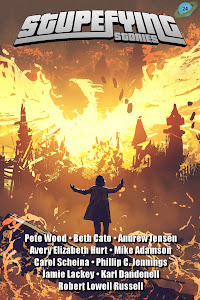
While we’re struggling not to die laughing at that last sentence, you should take a moment right now to check out Stupefying Stories 24. SS24 features:

  • Pete Wood - "Birds of a Feather"
  • Beth Cato - "Monsters of the Place Between"
  • Andrew Jensen - "Running Away with the Cirque"
  • Avery Elizabeth Hurt - "Sanctuary"
  • Mike Adamson - "Last Stop Paradise"
  • Carol Scheina - "The Burning Skies Bring His Soul"
  • Phllip C. Jennings - "Mother's Day"
  • Jamie Lackey - "The Gentlepeople"
  • Karl Dandenell - "Krishna's Gift"
  • Robert Lowell Russell - "Days of Love and Loss: A Prologue to the Cat-borg Apocalypse"

 Get it today!

Thursday, October 24, 2024

Six Questions for… Pete Wood


Pete Wood
is an attorney from Raleigh, North Carolina, where he lives with his kind and very patient wife. His first appearance in our pages was “Mission Accomplished,” in the now out-of-print Stupefying Stories #6. After publishing a lot of stories with us he graduated to becoming a regular contributor to Asimov’s, but he’s still kind enough to send us things we can publish from time to time, and we’re always happy to get them.

For the past few years Pete has been in the process of evolving into a fiction editor, God help him, first and foremost with The Pete Wood Challenge, then with Dawn of Time, The Odin Chronicles, Tales from The Brahma, and on, and on. Along the way he’s introduced us to the creative work of Roxana Arama, Gustavo Bondoni, Carol Scheina, Patricia Miller, Kimberly Ann Smiley, Kai Holmwood, Brandon Case, Jason Burnham, and many, many more. We suspect Pete’s real love is theater, though, as evidenced by his short movie, Quantum Doughnut — which you can stream, if you follow this link.

[Pete Wood photo by Lee Baker]

With all the attention we’ve been paying to The Pete Wood Challenge lately, this seemed like an opportune time to catch up with Pete and ask him our usual batch of half-serious, half-silly questions.

§

SS: What is the first SF/F book or story you remember reading?

PW: That’s tough. I used to go to the bookmobile a couple of times a week and check out fairy tales when I was in first or second grade. Then I moved onto fantasy and science fiction. The first science fiction book may have been Danny Dunn, kid genius who developed all sorts of cutting edge technology from time machines to shrink rays. Or it may have been a paperback novelization of the 1960s television show, The Time Tunnel. I remember reading The Wonderful Flight to the Mushroom Planet in fourth grade. A bunch of us did. The first serious science fiction book that really stuck with me might be The Infinite Worlds of Maybe, by Lester Del Ray, or the story “Frost and Fire,” by Ray Bradbury. [Nb: You’ll find that one, along with a lot more stories that are iconic now, in Bradbury’s R is for Rocket.]

 SS: When you write a new story, are you a plotter or a pantser? 

PW: I’ve always been a pantser. I develop the characters first and then a concept and let the characters lead me where they want to go. My last two novellas have been heavily plotted with the characters thrust into the plot after the fact. That’s a tougher way to write, I think, because the characters can’t act naturally if their fates have already been predestined.

SS: Of everything you've had published, which book or story of yours is the one you are most proud of? Where can readers find it? 

PW: “The Less Than Divine Invasion,” published in the January/February 2023 issue of Asimov’s. This story took ten years to write. It started out as a novel and ballooned up to 40,000 words before I had to admit it just wasn’t working. I cut it back to 18,000 eventually. I had to massacre my darlings, but I think it ended up being a damned good story. It’s about an incredibly ill-conceived (and I hope reasonably comical) alien invasion that starts in a small town in North Carolina.

SS: Do you listen to music while writing? If so, what kinds of music or which artists? 

PW: I listen to albums or just a mix of certain artists. Back in college, I put on the Moody Blues LP of Days of Future Passed to write. That’s still an option, but my new favorite is probably Making Movies by Dire Straits. Kinda mellow, kinda profound and never too intrusive. A good Steely Dan mix is nice too.

SS: What feels like your best natural length for a story? 

PW: Flash. I love a good flash story. I can crank out a flash piece in an hour or so if I am lucky. You can pack a lot into flash if you try. I have a lot more respect for decent flash than stories or (God help us) novels that run on forever and have endless sequels. That’s why I love doing the Challenges for Stupefying Stories. The diverse takes on the prompts are fun and fascinating.

SS: If you could snap your fingers and make one cliché, trope, or plot gimmick vanish, which one would it be? 

PW: Sexism. I find it just depressing that so many golden age stories and novels have no female characters. In so many, the women are window dressing or sex objects. I gave up a third of the way through Stranger in a Strange Land, because Heinlein didn’t have a clue what women are like. Sadly, there’s still a lot of sexism going on. Women characters and authors have much more of a voice, but we still haven’t gone nearly far enough.

SS: Thank you for your time, and just in case we haven’t plugged it enough, here’s the link to every Pete Wood Challenge story we’ve published so far. There are more than 200 stories in this list, all free to read for the cost of a click on a link. Check it out!

The Pete Wood Challenge Story Index (So Far)


Heads up: from Sunday, October 27 to Thursday, October 31, Stupefying Stories #26 will be FREE on Kindle. You don't even have to be a Kindle Unlimited subscriber, it will just plain be FREE on Kindle for those five days. For those same five days we will be running a variety of discount deals for Stupefying Stories #23, #24, and #25. 

Tell your friends. Remember, likes are nice, but shares and retweets boost the signal.


Tuesday, October 1, 2024

Six Questions for… Brandon Nolta

Brandon Nolta
is a northern Idaho-based writer, editor, recovering computer mechanic, professional curmudgeon, and SFWA and Codex member. His fiction, poetry, and other scribblings have appeared in Stupefying Stories, The Pedestal Magazine, Amazing Stories, Tree and Stone, and a cacophony of other publications.

Brandon has been a staunch supporter of Stupefying Stories since so far back, we have trouble putting a date on it. His first appearance in our pages was “Aleph,” in the now out-of-print Stupefying Stories 12

His next appearance was “Memento Mori,” on the original SHOWCASE web site. 

(Which site is scheduled to be decommissioned soon, so read it while you still can!)

His most recent appearance in our pages was the outstanding steampunk adventure short story, “Cloudbreaker Above,” in Stupefying Stories 25, which almost made it up to being novelette length, but Brandon had too much integrity to pad his story out by a few pages and possibly bump it up into a less-competitive awards category.

Stupefying Stories 25 is free for Kindle Unlimited subscribers. You really owe it to yourself to check out  “Cloudbreaker Above,” especially when you can read it for free.

Brandon also has two books on our F.O.S.S. list: a Weird Western with a very different twist, Iron and Smoke, and a collection of short stories, These Shadowed Stars, that moved one reviewer to say, “Anyone can see that Nolta is up there with Bradbury, Vonnegut, Harlan Ellison, and Thomas M. Disch.” Brandon has another short story collection, No Refuge, coming soon from Montag Press, so with all this going on, it seemed like a good time to catch up with him and ask him our usual batch of half-serious, half-silly questions.

§

SS: What is the first SF/F book or story you remember reading? 

BN: It depends on how you define the genre, but the first book I can definitively name was The House with a Clock in Its Walls, by John Bellairs. I was probably in second grade when I came across that one; the young me was very much into horror, so the general vibe of Bellairs’ novel was right up my alley.

SS: When you write a new story, are you a plotter or a pantser? 

BN: Pantser, no doubt. I can plot a story from beginning to end, and I have done that on occasion, but the stories that I found most satisfying to write almost uniformly came from a central idea or image and working backward from that. I started what turned into my novel Iron and Smoke with the image of a man walking through the Western wastes, and along the way of figuring out why this guy was walking through the desert without a horse of any name, I found a story that threw together magic, 19th century American history, terraforming, and various eldritch things.

SS: Of everything you’ve had published, which book or story of yours is the one you are most proud of? Where can readers find it? 

BN: I’m definitely thrilled to have my novel Iron and Smoke out in the world, if for no other reason than I demonstrated to myself that I was able to write a novel, something I wasn’t sure I had in me. Whether it’s any good or not is a different question, and if I were writing it now, I might have taken a different approach to certain aspects, but I feel like it’s a good representation of where I was as a writer when I wrote it. It’s available from Amazon, B&N, and probably a few other online booksellers, if any are left

SS: Do you listen to music while writing? If so, what kinds of music or which artists? 

BN: I listen to music damn near all the time, including when I’m writing. If I’m having trouble focusing, I might switch over to instrumentals, usually jazz, classical, or even New Age. Most of the time, though, I’m listening to what I generally listen to, which is a mix of classic rock, Americana, electronic (Underworld has been getting a lot of play on my Spotify account lately), metal, and 80s/90s pop and alternative. Sometimes I can even find some writerly inspiration in the music; James McMurtry and Joni Mitchell are particularly good on that score.

SS: If you had a theme song that played every time you came into a room, what would it be?

BN: Most of the time, “The Intro and the Outro,” by the Bonzo Dog Band. On a good day, “Pharoahs,” by Tears for Fears.

SS: In regards to your story, “Cloudbreaker Above,” is there anything special you’re hoping readers will notice or appreciate in it? 

BN: I would be tickled if readers saw the distant roots of the story I was thinking about when I wrote “Cloudbreaker Above,” although it would probably take an act of actual telepathy to see the line from Jack London’s “To Build a Fire” to my story. It wasn’t a thematic connection in my mind as much as it was the “one damn thing after another” nature of the plot. Of course, things worked out differently for Chernin than for London’s protagonist, unless you’re reading the 1902 version of that story (I had the 1908 version in mind).

SS: What’s next for you? What are you working on now? 

BN: My third book and second collection of stories, No Refuge, is in the proof stage now, and as soon as I finish going through it, I’ll return it to the good folks at Montag Press, the fine press who have published both of my previous books. I’d like to see if I have a second, third, and maybe more novels in me; I’ve got the ideas for them, but whether I still have the discipline is an open question at the moment.

SS: Is there an author whose work you think has been unfairly overlooked or forgotten?  

BN: I don’t know if I’d go so far as to say unfairly forgotten, but I don’t think Theodore Sturgeon ever got as much recognition as he deserved. That man could craft a story with bite, and while some of his work is still recognized in some sectors, much of his work is probably unknown to current readers. I don’t think I’ve ever read a story with as much quiet monstrosity as “Vengeance Is,” and that’s just the first Sturgeon tale that comes to mind. Although his name is still recognizable, especially among horror fans, Richard Matheson is another writer I think wasn’t as acclaimed as he should have been. You could do an entire creative writing course off “The Distributor” alone.

SS: Did you always know that you wanted to write genre fiction, or did you start out intending to write something else? 

BN: Yes; I never seriously considered anything else. The only time I wasn’t actively working in genre was when I was studying for my MFA.
When I first started writing as a kid, everything I wrote was science fiction or horror. It’s just how I’m wired. I can write in other genres, including literary fiction, but why? It’s not where my interest lies.

SS: Thanks for your time, and be sure to let us know when No Refuge is scheduled for release. We look forward to seeing it, and to helping to promote it, if your publisher does pre-orders or ARC copies.

Thursday, September 26, 2024

Six Questions for… Cameron Cooper


Cameron Cooper is the pen name of bestselling author Tracy Cooper-Posey, and the author of the six-volume Imperial Hammer space opera series, the eight-volume Iron Hammer space opera series, the five-volume Indigo Reports series, the five-volume Ptolemy Lane space opera mystery series (I’m particularly intrigued by The Body in the Zero-Gee Brothel; great title)—

And all of this since 2015!

As Cameron Cooper, Tracy writes science fiction short stories and novels, including space opera. Her fiction has appeared in Shelter of Daylight, Boundary Shock Quarterly, Blaze Ward Presents, and Space Opera Digest 2021. She came fourth in Hugh Howey’s SPSFC#2 in 2023, with Hammer and Crucible. An Australian-Canadian, she lives in Edmonton, Canada with her husband, a former professional wrestler, where she moved in 1996 after meeting him on-line. https://CameronCooperAuthor.com

We have been following Cameron’s remarkably productive career with great interest ever since “He Really Meant It” showed up in our inbox. She’s been a bit quiet lately, so it seemed like a good time to touch base with her and ask a few questions.


SS: What is the first SF/F book or story you remember reading?

CC: Oh, that’s easy. It has such a profound effect on my reading life and, eventually, my professional life, that I’ve never forgotten it. 
I grew up reading fairytales, including a doorstopper of a volume of Classic Fairytales by Readers’ Digest (I was without TV or movies until I was thirteen). So one could say they are my earliest fantasy influence.

But the book that really made me sit up and pay attention to an entire genre was The Chrysalids, by John Wyndham. It was required reading in my English class and was the only “required” novel that I ever enjoyed. I was, frankly, gob-smacked by story. I turned into a science fiction freak overnight.

SS: Who do you consider to be your most significant influence?

CC: That’s an open-ended question, isn’t it?  Depending upon who you speak to, I’ve been influenced by a great many evil and immoral people, and it shows. 

As for writers who have influenced my own writing, well, I can’t leave it at just one. 

Isaac Asimov has been a major influence over my love of writing a lot, of writing more and more books. If you read enough of his autobiographical essays and epigraphs, you get the impression that he simply adored writing, that it was enormous fun for him. And that has rubbed off, I’m glad to say. I can’t think of anything that is more fun while wearing clothes than making up stories.

Consuming stories comes close, but making them up is better.

While, on the other hand, Mary Stewart, author of the historical fantasy Merlin series, had a profound impact upon my writing style. Her sense of place, the way you feel you are there, is something my reviews tell me I also manage to impart. 

Desmond Bagley, the thriller writer, taught me how to make thrillers not just non-stop action, but also intelligent and, at times, thoughtful. I don’t write pure thrillers, but the action side of my stories, I think, tends to be as nuanced as his.

SS: When you write a new story, are you a plotter or a pantser?

CC: Plotter. All the way. I even plot out flash fiction and short stories. Those outlines might be three sentences long, or six beats only, but I prefer to have the story concept, the character arcs and the end of the story nailed before I write the first draft.

I didn’t always plot first. My first four novels (all trunked, now) were written without a plan. Then I picked up a book on screenwriting. Hollywood would seize and rust without their screen treatments and concept outlines, and they reach for high concepts. Writers must plot first. It’s a professional requirement. Reading about the techniques of plotting and crafting a story was a light-bulb moment for me.

I plotted my very next novel. It won a national award and was the first novel I sold.

I’ve plotted ever since. I’ve tried pantsing a few times just to see if it made better fiction for me but have never finished a single story that way. It’s too stressful for me.

SS: How do you balance writing vs having a life?

CC: A life? What’s that?

My family was a sensible middle-class Australian family who instilled in me the belief that having “a good job” that paid the bills was the best I could reach for. University was out of the question. So were high-falutin’ creative careers like acting or writing.

They were unimpressed when I sold my first story. They were equally unmoved when I sold my first two novels in the same week, a couple of years later.

I had to nurture for myself the dream of selling well enough to write full time. I held onto it for years, until I reached that goal in 2015. I worked my rear off to get there and thought that without the day job getting in the way, I would be able to relax a bit, and write all day.

Hollow laugh. I’ve worked harder, and for longer hours, since I quit the day job than I ever did while working for the man.

But…it doesn’t feel like work. I know, I know. That’s a tired old cliché, but it’s worn smooth because it’s quite true. I work ten-hour days most days, often twelve-hour days, that simply don’t feel like workdays. 

And now I’m in the privileged position where my husband, my son, and most recently, my daughter, are all also working in my family corporation, so every conversation drifts in and out of shop talk, and we don’t have to explain industry stuff to each other.

Each day, we all park ourselves in our corners of the house and get to work.  But it’s just not work. Not really. The business of writing and publishing fiction is the weft through which the rest of our lives warp.

SS: This story, “He Really Meant It:” is there anything special you’re hoping readers will notice or appreciate in it?


CC: I love flash fiction because of the neat ideas it presents, in one swift package. If science fiction is the genre of ideas, then flash SF is ideas stripped down to their skivvies.

But the best flash fiction, while presenting its idea, manages to impart a sense of the iceberg of a story sitting just beneath the prose. 

I’m hoping that readers spot the iceberg-sized story beneath “He Really Meant It,” too.

SS: What’s next for you? What are you working on now?

CC: I received an email from a reader several months ago, demanding to know (politely!) when I was going to write another Hammer series. This took me by surprise.

I’ve already written two complete Hammer space opera series, The Imperial Hammer and The Iron Hammer. Of course, there’s always more story to tell, but I thought that writing a third series would push my readers’ patience too far.

So I put out a poll asking my readers what they thought about the idea. A massive 99.9% of the responses said, “write another series! and most of the accompanying comments were of the “write it now” vein.

So I’m world-building and outlining a third Hammer space opera series, featuring Danny Andela, the protagonist from the previous two series.

I am, Asimov-style, having a blast.

SS: Thank you for your time, and on a parting note; if our readers want to check out more of your work, where should they look? 

CC: My website, https://cameroncooperauthor.com/, is always a good place to start. But if they’re looking for free e-books and special deals, they should go to https://cameroncooperauthor.com/free-sf/. There’s always something new coming up on that page.

Tuesday, September 24, 2024

Six Questions for… Andrew Jensen


We seem to be publishing a lot of Andrew Jensen’s stories lately, so this seemed like an opportune time to catch up with him. We have been following Andrew since his stories first began to show up in our slush pile in 2018, and all we can say is, Don’t let that soft and fuzzy Ned Flanders-style exterior fool you! He may look like he’s mostly harmless, but underneath that mild Canadian surface there lurks a writer with a seriously snarky sense of humor and a wonderfully clever way of playing with words.

Andrew’s standard author’s bio reads as follows: 

Andrew Jensen has moved to New Brunswick with his family and too many dogs and cats. He has retired from the ministry, but of course, clergy never really retire. His stories have appeared in Canada, the USA, New Zealand, and the UK. This past summer, his work appeared in both Amazing Stories and James Gunn’s Ad Astra.
We like to dig a little deeper, though, so let’s get right to the Q&A.

______________________


SS: What is the first SF/F book or story you remember reading?

AJ: The Lion, the Witch, and the Wardrobe was probably the first book, although a short story called “The Phantom Tollbooth” also sticks in my mind. I loved the ways they transported me into other worlds.

SS: Who do you consider to be your most significant influence?

AJ: It’s a split: Jonathan Swift is a life-long influence, but Terry Pratchett is my favourite author. I enjoy irony, but I’m moving in a gentler direction now.

SS: When you write a new story, are you a plotter or a pantser?

AJ: Definitely a pantser. I never know what’s going to happen, except in the broadest strokes. I am working up the discipline to plot better.

SS: If you could change one thing about the way you write, what would it be?

AJ: See the Plotter/Pantser question!

SS: What is your favorite time of day to write?

AJ: I am a morning writer, although I’ll grab whatever time becomes available. Some of my best stuff has happened at night, after everyone else has gone to bed.

SS: What is your favorite place to write?

AJ: The dining room table, on my laptop. Lots of space for snacks.

SS: What is your favorite beverage to drink while writing?

AJ: Orange Pekoe tea, usually Tetley’s. The gnome morris dancers are inspiring, too.

______________________

Recommended Stories by Andrew Jensen

“A Can of Piskies”

The elves’ latest plan to overthrow and conquer humanity was flawless and foolproof. All it required was the active cooperation of a large number of cats…


“Chapter 7”

There was a community uproar when the Golden Sandworm closed its doors… well, for a given value of ‘community.’ The guy with the bat’leth seemed pretty upset, but one mention of the police calmed him right down…

“Waxing Crescent”

25 years ago, the Moon disappeared. Really, is there anything more boring than commemorating something that happened to your parents? What can we do to make this interesting?


“Happy Anniversary?”

For some, the disappearance of the Moon was a prayer answered. For others, it was a heartache that would never go away.

“Running Away with the Cirque

Even in the far future, even on strange new worlds, some people will still find their worlds just a little too small and dull, and dream of one day leaving it all behind and running away to somewhere else that’s fun and exciting.

STUPEFYING STORIES 24, by the way, is free to read on Kindle Unlimited. Check it out!

Thursday, September 19, 2024

Six Questions for… Elise Stephens

Elise Stephens’ storytelling is influenced by a love for theater and a childhood filled with globetrotting. She lives with her family in a house with huge windows, to supply the vast quantities of light she requires to stay happy. Her short stories have appeared in Analog, FIYAH, Galaxy’s Edge, Escape Pod, Writers of the Future Vol 35, and other places, including, of course, Stupefying Stories.

Her first appearance in our pages was “Two-Tone,” in Stupefying Stories 25. With the release two weeks ago of Thyme Travelers, which contains her story, “Remembrance in Cerulean,” it seemed like a good time to catch up with Elise and ask what she’s been doing lately.

______________________


SS: If you could change one thing about the way you write, what would it be?

ES: Sometimes I wish I could write in a more organized fashion while writing a scene. However, because I’m a pretty emotional person, my feelings get revved up as soon as I begin engaging in the mental worlds and goals of my characters and… suddenly my handwriting gets sloppy and my formatting collapses and I can still recall all of the emotional beats afterward, but the messy draft is pretty much always my first draft. Sometimes I wish that I could write with better form so that it doesn’t take me so long to decipher my typos or correct all the extra spaces that my handwriting recognition software has inserted, due to the fact that I wrote it in such an elevated state. Or maybe my artistic process just isn’t tidy and I have this self-directed annoyance because I’ve got a few close friends who are editors and I find myself envious of their neat drafts. Believe it or not, I’m actually an author who plans and architects my stories very carefully, but apparently that neatness evaporates when I roll my sleeves up to write the draft itself. 😀

SS: Of everything you’ve had published, which book or story of yours is the one you are most proud of? Where can readers find it? 

ES
: Of my novels, Forecast is my favorite. It’s an urban fantasy about family and second chances and a spooky magical ability to see into the future. There’s a secret society and a familial curse and I love the twin teenage siblings.

Forecast is available on all the usual e-book platforms, and in print from Amazon. You’ll find the links here.

https://books2read.com/ForecastEliseStephens
Or you can go to my web site and find links to everything. (Including my free e-book!)

https://www.elisestephens.com/

SS: Do you listen to music while writing? If so, what kinds of music or which artists?

ES: Yes. Instrumental music is my favorite, but there are folk bands with lyrics that I love, too. I think I listened to the Netflix soundtrack from The Witcher on repeat for almost a full year while I was writing a particular fantasy novel. I also really enjoy The Game of Thrones soundtrack, and the work by the band The Amazing Devil.

SS: If you had a theme song that played every time you came into a room, what would it be?

ES: I have about a zillion songs spinning through my head in answer to that, but The Corrs have an instrumental song called “Rebel Heart” (Spotify Link) which I first heard via a friend in high school and then later went on to use it as the bride-walking-down-the-aisle song at my wedding.

SS: Your story, “Two-Tone:” is there anything special you’re hoping readers will notice or appreciate in it?

ES: Art is supposed to cause some degree of an emotional reaction in the people who experience it. I’ve exaggerated that with my emotion-infused paint that’s used in lumastration. I want readers to think about the impact that art has on others and whether the artist might bear some responsibility regarding the kind of art they create, since art can touch and sometimes even alter the hearts and minds of those who encounter it.

SS: What’s next for you? What are you working on now? 

ES: I’m finishing up a novel set in the same world as “Two-Tone” — Nerr is also one of the main characters! —and hope to find a publishing home for it sometime in the near future. My agent is pretty excited about this book and I’m hopeful! Wish me luck!

SS: If you could snap your fingers and make one cliché, trope, or plot gimmick vanish, which one would it be?

ES: The writer with Writer’s Block. Bleh. This isn’t the main woe that professional writers face, but apparently that’s what the world thinks is our big hang-up.

SS: Thank you for your time, Elise. And now, just in case we haven’t mentioned it enough times, here’s where readers can find your story, “Two-Tone.”