Showing posts with label movie reviews. Show all posts

Friday, January 13, 2023

A little something for the weekend?

Getting back into a regular writing and publishing schedule while also planning Karen’s funeral and working through all the loose ends of her estate is proving to be tougher than expected. However, even though I promised I’d stop doing them, writing a movie review always seems to be a good way for me to get me moving again. Without further ado, then…

Recommended watching:

Written and directed by Jordan Peele, who you should at least recognize as being one-half of the comedy duo of Key & Peele, NOPE is heir to a long line of clever little science fiction/horror movies. Filmed on a modest budget ($68 million), this is not a movie that will dazzle you with its special effects, awe you with the big-name star power of its cast, or stun you with the sheer imaginative brilliance of its script. This is simply a movie that will entertain you, from its slow-burn beginning to its frenetic climax, and it seems as if there are damned few filmmakers content to do that these days. You will care about the fates of the characters in this movie, and follow willingly along with them as they go down the rabbit hole and discover that something that only seemed a little odd at first is far more sinister than they’d ever imagined.

If you liked TREMORS, I believe you’ll enjoy NOPE.

Recommended missing:


The latest installment in the Marvel Cinematic Universe, THOR: Love and Thunder, is… weird. It seems to be trying to follow in the footsteps of THOR: Ragnarok, but with not one iota of the wit that made Ragnarok entertaining. It cost a quarter of a billion dollars to make. There may be a few scenes that don’t have eye-popping CGI effects, but if there were, I don’t remember them. The movie is packed with big-name actors and actresses: Chris Hemsworth, Natalie Portman, Chris Pratt, Christian Bale as the villain (Did they actually try to come up with an “All Chris” cast?) If you watch closely you’ll spot gobs of other “name” actors in bit parts and cameos. Even Russell Crowe gets a turn, as an obnoxious, overweight, and intentionally unhelpful Zeus.

The core story of the movie is that Jane Foster (Natalie Portman) is dying, from an unspecified cancer that has reached Stage 4 and is not responding to chemotherapy. In desperation she decides to abandon science and seek magical help in New Asgard, and ends up becoming the Mighty Thor, complete with her own set of chrome armor and a pieced-back-together Mjolnir. Thereafter…

Ah, who cares? This movie is just plain weird. It seems to be going off in six different directions at the same time, and can’t find a single voice. It’s a comedy—no, it’s a tragedy—it’s a self-parody—no, it’s a statement, about all sorts of things that are utterly irrelevant in a comic-book movie. Korg, the rock creature from Ragnarok, is gay? From what else is revealed in this story Korg’s species is hermaphroditic, like earthworms. In the context of a hermaphroditic species, how can the idea of gay possibly have any meaning?

There are lots more things about this movie that bother me: for one, the music is terrible. Someone is credited as the composer for this film, but it sounds more like they hired a DJ to spin records for a sock hop. For another, Jane Foster is way too active and healthy-looking for someone who has Stage 4 cancer and is in chemotherapy. On top of that, the depiction of chemo as presented in this movie is nowhere near as ugly and invasive as the real thing. (But then, if they were to make it realistic, this would be a horror movie.)

I could go on and on with the failings of this movie, but suffice to say: I watched this one so that you don’t have to. If you liked THOR: Ragnarok, give this one a miss. Watching it will only make you question your own judgment for having liked Ragnarok.


Recommended running screaming from:


Combining the worst aspects of JUSTICE LEAGUE and SUICIDE SQUAD, the latest entry in the DC Cinematic Universe, BLACK ADAM, is an object lesson in how to spend a quarter of a billion dollars to make a tedious, uninteresting movie that seems to be much longer than its two-hour running time. The only worthwhile thing in this movie is Pierce Brosnan’s turn as Doctor Fate. I don’t think Pierce Brosnan could deliver a bad performance if he tried.

Wait, I spoke too soon. Brosnan was painfully awful in Mama Mia. Okay, amend that to, “I don’t think Pierce Brosnan could deliver a bad performance if he tried, provided the part doesn’t require him to sing.” Seriously, the guy can’t carry a tune in a bucket.

The only way BLACK ADAM could have been worse is if the script had required Pierce Brosnan to sing. If your choice tonight is between watching BLACK ADAM or cleaning the litter box, clean the litter box. Your cat will thank you.   

Saturday, September 10, 2022

Morbius • Review by Karen & Bruce Bethke


Karen was adamant. “I know you promised to stop running movie reviews,” she said. “But you have got to review this one. You need to warn people. They need to know just how bad it is.”

Seriously? You think this one is that bad? How so?

“It’s banal,” she said. “Trite. Insipid. There isn’t one scene or line of dialogue in this movie that doesn’t feel like it was lifted from a different and better movie. They didn’t write a script for this one. They put a half-dozen other scripts through a shredder and then glued the pieces back together.”

I’ll admit, in the scene where the cops are grilling Morbius and he says, “Don’t make me hungry. You wouldn’t like me when I’m hungry” — well, I did chuckle a little at that. And that scene where Morbius is threatening some bad guy, and the terrified bad guy gasps, “Who are you?” and Morbius switches to his CGI goon face and growls, “I’m... Venom!” in exactly the same menacing way Kevin Conroy delivered, “I’m... Batman!” Okay, I did actually laugh out loud at that. But I’ll concede that all the big CGI fight scenes did look like they were lifted from a Matrix movie, except for the ones that looked like they were lifted from Batman Begins.

“Matt Smith is wasted in this one. Just squandered. He actually made me feel sympathetic for the kids who were beating him up when he was a kid on crutches in the childhood flashback scene.”

But… But that’s the patented Marvel formula for creating the protagonist / antagonist relationship! The ultimate worst bad guy is always the hero’s childhood friend, or brother, or favorite teacher or late father’s business partner or something like that, who acquires exactly the same powers as the hero only stronger, but who always has some character flaw that turns him to evil and ultimately leads to his defeat. We saw that in Ant-Man, Iron-Man, The Incredible Hulk, Winter Soldier, Thor, Venom… 

“Yes yes, exactly. We’ve seen it before. Over and over. Now show me a new idea. Even for a Marvel movie, this one was an unimaginative recycling of old ideas.”

Well, to be fair, this one isn’t properly a Marvel movie. It’s a Sony/Columbia movie, made using Marvel intellectual property Sony acquired as part of the Spider-Man deal. It’s more like Venom in that regard. The people who made the Avengers movies weren’t connected to this one.

“That’s a shame. The people who make the Marvel movies at least know how to make likable characters and create romantic interest. There is zero romantic chemistry between Morbius and Martine.”

Wait a minute. Weren’t you the one who started cooing “Beel!” and “Soooookie!” whenever those two were on screen together?

“In fact, the only likable character in the entire movie was that Hispanic cop—”

You mean FBI Agent Rodriguez?

“Who was the first one to figure out and accept that they were dealing with an actual vampire, and respond accordingly”

That was amusing, the way the other cops reacted to him when he started showing up at crime scenes with holy water and silver crucifixes.

“But Agent Rodriguez is it. Beyond him there isn’t one character in this movie that you like, identify with, or even care about. Especially not Morbius. And when you don’t care about what happens to the central character in the movie—whether he lives or dies, succeeds or fails, finds love or has his heart broken—you’d better have something else really interesting going on around him to make it worthwhile. And Morbius doesn’t.”

§

Well, there you have it. Our resident expert on vampires and vampire movies—she has an enormous collection of vampire movies and an encyclopedic knowledge of them all—has weighed in, and found Morbius wanting. You have been warned. 

—Bruce & Karen Bethke

“P.S.” she adds. “That whole business with vampire bats acting like little flying piranhas and Morbius being able to control them the way Ant-Man controls swarms of ants is just ridiculous. Absolutely ridiculous. Do I need to explain why?”


Saturday, April 30, 2022

A little something for the weekend?


Remember when Marvel movies were fun? Remember when we all used to look forward to the next Marvel movie, because it was going to be exciting, different, and a great way to take your mind off the hook and get lost in pure heroic escapism for two solid hours? Remember when Marvel/Disney/Sony/Whatever was not pounding out four theatrical movies, plus four TV series, plus three direct-to-streaming movies, plus two holiday specials, every frickin’ year?

[Holiday specials?!?! Yeah, seriously. The Guardians of the Galaxy Holiday Special is going live on Disney+ this coming December. At last we’ll know the answer to the question we’ve all been wondering about for the past 44 years: can anyone make a bigger turkey than the legendary 1978 Star Wars Holiday Special? Stay tuned…]

Most importantly, though, remember when it was possible to watch, enjoy, and make sense of a new Marvel movie without having watched at least three other movies beforehand? 

This is where Spider-Man: No Way Home fits into the Marvel Cinematic Ecosystem. If you have not at the absolute minimum watched Spider-Man: Homecoming and Spider-Man: Far From Home, this one will make no sense at all. Give it a miss.

If you have watched the previous two, and feel a bloody-minded determination to finish out the series, then know that to understand most of what’s going on in this one, you should pop a 55-gallon drum of popcorn and also watch, in this order, the following movies:

  • The Avengers
  • Captain America: Civil War
  • Spider-Man: Homecoming
  • Doctor Strange
  • Avengers: Infinity War
  • Avengers: Endgame
  • Spider-Man: Far From Home

Ideally you should also have watched all three Tobey Maguire Spider-Man movies, both Andrew Garfield Amazing Spider-Man movies (a.k.a., “The Spider-Man movies almost nobody watched”), and what the Hell, throw in Spider-Man: Into the Spider-Verse, too. (Although this last one might leave you with a profound feeling that No Way Home would have been better if both Peter Porker and Miles Morales had been given at least brief cameos in it.)

And then, by the time you have watched all of these movies, either your brain will have turned into feta cheese, or else you will have realized that by the end of Spider-Man: Far From Home, the filmmakers have painted poor pitiful Peter Parker into such an impossibly tight corner that the only way they can get him out of it is by resorting to the sort of Colossal Magical Timey-Wimey Cosmic Reset that Marvel doesn’t seem to mind doing all the time, but that to me always feels like a cheat, just one thin step above, “And then it turned out, it was all just a dream.”

In 2004, Toho Studios released Godzilla: Final Wars, which was intended to be both a 50th Anniversary Godzilla’s Greatest Hits sort of movie and also the final film before they retired the character for a decade, to retool him and come up with the truly weird Shin Godzilla.

Think of Spider-Man: No Way Home as Spider-Man’s Final Wars. It’s loud. It’s fun. Peter Porker—er, Parker—gets to fight all his greatest villains, even the dead ones, one more time. But let’s face it: 25-year-old Tom Holland is getting a bit long in the tooth to continue playing high school student Peter Parker. Perhaps it’s time to wrap up all the story arcs, close out the series, let him swing off into the sunset, and then give the character a few years’ rest before starting over again, preferably with Miles Morales.

Hey! Didja hear there’s a new Doctor Strange movie coming out next week? Are you excited about it?

Yeah. Me neither.

~brb

Saturday, March 12, 2022

A little something for the weekend?


“King Kong doesn’t stand a chance,” the Kid said. “Godzilla is a gigantic, primordial, atomic fire-breathing monster. King Kong is just a big gorilla. Realistically, Godzilla—”

Wait. Stop right there. “Realistically” and “Godzilla” don’t belong in the same sentence. They barely belong in the same universe. If you’re going to think realistically about anything involving Godzilla, you’re wasting your time. On the descending scale of scientific stupidity there’s science, junk science, redneck science, Star Trek science, Doctor Who science, Forteanism, and somewhere way down at the bottom of the stack, just a slim step above a consensus of leading public policy experts, there’s Godzilla science.

So let’s have no more attempts at thinking realistically about this movie, okay? Let’s just accept it for what it is: a giant monster slug-fest in which a major modern world-class city—in this case, Hong Kong, not Tokyo—gets stomped into rubble. This is the movie you’ve been waiting for ever since the second Pacific Rim movie turned out to be such a disappointment. This is the movie that Legendary Pictures has been building up to ever since they released their 2014 Godzilla reboot, followed by Kong: Skull Island (2017) and Godzilla: King of the Monsters (2019). This is the next chapter in a continuing story and a direct sequel to King of Monsters, and yet you need not to have watched any of the previous movies for this one to make as much sense as it’s ever going to make.

The plot is—aw hell, who cares, it’s a Godzilla movie. It has all the intellectual depth and drama of a WWF tag-team match. Anything the human characters do or say is just there to move the point-of-view along from one titanic set-piece battle to the next.

Legendary has done one fairly clever thing with this series in general and this movie in particular. In his past incarnations, King Kong has always had just one story, and it’s a recapitulation of the plot of Sir Arthur Conan Doyle’s 1912 novel, The Lost World. To wit:

  1. Expedition to uncharted place find fantastic land where giant ancient animals still survive

  2. Expedition captures one such giant animal and takes it back to civilization to show it off

  3. Said giant animal breaks loose and goes on rampage through city only to be killed in the end

  4. Oh yeah, and there’s a romantic subplot between two of the human characters, but who cares?


I mean seriously, how many times have you seen that story?

For this iteration of Kong, though, Legendary has done one thing that is decently creative. Instead of a giant gorilla and yet another regurgitation of the Lost World plot, they’ve made Kong a gigantic primitive hominid. He’s an intelligent, tool-using creature, the last known descendant of a race of such beings, and he is quite capable of communicating with humans when he wants to, thanks to [SPOILER ALERT!] an adorable little deaf girl who has taught Kong sign language.

That is the nicest touch in this movie. The major problem with this movie, and I hesitate to say it, is Millie Bobby Brown. In Godzilla: King of the Monsters, her character, Madison Russell, was absolutely central to the story and to the development and resolution of the plot. In this movie, though—

Honestly, she’s given nothing important to do. So instead she spends a lot of time running around, pursuing a sub-plot involving a paranoid podcaster that eventually produces one meaningful reveal, but her part could just as easily have been cut completely from the film and replaced with about thirty seconds of exposition.

RECOMMENDATION: Gorgeous CGI, titanic giant creature battles, lots of rubble and destruction; inside this ponderous two-hour behemoth there’s a really good 90-minute action movie roaring with rage and demanding to be let loose. Don’t stream this one. Go to your local Redbox and rent the disc—or better yet, buy it, as you can probably get the used Blu-Ray for about three bucks now—and then you can watch it at your leisure and fast-forward through all of Millie Bobby Brown’s frenetic but meaningless scenes. 


Saturday, March 5, 2022

A little something for the weekend?


The 1980s saw the revival of the horror/comedy, a sub-genre Universal pretty much ground into dust in the 1950s with all those Abbott and Costello Meet [Insert Name Here] movies and then beheaded, dismembered, and drove a stake through the heart of in 1966 with The Ghost and Mr. Chicken. Thereafter the sub-genre slumbered fitfully in its coffin for two decades, only to reemerge in the 1980s with An American Werewolf in London.

If you haven’t seen it, An American Werewolf in London is definitely worth watching. (The belated and almost unrelated sequel, An American Werewolf in Paris, far less so.) The practical makeup effects are genuinely shocking, the horror aspects are actually frightening, and the humor in it is not just a succession of gags and cheap double entendres but actually clever. More to the point, it showed what could be done with the genre using modern (by 1980s standards) film making skills, a serious budget, and a good cast.*

[* An aside: John Landis wrote the original script for American Werewolf in 1969, but it took him ten years to find a studio that wanted it. At one point Universal expressed interest but only if he cast Dan Ackroyd and John Belushi as the two lead characters. You may take a moment now to shudder in sheer horror at the thought of what that movie would have been like.] 

In Hollywood nothing succeeds like success, so the critical and commercial success of An American Werewolf in London spawned a flood of new films in the 1980s that tried to find that horror/comedy sweet spot and cash in. Some are painfully unwatchable now: e.g., Transylvania 6-5000. Some have become iconic: e.g., Gremlins, Ghostbusters, or The Lost Boys. Some are weird but interesting: for example, The Hunger, Fright Night, or Sundown: The Vampire in Retreat. (I have often wondered if Charlaine Harris watched Sundown before she came up with Sookie Stackhouse and True Blood, and thought no one would notice if she lifted a few ideas from that old flop.)

By the 1990s the horror/comedy genre had pretty much run its course, leaving us with two terrific but now nearly forgotten 1992 films, Innocent Blood and Buffy the Vampire Slayer—forget the TV series and all its many spinoffs, the original 1992 movie is far better than you remember it being—and one leaden, plodding, late-to-the-party, utterly unfunny turd, Mel Brooks’ Dracula: Dead and Loving It. Along the way, though, the sub-genre also produced one surprisingly pleasant little confection: Once Bitten, starring Lauren Hutton and Jim Carrey.

Yes. That Jim Carrey.

I was dimly aware that this film existed, as it’s been showing up in edited-for-television form on the downmarket channels for years. I’ve seen parts of it before, but never the entire movie, from start to finish, in the theatrical release cut, until recently. 

That was a pity. I’d forgotten that there was a time when Jim Carrey was actually young, fresh, and funny, and not the tiresome and insufferable thing he is now. I’d forgotten that there was a time when a major Hollywood studio could make a movie that was lighthearted, romantic, entertaining, and yet only 94 minutes long. I’d forgotten how Cleavon Little could totally steal a scene just with a single word or a gesture. Most of all, I’d forgotten it was possible to make a movie that was a bit risqué and contained “adult situations” without going either Full Monty or Full Saccharine and Insipid.

The plot, such as it is, is this: Lauren Hutton plays “the Countess,” a 400-year-old vampire who must once a year feed three times on the blood of an adult male virgin in order to keep her eternal youth. The complication is that she’s living in Los Angeles, and in Los Angeles in 1985, adult male virgins are very hard to find. Enter Jim Carrey, as high school senior Mark Kendall, who doesn’t want to be a virgin, but his pretty and wholesome girlfriend, Robin, played by Karen Kopins, is making him wait. So Mark and his two dimwitted high-school buddies hatch up a plan to take a road trip to Hollywood, to see what they can find, and the plot is off and running…

This is not a movie that will change your life. This is not even a movie that tries to be anything more than lighthearted and entertaining for an hour and a half. There is no gore, no violence, no nudity, only a few four-letter words, and the final battle between Robin and the Countess—did I forget to mention that Robin is the hero?—becomes a dance off.

This is also a movie that probably could not be made today, just based on Cleavon Little’s performance alone, and that is so neutered and watered-down in the edited-for-TV version that it’s worth going out of your way to find the theatrical cut. 

Recommendation: a fun movie to stream on a rainy Saturday night. Make popcorn.

Saturday, February 5, 2022

A little something for the weekend?

Recommended Watching

DUNE (2021)


This film is just plain beautiful. Well-scripted, well-cast, well-acted, beautifully filmed, and the effects are done so perfectly you’ll forget they’re CGI. True, the script does deviate from Frank Herbert’s original 1965 novel in ways that are in some cases trivial and in other cases significant, but in nearly all cases the deviations improve on the original material. 

But…

It’s long. Holy mackerel, is it long! The running time on this one approaches three hours, and at that length it still makes it to only slightly past the halfway mark in the original novel. If you’re familiar with the original story—

Okay, I don’t want to hear any complaining about spoilers here. The original novel has been out since 1965 and won both the Hugo and Nebula awards. Even the damaged David Lynch film adaptation of the novel has been out for nearly 40 years. If you’re still in a position to be surprised by anything in this story, it’s your own fault. Were you also surprised when the titular ship in Titanic sank? 

Back to the movie. It’s difficult to draw direct comparisons to the novel because Frank Herbert didn’t use chapters or chapter numbers, but in the Ace mass-market paperback I have on my desk right now the novel is 500 pages long (with an additional 50 or so pages of appendices and glossaries), and this movie ends with the scene on page 318, in which Paul and Jessica have been taken under Stilgar’s protection and provisionally accepted into the Fremen community.

Which means there’s nearly 200 more pages of novel waiting to be scripted, shot, and filmed, and Dune Part 2 is not scheduled to be released until October of 2023. It’s supposed to be a two-parter, but if the filmmakers keep to the pace they’ve established in this movie it may well turn into a trilogy.

Recommendation: If you have three hours to kill and don’t mind waiting a few years to see how it ends, this one is definitely worth streaming. If not…


Recommended Watching (?)

DUNE (1984)

David Lynch’s 1984 adaptation of Dune is… challenging. It’s probably best to think of this one as a marvelous buffet of cinematic junk food, from the same people who brought you Barbarella and the 1980 version of Flash Gordon. Parts of it are brilliant. Parts of it are awful. If you are familiar with the original novel, parts of it will leave you wondering, “Where the f*** did they find that in the book?”

Parts of it had me going back to the novel, to realize that yes, Frank Herbert did in fact write that scene exactly as it was filmed. The excessive use of voice-overs, for example, to reveal what characters were thinking: yes, Herbert was constantly switching points of view and diving into and out of his characters’ interior monologues. 

Father, the sleeper wants to hit snooze!

Still, this one remains in my permanent collection and I bring it out every few years to watch again. For me it’s become a guilty pleasure; a great movie to watch when I just want to make a big bowl of popcorn and take my mind off the hook for a few hours. It’s a trippy artifact of its times, with some really impressive practical effects balanced off against some really terrible traveling matte shots, and every time I re-watch it I feel more strongly it’s a shame the writers for Star Trek: The Next Generation never gave Jean-Luc Piccard the line, “ATOMICS!” Patrick Stewart delivers it so well.

Ultimately, David Lynch’s 1984 adaptation of Dune belongs right up there the 1980 version of Flash Gordon. It’s loud, noisy, garish, stupid, over-the-top fun.

And sadly, it really highlights the fact that Toto was not Queen. One can only imagine what this movie would have been like with a really great big bombastic 1980s arena-rock score.

Recommendation: If you have an affinity for cheesy sci-fi, this one is an all-you-can-eat cheese plate. Bon appetit!

Saturday, January 29, 2022

A little something for the weekend?

Recommended Watching

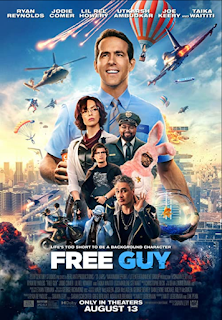
Free Guy

Some people just can’t stand Ryan Reynolds. If you are one of those people, give this one a miss, as this movie features Ryan Reynolds at his Ryan Reynoldsiest.

If that prospect doesn’t bother you… 

Free Guy is a hoot, and a lot of fun.

In this movie Reynolds plays “Guy,” a man whose life is so boring, repetitious, and inconsequential that he doesn’t even realize he doesn’t have a last name—until the day he wakes up, and realizes he’s just an NPC in someone else’s MMRPG.

Then he decides to try deviating from his script, just to see if he can make a difference.

I don’t want to say too much about this one, except to say that it’s smart, funny, and full of surprises. I like to think it’s the sort of story Philip K. Dick might have written if he was still alive today—and if he wasn’t a paranoid schizophrenic, and wasn’t loaded to the gills on anti-psychotic meds, and was much better at writing comedy than he really was, and in short, was more like the person I wish he’d been in real life and not like the sad mess he actually was. Never mind. Forget the analogy.

There is an inner plot—about Guy discovering who he is, the truth about the world he lives in, and the real reason for and purpose of his life—encased in an outer plot, about the usual stolen code and evil megacorporation and rich megalomaniac fashion victim übervillain and all that sort of thing. The outer plot isn’t particularly groundbreaking in any way, but it is necessary in order to add extra meaning and urgency to the inner plot. By the end of this movie you will actually care about the characters in this story, the NPCs even more so than the “real” people, and the ending is very positive and uplifting.

Which makes it all the more puzzling to me, then, that the screenplay for this one was co-authored by the same yutz who co-authored the second movie on today’s double-feature—but more about that in a minute.

Recommendation: Make a big bowl of popcorn, kick back, and enjoy this one!

_____________________

Recommended Missing 

Ready Player One


My momma always told me, “If you can’t say anything nice, don’t say anything at all.”

Must. Bite. Tongue…

Sorry mom, I can’t do it. Maybe someone else can find something positive to say about this one, but for me, this movie manages to combine everything I find irritating about Steven Spielberg at his smug, smarmy. self-indulgent and self-referential worst with everything I absolutely hate about contemporary formulaic, derivative, paint-by-numbers “cyberpunk” fiction, all rolled up into one great big incoherent steaming turd of a movie. There is such a thing as homage, and it can be quite good. This isn’t an homage, though, it’s a flash mob storming through the 1980s and stealing everything that isn’t nailed down.

The fact that this movie made a half-billion dollars irks me.

The fact that the novel this movie was based on was a New York Times bestseller infuriates me.

The fact that the sequel, Ready Player Two, debuted as the #1 bestseller on the New York Times list and the film is already in development renders me nearly speechless. If the Russians were to wipe us out in a nuclear war next week and thus prevent the sequel movie from being completed and released, they would be doing the world a favor. 

Maybe someone else can find something positive to say about this one. I can’t.

Recommendation: If your only choice is between watching this one or gouging your own eyes out, say goodbye to your eyes and start gouging.

Saturday, January 22, 2022

A little something for the weekend?

Recommended Watching

Ghostbusters: Afterlife


I’ll make this simple. If you are at all a fan of the original 1984 Ghostbusters, watch this one. After a troubled development history and a release schedule frequently delayed by the COVID-19 pandemic, it finally appeared in theaters last November, to mixed reviews and strong but not overwhelming ticket sales.

Never mind that. It’s out on streaming media now, with the DVD and Blu-Ray versions scheduled to roll out on February 1, supply chain willing, so you have no more excuses.

See this one.

It’s that good. 

For reference, this one is a direct sequel to the 1984 original, and a direct continuation of the original story. It makes some passing reference to the events of the botched 1989 sequel, Ghostbusters II, but as for that 2016 abomination, in the universe of this story, that movie never existed. Lucky them. 

[In reluctant defense of the 2016 movie: at one time the project was in development as Ghostbusters III with the plot revolving around Dan Ackroyd training in a new generation of Ghostbusters, who were to be Chris Farley, Chris Rock, and Ben Stiller. So we can all thank Gozer we were spared that nightmare.]

Some of the trailers make it look as if Paul Rudd is the star of this movie, but that’s misleading. The unquestioned star of this movie is McKenna Grace, playing 12-year-old Phoebe, who is on a journey of discovery to find out who she is, where she came from, and where she’s going. Her story just reaches in and gets a firm grip on your heartstrings, and if you aren’t at least a little choked up by the final scene there’s something wrong with your sense of empathy. This movie has been panned by some critics for having “too much fan service,” but seriously, what’s wrong with that? This is a sequel to a beloved modern classic, and it wraps up loose ends and character arcs that have been left hanging for more than thirty years. It damn well better include plenty of fan service!

We wound up watching this one twice, because there were so many bits of business and things going on in the background that we missed the first time through. Highly recommended.

_____________________

Recommended Missing

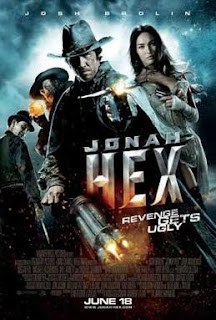
Jonah Hex


I’m beginning to suspect that somewhere in Netflix’s algorithms there is a “taunt” parameter, and it was created by someone with a truly sadistic sense of humor. I say this because for some reason Wild Wild West has been showing up on my “Recommended for you” list a lot lately, traveling in the company of this turkey. Given that I wouldn’t get up out of puddle of cold vomit to watch Wild Wild West again—I count myself lucky to have slipped out of the regional premiere before anyone recognized me—and given that while I was never a fan of the Jonah Hex comic, we found the character of Jonah Hex as played by Johnathon Schaech in DC’s Legends of Tomorrow to be generally likable, we decided to give this one a try. I mean, hey, it stars Josh Brolin and John Malkovich. How bad can it be?

Pretty bad, it turns out.

If you are one of those people who actually liked Wild Wild West—if you wish Warner Brothers made more movies just like it—I have good news for you. They did. Unreconstructed ex-Confederate madman plotting to overthrow the government? Check. Lots of knuckling-dragging redneck mo-ron Southern stereotype minions? Check. (Plus one over-the-top homicidal Irishman.) A lot of confusion over just where exactly this story takes place? Check. Utterly insane and ludicrous “ultimate weapon” in the hands of the madman? Check. The President of the United States, with all the resources of the Federal government at his command, decides to call on just one man to save the day, and that man is a surly and uncooperative antihero? Check.

To be honest, I watched this one all the way through to the end of the credits, just because I was so certain I was going to see some familiar names from Wild Wild West pop up. But to my stunned surprise, the only familiar name that leaped off the screen at me was in the music credit: Mastadon.

Sure. What the Hell. If you’re going to make a movie that’s this big of a stupid mess, why not hire a heavy metal band to do the score?

Recommendation: Watch only if you have absolutely nothing better to do


Tuesday, December 28, 2021

Adieu, Mr. Bond (Part 3)

[continued from Part One | Part Two]


So Who Is This Bond Fellow, Anyway?

If Bond has no place in the world of real espionage, and if the details of his life, his adventures, and even his face may be changed and changed again at the storyteller’s discretion, then where does he belong? Once again, we’re back to the challenge of trying to identify the one true Bond with only mood, tone, and character to work with, so let’s consider the things about him that never change from one tale to the next.

Bond in a warrior. He never serves mere political expedience or convenience. If any government actually had a man like Bond on the payroll they’d be unable to resist the temptation to have him knock off a bothersome investigative reporter or two every now and then, but Bond never does that. Instead, he fights only clearly identifiable villains who are at least his equals, if not more powerful. More to the point, he fights only enemies that can be defeated. In Bond’s world there are no insoluble problems or lingering diplomatic ambiguities.

Bond has a code of honor. He may have a license to kill, but he does so only reluctantly and takes no pleasure in doing it. He will try the disabling knee or shoulder shot rather than the killing shot if he can. (Except when battling his way through mobs of minions and henchmen, but who cares about peasants?) He never kills innocent victims, never accidentally kills the wrong person, and will let a mass-murderer escape to kill again rather than put women or children in the line of fire. In Bond’s world there is no collateral damage.

Bond is a gentleman. He is a master of every form of hand-to-hand combat known to man, but his signature weapon (which has its own name, by the way) is a small-caliber pistol, or as Sir Alec Guinness might say, “A weapon with a more civilized edge.” Bond always meets his adversaries face-to-face and challenges them to single combat: he never strikes first from hiding or without warning, and he would never call in an airstrike to level a crowded restaurant just to get the one evil man hiding in the basement. Bond’s adventures frequently end with götterdämmerung final battles, true, but it’s always left to a Felix Leiter or a Tiger Tanaka to do the scut-work of marshaling the faceless but loyal peasant infantry; Bond himself answers to a higher calling. In Bond’s world there are no drunken and unreliable CIA mercenaries.

Finally, Bond is a romantic. As he travels on his hero’s journey, beautiful women are constantly throwing themselves at him, and while he may have dalliances — in some stories, lots of dalliances — there is always one true love waiting for him at the end of the tale. Admittedly the earlier stories of his adventures were often quite bawdy, but that was more a reflection of then-current social mores and the bawdiness has been toned down considerably in recent years. In Bond’s world there are no sexually transmitted diseases or pregnant ex-girlfriends.

With all the evidence that has been presented, then, the answer finally begins to become clear. Who is James Bond? He’s no noir anti-hero, no shadowy undercover operative, and no brilliant intelligence analyst. He’s no government assassin, no cold-blooded killer, and certainly no spy.

What he is, in truth, is a paladin. He’s a modern day knight-errant, who, mounted on his noble steed DB5, roams the world, righting wrongs, fighting evil, and protecting the weak. He’s a fantasy hero, and the place he truly belongs is in the Land of Make-Believe and Once Upon a Time, standing shoulder to shoulder with Aragorn, Luke Skywalker, Sir Lancelot, Wilfred of Ivanhoe, and Roland and all his cavaliers, defending the borders of the peaceable kingdom from the never-resting forces of darkness that roam out there in the wild lands.

(P.S. And those of you who are still bothered by Bond’s bawdiness should go back and read some of the early chansons de geste, Orlando Furioso, or for that matter an unexpurgated version of the Canterbury Tales. The early aubades and tagelieder in particular are just full of tales of heroic and noble knights who nonetheless are a rather randy lot and never pass up the chance for a good roll in the hay with an unhappily married noblewoman. The idea that medieval heroes were somehow pure and chaste is mostly the work of eighteenth-century bluenose Thomas Bowdler and his imitators, and not an accurate reflection of the actual songs and tales of the Middle Ages.)

Does Bond Have a Place in the Modern World?


Thus we come back to the question we began with: does Commander James Bond, C.M.G., R.N.V.R., have a useful place in the twenty-first century? The answer is yes, but not for the most comforting of reasons.

The truth of the matter is that real deep-cover human intelligence work is a very disturbing, unpleasant, and ugly business. The truth is that in the world of espionage, “truth” itself is a very rare commodity, constantly attended by a bodyguard of lies and veiled by a smokescreen of ambiguities. The truth is that assassinations and executions — those intelligence operations that are euphemistically termed “wet work” in the jargon of the trade — are utterly stomach-turning in their hideousness and frequently result in much blood, screaming, and death or injury to innocent bystanders.

The irony — some might say, the hypocrisy — of western civilization is that we need those modern paladins who walk the wild forests at the edge of the known world, slaying dragons and goblins so that the petit bourgeoisie might sleep soundly in their beds. But the truth of the matter is that a good clear look at the actions of those same paladins will give most people the screaming heebie-jeebies.

And so we need Commander James Bond, Companion of the Order of St. Michael and St. George, Royal Navy Volunteer Reserve.

Or to put it another way: If you want a sickeningly realistic and unblinking look at the world of real wet work, go watch actor Daniel Craig portray Mossad assassin “Alan” in the movie, Munich (2005). But if you’d prefer a comforting heroic fantasy instead, go watch actor Daniel Craig portray James Bond in the movie, Casino Royale (2006).

Personally, I know which one I would rather believe is out there somewhere, working day and night with no regard for his own safety, to protect me and all those I hold dear.

[...to be concluded...]

Monday, December 27, 2021

Adieu, Mr. Bond (Part 2)

[continued from Part One]

Will the Real James Bond Please Stand Up?

With the realization that Ian Fleming didn’t even try to keep James Bond’s backstory straight or consistent (much as his own personal accounts of what he did for British Naval Intelligence during the war always remained a bit vague), many smaller realizations finally begin to fall into place. The first is that the real James Bond is not the literary one Ian Fleming created: it’s the ever-changing succession of movie Bonds who have appeared in the decades since. Without the movies James Bond would now be just another forgotten seventy-year-old hard-boiled pulp thriller character, right up there with Sexton Blake or the Black Bat. Ian Fleming may have supplied the original template, but as with the tales of King Arthur or Charlemagne, it is the subsequent retelling and reshaping of these stories by others that has made Bond a legend.

The second realization is that there is no one true Bond. They are all true; even David Niven in the 1967 version of Casino Royale. Like all good legendary characters, Bond is profoundly malleable and often allegorical. He is an ageless hero, with no reliably fixed beginning and no apparent end in sight. His movies function as mirrors to their respective times, and the tales of Bond’s many adventures most strongly reflect the worries, hopes, fears, and joys of those who are telling the tales, and those who are eagerly listening. When considering the question of whether the world still needs Bond, then, it’s important not to let the then-contemporary trappings of previous tellings of his deeds interfere with the essential truths he embodies.

But again, we’ll come back to that.

The third realization is that deep down, in his heart of hearts, the real James Bond is not a spy. Yes, he ostensibly is an employee of a real intelligence agency, MI6, and his adventures take place in countries with real names and cities you can find on a map. But disregarding for a moment the oxymoronic concept of a famous secret agent, any attempt to draw a correlation between Bond’s gallivanting about the globe on a seemingly bottomless expense account and the tedious process of real covert intelligence work —

A Smart Slap in the Face with the Cold Wet Washcloth of Reality


Okay, look. We could do the whole Tom Clancy thing here, get bogged down in acronymspeak, and lard this discussion with terms like HUMINT, ELINT, and SIGINT. We could discuss the relative effectiveness of various KGB and Mossad “wet work” methods, debate the usefulness of the Mersenne Twister 19337 algorithm in cryptography, or wander off into a long and tedious explication of cut-outs, dead drops, false flag operations, and all the other baroque feints and shadows that are the tools of the trade in the espionage business. But before we go any further, there are a few essential concepts you simply must understand.

Intelligence is all about discovering what your potential enemy’s plans and abilities are before he can use them against you. Counterintelligence is all about preventing your enemy from doing the same to you. Now, the perfect intelligence operation is one in which the enemy’s secrets are learned without his ever suspecting that his secrets are no longer secret. The perfect counterintelligence operation is one in which the enemy’s plans are disrupted before he can put them into effect and he blames only himself for their failure. Never should you let your enemy know just who exactly it is who has foiled his plans or how, because, like a parlor magic trick, an intelligence method that has been stripped of its veil of secrecy is an intelligence method that no longer works.

And yes, while even “nice” governments have from time to time used assassins as instruments of policy, no one in their right mind would ever employ a man such as Bond in this role, if only for fear that he might someday retire from the service and publish his memoirs. Instead, the grisly truth is that assassins should be disposable people. The ideal assassin in an illiterate and mute suicide bomber: he can’t talk if captured, there’s little risk he’ll abort the mission if he finds his escape route blocked, and if he succeeds there is absolutely no chance of his ever coming back later and demanding more money to stay silent. A passable second choice is a man such as Mehmet Ali Agca, the attempted assassin of Pope John Paul II. While many in the intelligence world believe this operation was run by the Bulgarian Secret Service acting as a cut-out for the KGB, and Agca himself was captured and has talked at great length, there is little chance of ever learning the truth from his testimony. Agca has spun tales of enormous conspiracies-within-conspiracies, and has at various times claimed to be a Bulgarian agent, a CIA agent, a Palestinian militant, an Italian military intelligence agent, an employee of a dissident faction in the Vatican Bank, and the second coming of Jesus Christ, here to fulfill the Third Prophecy of Fatima.

As I’ve said before: when it comes to the world of espionage, the truth is as slippery as a salamander in a jar of Vaseline.

In any case, a well-executed intelligence, counter-intelligence, or assassination operation never requires sending in a lone agent to perform feats of derring-do, effect hair’s-breadth escapes, fight desperate battles against legions of hapless minions, completely demolish the enemy’s citadel in a cataclysmic fiery blast, or end up in a rubber life-raft with a rescued beautiful maiden. Are we all clear on this?

Good, because here is a case in point. In April of 1943, U.S. naval intelligence codebreakers intercepted and decrypted radio messages giving the exact whereabouts and travel plans of Admiral Isoroku Yamamoto, Japan’s supreme naval commander and architect of the attack on Pearl Harbor. Now, if Bond had even a tenuous rooting in reality, the British Secret Service’s Special Operations Executive clearly would have responded to this information by sending in a lone undercover agent equipped with an underpowered handgun. Posing as Dutch East Indian rubber plantation owner, this British agent would no doubt have easily dispatched several dim-witted henchmen, had a quick but torrid roll on the futon with Yamamoto’s personal secretary and mistress, Kissy Suzuki, fought a thrilling katana duel with Yamamoto’s master assassin, Oddjob, been captured and then rescued from certain death at the last moment by the beautiful French Polynesian girl, Improbable Chance, and in the final nick of time completed his mission by killing Yamamoto and narrowly escaping from the subsequent fiery explosion of Yamamoto’s secret lair, to end up floating in a rubber life-raft with Ms. Chance, somewhere in the Java Sea.

As it happened, though, Americans were in charge of this operation, so they instead sent in a squadron of P-38 fighters with orders to blast the living daylights out of Yamamoto’s military transport, the decoy transport, his fighter escort, and anyone else who happened to be in the general vicinity at about the same time. Yet for the remainder of the war the Japanese continued to believe that Yamamoto’s flight plan had been discovered and betrayed by native coast-watchers, and failed to realize that the Americans had broken their naval codes and were reading their most-secret communiques.

There. This is what a successful license-to-kill intelligence operation looks like in the real world.


...to be continued...

Sunday, December 26, 2021

Adieu, Mr. Bond (Part 1)

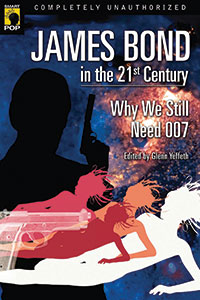
I’d planned to run a review of the latest James Bond movie, No Time to Die, this morning, but got so tangled up in the writing of it that I decided to drop back and punt instead. Ergo, here for your reading pleasure is “James Bond: Now More Than Ever,” the capstone essay I wrote for the 2006 BenBella book, James Bond in the 21st Century

Understand, James Bond and I go way back. I’ve seen all the movies, and read all of Ian Fleming’s original novels. I thought Connery was terrific in the role, grew to loathe Roger Moore in it, and have even seen the 1967 version of Casino Royale that starred Peter Sellers and Woody Allen. (What can we say about that one? It was the Sixties. Drugs were involved.) My high school chums and I were so thrilled by the Bond books that we even took the time and trouble to learn to play baccarat and played it all summer long one year, which probably explains why I still don’t know how to play sheepshead or cribbage.

The point is, I know Bond, perhaps to the point of obsessive excess, and consider the 2006 Daniel Craig version of Casino Royale to be a brilliant reboot of a series that had become hackneyed, stale, and laughably awful. It wasn’t just a reinvention of Bond: it was a restoration, that included more content from the original novel than any Bond film since From Russia With Love.

And now, fifteen years later, with No Time to Die, Daniel Craig’s tenure in the role ends, and James Bond’s character arc is at last complete, in a way that Ian Fleming never lived long enough to imagine but that is completely fitting. No Time to Die is a good movie—perhaps even a great one—but it’s also a long and a weighty movie, that poses unsettling questions, and it deserves more consideration than I can squeeze into one of my typical Sunday morning 500-word reviews.

Therefore, let’s begin with going back to before the beginning.

____________________


James Bond: Now More Than Ever


He's been called an embarrassing relic of the Cold War who should have been forcibly retired and put out to stud a generation ago, when the Berlin Wall fell. He's been called a fascist, a racist, a neocolonial imperialist, and at the very least a shameless sexist, if not an outright misogynist. He's been the butt of jokes and the subject of parodies almost from the day he first appeared in public, and he's been described as a two-fisted, hard-drinking, chain-smoking, skirt-chasing, walking talking catalog of every bad behavior that can possibly be exhibited by the human male. It's even been said that all you really need to know about him can be summed up in just two words: Pussy Galore.

With all of this embarrassing baggage, then, how can Commander James Bond, C.M.G., R.N.V.R., possibly have a useful place in the twenty-first century?

To answer this question, we must first ask another: who is he? Who is Secret Agent 007, Mr. Shaken Not Stirred, Mr. Kiss Kiss Bang Bang? Who is that man in the Saville Row suit, smiling with quiet confidence as he sits behind the wheel of that silver Aston Martin DB5, caressing the grip of his .32-caliber Walther PPK? Who is James Bond?

The answer to this question is not as easily found as it might seem. The peculiar challenge in assessing the proper place of James Bond in the modern world is in some respects quite similar to the challenge of picking the best brand of mineral water in the supermarket: there are so blasted many to choose from. Which one of them is the true, bona fide, and only Bond, James Bond?

As I often do with tough questions, I asked my wife. She said, "Sean Connery, no doubt about it. Very macho, very sexy, but with a roguish charm and a sardonic wit. Mm-mmm, Sean." As an afterthought, she added, "Just like you, dear." I decided to cut my losses and went to ask my friend John, the screenwriter.

"Definitely Roger Moore," John said. "Look, Bond is a joke. He's a superhero; a campy self-parody. He's the guy who can save the world without mussing his hair or spilling his martini, and Moore is the only one who got the joke and played him that way." I thanked John and left, and after that I asked more people, and got more answers. Some preferred Connery; others, Moore. Younger folks were more likely to pick Pierce Brosnan, and Timothy Dalton has his fans. No one would admit to liking George Lazenby.

But in the end, all my questioning proved fruitless. Everyone it seems has a favorite Bond, and not one single person answered, "James who?" All that my investigative efforts really produced was a wealth of opinions about the actors who had played the role, and what they'd looked like while doing it, and how they'd played it. Along with a favorite Bond actor, it seems everyone has a favorite Bond villain, a favorite Bond girl, a favorite Bond car, a favorite Bond stunt, and a favorite Bond improbable gadget. None of these opinions helped me to get any closer to resolving the crucial question of just who Bond is, though, and I still had no good answer to the question that lies at the heart of this essay: what is it about James Bond that saves him from occupying a prominent place in the dustbin of history, right next to Matt Helm?

So I went to the source.

The Gospel According to Ian

The portrait of Bond that emerges from Ian Fleming's original novels and short stories is markedly different from the collage that can be assembled by watching a series of twenty-some movies filmed over a span of fifty-some years. For one thing, Fleming's Bond doesn't look much like any of the actors who have ever played him onscreen. In the words of Vesper Lynd in Fleming's first novel, Casino Royale: "He is very good looking. He reminds me rather of Hoagy Carmichael, but there is something cold and ruthless in his..." (Whatever Mademoiselle Lynd intended to say next, of course, was forever lost in the explosion that blew in the front windows of the Hermitage bar. These sorts of conversation-stoppers happen all the time around Mr. Bond.)


Ian Fleming (l) and Hoagy Carmichael (r)
Projecting a little, Ian?

For another thing, it's important to note that the novels and movies were not made in the same chronological order. Bond's literary life begins with Casino Royale (1953), followed by Live and Let Die (1954), Moonraker (1955), Diamonds are Forever (1956), From Russia With Love (1957), Dr. No (1958), and Goldfinger (1959). His cinematic life, on the other hand, began a decade later with Dr. No (1962), and continued with From Russia With Love (1963), Goldfinger (1964), and Thunderball (1965). In some cases this resequencing of his story merely introduces continuity problems: for example, On Her Majesty's Secret Service was written and set before You Only Live Twice, and at the end of the latter book arch-villain Ernst Stavro Blofeld is not merely dead, he is really most sincerely dead. But in the movies the sequence of these stories is reversed, so it became necessary for the moviemakers to equip Blofeld with the sort of cheesy last-ditch escape devices that Mike Myers later parodied to such great effect in Austin Powers. In still other cases — Moonraker, for example — it apparently proved more expedient to simply junk Fleming's original story completely and start over from scratch, the result being that many of the later movies, and in particular the movies from the Roger Moore era, bear naught but an in-name-only relationship to the eponymous novels. This is a very important point, and we'll return to it in a bit.

For a third thing, though, a reading of Fleming's original novels quickly leads to the realization that Bond's origins and backstory are in constant flux. In Casino Royale, for example, we get this small insight into Bond's private life: "Bond's car was his only personal hobby. One of the last of the 4-litre Bentleys with the supercharger by Amhert Villiers, he had bought it almost new in 1933 and had kept it in careful storage through the war." Two years later, in Moonraker, Bond is described as being only eight years away from mandatory retirement at age forty-five, and yet nine years after that, in You Only Live Twice, Bond's official obituary states that in 1941 he dropped out of school at age seventeen to enlist in the Royal Navy. From these apparent contradictions, and many more like them, we must draw one of only two possible conclusions: either Bond's parents in 1933 were far more indulgent with their nine-year-old son than all but the worst of modern American parents, or else even Fleming himself didn't give a rip about keeping Bond's backstory straight. And if we can't trust the putative facts put forth by his creator, then what hope do we have to know anything about the real James Bond?

What we can know is that which we are left with: his mood, tone, and character. In this regard, Fleming was quite consistent. Bond, as written by Fleming, was neither the wry stud-muffin played by Connery, the smirking quipster played by Moore, nor the smart-but-tough human action-figure played by Brosnan. Bond was a film noir character from the get-go, who had less in common with his later cinematic portrayals than with his literary contemporaries and immediate predecessors: Mike Hammer, Sam Spade, Simon Templar, and the Continental Op. Fleming's Bond was a thug. He could pass for a gentleman when required, but underneath the civilized veneer he was a cold-blooded killer in the employ of Her Majesty's government. He could slit a sleeping man's throat or kill someone with his bare hands and feel little more afterward than the need for a good stiff drink. He could make love to a woman in chapter five and shoot her in the back in chapter six. He was, as Fleming described him, "a neutral figure — an anonymous blunt instrument wielded by a Government Department." He was meant to be an emotionally detached and utterly deadly assassin, a man who got involved in interesting business but was not himself interesting. In short, Bond was — ironically — meant by Fleming to be most like the least-liked of his big-screen avatars: George Lazenby.

What you start hanging about with Bond, you'll note, it is difficult to avoid becoming drenched in irony.


...to be continued...

Saturday, November 6, 2021

Movies: The Problem with Back To The Future • by Ray Daley


Back To The Future still holds up well, for a movie made in 1985.

HOWEVER! It’s not perfect, and I’m about to tear some holes in your beloved film.

If you haven’t seen it (HOW?), Back To The Future is the story of slacker Marty McFly and inventor Emmett Brown, AKA Doc. Doc is an inventor with numerous failures to his name but he doesn’t know the meaning of the word quit.

That’s fine, I don’t know the meaning of the word antidisestablishmentarianism but they made me learn how to spell it at school. Anyway, Doc manages to perfect time travel and performs two successful tests, the second throwing Marty back to the year 1955, 30 years before the movie is set.

Marty discovers his father is a pervert and accidentally manages to ruin the moment when his father met his mother, ultimately unraveling the thread of his existence.

AND THIS IS WHERE WE HAVE OUR FIRST PROBLEM—THE PHOTOGRAPH!

In his pocket, Marty is carrying a photograph of himself, his older sister, and their older brother. Who suddenly start vanishing from the picture. From this point onward, the movie is on a ticking clock. If Marty can’t get his mother and father to fall in love again, he’ll fade out of existence. forever.

“So, what’s the problem, Ray?” I hear you all shouting? (What’s that? You’re not shouting? Okay, I’ll just wait here until you do. I’ve got all day. Okay, you’re all shouting now? On we go!)

The photograph is the problem. Ignoring the sheer fact it shouldn’t exist at all because it hasn’t been taken yet (which the writer glosses over without a moment’s thought) Marty’s siblings vanish in the order they were born in. Only they shouldn’t.

As the youngest, Marty should vanish first on that photograph. It’s a massive continuity goof that almost no-one notices until it’s pointed out to them. Marty’s oldest brother should be last to vanish. He should be the protagonist of this movie. Again, we’ll gloss over the fact that he isn’t. Now, if Marty was the eldest, the photograph would make sense. IT DOESN’T.

I’ve probably just blown your mind there.

Okay! Now let’s talk about an alternate reality.

Michael J. Fox wasn’t the first actor cast as Marty McFly. Oh, no. Eric Stoltz (of Cher movie Mask fame) was originally Marty. Eighty-percent of the movie was shot before someone decided he just wasn’t working out as they’d hoped. He is still in one scene. Go check the 1955 cafe scene where George punches Biff. That’s Eric Stoltz’s arm! Neither Eric or his arm get a credit, which sucks. If my arm was in a movie, I’d want a credit for it. And ice cream, but I always want ice cream.

TIME FOR THE SECOND BIG PROBLEM

The stupid, wrong photograph isn’t the only big problem with Back To The Future. It’s an issue that should be addressed in ALL time travel movies. I can tell you all about it with three simple words.

THE EARTH MOVES. 

Apart from spinning at roughly 1000 miles an hour on its axis, the Earth is also moving in space, around the sun. It’s why we have seasons. Where we were in 1985 is certainly not where we were in 1955, or where we will be in 2015. If you traveled into the past, you’d have to not only account for the rotation of the Earth, you’d also have to factor in our orbit around the sun. Otherwise, if you were able to travel in time, you would almost certainly end up floating in space, and certainly not on Earth.

[Editor’s Note: Which is why having a T.A.R.D.I.S. instead of a DeLorean would be quite useful, hmm?] 

Even if you were freakishly lucky and somehow managed to land on Earth (and trust me, compared to space, Earth is a tiny target to hit!), the chances of it being exactly where you’d left from would be slim to none. Chances are, you’d most likely end up in the ocean.

Time travel to the past is possible, right now. You can jump on a jet plane and travel both backwards and forward in time by a few hours. Sure, it’s merely crossing time zones, but you can leave Europe, fly to America and arrive before you left. Tell me that isn’t time travel!

Back To The Future asks some difficult questions. It asks us to believe the butterfly effect is a thing.

As far as Science Fiction goes, the butterfly effect was first shown in the Ray Bradbury story “A Sound of Thunder,” in 1952, in which a time-traveler steps on a butterfly in the Late Cretaceous era, altering the future. Back To The Future shows us both positive, negative and neutral outcomes of the butterfly effect.

Neutral effects with Twin Pine Mall becoming Lone Pine Mall, positive effects with Goldie Wilson encouraged to run for Mayor and George McFly stepping out of the shadow of his school bully, Biff, with the negative effects obviously being Marty initially ruining his parents first meeting.

Personally, I don’t believe in the butterfly effect. I believe in causality. This means whatever happens, happens, regardless of if you were there or not. I’m fine with the concept of traveling back to the moment you left, which is the present.

I don’t believe traveling to the far future (anything beyond more than 12 hours) is even remotely possible. Why? One simple fact.

IT HASN’T HAPPENED YET.

Something is only an event once it’s taken place. Until it has, there is nothing. The future is the present, eventually. The present happens, a second passes, we’re in a new event, a new future, a moment which is currently taking place but is yet to physically happen as it’s happening. I know, it sounds crazy complex, so here’s an easy breakdown.

Take a piece of paper and something to write on. That paper is the present and the future. It’s blank, there’s nothing there until something happens. So you write your name on it. That’s an event, once you’ve finished writing your name happened in the past. Unless you have an ink eraser or you wrote in pencil, what’s done can’t easily be undone.

By writing on the paper, you’ve changed its timeline. It went from always being blank to now having your name written on it. However, you can’t go from a moment when it was blank, to a time when your name is already written on it, not without performing that action yourself.  You’ve got to make the future, you can’t just move into it.

So we’ve dealt with the stupid science of Back To The Future.

Bruce asked me to talk about cultural appropriation. Specifically, Marty becomes a white saviour. He gets the dance going, brings Mom and Dad back together so they have kids, setting the timeline back to as it should be. And in the process, steals another man’s thunder.

Chuck Berry.

I need to say a thing first. I checked, Marvin Berry was real, he was Chuck’s cousin. However, Marty did not invent or inspire rock and roll. Before he plays Johnny B. Goode, he instructs The Starlighters that it’s ”a blues riff in B, watch for the changes”. If they’ve never heard any rock and roll style music before, they would have no clue what Marty was saying or his intended meaning.

HOWEVER

As Blues music had been around since the start of the 20th Century, Marvin and his band would have been well aware of the style. Bill Haley had already been number 1 with Rock Around The Clock in 1954 and Chuck Berry had a hit with Maybellene. Marty didn’t inspire anyone. Rock and roll already existed. That phone call was unnecessary, Chuck Berry was already famous. Probably not a fact the casual watcher is aware of. You are now.

You’re welcome.

I’m not going to mention one of the most uncomfortable plot aspects, which is someone thought incest was funny. Mostly because it’s not.

I will say this in closing though.

Whilst Fox’s portrayal of Marty makes the part, the ensemble cast truly makes the movie. Without Thomas F. Wilson, Lea Thompson, Christopher Lloyd, Crispin Glover and Donald Fullilove there would be no Back To The Future. It’s a fine and enjoyable movie, and if you haven’t seen it yet, I would encourage you to do so.

Nostalgia is always going to be popular, and while Back To The Future isn’t perfect it comes pretty close in places.

____________________


Ray Daley
was born in Coventry and still lives there. He served six years in the RAF as a clerk and spent most of his time in a Hobbit hole in High Wycombe. He is a published poet and has been writing stories since he was ten. His current dream is to eventually finish the Hitchhiker’s Guide fanfic novel he’s been writing since 1986. Tweet him @RayDaleyWriter or check out his web site at https://raymondwriteswrongs.wordpress.com/

Saturday, October 30, 2021

The Spooky Season: Let's Talk About Zombies! • by Ray Daley


While I'm mostly known for writing science fiction, one of the other hats I wear is that of a horror writer. I love me a good horror film, be it haunted houses, undead armies, crazed slashers or whatever. There's nothing like a damn good scare.

I saw my first X-rated horror film when I was 13—The Sword & The Sorcerer. Let me tell you this, a guy gets his head shoved into a working grindstone and another man de-crucifies himself. It's got quite a decent amount of gore sprinkled over what is essentially a dark fantasy film. Worth a look if you like gory movies, some good demons, dark magic and a frankly amazing triple-bladed sword.

However. That's not what I've got you here to talk about this time. I wanted to discuss zombies.

The undead, shambling, reanimated corpses who frequently hunger for brains.

Most folks should be familiar with the King of zombie films, George Romero. The man who coined the line, "When there's no more room in Hell, the dead will walk the Earth."

That's probably what most people think of when asked to form a mental picture of a zombie.

Originally, zombies came from Haitian voodoo culture, using black magic to reanimate a dead body, although the word can be traced back to West African roots where it meant god or fetish (an object which has supernatural powers). In English, the word zombie (spelt zombi) was first recorded in 1819. We've been curious about them for a damn long time!

So what is wrong with movie zombies?

READ MORE ► 

Saturday, October 23, 2021

Movie Review • “DUNE: It's Got a Lot of Problems..." by Ray Daley


WARNING: HERE BE SPOILERS!

So I recently got to see the new version of Dune. I'd seen all the trailers. I was looking forward to it but had a few reservations.

Reservation 1 - The Star

Timothée Chalamet as Paul Atreides. He looks about fourteen and is so skinny it appears he’d probably snap in half in a brisk breeze. He does not look like the saviour of a planet, not by a country mile.

Reservation 2 - The Length

It was fairly widely known we weren’t getting the entire first book of Frank Herbert's Dune in this movie, despite the fact it's longer than the 1984 version, which managed to do that.

So, with a couple of reservations, I watched the film. And it's got problems. Well, if you're watching with a critical eye, it certainly has.

I'll go ahead and hope you're already vaguely familiar with either the book or the 1984 movie. The 2000's miniseries is actually Children Of Dune, so can be ignored. Dune is essentially the story of a white saviour coming to free indigenous people. It's also a serious case of cultural appropriation, which everyone seems to gloss over as well.

So what are these problems?

Dune falls down hard in a couple of fairly important places.

Sunday, October 10, 2021

Movie Review • The Last Days on Mars


I’ll save you some time. If this one shows up on the recommended list while you’re scrolling through Amazon searching for a good sci-fi movie to watch, just keep scrolling. To condense this review to one word: avoid.

Sure, the movie looks promising. It stars Liev Schreiber, who has been in some good things, and has an international cast. It’s beautifully photographed. They spent serious money on the sets, costumes, and props. It’s only 98 minutes long.

By the end of it, though, it will have seemed much longer, and you’ll be wondering where you can apply to get that hour and a half of your life back. 

The opening setup seems promising. It’s in the closing days of a six-month expedition to Mars. (Hence the title.) The expedition has been frustratingly unproductive, and there’s a lot of tension and hostility between the members of the team. For a while it looks like this is going to be some kind of atmospheric drama about people who can’t escape each other living in a pressure-cooker microcosm and cracking up under the strain.

Sidebar: One technical point worth noting here, with a little admiration, is that the backstory is that an Earth-Mars cycler system has been established. They can’t leave Mars until the orbiting platform returns and drops a new lander with the resupply crew. This is interesting at first, but the more Schreiber’s character has nightmares/premonitions about not being able to make it back to the orbiter, the more you begin to feel that you’re being clubbed over the head with foreshadowing.

Anyway, with all of that established: as the days tick down and the pressure builds, the obligatory Crazy Russian on the team breaks the rules, defies orders, and takes one last trip to one of the dig sites to take one more core sample, and lo and behold, he at last discovers life on Mars! In the form of a mysterious bacterium, which he quickly discovers, turns people into—

Zombies.

Yeah, frickin’ zombies. They’ve spent all this time and money and effort and character-building up front, just to turn it into another frickin’ zombie movie. Imagine Aliens mashed up with—well, pretty much any standard-issue by-the-numbers completely imagination-free zombie movie and that’s what you’ve got. They’ve taken the time and trouble to make a movie that actually looks as if it was filmed on goddam Mars, and then turned it into a formulaic zombie movie that could have been made on any suitably dusty location in the American Southwest. 

Hint to writers: if you’re going to take your characters to Mars, have them find something more interesting to do there than to turn into either zombies or zombie chow.

Yes, of course, Liev Schreiber’s character ends up being the sole survivor. Yes, of course, when the lander finally shows up the zombies surprise and overwhelm the relief crew. Yes, of course, Schreiber manages to escape the zombies and take the lander back up into orbit—but too late, he’s missed the rendezvous with the orbiter, and doesn’t have enough fuel left to make a safe landing. But that doesn’t matter anyway, as he realizes that he’s been exposed to the bacteria and is probably infected as well. He delivers one last monologue, in the form of a last message to Mission Control that seems cribbed from Ripley’s last message at the end of Alien, and then…

Roll credits.

In short, this movie begins with some promise, then turns into a paint-by-numbers zombie movie, and then everyone dies. The end. What a waste. 

—Bruce Bethke