Showing posts with label notes towards a manifesto. Show all posts

Thursday, March 17, 2022

Sci-Fi vs Western: Clash of the Genres


Ever since the subject of Wild Wild West came up again, I’ve been thinking critically about the dichotomy between science fiction and the Western pulp genre. I’ve developed a theory that I think I will write more about later, but right now, I’m wondering why Western motifs and thematic elements work so well for horror and with such difficulty in hard science fiction. 

My memory is colored by the fact that I spent a lot of money on our spinoff anthology series, Tales From The Wild Weird West, only to have it fail in development and never reach release. Looking back at the facts of the matter, though, we’ve actually published quite a bit of fiction that veers into Western territory. Some examples:

“The Dead Barn,” by Amy Caylor - A Western post-zombie-Apocalypse story currently out in Stupefying Stories #23

“Rain Charmer,” by Gef Fox - A clever little tale of being careful what you wish for, currently out in Stupefying Stories #22. I’d call this a story with a Native American motif, except that Gef is Canadian, so the proper term is First Nations.

“The New Herd,” by Lilliana Rose - Snarky, fun; better yet, it’s free, as it snuck in during one of the periods when we were trying to reboot SHOWCASE as a webzine. Read it now!

“Princess Nicotine,” by John Skylar - A cyberpunk Western, if you will. Published in SS#18, which is now out of print. Too bad you missed it.

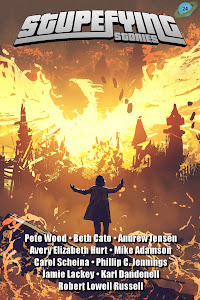
“I Live the Warrior’s Life,” by Robert Lowell Russell - Plenty of people write stories in which the veil between worlds is pierced and monsters from the Other Side cross over into our world. Robert had the imagination to realize that in North America we’d get things from the Eastern Woodlands folklore, and they had some real nightmares. This story was so good we made it the cover for SS#16.

“Long Cold Wish,” by Laura DeHaan - Also in SS#16, a really creepy and first-rate paranormal mystery that I’ll probably tap for our Best of anthology, if we ever do one.

“Red Dust and Dancing Horses,” by Beth Cato - Just because a girl is growing up under a dome on Mars, that doesn’t mean she can’t be obsessed with horses, does it? This one first appeared in SS#5 and has been anthologized so many times since then that it almost seems unnecessary to reprint it, but I am really proud that we were the first to publish this one.

This is just a short list of the stories that spring immediately to mind. I’m sure there have been more. 

Monday, January 17, 2022

2021: The Year in Review | 2022: The Road Ahead


Obviously, we didn’t make our January 15th target for releasing Stupefying Stories #24

To say 2021 was challenging is an epic understatement. While we began the year in fairly decent form with the release of Stupefying Stories #23

[Buy the book, wouldja? Or if you downloaded a copy while it was free on Kindle Unlimited, read a story in it now, if only to make the KENP counter tick over and reassure me that the book is still alive.]

 —and The Pete Wood Challenge got off to a great start, in hindsight, by June there was clearly something going wrong with Karen’s health, although that didn’t become inescapably obvious until July. 

Then July hit like a two-thousand-pound JDAM. Then August. Then September. Debris was still raining down and we were still running around putting out secondary fires in October, and while the smoke cleared a little in the first half of November, that was just an illusory respite.

Six months in, it’s time for me to admit that our definition of “normal” needs to be recalibrated again, and this situation is not going to improve significantly any time soon. My available time has become even more constrained, and the sales and KENP numbers tell the tale. Stupefying Stories isn’t getting much interest, except from writers hoping to sell stories to us. The books that are selling well for us are:


#1 - Henry Vogel’s FUGITIVE HEIR series. 

If you have not already read it, check it out. If you don’t have time to read yet another book, grab the audio book. With all of Audible’s promotions you can probably get the first one free.

Seriously, if you like audio books, get this one. The Fugitive Heir would have been a wildly profitable series for us, except that I plowed all the profits from the e-books back into producing the audio books. I’d like to recoup a little of that.

Fortunately, Audible has changed their process since then, greatly reducing the up-front costs, and I am now cautiously optimistic that we won’t lose money on the audio book version of Eric Dontigney’s THE MIDNIGHT GROUND that is now in production.


#2 - Henry Vogel’s THE HOSTAGE IN HIDING.

Strictly speaking, Henry’s Kindle Vella serial novel-in-progress hasn’t been making money for us—at least not directly—but it’s been burning up the Vella charts and generating a lot of royalty and incentive bonus income for Henry, and we have high hopes that at least a few of his Vella followers will want to get the print edition when we release it. We don’t know exactly when that’s going to happen, as Henry has yet to finish writing the story, but we expect it to happen fairly soon, as he’s already plotting out the follow-on books in the series. 

Indirectly, since THE HOSTAGE IN HIDING is the direct sequel to the FUGITIVE HEIR trilogy—think of it as The Fugitive Heir: The Next Generation—this probably explains the renewed interest lately in the Fugitive Heir trilogy.


#3 - Henry Vogel’s SCOUT’S HONOR series.

While the most recent titles in this series haven’t sold as well as the original four books, the series as a whole continues to sell, and the standalone “side quest” novel HART FOR ADVENTURE is doing quite nicely. I’ve advised Henry to strike while the iron is hot and continue working on the HOSTAGE IN HIDING series, as it’s doing so well on Vella, but if you’d rather see him write another Scout book, let him know. Authors love to get feedback from readers! And ratings and reviews, too!


But, do you begin to see a pattern emerging here?

________________

2022: The Road Ahead

As loathe as I am to admit it—as much as my heart rebels against it—as much as I really hate the trite cliché, “the new normal,” it’s time to face the facts. I have been living in crisis mode for so long, lurching from one medical misadventure to the next, that I’ve lost sight of the larger picture. What happened to us in 2021 was exceptional only in its severity. Otherwise it was a repeat of 2020, which was a repeat of 2019…  I think we need to go back to 2017 to find a time when our situation really seemed to be under control, and when we weren’t scrambling, improvising, or trying to make Stupefying Stories successful through sheer egotism, optimism, and force of will.

Perhaps more egotism was exactly what was needed. I never did make a strong case for why a story hand-selected by Bruce Bethke® was something that should be given more than the usual amount of attention given any other small press publication.

Too late to change that now. The time has been spent. The candle has been burnt at both ends for too long and is now just a smoldering wick. The tank of midnight oil has run dry, and the Big Bag o' Clichés has just some lint and a few loose Scrabble tiles bouncing around at the bottom. Whatever we set out to do ten years ago with Stupefying Stories, it’s been done, or never will be. We helped launch a few careers. We’ve seen writers who we were the first, or among the first, to publish go on to become award-winners, successful novelists, and names on the covers of the big magazines.

But the spare time has been spent, and it’s hard to come by more. The fact that I still haven’t been able to find the time to finish that review of No Time To Die I began writing two weeks ago—that it’s taken me six hours to chisel out the time, in five- and ten-minute increments, to write this column today—speaks volumes.

It’s time for me to embrace the lessons I’ve learned and find the exit. 

Stupefying Stories will continue for two more issues. #24 is just about done and ready to release anyway, so what the Hell, let’s go for it. #25—that’s a nice number, twenty-five—is going to be our “going out with a bang” issue; no excuses, no explanations, and no holds barred. #25 will be composed entirely of stories that made me say, “Damn, I wish I’d written that!” Louis Shosty, you’re up.

The original novels will continue. After all, they’re the things that make money.

This website will continue. We have a lot more Pete Wood Challenge stories in the pipeline, as well as at least three serials. This website will in fact continue to evolve, as I push it towards becoming the site I wanted SHOWCASE to be. We will continue to publish original fiction on this site, though we’ll be scaling back our ambitions considerably. The Stupefying Stories Presents line will continue as well, as I have a few more projects I want to get out the door under that aegis.

Unfortunately, this also means that at this time we have far more stories accepted and under contract than we’ll be able to publish in the immediate future. So beginning this week, I will be contacting authors to let them know whether I would like to use their stories in our remaining planned publications or if I’m releasing them from their contracts.

It’s been fun. Thanks for all the fish.

Bruce Bethke

Wednesday, June 16, 2021

Notes towards a manifesto • 5


The Department of Useless Prescience checks in, reinforcing the idea that I am trapped inside a time loop. As I was writing this morning’s post I began to get a profound feeling of déjà vu all over again, so I checked and—yep.

From the July 2005 issue of Strange Horizons, with a few pertinent edits:

Lynne Jamneck: What's your opinion on the current state of SF writing?

Bruce Bethke: I believe you've actually asked at least three questions here. In terms of pure writing, the current state is better than it's ever been before. Compare any current issue of any major magazine to the clunky prose produced by the Grand Masters during the Golden Age or the psychotic fugues whipped out by the Young Turks during the New Wave, and I think you'll agree that for sheer literary quality, there are more highly skilled writers working now than ever before.

In terms of the market, on the other hand, things right now are as bad as I've ever seen in my adult life. From what I've read, you'd have to go back to around 1960 to find a time when the paying market for new SF was as tough.

What this means for writers, then, is that there are a lot of very talented people doing a lot of extremely good work, and publishing it in some pretty marginal venues. It's a difficult time to be trying to earn your living as a professional science fiction writer.


Lynne Jamneck: Are you seeing any interesting avenues in which the genre finds itself expanding?

Bruce Bethke: I think it's a mistake to talk about “the genre” as if it were a monolith. There may have been a time when it was possible for a dedicated fan to read a good sampling of all the new SF being published, but that time—if it ever really was—was long ago. What we’ve been going through for at least the last 30 [~brb: make that 45] years has been a sort of literary cladogenesis, with “the genre” fragmenting into dozens [hundreds] of related but distinct daughter-genres and microgenres.

The interesting part of this is that, between print-on-demand publishing, e-publishing, web publishing, and all the other emerging technologies, it's now at least semi-practical to publish fiction that has no hope of ever appealing to a mass audience. If you wanted to, say, launch an e-zine devoted exclusively to publishing stories about promiscuous centaurs living in trailer parks in Alabama, you could do it, and do a very professional-looking job of it. Not only that, but thanks to the Internet, you would actually stand a pretty fair chance of reaching the 500 people in the world who want to read nothing but stories about promiscuous centaurs living in trailer parks in Alabama. So there's more fiction being published than ever before.

The downside for the writer, though, is that there's no money in it. The general interest magazines appear to be following the general interest anthologies into extinction, and extreme specialization and small-niche marketing seem to be the shape of things to come. Readers now have unprecedented power to find only exactly the types of fiction they want to read, without risk of accidental exposure to anything else. I suppose they've always had this power—I can think of entire years when I subscribed to Asimov's and only read two or three stories in each issue—but at least with a general interest magazine, there was always the possibility that after you'd read the Michael Swanwick and Lucius Shepard stories, you might take a chance on Karen Joy Fowler.

But this trend towards extreme narrowcasting—it's both fascinating and disturbing. When readers can exercise such fine control over the input they receive, how does a writer crack through that protective shell?

And more germane to Rampant Loon Press and the future of Stupefying Stories: how does a publisher do it? 

—Bruce Bethke 

___________________________________


In the meantime, while you’re pondering the answer to that question, please take a moment now to make an affordable donation to the Campaign to Save General-Interest Magazines from Extinction, by clicking the following link:

stupefy (ˈstü-pə-ˌfī) to stun, astonish, or astound

Edited by award-winning author Bruce Bethke, STUPEFYING STORIES is a bold attempt to grow a new general-interest science fiction and fantasy magazine from the ground up. For the past ten years we've been a part-time purely-for-the-love-of-it affair publishing on a wildly erratic schedule, but our goal is to grow to become a regular monthly magazine that pays pro rates—

And here's the radical part: we want to do this not by chasing after foundation grants, asking people to contribute to our crowdfunding campaign, or begging passers-by for spare change, but by selling books and magazines that people LIKE TO READ!

Available on Kindle, in paperback, and free for Kindle Unlimited subscribers.

Why not take a minute now to check us out?  

Monday, June 14, 2021

Notes towards a manifesto • 4


In another of my recent web chats, I was asked once again to recount the saga of how “Cyberpunk” went from being a new story, fresh and young and full of hope and promise, to at last becoming a published story, a bit jaded, weary, and battle-worn by the time it got there. 

In somewhat compressed form, the tale goes like this: in the early spring of 1980 I wrote the original version of the story, which ended with the paradigm shift and the words, “Dad, there’s going to be some changes around here.” I immediately sent it off to George Scithers at Asimov’s, who hung onto it for a bit longer than usual, then sent it back with a letter detailing everything that was wrong with my story but inviting me to rewrite it and resubmit. In particular he wanted me to fix the ending, on the grounds that Asimov’s readers would never go for an ending in which the tech-savvy teenage punk was able to win because he understood the emerging new technology far better than his father did.

I thought about that for a bit, then slapped on a coda in which Mikey gets his comeuppance and gets packed off to a military boarding school. I resubmitted the story to Asimov’s, and this time it stayed there for quite a bit longer than usual, then came back with a note from Scithers saying that while the story was improved, he’d run it by a real mainframe computer expert, and the whole idea of punk kids running around causing serious trouble using cheap computers the size of notebooks was just too far-fetched to be credible.

After Scithers at Asimov’s rejected the story a second time, I shrugged, then sent it to the next magazine on my target list: either Analog or OMNI, I can’t remember which and don’t feel like looking it up right now. The point is, between the summer of 1980 and the summer of 1981, every editor at every major magazine then in the science fiction publishing business got the chance to read this story.

And every one of them rejected it, usually with some variation on the “Real close, nice try kid,” brush-off.

In the summer of 1981 I sent the story to Amazing Stories. Founded in 1926 by Hugo Gernsback—the Hugo Gernsback, for whom the Hugo Awards are named—by 1981 Amazing was the Nora Desmond of science fiction publishing; a once-grand old lady lately fallen on hard times, and no longer considered even close to being an “A-list” market. What I didn’t know then was that there was also a lot of turmoil going on behind the scenes, as the magazine was in the process of being acquired by TSR (the makers of Dungeons & Dragons), and the editorial staff was struggling with continuing to put out a magazine while also wondering whether they’d still have jobs once the acquisition was complete. (It turned out the answer was no, they didn’t.) 

My story sat gathering dust at Amazing for about a year. In response to my ever-more-frantic queries I received a series of ever-more-promising replies from a soon to be unemployed assistant editor, until finally my last shit-or-get-off-the-pot query produced a reply from none other than George Scithers, just hired away from Asimov’s. Scithers informed me that the outgoing editorial staff had thrown out every manuscript they’d been holding for further consideration and I should consider my submission lost. However, if I wanted to resubmit the story…

I shrugged, thought ‘why not?’, and sent a fresh printout of the manuscript to Scithers, who loved it, had to have it, and in July of 1982 finally bought it. It was published in the November 1983 issue of Amazing—strictly speaking, AMAZINGTM Science Fiction Stories combined with FANTASTICTM Stories; the magazine by that point was quite a conglomeration of merged trademarks—which was on the newsstands in September of 1983. 

And the rest, as they say, is history.

¤     ¤     ¤

Looking back from the vantage point of now, the lesson here is simple: everything changes. Writers change and grow. (At least, I hope you do.) Readers change. Publishers change. Markets change. Magazines change.

Even editors change.

In 1980, George Scithers was the four-time Hugo Award-winning editor of Asimov’s, the top magazine in the field. (Although Ellen Datlow over at OMNI probably would have argued with that.) In that role George’s job was to keep Asimov’s the best-selling monthly magazine in the industry, and between the magazine’s reputation and Davis Publications’ generous budget he had first pick of the best stories being produced by the best short-story writers then working. The 1980 George Scithers had no trouble filling every issue with first-rate stories by “big name” authors.

In 1982, George Scithers was the new editor at Amazing, and his job was to use TSR’s enormous budget and marketing power to dethrone Asimov’s. The problem was that because of Amazing’s dodgy reputation and faltering circulation, a lot of “his” writers chose to stay with Asimov’s rather than follow him to Amazing. He would have to start over and develop a new talent pool.

In short, the 1980 Scithers didn’t need to take risks, he just needed to keep doing what he’d been doing all along. The 1982 Scithers absolutely had to take risks and be open to finding new talent, because that was the only way he would be able to grow his magazine’s circulation.

That, in a nutshell, is what turned a story that was unacceptable in 1980, and rejected by every major editor then working in the business, into the legend that was born in 1983. Not one word of the story changed.

The only thing that changed was the relative career situation of the editor who had rejected it twice, and then on the third try bought and published it.

Submitted for your consideration,

—Bruce Bethke

Saturday, June 5, 2021

Notes towards a manifesto • 3


In one of my recent web conferences I was asked, “What one piece of advice would you give to new writers?”

That one caught me a bit flat-footed. I tap-danced around the point and eventually gave my usual flippant reply, but seriously, I don‘t know that I can distill it down to one piece of advice. 

I have a lot of advice I could give, that I usually find it best to keep to myself. The reason is that it’s all based on my experiences as a beginning and developing writer in the land of long ago and far away, and that world doesn’t exist anymore. 

You, writing now, are trying to build your careers in a new world, one very different from the one in which I planted and grew my own writing career. For one thing, it is truly a world now, not just a single country on a single continent. 

When I was a short story writer in the 1980s, there were around a half-dozen genre magazines in the U.S. that paid “pro” rates to authors and sold around one hundred thousand copies each, every month. (The numbers were continuously in flux as new magazines were being launched and old magazines being put out of their misery all the time.) 

More significantly to me, it was overwhelmingly an American market. Due to the requirement that would-be contributors had to type and mail paper manuscripts to submissions editors, UK, Australian, and European writers were pretty much excluded from the American market, so there were far fewer writers competing for those publication slots. Editors couldn’t just stick to buying stories from well-known big-name authors, either. There simply weren’t enough well-known big-name authors writing new SF/F short stories to keep the magazine publication pipelines full…

Because all the well-known big-name authors were off writing novels, as that’s where the real money was.

The novel market then was very different, too. Back then there were at least a dozen major publishers with healthy lines of hardcovers and mass-market paperback originals, all competing for shelf space in the indie and chain bookstores. This led to a standard career progression almost every genre writer followed: 

  1. Write short stories until you break into the “pro” magazine market.
  2. Write and sell more short stories until you became a well-known name.
  3. Sign the standard “Rich & Famous” contract with a book publisher.
  4. Graduate to writing novels and never look back!

Again, this was overwhelmingly an American market. There was another world out there, of foreign publishers and translations and reprint rights and all that—and to tell the truth, there were years I made a lot more money off foreign translations and reprints than I did off new American sales—but still, the business of SF/F publishing was overwhelmingly an American genre.

But that’s all gone now.

So that’s the first piece of advice I would give to new writers. Never forget: it’s a world market now. 

...to be continued...

—Bruce Bethke

_________________________________________


SEX! DRUGS! ALIENS! ROCK ‘N’ ROLL! ALL THIS AND MORE FOR JUST $0.99, OR FREE FOR KINDLE UNLIMITED SUBSCRIBERS!

JIMI PLAYS DEAD

b/w “Buck Turner and The Spud from Space”

 Exclusively on Kindle  (for the moment)


Friday, June 4, 2021

Notes towards a manifesto • 2


In the process of learning how to run a small-press publishing company and produce a decently professional-looking product, it seems I’ve lost sight of a key detail. The original mission of Rampant Loon Press in general and Stupefying Stories in particular was to use the attention people wanted to pay to me, because of some stuff I wrote back in the 1980s and 1990s, to get them to pay attention to new writers who are up and coming now

To some extent we’ve succeeded. I do feel a certain pride whenever I see the name of someone who we were the first to publish, or one of the first to publish, now appearing on the cover of a major magazine, or on the shortlist for a major award, and or in a press release announcing their new novel. 

Along the way, though, I’ve neglected to continue to cultivate the Bruce Bethke® brand, and that plot has gotten a bit weedy and overgrown lately. The point was driven home to me during one of my recent web-ins to a panel at a con. Once the other people on the call realized who I was and what I’d done, the conversation pivoted—and for a few minutes it was fun, but then all the questions started to take on the form of beginning with, “Back in your day…”

The snark is strong in me. It took a great deal of willpower for me not to begin to answer questions like that with, “Well, kid, back in my day, we didn’t have those fancy-shmancy computers! We had typewriters! And slide rules! And we were happy to have them! We put men on the Moon with slide rules!

Actually, one of my best friends from high school (and my roommate for a year in college) now has some kind of post-PhD degree and works for NASA, doing AI. His software is still crawling around inside rovers on the surface of Mars. Back in “my” day we used to sit up till the wee hours, shooting the bull about the future and imagineering what might come from having real functional artificial intelligence, or at least the ability to get time on the mainframe to debug code without having to stay up until 2 AM to do it.

But why ruin a good story! Get off my lawn, ya whippersnappers!

There is a distinctly generational aspect to a writer’s career. At first we write to impress our parents and teachers, and we learn to write what pleases and impresses them. Later, when we get a little older and try to move out into the bigger world, we transfer this appeal-to-adult-authority sort of writing to editors and publishers, as we’re still writing to try to please and impress people older than ourselves, because they control the futures of our careers.

Later still, assuming the writing has been working, we shift over to writing to please and impress our contemporaries. This is usually where most writers’ careers peak, as we tell stories to amuse and impress our friends. Make no mistake, there is a great deal of success to be found in doing this.

But…

But, writers age. Our contemporaries fade away. The audience turns over, and shifts to becoming ever younger. Eventually you find yourself writing to please and impress people much younger than yourself, and it’s a challenge. They don’t speak quite the same language you do. They don’t have the same cognitive mappings. Things that you think are brilliant, clever, and profoundly meaningful are Dad Jokes to them. If you are really lucky, you can make the transition to being one of the adult authority figures whose approval they seek. 

For most writers, though, this is where the career peters out, and they wander off, muttering about diminishing sales, lack of publisher support, what’s the hell is wrong with the market these days, and how all the new stuff hitting the bestseller lists lately is total crap.

Creative careers—all creative careers, it doesn’t matter whether you’re a writer, an artist, a musician, or whatever—have three distinct stages. First you imitate. Then you innovate. Then, if you’re lucky enough to stick around that long, you can instruct. But what comes after being an instructor?

“I know!” my wife says brightly. “You become an influencer!”

Oy vey. Must I?

—Bruce Bethke

______________________________


While you’re pondering the answer to that horrible question, influence this!
Available now in paperback, on Kindle, and free for Kindle Unlimited subscribers!

Do you miss Firefly? Do you like The Expanse? If so, then The Privateers of Mars is exactly what you need. [...] Structured as three loosely interconnected short stories, it reads like three episodes of a great science fiction show that you wish someone would make.”

—Amazon reader review


Thursday, June 3, 2021

Notes towards a manifesto • 1


Truth be told, I don’t miss SF/F cons. I used to attend quite a few of them, not because I enjoyed the experience so much as because I felt it was a necessary thing to do to help promote my writing career. Doing a con always left me feeling drained, though.

At first I attributed it to the travel schedule, the late hours, and, let’s be honest, the drinking. Did you know that when you are a semi-famous science fiction writer, the fans will provide you with all the alcohol you can possibly drink? There was this one particular WorldCon where I ended up in a private party with a bunch of Japanese fans, who decided the author of “Cyberpunk” really needed to learn how to drink sake the right way, and he needed to keep practicing until he got the hang of it…

Decades later, the memory of my hangover the next morning still gives me a headache.

Eventually, though, after eliminating the drinking and trying to change all the other variables and still not fixing the problem, I came to the conclusion that it wasn’t the travel, the hours, or the overindulging: it was the con experience itself that I found exhausting. It was the having to be on, for hours on end and days at a time, all the entire while that I was at the con. 

My epiphany came when I once again found myself talking to a bunch of aspiring writers about how I made the transition from being a musician to being a writer, and how the great thing about writing fiction is that you don’t have to book a venue and rehearse and perform your stories. As a musician I loved working in the recording studio; I could spend hours in the studio trying to get the perfect three minutes down on tape and at the end of the session feel completely energized by the experience. But at the same time, I came to realize that I hated performing in front of a live audience, because no matter how well it went, the experience always left me feeling keyed up, while at the same time disappointed and drained.

Ooh. Little light bulb suspended in mid-air over head flicks on. When I’m at a con, I’m not being me. I’m on a sort of a stage, performing the role of Bruce Bethke®, Semi-Famous Sci-Fi Writer, for the duration of the con. That’s why I can never seem to get the con over with and get out of there fast enough. 

¤     ¤     ¤

There are introverts and extroverts, and people who land in all kinds of different places along the spectrum. Generally I’m an introvert, as are most writers, but I’m that odd duck that psychologists label an outgoing introvert. I can switch it on and fake being an extrovert, for a few hours, but the transformation burns a lot of energy and all too often I wind up waking up the next morning in the wolf pen at the local zoo, wondering how the Hell I got there.

So, here’s an unexpected benefit of the COVID-19 pandemic: it’s pretty much killed off the con scene. As an adaptation people have begun holding virtual cons, using various sorts of Internet teleconferencing software, and now that I’ve done a few of them, I find them a vast improvement. I’d be happy to do more.

Admittedly, as you can see from the photo, my current teleconferencing setup looks a bit… silly. I do have a really first-class HD web cam, but it hogs a lot of bandwidth. By putting this laptop on top of a stack of disused monitor stands I instead put the laptop’s good-enough camera at eye-level, thus avoiding that chronic crick in the neck I get whenever I have the laptop at desk height, and as an unexpected bonus I get remarkably good audio quality. I did a series of test recordings using various headsets—I have six or seven of them, I think—and was very surprised to find that I got the best voice quality from the laptop’s built-in mic. 

Hmm. Maybe I don’t need to buy that USB mic I was eyeing up after all. Darn. I love new toys.

¤     ¤     ¤

My most recent virtual meeting was with the Chalk Scribblers, a writer’s group based in London, and it was done using Google Meet, a platform I’d not used before but that I found worked much better than Zoom. I had an interesting time, and they asked a lot of good questions, some of which caught me flat-footed and thus remained stuck in my mind and provoked further thought. For example, one writer asked if I had any suggestions for how to maintain a work/life balance.

Honestly, that’s something I’ve never been much good at. I’ve always been a sort of work/work person, who has a great deal of trouble switching off Bruce Bethke® long enough to just relax and enjoy life.

And that, as I thought about it more, became my suggestion: 

Throw out all that stuff you were taught in school about finding your “inner voice” and expressing the real you and all that. Adopt a pseudonym. View your writing career as a piece of performance art. Perform the character of Famous Writer You®. Create a strong barrier between Writer You and Real You, so that you can stop performing that character 24x7.

Remember, Writer You is a greedy parasite, and if you don’t find a way to keep it safely sealed up inside a terrarium, eventually it will devour all of your time and energy, leaving nothing left for anyone else in your life. 

Submitted for your consideration,

—Bruce Bethke

_________________________________________


SEX! DRUGS! ALIENS! ROCK ‘N’ ROLL! ALL THIS AND MORE FOR JUST $0.99, OR FREE FOR KINDLE UNLIMITED SUBSCRIBERS!

JIMI PLAYS DEAD

b/w “Buck Turner and The Spud from Space”

 Exclusively on Kindle  (for now)


Thursday, March 4, 2021

A few words from the editor...


[DRAFT]

Hello, I’m Bruce Bethke, editor of Stupefying Stories magazine and executive cat-herder-in-chief here at Rampant Loon Press. You hold in your hands Stupefying Stories 23, a book that was beginning to approach The Last Dangerous Visions in terms of its quasi-mythic “Will that damned book ever be released?” status.

Yet here it is at last: the biggest and most expensive project we’ve done to date. Twelve stories, covering a range of genres from contemporary horror, to urban fantasy, to science fiction so hard it clanks. Twelve authors, ranging from names you probably know and love already to new voices you haven’t heard before, but who we believe you’ll be hearing a lot more from in the not-too-distant future. A nice balance of previous contributors and new friends; a good mix of lengths and tones, from a novelette set on a generation ship gone terribly awry (“Outrider”) to the delightful little confection that is “Brimstone and Brine.”

Still, it’s been so long since we released Stupefying Stories 22 that is seems like a longer introduction is needed. Therefore, since author’s and editor’s bios are always written in third person, it’s time to shift into third-person and tackle two questions: who is Bruce Bethke, and why should you care about the stories he’s presenting in Stupefying Stories 23?

#

To answer the second question first, consider this review quote from Dave Brzeski at SFcrowsnest Magazine. Writing about Stupefying Stories 22, he said [emphasis added]:

“This is perhaps not a publication for those whose tastes fall within narrow boundaries, as the stories can fall pretty much anywhere within the broad scope of speculative fiction. It's fairly obvious that Bruce Bethke's only criteria for the magazine is that the work should be of a uniformly high standard.

To coin a phrase: Dave Brzeski gets it.

To answer the first question, then, we need to add a qualifier: when? In the 1980s Bruce Bethke was a successful short story writer, with a list of professional publication credits so long he quit counting new sales after a while. In particular some of the science fiction stories he wrote and sold in the 1980s are considered “significant” now, by people who feel themselves qualified to judge such things. (And if you want to talk about any of those old stories, there’s a feature called “Ask Dr. Cyberpunk” on the StupefyingStories.com web site where you can do just that.)

By the 1990s, Bethke had realized that writers cannot live on short story sales alone, so he graduated to writing novels and became an award-winning novelist. He also served a few terms on the board of directors of a certain famous science fiction and fantasy writers association, and took a contract job as an anthology editor at a major publishing house. In the process of doing these things he gained a great deal of experience and insight into how the commercial publishing industry really works, although he has difficulty describing that experience now—at least, not without using a great deal of profanity.

By 2000, fed up with the way the publishing industry grovels before a small handful of bestselling authors and treats all the rest of their original content creators like fungible contract workers, he walked away from fiction publishing and went off to do something else. Again, he has difficulty describing that experience now, but in this case it’s because of NDAs he signed that are still in effect.

In 2010, aided by a terrific crew of friends and volunteers, Bethke founded Rampant Loon Press and launched Stupefying Stories, with the goal of using the attention people wanted to pay to him, because of all those stories and novels he wrote back in the 1980s and 1990s, to help boost the careers of new up-and-coming writers. Since then Stupefying Stories has had its ups and downs, and more than a few times when things went completely sideways, but along the way Rampant Loon Press has published dozens of books, hundreds of stories, and given a hand-up to hundreds of newer and younger writers.

Judging simply by the number of writers who got their start here and then moved up and on, to become award-winning authors, successful novelists, or recognized names on the covers of major magazines, that part of the original goal has been a success. And with the backstory thus established, it’s time to shift back into first person and talk about Stupefying Stories 23.

#

As we turn the corner into the third decade of the 21st Century, it’s tempting to issue a manifesto, to declare that Stupefying Stories has made a fresh start, or in some other hubris-laden way to make a statement, laying out our ambitions and plans for the coming year. However, I’ve become gun-shy about doing that. For the past ten years we’ve been experimenting, learning, and making mistakes galore. Too many times, when I thought we finally had everything all figured out, the Fates decided to throw a new spanner in the works, just to see how we dealt with it. 2020 in particular was a year in which absolutely nothing went as planned or expected, for us as well as for everyone else. Frankly, if 2020 was a car, I’d call it a total write-off and call someone to tow it away to the scrapyard.

Therefore, rather than make a statement, allow me to present to you Stupefying Stories 23. Consider this the prototype for the direction in which I want to take Stupefying Stories, God willing and the creek don’t rise. As I said at the start of this introduction, this is the biggest, most ambitious, and most expensive project we’ve done to date. We’re even using interior illustrations in SS#23, for the first time since our 2010 debut issue. (Although the illos didn’t turn out quite as planned: some look much better in the ebook than in the print edition.)

We’re still learning. We’re still evolving. Stick with us. Stupefying Stories 24 will look even better.

Per aspera ad astra,
Bruce Bethke 

Wednesday, April 18, 2018

Notes Towards a Manifesto

Part 3 • “Where we’re going,” by Bruce Bethke •


This goes somewhere, but you have to read the entire thing. Trust me.

I’ve been trying on a lot of faces lately. Some are old. Some are new. Some come from deep in the catacombs of the ancient gallery. After quite a few experiments, I’d settled on this one:

This is how I look now. Or at least, it’s close enough. This photo is one of a series shot in July of 2015, as we were trying to come up with a good “author’s photo” and in which I was trying on different facial expressions. Friendly, serious, approachable, encouraging...

No, this candid snap is me now. Intelligent. Skeptical. Generally kindly, but querulous if provoked. I have a strong acerbic streak and have been known to reduce young writers to quivering mounds of jelly by telling them what I really thought of their mess of an attempted story. I have worked very long and hard to keep that acerbic streak under tight control. But I am getting tired of maintaining this whole Minnesota False Modesty façade.

The only real difference between this photo and how I look right now—aside from the lack of snow in the background—is the pipe. I quit smoking three years ago. Much as I enjoyed my pipe, or a good cigar every now and then, when one is married to a woman with metastatic breast cancer, one quits smoking.

There. You want a way to keep teens from starting to smoke? Forget the slick TV ad campaigns. Make them spend an hour a week in the waiting room of an oncology clinic, just watching the parade of patients in and out. Better yet, make them talk to some of the patients.

Talk? Who am I trying to kid? May as well ask them to talk to their grandparents.


As I make this transition, from author, to editor, to publisher, I can’t help but feel just a bit grandfatherly. Personally, I like to think that I’m at last evolving into my Protector stage—and if that reference confuses you, go back and read more early Larry Niven. The point is that this is a whole different way of looking at my place in the literary world, and yet, it’s strangely familiar. When I began this journey, I was a businessman, dabbling in writing. For the record I was a successful businessman, too, very good at what I did, and making what was then a very good living at it.

The problem was that when I was a businessman, I was also—well, kind of a dick. Arrogant. Brusque. Focused. Driven. Very impatient with people who got in my way or wasted my time. This worked a lot of hardships on my marriage, my friendships, and worst of all, on my relationships with my children. Thankfully, I was given the chance to change my life, and to take it in a better direction.

Now, though, as we evaluate Rampant Loon Press and Stupefying Stories, the conclusion is inescapable: what we need is a businessman.

And a Twitter account. Eric Dontigney has convinced me of that. Eric is a wonder. I really like what he’s done with our Facebook presence and wish I had six more just like him. Well, not just like him: I’d prefer to get my Additional Erics in a nice mix of ages, genders, and colors. Perhaps in a few years, when human cloning really comes online...

So here’s my fear, and my challenge. As I make this transformation to my final adult phase, and let my businessman persona out of the dungeon one more time and put him in charge again, can I make Rampant Loon Media LLC the success I truly believe it can be while still retaining my basic decent humanity?

I don’t know. Let’s find out. And so I hold my copy of today’s Wall Street Journal on high, take a deep breath, and shout the ancient magic name of power:

“MILTONFRIEDMAN!”


Right, okay, now where were we? Oh yeah, if you’ll just turn to page 3 of today’s agenda, you’ll see the goals we’re setting for 2018 and beyond:

1. Get Stupefying Stories onto a steady, predictable, first-day-of-the-month release schedule for both the Kindle and print editions. 

We’ve already got the technical problems licked and can produce both ebook and print editions from common source. What we need to solve now is the production problem, and release new books simultaneously in book ebook and print. There’s no way around it. We need to do this, therefore, we will.

2. Get the subscription problem solved and start selling subscriptions.

Right now Patreon looks like the best way to do this. Therefore, we’ll make this happen.

3. Build our mailing list and begin direct advertising. 

Much as we’d like to, we can’t trust Facebook or Twitter to be there tomorrow and thus far our Amazon ad campaigns have been financial sinkholes. We need to reach readers directly and build our readership.

4. Raise more money. 

There are two ways to do this: sell more books or beg people to support us through a Kickstarter or GoFundMe campaign. Personally, I find the latter to be just slightly more ethical than a Ponzi scheme. “Donate your money to help our business grow, because then you can bask in the glow of... feeling all virtuous or something.”

Me, I like the idea of selling more books. That’s the beauty of the free market. If people like the product you’re producing, they tell you so by buying it.

5. Remember that the ultimate goal here is to grow Stupefying Stories into a professional market. 

Right now we’re a small-press semi-pro market because that’s what we can afford to be. Thus far, we have plowed every penny we’ve made back into paying authors and artists more. The big target is to grow sales to the point where we can afford to pay authors pro rates and become recognized as a professional market.

6. Grow new editorial and production talent in-house. 

The company can’t survive and grow if I am the bottleneck on every project. Remember, my personal goal is to one day be able to step back from this business and watch it run without me like a well-oiled machine. This also ties into goal #4: we need to grow sales, to raise money, so that we can begin paying the staff. Thus far only the authors and artists are getting paid, and it’s hard to grow and keep production talent if they’re only working for the experience and a bullet-point on their resume.

7. Investigate other ways to raise cash.

We have put a lot of time and energy into learning how to create ebooks and print books, and into learning how to set up the behind-the-scenes sales and distribution mechanisms. Perhaps it’s time to—shudder!—seriously consider selling this expertise as a consulting service, for writers who want to self-publish.

I know: this way lies pandering to the lowest common denominator and something that looks an awful lot like vanity publishing, but perhaps we can make this into a viable source of revenue while maintaining our integrity.

...and that’s enough for this meeting. Motion to adjourn?

~brb 

Monday, April 16, 2018

Notes Towards a Manifesto

Part 2 • “Where we are,” by Bruce Bethke •


Funny how writing something out in detail and then letting it sit for a day before re-reading it can reveal a fundamental error in your thinking. When I wrote Part 1, I thought I had a solid grasp on the plan I was about to lay out in Part 2. I was going to spin a wonderful little analogy comparing Stupefying Stories to my garden, explaining that I plant a garden each year not because I need to but because I want to, and then talking about how much I enjoy the surprise of seeing what takes root and develops. I was going to explain that the best part of this job is seeing the names of writers who we were the first, or one of the first, to publish, show up years later on the short lists for major awards, or on the covers of major magazines, or on the bestseller lists. For example, if you look closely at issue #6, August 2012, you’ll see the name of this year’s Newbery Medal winner on the list of contributors.

Once I actually wrote it all down, though, I spotted a serious flaw in my thinking. To be blunt, I caught myself failing to follow my own often-given advice, which I usually present in words like these:
“To succeed as a writer, you need talent, good craft skills, good work habits, and at least some good luck. Since you can’t control how much talent or luck you have, if you want to take your game to the next level, you must concentrate on developing good craft skills and work habits.”
Hmm. Doesn’t exactly sync with the puttery, hobbyish, aleatoric nature of my garden analogy, does it? To make it worse, though, that thought collided head-on with something I wrote in Part 1:
“There is a distinctly generational component in the fiction writer’s life-cycle. At first we write to impress our elders, because they’re our parents, our teachers, and eventually, if we’re lucky, our editors and publishers. Then we write to impress our contemporaries, because they’re our friends and peers, and in general, they share our language, vocabulary, common assumptions, innate value judgments, and experiential base.

“The trouble comes in the third stage, when we’re writing to try to impress those younger than ourselves...”
Double-hmm. Who exactly am I trying to impress with Stupefying Stories? Certainly not my elders. They’re nearly all gone now. Probably not my contemporaries. There are fewer of them every day, and it’s hard to get the attention of those who remain. For the most part they’re focused on running out the clocks on their own careers, and have little interest in a new magazine unless it’s someplace where they can dump their old trunk stories for pro word rates.

Which leaves...

And this is when the fundamental error in my thinking rose up and slapped me in the face. For the past eight years, I have been treating Stupefying Stories as a puttery, hobbyish, aleatoric thing that I have been doing for my own amusement and to impress my contemporaries. I have been thinking like a writer, operating in a loose collection of writer-to-writer relationships, and giving scant thought to building the readership. I need to work on—

Not my craft skills as a writer. Not even my craft skills as an editor. But my craft skills as a publisher.

This makes me nervous. Writers hate and fear publishers, and usually for good reason. But the question we’ve been tap-dancing around since last Wednesday is this: what’s more important now? For me to be liked, or for Rampant Loon Press to become a successful business?

Tomorrow: Part 3 • “The Part Previously Known as Part 2”   

Wednesday, April 11, 2018

Notes Toward a Manifesto

Part 1 • “How we got here,” by Bruce Bethke •


...and here we are, in the second week of April already. It’s 20-something degrees outside. There’s a fresh blanket of snow covering the yard, with more snow in the forecast. I’m standing at the deck door, sipping my coffee, looking out at the yard and the cow pasture beyond it, and thinking: looks like I’m not going to get an early start on the garden this year.

I’ve been doing a lot of that lately. Thinking, I mean. As we’re formalizing our submission guidelines and hammering out a serious business plan for Rampant Loon Press and Stupefying Stories, for 2018 and beyond, the situation requires much serious thought and a surprising amount of introspection. Why am I doing this? What exactly am I trying to accomplish here? How will I know if I’ve succeeded? When will I know?

Who is this Bruce Bethke character, anyway?

If you’re reading this, that last one probably sounds like a fatuous and self-serving question. “Why, you’re Bruce Bethke, critically acclaimed and award-winning science fiction writer! Editor of Stupefying Stories! Author of Headcrash! You’re the guy who wrote ‘Cyberpunk’!

Yes, that’s all true, as far as it goes. But if we’re going to define Stupefying Stories as, “Stories Bruce Bethke® Likes,” we need to dig a little deeper. What do I like in a story? Why? We all have conceits and biases. What are mine, and how much of them is it advantageous to reveal now?

Thursday, March 15, 2018

Op-ed • “Notes Towards a Manifesto,” by Bruce Bethke •


It seems I need a manifesto.

I’m not entirely sure why. I’ve gotten along for decades just fine without one. But everyone seems to have a manifesto these days, and I’m beginning to feel embarrassingly underdressed without one. As we’re working to improve sales and develop the Stupefying Stories and Rampant Loon Press brands, people keep asking me, “What does Stupefying Stories mean?”

Um, “stupefy” is a transitive verb. It means to stun, astonish, or astound. So—

“No, no, what does Stupefying Stories stand for? What does it mean? What’s your agenda?”

Ooh. Agenda. I don’t like that word. It makes me nervous.

Thursday, January 4, 2018

Talking Shop


Op-ed • “2018: Where We Stand,” by Bruce Bethke •


We began with a Kindle.

That sounds much better than, “We began with a series of expensive blunders, some of which continue to this day.”

A decade ago, when we first incorporated Rampant Loon Media LLC, I really had no interest in becoming an SF/F fiction publisher. At that time I’d already spent about 30 years in the publishing business, on one side of the desk or the other, and in the end, I’d walked away from genre fiction with no regrets.

Or so I thought.

Saturday, October 31, 2015

2012 CLOSEOUT SALE


When we launched the e-book version of Stupefying Stories, we included a “three years and out” self-destruct clause in the contract. Four years later that self-destruct clause continues to work as designed, so this is your LAST CHANCE to buy these vintage 2012 issues at special closeout prices before they go out of print, never to be re-released again.


STUPEFYING STORIES 1.9
CLOSEOUT PRICE: $0.99 USD

GOES OUT OF PRINT: NOVEMBER 15, 2015

For 1.9 (a.k.a., the “mid-October” issue) we pulled out all the stops and turned the creepiness factor up to 11. Featuring another awesome Aaron Bradford Starr cover that deserves to be a poster, this one starts with the beautiful and elegiac “Between Life and Oblivion,” ends with “Going Out With a Bang”—a story that, as one reviewer put it, “puts the black in black humor”—followed by Thomas Pluck’s clever little exit sting, “The Old-Fashioned Way,” but in-between it’s full of spooks and specters, ghosts and ghoulies, and things that go bump! in the night. (Or sometimes not: check out Robert Hobson’s story.) In particular, if “The Florence” or “The Jade Box” don’t give you the shivers, you’d better check your pulse, because you just might be dead.
Contents
  • BETWEEN LIFE AND OBLIVION, by Samuel R. George
  • THE FLORENCE, by Chuck Bordell
  • DOOR IN THE DARKNESS, by David Steffen
  • STREAMING, by Sharon Irwin
  • THE FLINT INDENTURE, by Tim W. Burke
  • NOT EVERYTHING GOES BUMP, by Robert W. Hobson
  • ASHES TO DIAMONDS, by Jamie Lackey
  • BLOOD AND SALTWATER, by Cassandra Rose Clarke
  • A HOMEOWNER’S DILEMMA, by Mark Hill
  • THE GHOST TRAIN, by Fox McGeever
  • THE JADE BOX, by Stephen G. McDonald
  • GOING OUT WITH A BANG, by Gary Cuba
  • THE OLD-FASHIONED WAY, by Thomas Pluck

Available for the Amazon Kindle at these links: United States, United Kingdom, Germany, France, Spain, Italy, Japan, India, Canada, Brazil, Mexico, and Australia.

Also available for the Barnes & Noble Nook and in the Apple iTunes Store.


STUPEFYING STORIES 1.10

CLOSEOUT PRICE: $1.49 USD

GOES OUT OF PRINT: NOVEMBER 30, 2015

For this one I turned the Editor-in-Chief’s chair over to M. David Blake, who has been with us since the old Friday Challenge days and has served as Technical Director and Associate Editor of STUPEFYING STORIES from the very start. I gave him a budget and free rein to select the stories, as well as permission to experiment with the design, and I’m pleased to see that he picked some stories I would have picked—some I would not have picked—actually pinched a few from my production queue—and in the end, produced a book that is bigger, in some ways better, and definitely recognizable as a STUPEFYING STORIES book and yet distinctively different.

Good stuff. I liked it so much, I gave Mr. Blake the budget and permission to go ahead with STRAEON. This book should not be taken as a precise blueprint for STRAEON, but if you want some sense of how my editorial judgment and his editorial judgment differ—and we do differ; our tastes are at best similar, not congruent—then buy and read this book.

P.S. And if you’re wondering about the odd volume numbering: it’s an Amazon thing. We wanted to call this one 2.1 but ended up having to call it 1.10 for Amazon’s sake.

Contents:
  • QUEEN OF SHEBA, by Samuel M. Johnston
  • WEDNESDAY’S CHILD, by Damien Walters Grintalis
  • SNATCHING BABY DELILAH, by Travis Daniel Bow
  • NONSENSE 101, by Gary Cuba
  • LUCKY, by Bill Ferris
  • THE ANTS GO MARCHING, by Sarah Pinsker
  • LOVER’S KNOT, by Ada Milenkovic Brown
  • GIRL WITHOUT A NAME, by Courtney Valdes
  • TOILET GNOMES AT WAR, by Beth Cato
  • MOONDUST, by Elizabeth Berger
  • CITIZEN ASTRONAUTS, by Holliann R. Kim
  • HEARTBREATH, by E. Catherine Tobler
  • REVOLVER, by Clarence Young
  • OFFICE DEMONS, by Christie Yant
  • NUMBER STATION, by Alex Shvartsman

Available for the Amazon Kindle at these links: United States, United Kingdom, Germany, France, Spain, Italy, Japan, India, Canada, Brazil, Mexico, and Australia.

Also available for the Barnes & Noble Nook and in the Apple iTunes Store.


STUPEFYING STORIES 1.11

CLOSEOUT PRICE: $0.99 USD

GOES OUT OF PRINT: DECEMBER 31, 2015

By the end of 2012 STUPEFYING STORIES had finished evolving from our initial vision of a publication that didn’t recognize genre labels to being a straight-up SF/F publication, and this book is the apotheosis of that development. It had also evolved from being an “anthology series” to being something that clearly walked, talked, quacked, and otherwise behaved like a monthly magazine, so we gave up trying to resist that label as well, and decided to let it become the monthly SF/F magazine it clearly wanted to be.

I am proud of every single story in this book, but especially so of “Moonbubble,” by Eric Cline.

Then again, if we were ever to adopt a story as a manifesto, it would be “We Talk Like Gods,” by Jon David.

Contents:
  • WE TALK LIKE GODS, by Jon David
  • TINY, TINY HUNGERS, by Mark Wolf
  • MOONBUBBLE, by Eric Cline
  • THE RELIC, by Lou Antonelli
  • MR. NON-EXISTENT, by Paul Malone
  • BLUE STRIPPED, by Gerry Huntman
  • HoPE, by A. A. Leil
  • AVOCADO RUTABAGA AUBERGINE, by M. Bennardo
  • IN THE SHADOWS OF THE EMPIRE OF COAL, by Shaun Duke
  • MEASURE OF INTELLIGENCE, by Torah Cottrill
  • THE GODS OF SAND AND STONE, by Joel V. Kela

Available for the Amazon Kindle at these links: United States, United Kingdom, Germany, France, Spain, Italy, Japan, India, Canada, Brazil, Mexico, and Australia.

Also available for the Barnes & Noble Nook. (Why not in the Apple iTunes Store? Well, thereby hangs a tale…)