Saturday, December 2, 2023

“Advances” • by L. D. Colter


Zane had almost finished his second beer when she walked in. 

The mauve hair highlighted with metallic gold was the same as her profile picture, but the rest of her was more than he’d expected. He’d sent a “Want to meet?” prompt to an attractive woman on the singles site, but the person in the doorway looked more like a supermodel. Zane wondered if he should have slammed three beers instead of two. It was a delicate tipping point between settling his nerves enough not to make a fool of himself and not getting so buzzed that he made a fool of himself anyway.

She scanned the room and spotted him at the bar. Heads turned as she approached him. “Zane McWilliams?” It wasn’t really a question.

“Hi, I’m,” he extended his hand ready to introduce himself, realized that was no longer necessary, and stopped awkwardly, “um, pleased to meet you. You must be Sarathan.” He shook her hand a second too long. Her face was like an airbrushed photo and she had a sultriness that hadn’t come across even in 3-D. His hormones cheered, but part of him wished she had been more what he’d imagined—a nice, ordinary, easy-to-talk-to person. Based on his last few dates, that was apparently harder to come by than one would guess.

She slid onto the stool next to him. Her short skirt hitched higher on her smooth thighs.

“Can I get you a drink?” he asked.

She named a flavor of martini he hadn’t known existed. Zane signaled the bartender, ordered the drink, and held out the inside of his forearm to have his microchip scanned. A larger than expected monetary value appeared on the scanner and disappeared from his bank account.

“So, you’re a programmer,” she said.

He’d marked Technology Industries as his profession on the dating site, but had left the subcategory blank. Saying you were a programmer was about as individual and interesting as being a drone in a hive. Programmers were the new mass-production workers, like factory workers of the Industrial Revolution. If she knew his job, her chip must be scanning his already, the info traveling neural pathways directly to the language center of her brain.

“Um, yeah,” he said.

“Devon H and S,” she divined. “Big company.” Her chip must be one of the latest models, to read him with that kind of detail.

“Yeah,” he said, feeling less significant by the minute. Devon H&S employed eight million people worldwide, very few of whom held impressive positions.

How deeply could her chip read, anyway? He was going to have to get an updated shield if the new models were this advanced. “So, you’re in TI as well?” he said, stopping her before she could delve any further into his boring life. Tech Industries was all she had posted in her online profile and was as far as his chip could read.

“Yes.”

“Who do you work for?”

“New Millennium Advanced Tech.” She sipped her martini, exuding sophistication and elegance in every line.

“Oh.” No wonder she had the latest technology. New Millennium was a small company on the cutting edge, and they hired only the best and brightest. Zane had planned to apply a number of times, but recent promotions had kept him on at Devon.

“Any special department?” he asked.

“Profiling.”

Zane wasn’t sure what that was and didn’t want to look stupid by asking. He hunted through her available information for something they could talk about that might put him in a more positive light. There was a small buzz in his brain, like he’d encountered a shield, but different somehow. Different, but familiar. A possibility occurred to him.

“Would you excuse me for a moment?” Zane gestured toward the restroom, and she nodded.

Once in the men’s room, he removed a portable microprocessor from his jacket. He had intended to do some work from home over the weekend, but maybe he’d do a little here as well. After some quick parameter changes, he opened “search and block” and set the unit to emit, then placed the unit back in his pocket and returned to the bar. When he was a few feet from Sarathan she gave a small exclamation of surprise and nearly knocked her martini over.

The face was still hers, still attractive, but without the glow of perfection it was more of a girl-next-door attractiveness. The sultry air about her had vanished as well—and with it, the feigned confidence that the illusions had given her. Her hands fluttered on her purse. She bit her lip. Zane found himself looking at a nice, normal woman, who was apparently every bit as uneasy about first dates as he was himself.

“So,” he said, taking his seat next to her again. “Profiling. Does that have to do with artificial images?”

“Um, yeah,” she said, blushing furiously and glancing toward the exit.

“That’s a really interesting new field,” he said. “I’d love to hear about the work you do. Can I get you another martini?”

She studied his face as if afraid he was making fun of her. He wasn’t.

“Okay,” she said, blushing again, but risking a tenuous smile. “I’d be interested to hear about your work, too. Decryption, I’m guessing?”


Liz Colter has farmed with a team of draft horses and worked as a field paramedic, Outward Bound instructor, athletic trainer, roller-skating waitress, and concrete dispatcher, among other curious choices. Her short stories have been published in a variety of magazines and anthologies, and she was a 2020 finalist for the WSFA Small Press Award. Her debut novel A Borrowed Hell was the 2018 Science Fiction & Fantasy winner of the Colorado Book Award and While Gods Sleep was the 2019 winner. You can find a list of her published works and more at www.lizcolter.com


Friday, December 1, 2023

Introducing Henry Vogel


“Wait? What? Introducing? Why, we’ve known Henry Vogel for years!”

Ah, yes, you may think you know Henry Vogel, but—

“No, it says right here in my copy of Stupefying Stories that he’s the Rampant Loon Press consigliere—whatever that is.”

“Funny. In my copy it says he’s your dotar sojat, whatever—”

Yes, yes, I have indeed called him that at various times, and Henry himself would be the first to tell you that both I and the movie got it all wrong, because in Edgar Rice Burroughs’ Barsoomian Tharkish language dotar sojat actually means…

Oh, never mind. Just sit down, kids, and let me tell you a story about a man named Henry… no, wait, wrong song. Let’s try this one instead.

So let me introduce to you
the act you’ve known for all these years

§

I’d like to claim credit for Henry Vogel’s success as a writer, but he showed up in The Friday Challenge one day mostly fully formed, just needing a little more encouragement, polishing, and refinement. Ever since then he’s been a behind-the-scenes stalwart here, first in The Friday Challenge and then here in Stupefying Stories. Mostly, from my point of view, he’s been the calm voice of reason who has talked me down from the ledge more times than I like to think about, as befits someone who spent most of his career doing software development testing and QA work. From time to time he surfaces and becomes visible to the writing public, to share his hard-won knowledge about life as an indie author and comic book scriptwriter. (“We were Indie before Indie was cool,” he likes to say.) Lately he’s been our foremost scout, exploring and reporting back from the wilderness of the strange land known as Kindle Vella.

Around here, though, he will always be famous, or perhaps infamous, for the time he showed up at The Friday Challenge with his hilarious but hopelessly unpublishable comic book script, “Lex Luthor’s and Bruce Wayne’s Ex-Girlfriends Meet at a Cocktail Party and Compare Notes,” which introduced the now legendary crotchless Batgirl costume. Thus he proved that beneath that calm, quiet, fuzzy and lovable exterior there lurks an encyclopedic knowledge of sci-fi and comic geekdom, and a nearly infinitely deep and dark well of snark and sarcasm, shot through with shining threads of a sly sense of humor. 

For the sake of the greater good, he mostly keeps that persona hidden.

Mostly…

§

Like most of us, Henry really can’t remember when he became a science fiction and comic fan; that appetite seemed to be there as soon as he began to read. He got his start on writing side of the business back in the 1970s, as the co-editor of Eternity Science Fiction, a short-lived small press SF magazine. (That description seems redundant.) It’s difficult to tease tales of his experience as an editor out of him; when they do come out, he’ll talk about, say, the time Ray Bradbury’s “A Sound of Thunder” showed up in his slush pile, submitted by someone who insisted the story was their own original work.

Sigh. Do I know that one. 

Of his experience with Eternity, the best Henry will say is, “If I hadn’t done that, I would not have had the misplaced confidence to start doing Southern Knights.”

Southern Knights was Henry’s first big foray into indie comic book writing and publishing  Essentially, the Knights were a superhero team based in Atlanta, not New York, with a distinctly Southern flair, neatly anticipating DC’s decision a few years later to turn the Justice League into a franchise and open branch offices around the world. Southern Knights opened the door for X-Thieves, the X in the title standing for “Aristocratic Extraterrestrial Time-Traveling,” not Marvel-style mutants, as well as other comic book scripting work, including a brief stint with the company that managed to get the comic book rights to Voltron before anyone in North America knew what Voltron was. If you’re the sort who likes to buy old comic books in sealed bags and never actually read them, issues of Southern Knights and X-Thieves are still to be found on the Internet, and there are even three albums of collected X-Thieves stories to be found, if you prefer graphic novels to comic books, and if you like to give inflated amounts of money to collectors instead of to the original content creators.

Eventually, though, the glamor of being in the comic book business faded, and Henry decided to walk away from it all, to concentrate on his marriage, his family, and having a career with benefits, medical insurance, paid time off, and all that other mundane stuff.

Of course, the number of SF writers who have decided to hang it up and “get away from it all”—there’s even a word for it, “gafia,” in verb form, “to gafiate”—is legion, and sooner or later, most come back. As I can attest, it’s damned hard to walk away from the publishing business, once you’ve had a taste of success.

§

Henry’s return came in an unorthodox way, though. In 2005 he decided to become a professional story-teller, and go out into the world on the school, library, and festival circuit, telling stories to live audiences, mostly of children. (No, not while in drag. Was that question really necessary?) For him, this was a brilliant career move. If you’ve ever heard him speak, he “spins a good yarn,” as the expression goes, and he once told me that nothing makes you focus on keeping your story moving and getting to a satisfying ending like trying to keep an audience of fidgety 8-year-olds entertained. 

We’ve never published a collection of Henry’s children’s stories—they seem to lose something in the translation from Henry’s story-telling performance to the printed page—but you’ll find three of his best in the collection, I’m in Charge! & Other Stories, from VL Publishing. Personally, I’d recommend getting the paperback edition, as with all the interior illustrations it is just beautiful. Makes a great Christmas present for the young reader in your family.

No, seriously. It would make a great Christmas present, or at least a stocking-stuffer. You should give it a closer look.

§

When Henry first showed up in The Friday Challenge, then, he was already a talented story-teller and a seasoned professional. In the years since, he’s become a good friend and a reliable ally: thoughtful, insightful, and always supportive. While we have published a few of his “adult*” stories in Stupefying Stories—“Heart of Dorkness” in the original Stupefying Stories: It Came From The Slushpile, and “Watch This!” in issue #2—it quickly became apparent that his real hidden strength lay in longer formats.

[ * By “adult” I mean of a length and covering topics and situations not suitable for children. Henry is adamant that his stories never include profanity, explicit sex, or gratuitous violence. While he writes novels intended for adults, he insists that his stories never include content unsuitable for the bright YA reader.]

In 2014 Henry proved this, with the release of Scout’s Honor: A Sword & Planet Adventure. An unabashed homage to Edgar Rice Burroughs’ Barsoom tales (with just a few dashes of Leigh Brackett, Jack Vance, and Fred Saberhagen in there too, I think), Scout’s Honor is the sort of rollicking sci-fi pulp adventure that caused me to fall in love with the genre in the first place. Heroes, villains—and you can tell the difference—sword fights, airships, zap guns, a lost world, a beautiful but plucky princess who could have been played by a young Carrie Fisher, or in an earlier age, by Jean Arthur: Scout’s Honor is just plain fun, and the cliffhanger-driven pace never lets up until the last reel.

Of course, if you’re the sort of litterateur who frowns on finding fun in your science fiction, then you should pass this one by. There are plenty of depressing and nihilistic Nebula winners out there, waiting to feed your sense of anomie and existential despair.


To my surprise and delight Scout’s Honor was also our first big breakout bestseller, selling thousands of copies on Kindle. We’ve since expanded distribution to other platforms—the above list is by no means complete, it’s just what would fit neatly in the graphic—and into trade paperback, but go ahead. Click on the UBL image. If you haven’t already read Scout’s Honor, you can pick up the e-book for just 99-cents.

Or, if you’re the sort who would rather binge-read, you can click this link to get the entire series. It’s up to seven books so far, and Henry is showing no signs of stopping: he’s writing the eighth book right now, and running it as a serial on Kindle Vella

Fiction doesn’t get much fresher than this. On Vella, you’re practically reading over the author’s shoulder while they’re writing the book.

§

Once you’ve had a big breakout success like Scout’s Honor, what do you do for an encore? If you’re me, you do something stupid, like Rebel Moon, but if you’re Henry, you’re more level-headed than I am, so you do the obvious thing: you launch another best-selling series. In 2016 Henry gave us The Fugitive Heir, which again set new sales records for us, sold thousands of copies on Kindle, and proved beyond any doubt that Henry is not a one-hit wonder, a one-trick pony, or a one-idea writer.


With The Fugitive Heir he launched The Connaught Family Chronicles, which led to last year’s hugely successful and award-nominated book, The Hostage in Hiding, and…


And here I am again, out of time to write and with so much more left to say. I guess that’s just what happens when I start writing about something or someone as interesting as Henry Vogel.

Seriously, check out his books.  I guarantee, you’ll like what you find.

~brb

Thursday, November 30, 2023

The Never-ending FAQ • our plans for 2024

 
Apparently I was less than clear in yesterday’s status update post. Stupefying Stories is *not* ceasing publication. Rather, we’re taking a step back and a little time off, to reevaluate our business model and change the way we go to market.

I still love genre fiction. I’m still proud of (most of) what we’ve published. I still like (most of) the people I’ve come to know through my years of running Stupefying Stories, and before that The Friday Challenge, and before that being on the SFWA Board of Directors, and before that et cetera, etc., etc., etc., etc.…

But Stupefying Stories, as a publication that aspires to be a monthly general-interest SF/F magazine, can’t go on. We are just plain losing too much money on it. I didn’t worry about this when I was a project manager pulling down a six-figure salary and could afford to consider it my eccentric and expensive hobby. 

[For the record, the real point of origin of Stupefying Stories was when I found a Jaguar E-type with a blown engine in a junk yard in northern Wisconsin, and Karen put her foot down and said I could either start a new science fiction magazine or buy and restore yet another refugee from a vintage British sports car museum, but I couldn’t do both.]

But now that I am retired, living on a fixed income, and watching my investment portfolio sublimate into thin air in the current economy (but that’s a topic for another time), I just plain can’t afford to keep Stupefying Stories going in this form. So now it’s time for us to step back, think, discuss, restructure, and find a new way to bring great short fiction to the market—preferably without shoveling bales of cash into the furnace this time. 

Yesterday I fished up a salient quote from that old Strange Horizons interview. After re-reading the entire interview for the first time in years, I have a better quote for today. Geez, that guy Lynne Jamneck interviewed for that piece was clever and observant. 

Maybe, with a little time to breathe, I can be that guy again.

LJ: Will electronic publishing have a negative or positive influence on the publishing industry?

BB: This is a case where “positive” and “negative” really are a matter of your point of view. For the delivery truck driver who makes his living hauling magazines around to newsstands, it’s bad. He’s going to have to find something else to do. For the writer who’d be willing to sell his mother for transplant parts in order to get published, it’s good. As I said earlier, there is a lot more material being published now than ever before, and thanks to the Internet, you can reach readers you’ve never reached before, literally all over the world. I mean, consider us; here’s a guy in Minnesota doing an interview with a writer in New Zealand, for publication—where?

As far as professional writers are concerned, the big problem is that the old business model for the publishing industry is dying and electronic publishing won't be “just like it, only electronic.” We’re probably moving to some model where author payments are based on actual unit sales, and the days of publishers giving out big advances based on the hope that the author’s latest book might break out of the midlist are probably over. Positive? Negative? It’s change, is what it is, and the emotional quality of that change depends on how you deal with it. [~brb: emphasis added]

As for what this new business model might look like: kindly remember that the original novel is a fairly recent development and the paperback original even more so. Dickens, for example, sold most of his work as newspaper serials, and people subscribed so that they could read the next chapter. The future of fiction authorship may look very much like the past. 

Ad astra per alta cacas,
Bruce Bethke
Editor / Publisher
Stupefying Stories | Rampant Loon Press

Wednesday, November 29, 2023

The Never-ending FAQ • assessing 2023


We always knew that November 2023 was going to be a difficult month. 

The last three years of Karen’s life were challenging. The last three months, horrific. The last three weeks, heartbreaking. The last three days… I don’t have the words. This coming Saturday it will have been one year to the day. Somehow I will get through it, but I don’t know how, just yet. I suspect it will involve my making a giant batch of mostaccioli and totally blowing my carbohydrate budget for December. 

I had thought that by throwing myself into work I could build up the momentum to plow through October and November without stopping. Stupefying Stories 26 was too ambitious, though; too big, too exhausting. By the time I’d recovered from getting that behemoth finished and out the door, other things in my life were starting to hit the fan, some of which you already know about and others of which are none of your business. Being forced to take a longer than planned time-out, then, I began to ask questions. Two of the biggest of were:

What exactly am trying to prove here?

What is the point of Stupefying Stories, anyway?

I could answer those questions by quoting our mission statement. I wrote it, after all. But instead, I keep hearing echoes of these other words of mine, from an interview I did with Strange Horizons back in 2005.

LJ: Are you seeing any interesting avenues in which the genre finds itself expanding?

BB: I think it’s a mistake to talk about “the genre” as if it were a monolith. There may have been a time when it was possible for a dedicated fan to read a good sampling of all the new SF being published, but that time—if it ever really was—was long ago. What we’ve been going through for at least the last 30 years has been a sort of literary cladogenesis, with “the genre” fragmenting into dozens of related but distinct daughter-genres and microgenres.

The interesting part of this is that, between print-on-demand publishing, e-publishing, web publishing, and all the other emerging technologies, it’s now at least semi-practical to publish fiction that has no hope of ever appealing to a mass audience. If you wanted to, say, launch an e-zine devoted exclusively to publishing stories about promiscuous centaurs living in trailer parks in Alabama, you could do it, and do a very professional-looking job of it. Not only that, but thanks to the Internet, you would actually stand a pretty fair chance of reaching the 500 people in the world who want to read nothing but stories about promiscuous centaurs living in trailer parks in Alabama. So there’s more fiction being published than ever before.

The downside for the writer, though, is that there’s no money in it. The general interest magazines appear to be following the general interest anthologies into extinction, and extreme specialization and small-niche marketing seem to be the shape of things to come. Readers now have unprecedented power to find only exactly the types of fiction they want to read, without risk of accidental exposure to anything else. I suppose they’ve always had this power—I can think of entire years when I subscribed to Asimov’s and only read two or three stories in each issue—but at least with a general interest magazine, there was always the possibility that after you’d read the Michael Swanwick and Lucius Shepard stories, you might take a chance on Karen Joy Fowler.

But this trend towards extreme narrowcasting—it’s both fascinating and disturbing. When the reader can exercise such fine control over the input he receives, how does a writer crack through that protective shell?

Eighteen years later, the answer seems clear. You can’t. The algorithms have triumphed. Amazon über alles. Not only is Amazon making sure their customers only see ads for stuff just exactly like other stuff they’ve already bought and liked, they’re making sure none of those damned Mississippi centaurs are sneaking in the back door and surprising anyone. The literary omnivore, the “general interest” SF/F reader, while not extinct in the wild quite yet, definitely should be on the endangered species list. There aren’t many left. Maybe we should start a captive breeding program. God knows most of them need all the help they can get in that department.

§

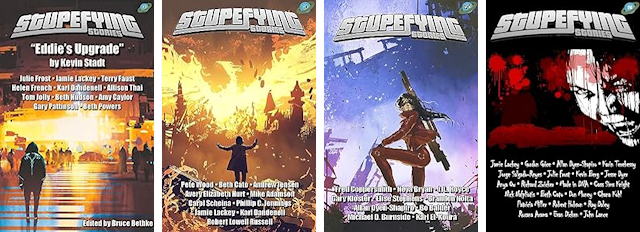
I chose the above collage of covers to illustrate a crucial point. Stupefying Stories 20, with the cover story “Zombie Like Me” by Clancy Weeks, was the last issue we did that moved a thousand copies. Stupefying Stories 21, with the cover story “D.E.W. Line” by K. H. Vaughn, was the last one we did that broke even. Ever since then the trend has been accelerating steadily downward, with the result being that Stupefying Stories 26—our biggest, most recent, most ambitious, and most expensive project in years—turned out to be a Disney Plus-level flop. While we’ve put out some real turkeys over the years, SS#26 is our worst-selling title ever. For what we spent on producing SS#26, I could have given every person who actually bought a copy of it a $50 bill and come out money ahead.

We could talk about the why of this for weeks to come. We could discuss all the couldas, wouldas, and shouldas until we talk ourselves hoarse. None of that matters now. The point is, this is where we are. The window for Stupefying Stories, at least as a monthly general interest magazine, has passed us by. Four years ago we still had a fighting chance. While we were busy dealing with other issues, though, the publishing ecosystem continued to evolve, and one need not have a 12th-level intellect to see that this new world in which we now find ourselves is one in which we cannot thrive. Everyone and their cat has a publishing company and an SF/F/H magazine now. There are too many writers and underfunded small-press publishers fighting tooth and claw for attention and chasing after ever fewer readers. If you want to know what this world looks like from my perspective, read The Mote in God’s Eye, by Larry Niven and Jerry Pournelle.

When we launched Stupefying Stories, it was with the idea that we would use the attention people wanted to pay to me, because of what I did back in the 1980s and ‘90s, to get them to pay attention to newer and younger writers who are writing now. The irony of it is that no one seems to want to listen to me talk about anything new now; they just want me to go on and on and on about what I was doing forty years ago. If you think it’s boring listening to your grandfather talk, imagine being him, and having people be interested only in your stories about The Old Days. 

Then again, perhaps I am dead, and stuck in some circle of the Inferno that Dante Alighieri failed to mention.

§

This is not the end of Rampant Loon Press. Our original novels are doing well, in general. It’s just that in the past year, only Stupefying Stories 25 has managed to crack into our in-house Top Ten bestsellers list. This truth is not the market whispering subtle guidance to us. It’s the market screaming through a bullhorn, “SPEND YOUR TIME AND MONEY ELSEWHERE!”

Consequently, Stupefying Stories must change.

We’re still going ahead with issues #27 and #28. We’re too far along to pull the plug on them now. I had thought about consolidating them into one volume, probably to be titled something like Bruce Bethke Presents The Big Fat Book of Cyberpunk, but Penguin Random House beat me to the punch with this book, which landed on my front porch with a loud thud the other morning. 

Look at it from the SF consumer’s POV. Why take the risk of spending money on new stories by new writers who you probably don’t know when you could drop $32.50 on this one and get a thousand pages of old stories by famous writers? Seems like a slam-dunk to me. If I was a customer, I know which one I’d buy.

§

The future of Stupefying Stories, then, looks something like this. Issues #27 and #28—formerly the cyberpunk-themed issue—will be our last numbered and dated issues. (Unless I change my mind and consolidate them into a single book. That may yet happen.)

Beginning with what would have been #29—a.k.a., “Clankalog”—we’re going to tightly focused “theme” anthologies, on approximately a quarterly basis. We haven’t settled on the themes we’ll be looking at for books to be released in 2024, but one thing seems obvious: no more horror. The market has been quite clear on that point. We can’t do horror, at least not in a form the horror-buying public finds desirable.

SHOWCASE will continue, albeit in scaled-back form. The response to our many calls for support has been gratifying, and we sincerely thank you for your donations and support, but we’re still not bringing in enough each month to cover the cost of publishing new SHOWCASE stories daily. Therefore we’re going to scale back the publication schedule for now, although we reserve the right to increase it at a later date, if we can afford to do so.

There are more changes coming, but these are the biggest ones. Any questions?

Kind regards,
Bruce Bethke
Editor / Publisher
Stupefying Stories | Rampant Loon Press

Tuesday, November 28, 2023

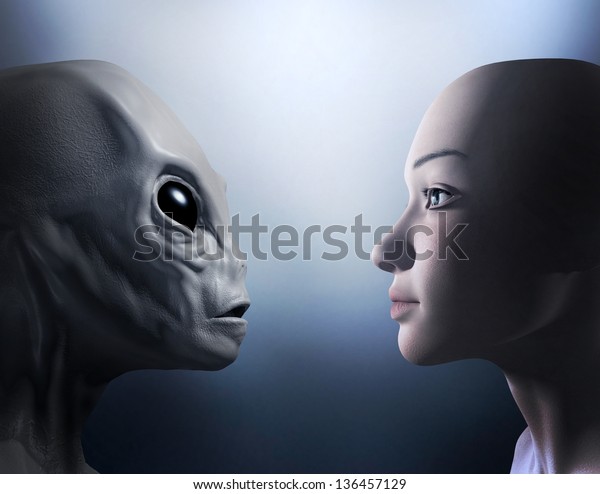
Creating Alien Aliens: Does How Aliens SENSE Their World REALLY Make Them Alien: A Thought Experiment With SOUND…

Five decades ago, I started my college career with the intent of becoming a marine biologist. I found out I had to get a BS in biology before I could even begin work on MARINE biology; especially because there WEREN'T any marine biology programs in Minnesota.

Along the way, the science fiction stories I'd been writing since I was 13 began to grow more believable. With my BS in biology and a fascination with genetics, I started to use more science in my fiction.

After reading hard SF for the past 50 years, and writing hard SF successfully for the past 20, I've started to dig deeper into what it takes to create realistic alien life forms. In the following series, I'll be sharing some of what I've learned. I've had some of those stories published, some not...I teach a class to GT young people every summer called ALIEN WORLDS. I've learned a lot preparing for that class for the past 25 years...so...I have the opportunity to share with you what I've learned thus far. Take what you can use, leave the rest. Let me know what YOU'VE learned. Without further ado...

All right…I want to start doing some experimenting with creating aliens based on the information in Dr. Robert Freitas, Jr’s book, XENOLOGY (link below). So, first the facts/observations and concept: 
ACOUSTICAL SENSES: Two Dimensional

“For instance, water striders…Much like the kinesthetic sensors in human bodies which provide continuous positional and velocity data for each limb (called Proprioception), water striders can detect the slightest disturbance traveling across the surface of the water…one species conducts its entire courtship display using complex patterns of modulated surface waves…”

“[some] spiders are known to use surface wave communication by] strumming the webs they weave in specific rhythms and patterns…between mother and offspring…Desert scorpions can also detect compressional and surface waves in sand to locate prey…”

“…the universe inhabited by such creatures [using] two-dimensional waves [would create a world of] ‘persistence messages’. 3-D acoustical waves pass an observer…one time, never to return again…oscillations in 2-D media die away only very slowly from frictional forces. The entire surface space is set in motion by such stimuli, and damping is often very weak. The media continues to ‘wave’ for a long time after[wards]…[it would sound like] they were in an echo chamber. Words would have a peculiar drawn out quality, persisting long after they have been spoken. And since the higher frequencies always travel faster than the lower ones, each repetition of the echo will sound distinctly different. The word will stretch itself thin, the higher pitched treble notes bunching together at the beginning of the sound and the progressively lower bass tones trailing behind.’”

BTW: this concept has already been PERFECTLY explored in Adrian Tchaikovsky’s, winner of the Arthur Clarke Award in 2016 and nominated for a similar award in France and Germany, CHILDREN OF TIME details a millennia-long Human mission to seed Humanity on another world gone horribly wrong that creates a civilization of intelligent “spiders”. If you haven’t done so, read it for a fascinating story – and an explanation of this form of communication.

I’ll play around with this in my own way: say I’m a First Contact specialist, and there is an obviously sapient civilization on a world that is made up. The atmosphere is going to have to be exceptionally dense, so I’m going to postulate that the world is, while NOT a water world, has an atmosphere that Humans would describe as incredibly HUMID. “If the relative humidity is 100 percent (i.e., dewpoint temperature and actual air temperature are the same), this does NOT necessarily mean that precipitation will occur. It simply means that the maximum amount of moisture is in the air at the particular temperature the air is at.”

I’m going to add a denser atmosphere on this world as well. How do my aliens sense vibrational waves in this dense, wet atmosphere? I’m going to give them long bristles – maybe rigid, protective spines surrounded by a “bush” of delicate, sensitive fibers. Do I have to have them be spiders or other creepy-crawly things? Nah, I’m going to make them a bit like large echidna…spiny anteaters. Not small enough to “step on”; large enough to both hold a complex brain somewhere in their bodies…let’s say in the CENTER of the body mass, well-protected by bone, and equidistant from the surface of “spines and bushes” – plus I’m going to raise them off the ground by giving them four longish motivation limbs, jointed so that movement in any direction is easy. They’ll have a “manipulation limb” between each “leg” – so four legs, four arms, a brain in the center…

They’ll need something to see with…above each arm, an eye, roughly equivalent to a Human eye…nah, how about more like a land snail’s eyes (and nose – they typically have two tentacles with eyes, two tentacles below them that “smell”. So the body is ringed with eight eyes and eight “noses”…

I’m also going to give them fur, though not as boring as Human fur. About half of the fur is a sort of extension of the sensory “bush” and can change color somewhat as well as compress and extend. It’s shorter than the spines, the bush, and the eye and snorf-stalks.

OK, there I am on the Home World of the Echidnates – which is what they’ll end up being called in the Human-Alien Contact records for all time…

How do I talk to them? How do I even approach them?

Approach is easy – they see and smell all around them (BTW, I’m excluding predators and disease at this point to keep the thought experiment easier…) They’ll see me as slightly taller than they are; though very weirdly…spindly and incredibly balanced on two legs – they’re smart enough to be able to recognize Human legs as a version of their own legs. Eyes same thing – smart ones will look at us, see the big knob on top and make a serious connection that OUR sensory organs seem to be clustered on a single tentacle – the legs and arms, while two of each seems to be courting a life of constant falling over, are at least recognizable.

Now for sound. I’m going to give the Echidnate Home World an atmosphere that is, while uncomfortably humid for us, breathable, though the O2 level is higher and the CO2 level is lower. There are some nasty fungi and other microorganisms in the air, though it appears that they can’t gain much foothold in Humans. However, the world around us is less…rigid than our own world.

Trees seem to be limited to Ginko-type plants, maybe palms, lots of hardwood. In fact, from what we can see, there’s not much in the way of “wood stuff” around. Structures appear to be stone, though the main construction material appears to be a sort of “land-based” coral. We don’t seem much in the way of metal tools; though stone, the coral, and other “nonmetals” appear to be used as Humans would use metal. We DO know that they have radio communication minimally, but it seems that LASERS are predominant…

I lift up my hand, and I speak a version of a language we’ve picked up from several of their laser coms. My target Echidnate stops and turns so that two pairs of eyes and noses are aimed at me. One leg forward, the other three back, forming a stable-looking tripod. Two side-arms swing forward, and the third, forward arm hangs, slightly coiled straight at me. “We come in peace,” I say, hoping that we’ve parsed out the words correctly. The landing of our own spacecraft was never hindered by the spacecraft we discovered exploring their star system.

The spines-and-bushes on the Echidnate’s back vibrate and my host opens a thin-lipped mouth above the eye and scent stalks and speaks. The sounds are surprisingly high-pitched, more child-like than what I expected. Suddenly understanding that the higher-pitched sounds will facilitate speedier communication than my lower-pitched male voice, I gesture and one of the women on the First Contact team who steps up and repeats our message of greeting…I also wonder if they have four mouths as well. I make a mental note to talk with our xenobiologist – what and how they eat will be another interesting aspect of these new sapient beings.

We recall that, somewhat like Humans, the Echidnate sense their world in a more-or-less single dimension. We also notice that the one we’re trying to contact stands in front of a curved wall of solidly-grown coral colored bright blue. I can hear the fain echo of our voices, as if the Echidnate is standing at the focal point of a parabola…

OK – there you go. Using the information I had and extrapolated, I now have a totally new alien; one I’d never imagined…

Next Time: ACOUSTICAL SENSES: Three Dimensional

Source: http://www.xenology.info/Xeno/13.3.1.htmhttp://www.xenology.info/Xeno/13.3.2.htm
Image: https://image.shutterstock.com/image-illustration/alien-human-600w-136457129.jpg

Saturday, November 11, 2023

Armistice Day 2023


One hundred and five years ago today, the guns on the Western Front fell silent, and the “war to end all wars” came to an official close.

That wasn’t exactly what really happened, of course. On the Eastern Front, the Great War segued into the Russian Revolution, followed by the Polish-Soviet War, and then the Russian Civil War. On the Greco-Turkish front the fighting continued until 1922, and in a very real sense what is happening in Gaza today—and in the streets of London right now—is lingering fallout from the collapse of the Ottoman Empire then.

But back to 1918. If you read German sources, you’ll find the German military leadership at the time considered the 11/11/18 Armistice to be merely an opportunity to fall back, rest, reorganize, re-equip, and get ready for the next chapter in the never-ending war between the Franks and the Saxons, which with rare exceptions has been going on since the time of Charlemagne. 

Never mind that now. Let us accept for the moment that on November 11, 1918, “the war to end all wars” officially came to an end. The older I get, the more poignant this anniversary becomes to me, while at the same time the more horribly sardonic H. G. Wells’ 1914 propaganda phrase—yes, H. G. Wells, not Woodrow Wilson, coined the expression, “the war to end war”—becomes as well.

The Great War was my grandparent’s war. As I sit at my desk and write this, if I were to look up, I’d see some of the medals my great-uncle won as an infantryman fighting in the mud of the trenches. Charles Everett came back from his war, but according to my mother, he was never the same again.

The Great War, Part 2, was my parent’s war. I’ve had the privilege of interviewing soldiers who landed on the beaches of Normandy on D-Day, fought in the island-hopping campaigns of the Pacific, and flew and fought in heavy bombers over Germany. To this day I remain in awe of what they did in those terrible days. My father was U.S. Navy, but like Robert Heinlein, he was sidelined by a medical condition and never saw combat. My father-in-law was a Marine Corps Pacific Theater combat vet; he never talked about what he saw or did. My wife’s Uncle Leon died in the Battle of the Bulge, and for sixty years his family didn’t know where he was buried, until a family friend on assignment to NATO headquarters in Brussels happened to find his name on a headstone in the Ardennes American Cemetery.

To me, though, the face of WWII will always be that of my childhood best friend’s father, Ben. He was a Navy landing craft crewman attached to a Marine division, and his service record reads like a list of the Hellholes of the Pacific. On those few occasions when he talked about his time in the Navy—usually after quite a few drinks—all he could talk about were all the friends he’d left behind, face-down in the sand on some faraway beach. He came back from the war, but never really came back, and before he turned 50 succeeded in committing suicide by drinking hard liquor and chain-smoking Camel straights.

My teachers’ war was in Korea. I’ve had the privilege of knowing men who landed at Inchon or fought at Chosin Reservoir. My generation’s war was in Viet Nam, but through the grace of God and a high draft lottery number, I missed it. Far too many of my friends and relatives got the invitation to the party, though, and some came back in boxes. Some never came back at all, we only know approximately where their aircraft went down. Some came back damaged, either physically or psychologically, while others came back just fine. Two of my best friends seemed to have come back just fine, only to explode in cancer years later, likely as a result of exposure to Agent Orange. 

I have had the honor of knowing, and sometimes even hiring, young soldiers who have come back from Iraq or Afghanistan. All the same, I fear that in years to come, we’ll learn that GAU-8 ammunition exposure was every bit as bad as Agent Orange.

In all these years, though, and after all these wars, I have learned that one thing is universally true. Anyone who is eager to talk about his or her time in the service—anyone who talks about the glory of war—anyone who insists that young people (and preferably someone else’s young people) should be proud to have the opportunity fight and die for their country—

Was probably a REMF.

Those I have known who were in the shit—in Normandy, or in the Pacific, or at Inchon, or as a door-gunner on a Huey flying over Quang Tri, or acting as a bullet magnet in Helmland Province—what they always talk about are the friends they left behind. 

So here we are, on Armistice Day. Once again I will pray for peace, but I fear that war is baked into our genome. I am not concerned for myself, or even for my children—they seem to be doing okay—but I think of the world in which my grandchildren will live, and try not to shudder. We Americans have been really lucky, these past forty years. No run of good luck lasts forever. 

Thus when the sun sets tonight, I’ll take down my American flag, carefully fold it and put it away, open a bottle of wine, and raise a glass in a toast: to those who never came home

May there be no more.


Monday, November 6, 2023

The Never-ending FAQ • tearing up our Q4 2023 schedule


This was always going to be a difficult month. 

The events of a year ago are still very much with me, very much on my mind, I’d just made a choice to stop talking about them in public. If you’ve been following Stupefying Stories for a while you know what I’m talking about. If you’re a newcomer, you’ll find the gist of the story here and the conclusion here. I’d unpublished these posts because I’d gotten tired of seeing them in the “Most Popular Posts” widget in the right column. I expect I’ll unpublish them again in about a week, but for today, I’ve made them visible again.

I had thought that if I threw myself into work and built up momentum with issues 24, 25, and 26, I’d be able to plow through October and November with barely a hitch. Doing 26 as a double-issue was, in hindsight, a mistake. By the time it was finally out the door I needed a few days’ break from work, to rest and recuperate, so I took those days off.

And then the terrorist attack on October 7th happened…

I had been doing a lot of spelunking through my old archives recently. With issue 27 in the works and the 40th anniversary of “Cyberpunk” coming up, I was getting interview requests and invitations to speak and the like and wanted to refresh my memory as to just exactly what was in my mind when I came up with the idea, 43 years ago. One thing that stood out in my notes, and that I’ve spoken about only rarely, was that cyberpunk in part began as a strong and cynical negative reaction. In the late 1970s, a lot of very authoritative people were going on and on about what a wonderful future lay ahead of us, once the whole world was wired and we had the free flow of information to and from everybody everywhere. It would usher in a new age of peace and understanding, they said, as we all got to see how much we were alike and how much we all shared. 

No, I’d decided then, that wasn’t how it was going to play out. Instead, I wrote, “In the future, anyone with a television camera, an AK-47, and a willingness to commit atrocities can be a player on the world stage.”

I hate it when my most dark, cynical, and misanthropic ideas turn out to be not dark, cynical, and misanthropic enough.  

§

October thus turned into a washout. The whole idea of filling the month with “fun” horror stories on SHOWCASE seemed to be—well, in questionable taste, to say the least. There were stories I had scheduled that I elected to delay or defer, at least until I wasn’t getting my daily dose of horror from watching the evening news. As for work on issue #27—well, I’m back to work on it now, but my usual sense of humor and optimism took some serious hits in these past four weeks, so I’m behind schedule.

Ergo, here’s where we stand, as of today.

STUPEFYING STORIES 27 • The 40th Anniversary of Cyberpunk issue is in progress. I’m hoping to have it ready to release by the 15th but will be happy if it’s out by the 20th.

STUPEFYING STORIES 28 • This was originally planned to be “Clankalog,” but we received so many outstanding stories for #27 we decided to do two back-to-back cyberpunk-themed issues instead. This one is also currently in progress, and I’m hoping to have this one ready to release on December 1st. I’m also hoping that spreading the release out to be what is essentially #27, Volume 1 and Volume 2, won’t be quite as exhausting as just plain doing a double-issue.

STUPEFYING STORIES 29 • This is “Clankalog,” the hard sci-fi issue, previously planned as SS#28 and scheduled for December 1st and now planned as SS#29 and scheduled for a January 1st release. If all goes according to plan—yeah, right, like that ever happens—we should have it buttoned-up by mid-December. 

We’d better have it done by then. Because at that time—here’s your last-paragraph bombshell—I’ll be going in for eye surgery and will be unable to work on anything that requires being able to read for a period of one to two months.

Nil desperandum,
Bruce Bethke

Tuesday, October 31, 2023

“The Night Parade” • by Robin Blasberg

The streetlamps cast their eerie glow upon the pavement as the parade marched along the empty street.

A small boy beat his drum at the back while the others sang innocently in front of him. Mary Had A Little Lamb rang out from their youthful voices. The drum thumped and the verses grew louder as they turned onto the cul-de-sac. The houses were all dark except for one. The children saw the dim light shining in the window above and shouted, “Come on out and play!” A terrified face peered down at them. The curtain snapped shut. There was the scrambling of feet down the stairs, and a bolt was drawn. But it was no use. The children broke into laughter and passed effortlessly through the front door. They joked and jostled each other as they followed the panicked maid to the second floor. The woman futilely tried to block their way to the room. But it was no use. As they crossed the threshold, they began to chant, “Ring Around the Rosie.” The thermometer dropped from the mother’s hand when she saw them, the cracked glass slicing through its last reading, 104 F. The house filled with her shrieks as the ghouls held out their hands to her child.


Robin Blasberg’s stories often make connections in unanticipated ways. Expect the unexpected because clever twists and surprise endings are trademarks of her work.


Saturday, October 28, 2023

“Graveside Dining” • by Angelique Fawns


Alma Smith’s stomach made somersaults as she rolled down the car window for some fresh air. The façade of the centuries-old cathedral cast long and wavery shadows on the driveway into London’s oldest burial grounds. 

Hopefully, all the ghosts of Nunhead Cemetery stayed quietly underground, where they belonged. She stuck her head out the window and inhaled decomposing leaves mixed with the sports car’s exhaust.

Angus's fingers drummed on the wheel of his Mercedes.

“This is where you’re taking me to lunch?” She asked.

Angus nodded. “Only displaced spirits talk to you, right?” He pointed to the mossy gravestones. “Isn’t everyone here in the right place?”

Some tension left Alma’s shoulders. “No one thinks to hide a murder victim in a graveyard, do they?”

A smile peeked through Angus’s beard. “One picnic to go. Complete with wine, avocado, and Kosher salt.”

“Avocado and salt?”

Angus winked. “My favorite snack. This looks like a nice spot.” He pointed to a sycamore tree sheltering ivy and bramble-covered tombs.

She surveyed the ancient, leaning stones, the mossy patches, and the beam of sun dancing through the trees and nodded. “For graveside dining, it’s perfect.”

They laid out a checked blanket and she accepted a glass of white wine.

Alma giggled, as the big man tried to get comfortable sitting cross-legged. He self-consciously pulled at the crotch of his jeans.

He shrugged, pink rising in his cheeks. “This might be the first time I wish I was wearing a dress.” He took a swallow of his own wine and wiggled closer. “It’s also the first time I’ve ever heard you laugh.”

Angus leaned in for a kiss and Alma closed her eyes…

The air turned frosty. Alma gasped as black smoke curled out from behind the mossy gravestone. Her knees trembled.

“Alma, are you okay? What’s happening?” Angus asked, jerking back. “I thought old souls in graveyards left you alone?”

Her teeth chattered. “I don’t know what, or who this is, but it's not normal.”

Angus tried to put his arms around her shoulders, but Alma shook her head. “Please don’t touch me, that makes it worse.”

Angus wrung his hands as Alma rolled onto her hands and knees. She fought for breath as the dark mist swirled around her, thickening and morphing into a figure.

“What can I do?” Angus asked. “I don’t see anything. Tell me what’s going on!”

She shot him an anguished look. “I’ve never experienced pain like—”

Alma swallowed her words. She could no longer see Angus or the cemetery. Her surroundings faded to a grey, gloomy street circa 1880. How did she end up in the Victorian era?

The dark mist was now a tall figure in a long black coat. With every minute that passed, he became more solid.

“Thou art a fine beauty, aren’t thee? Would ye be looking to make five shillings?” The man’s face was shrouded in shadow, and his tone was gravelly and wheedling.

“I’m not a prostitute. Go back to your grave.” Alma slowly got to her feet. “I don’t know who you are, but your soul should have moved on centuries ago.”

He gnashed stained teeth. “Look at the gown you’re wearing, only a woman of certain proclivities would be in the streets dressed as such.”

The figure gained more substance, and Alma could make out a mustache and serpent eyes.

“You’re not real!” She made the sign of the cross.

“Ahhh, too much of the poppy hath given you delusions. A moment in yonder back alley will have you back to sorts.” He took a step towards her, slipping a gloved hand into his pocket.

She saw the glint of steel and screamed.

“Alma, what can I do for you?” Angus’s panicked voice sounded like it was coming from the end of a very long tunnel.

The cloaked man grabbed her arm. “It’s been so very long. You shall keep me company. I love the ladies of disease and desperation.”

She gasped and spun out of his grip. Fury creased the apparition's face.

“Angus. What is the name on the tombstone? The old, mossy one?” She strained her vocal cords, hollering into the mist.

She tried to back up a step but couldn’t move.

Angus’s thin voice echoed though distorted time and space. “I’m trying to read it, but the name is so faded. I can’t tell!”

Alma felt the blood drain out of her face. She addressed the ghost. “Who are you? Why is your soul so malevolent?”

The apparition gave a chilling chuckle. “Everyone doth ponder that. Yet I remain a mystery.” He swiped his knife at her throat.

She dodged the blow and screamed up to the sky. “Angus, pour your salt around the grave! Be quick.”

Every second she remained in this hell world, the setting became more real.

The lanterns were brighter, the buildings more solid, and the handsome lines of the killer’s face grew sharper.

The ghost, more solid now than even a few seconds ago, flung his arms around her and hoisted her to his chest. “Let’s continue this parlay in the alley.”

Alma struggled but she was no match for the mad soul. He shoved her against a damp wall and placed his knife against her throat. She felt the sharp edge pierce her skin...

She shut her eyes and felt warmth wash over her. She spun out of the Victorian dimension with a sickening lurch, worse than the descent of a roller coaster.

Falling onto the picnic blanket, she heard the ghost’s enraged yowl as he dematerialized into a dark mist and was swallowed back into the tombstone.

Angus encompassed her in a massive hug. “Are you okay? That was crazy.” He brushed her sweaty hair off her forehead, his gaze filled with concern and panic.

“I’m okay. You put salt around the tomb?”

He nodded and she saw the ring of kosher grains encircling the ancient marker.

Alma got to unsteady feet. “That should keep him in place for a bit, but I think I’ve lost my appetite.”

Angus took her hand and the two of them climbed back into the Mercedes.

“I’m so sorry--”

She cut him off. “What are we doing for our second date?”

He grinned sheepishly. “I’m assuming you’d like to avoid cemeteries?”

Alma laughed and rubbed his knee. “No cemeteries, but please bring lots of salt.”


Angelique Fawns is a journalist and speculative fiction writer. She began her career writing articles about naked cave dwellers in Tenerife, Canary Islands. Her stories have only gotten stranger since then. She spends her day job creating promos for reality shows like Big Brother and Survivor, and lives on a horse farm with her family. Though she has no idea how she finds time to write, it often involves hiding in a dark corner of a pub, sipping on Chardonnay, and letting her nightmares spew onto paper.  Find her work in DreamForge, Ellery Queen’s Mystery Magazine, and Stupefying Stories, to name a few. If you dare, check out her podcast, Read Me A Nightmare, or her blog at https://www.fawns.ca/


Friday, October 27, 2023

“A Touch of Silver” • by Robert Walton


I touch my hair, my silver earrings—still in place after my dash across the rain-slick street. They came to me from my grandmother, so I treasure them. Besides, silver is so becoming.

Someone is following me, someone who does not mean me well. Footsteps—flat slaps on the pavement made by a big man, no trick-or-treater—pace closer. I touch the ivy-covered fence next to me, brushing my fingers through cool leaves until I reach an iron gate. It is ajar. I slip through and push its spiked bars shut behind me, gently so the latch doesn’t click.

A house looms like the prow of a ship, vast and Victorian. A window on the second floor is broken, one shutter hanging askew from a bent hinge. The other windows are dark, gaping like missing teeth.

The footfalls on the other side of the fence sound louder, nearer, and then they stop next to the gate.

He must have seen me. I hurry to the front porch, mount its steps, pause in deep shadow. The gate creaks open. An enormous man dressed in black slides through. His shaved head reflects moonlight above rolls of fat on his neck. The blade of the machete clenched in his right hand gleams.  

The front door yields to my push and I slip into a hallway. Shadows dart and skitter from my intrusion like panicked mice, scattering into deeper shadows. A rutch of claws on hardwood indicates the departure of a king rat. I hesitate, though not from revulsion. Rodents don't disturb me. 

A ponderous tread on the porch urges me forward. I pad through deep dust, cross the hallway and enter a musty parlor. I pass rodent-chewed chairs and loveseats, exiting through a door in the opposite wall. 

An eccentric stairway ascends to the upper floor. I take it two steps at a time. A hallway lined by closed doors awaits me. One door is open at the corridor's end, beckoning to me. I make for it as glass shatters below.

I reach the doorway and enter what once was the master bedroom. Moonlight shines through tall windows. A massive oak armoire stands against the wall to my right.  A canopied bed rises to my left like a clipper ship under full sail. 

Fatso's heavy tread wrings squeals from the stairs and then from the hallway's floorboards. He's faster than I thought. The door splinters against the wall. I whirl.

He stands grinning in the doorway, his broken teeth reflecting moonlight. “Hello, little lady.”

I do not reply, but step toward a window.

His eyes follow me, rolling like black marbles beneath his cliff of a brow. “Stand still. It will be over soon enough.”

I’m sure it will. His biceps bulge as he clenches the haft of his machete. It quivers with his eagerness. He takes a sudden step forward and swings the blade toward my face.

I leap inside of his swing, grip his right wrist, and stop the blade’s glittering edge inches from my throat. His eyes widen with shock. He grunts, strains, but the blade remains frozen in the air between us.

“I’m stronger than I look,” I murmur.

His muscles flex again as he tries to snatch his hand out of my grip. I tighten my hold, squeeze until I feel his wrist bones grate together. Sweat springs out upon his forehead.

“My stature,” I purr, “is somewhat variable, but I'm in petite mode tonight—five foot two, eyes of blue—you get the picture.” I press my small but distracting bosom against his midriff. 

“What are you?” he gasps. “Some sort of vampire?”

“Vampires are nouveau, dear.” I smile as sweetly as I can, showing my normal dentition. “I’m a ghost and I’ve lured you into my house.” 

“A ghost?”

I nod. “Or perhaps an angel—a dark angel.”

“A dark angel?”

“Very dark. I had unfortunate experiences with a certain man, you see, the man who owned this house when I was but a girl. He pulled me into this very room. I never left it—alive.”

Drops of sweat slide down the creases of his neck, but he does not speak.

“You’ll understand that I have issues with bad boys like you.”

“I’ll leave now,” he gasps. “No problem.”     

“Yes, you will.” Still gripping his hand, I step back and inspect him. “I could use a familiar, a nice black ghost cat.” I shake my head. “But I'm afraid you'd make a very chubby kitty.” 

He pushes with all his strength, trying to thrust me away. I lean closer and whisper in his ear, “Have you any last words you’d like to share?”

His lips make round, gasping motions like those of a beached trout.

“I thought not. None of the others did either.” I raise my right hand and give it a flick to extend my talons. I turn them and they catch stray gleams of moonlight. “Do you like my needles?” I caress his double-chin with their tips. “Silver is so becoming to a lady, don’t you think?”

His face contorts. “Please!”

“Certainly!” I plunge my needles beneath his chin, through his throat into his brain. He quivers for a moment as if thrilled. Then his dead weight slumps to the floor.

“Treat!” I hold my crimsoned talons up to the moonlight, admiring their scarlet gleam. “Or trick!”


Robert Walton retired from teaching after thirty-six years of service at San Lorenzo Middle School. He is a lifelong rock climber and mountaineer with ascents in Yosemite and Pinnacles National Park. He’s an experienced writer with published works including historical fiction, science fiction, fantasy and poetry. Walton’s novel Dawn Drums won the 2014 New Mexico Book Awards Tony Hillerman Prize for best fiction. “Sockdologizer,” his dramatization of Abraham Lincoln’s assassination, won the Saturday Writers 2020 Everything Children contest. Most recently, his “Mansa Musa’s Wisdom” was published in Cricket Media’s February, 2022 issue of Spider magazine.

http://chaosgatebook.wordpress.com


Have a Kindle? Find out what you’ve been missing!
Buy the four latest issues with just one click!

(Or buy just one, if that’s what you’d really prefer.)

Thursday, October 26, 2023

“Maria” • by Jason D. Wittman


My husband picks you when he learns your name. As you speak intimately of Rembrandt and Van Gogh, tossing your mane of copper hair, he thinks it no coincidence that we are both named Maria.

My husband is a fool.

You show samples of your work, saying art restoration is like archaeology, seeking clues to how the work once looked. He says my portrait cannot leave his country estate, being too delicate for transport (utter nonsense—he wants you there), and it is all he has left of me since my untimely death. He shows you a photograph.

You see my face, dark hair, dark eyes, olive skin. You think I look angry.

I am. But not at you.

You ask about the women in the background—the short-haired blonde reading by a tree, the raven-hair wearing a maroon scarf strolling by the lakeshore, seven in all. To your eye, they clutter the background—were they added by subsequent artists? 

Jonathan says they are part of the original painting, and must be treated accordingly.

§

The taxi takes you past fields and forests to the Trevanion estate. Jonathan only occupies it in summer, and when he leaves, so do the staff.

You don’t go inside just yet. The lake to your right looks inviting.

Its shore is rocky. Though the water looks deep, you know diving is not a good idea. You have a swimsuit in your luggage. You change, walk carefully to the edge, and lower yourself in.

The water is amazingly clear. You go down to gauge its depth, and encounter large, jagged rocks. Numerous fish flash silver in the tinted sunlight, and you playfully tickle a few.

When you come ashore, you sense someone waiting for you. But when you look up, no one is there.

You change again, and let yourself into the manor.

The furniture is covered with sheets, like cartoon ghosts poised to startle the unwary. Artwork adorns every wall. And in a top-floor room, with a wide, south-facing window, resting on an easel, is the portrait.

A photograph is nothing compared to reality. You sense my anger more keenly, though I only show it through my eyes.

It is too late in the day to start work now. You go to the kitchen, make a light supper, and go to bed early.

Your dreams are troubled.  You run through the manor, hearing anxious whispers to flee at once—but you never find the exit.

§

At dawn, you eat eggs and toast, and take your toolbox to the top-floor room.

Jonathan was not wrong about those background women. Your magnifying glass and ultraviolet flashlight show that clearly. But you still think their presence makes the painting feel crowded. And these women—the book-reading blonde, the scarf-wearing raven-hair, a blonde on the balcony, a brunette on the rooftop(!) in tight jeans and a turtleneck—don’t look like mere models but real people.

But your task is straightforward. You open your toolbox, draw out your solvents, pigments and brushes, and begin.

§

In the end, it is flawless. You tell Jonathan so on the phone: the scratch beneath my left eye is gone, the years of dust are sponged away, and the women’s faces show much more clearly. The work only awaits Jonathan’s approval.

“Good,” he says. “I will be there in three days at the most.”

You hang up, thinking you have time to celebrate.

We would warn you if we could.

§

You plan on ordering a gourmet pizza. Before that, however, you decide on a dip in the lake.

You don your swimsuit, walk gingerly among the rocks, and ease yourself in. It’s cooler than when you first came here, but nothing you can’t handle. The lake is clear as ever, and the fish are much more sluggish, making it easier to tickle them.

When you climb ashore, you look up in time to see Jonathan holding a rock.

He was planning to murder you all along. He thinks I want more company in my painting.

It began with Maria Bailey, the raven-hair by the lake, because she looked very much like me. Months after my death, Jonathan saw her, learned her name was Maria. They became lovers. Then he showed her my portrait, and she realized he was not loving her, but loving me through her. They argued, fought, she slipped, knocked her head against a hearthstone, and died.

I accepted her into my portrait because I pitied her. Yet doing so started a vicious cycle. For Jonathan saw her in my portrait, saw my look of pity for her, and mistook it for gratitude for providing me with company. And when that look of pity faded and became anger toward him, he thought I wanted more company. Thus, Maria Kivi reading by the tree, Maria Relph watching clouds from the balcony, Maria Fuller wearing her turtleneck and tight jeans, Maria Kacey, Maria Olsen, Maria Reddy.

All named Maria. That’s why he chose you.

Jonathan raises the rock. But you are no shrinking violet. You fight back.

The contest is too evenly matched for our liking. We exert our wills to try to affect the outcome.

We don’t quite get the result we want. Jonathan slips and falls to his death… but so do you.

§

You break the surface, wondering by what miracle you survived. You see us waiting on the shore.

“Take my hand,” I say.

The other Marias welcome you with open arms. “It’s all right,” says Maria Bailey, draping a towel around your shoulders. “You’re among friends now.”

The others turn back to the lake, knives in their hands. When Jonathan surfaces, I take his hand, and the others stab him dead.

You’re in the painting now, in case you haven’t guessed. You will begin each day rising from the lake. And each day we will kill Jonathan as he steps ashore.

We are happy in this afterlife he has sent us to.

But that doesn’t mean he gets to enjoy it.

__________________________

JASON D. WITTMAN lives and works in Minnesota. He has had published fiction in Scifi.com and Baen’s Universe, as well as three previous stories, “Emissaries from Venus,” “The She-Dragon of Bly,” and “Once Upon a Horror,” in Stupefying Stories.  He has also had two games published by Steve Jackson Games, and can recite Edgar Allan Poe’s “The Raven” from memory.

________________________


In a world...


Where the Soviet Union won WWII, England is now a Soviet satellite, some magic actually works (sometimes), and Premier Kruschev is going eyeball-to-eyeball with President Patton—

The last surviving member of His Majesty’s Dragonslayer Corps is called out of retirement, because it seems dragons aren’t extinct after all, and one has taken up residence in a prominent Politburo member’s country estate. Read the rest in THE SHE-DRAGON OF BLY, by Jason D. Wittman, just one of the terrific tales in STUPEFYING STORIES 22!

Available in paperback only, for reasons too arcane to explain.


Have a Kindle? Find out what you’ve been missing!
Buy the four latest issues with just one click!

(Or buy just one, if that’s what you’d really prefer.)