Friday, August 18, 2023

Six Questions for… Allan Dyen-Shapiro

[Editor’s note: “Six Questions for…” is a new feature we’re going to be giving a test run for the next few weeks. The idea is to go beyond the usual tiny author’s bio and give readers a better sense of who our authors are. If you think of a question you’d like us to ask, feel free to put it in the comments. We can’t guarantee the author will answer, but we’ll put it on the list of questions to ask in future profiles.]

Six Questions for… Allan Dyen-Shapiro

Allan Dyen-Shapiro is a Ph.D. biochemist currently working as an educator. He’s sold stories to numerous markets including Dark Matter Magazine, Flash Fiction Online, and Grantville Gazette. He also co-edited an anthology of SFF set in the Middle East. He is a member of SFWA and Codex. You can find links to his published stories (and some freebies) as well as his blog, where he opines on matters of interest to those who might like his fiction (environmentalism, futurism, science, literature, and science fiction in all media), at allandyenshapiro.com. Follow him on Twitter (@Allan_author_SF) and Mastodon (@Allan_author_SF@wandering.shop); friend him on Facebook (allandyenshapiro.author). 


Q: Who do you consider to be your most significant influence?

A: I'd have to say William Gibson. I didn't grow up reading science fiction. Sure, I read a lot of science-fiction adjacent authors like Kafka and Pynchon, but I grew up thinking about that as "literature." (Cue the chin rising in the air pretentiously and faux-British accent.) About 2001, I was heading for a vacation where I'd be staying with my in-laws and figured there'd be plenty of downtime, so I needed a book to bring. I happened to read that day in the New York Times a retrospective on this thing I'd never heard of called cyberpunk. The main name mentioned was Gibson's. So, I went to the local used bookstore, hoping to snag a copy of Neuromancer. They didn't have it. They did have All Tomorrow's Parties. When I read it, I was astounded. Somehow, without a science background, this author had written a main character that was doing my job. At the time, I was a biologist trying to deal with the enormous complexity of signaling pathways with very diverse types of data. My reputation depended on being able to keep an entire subfield of biology in my head, along with experimental details and how we were modeling it mathematically. Very few others could do this. Computers were not sufficiently advanced to do the sort of "assumption tracking" that I was doing in my head. Indeed, when I paired off with some of the world's top computer scientists and my engineering collaborators to write grants to fund trying to make software that would do what I was doing, we almost got funded. (Top grant in a joint NIH/NSF program that got nixed for political considerations, among other bad luck.) The only thing Gibson's protagonist had over me was a drug that enhanced his ability to synthesize a gestalt picture from disparate data. To me, that was the only science fiction element in the book, and it looked highly plausible that this drug could exist.

The thought occurred to me: I bet I could write this stuff. When changes to funding politics kicked me out of research, I began a concerted effort to read anything anyone suggested to me was good science fiction, beginning with cyberpunk. Once my career chaos phase ended with me holding a stable job (as a high school teacher), I put my first words to paper. (Okay, not literally—I can't read my handwriting, so, of course, I did it on a Mac.) It's not the 1980s, there are plenty of things that even the original cyberpunks no longer do because it would be dated, but there is a cyberpunk sensibility underlying all of my writing, even those pieces where it would not be readily apparent to a casual reader. 
 
And William Gibson is still  the only science fiction author where I've read everything he's written, although I've come close with Kim Stanley Robinson and Neal Stephenson.


Q: Of everything you’ve had published so far, which book or story of yours is the one you are most proud of? Where can readers find it?

A: This is a tough question, as I am proud of every story I ever sold (or tried to sell). If I had to pick the stories on which I've gotten the most positive feedback, I'd say there are three of the at-latest-count twenty-three I've sold that generated the most buzz. When the idea came into my head for software that puts social media posts into iambic pentameter, I spent a week laughing about it and knew I had to write a story around it. "Like Him with Friends Possess'd" ran in the December 2019 issue of Flash Fiction Online. Free link to the story here: https://www.flashfictiononline.com/article/like-him-with-friends-possessd/ "Side Effects" ran in the March/April 2023 issue of Dark Matter Magazine. It's simultaneously a hard SF story about psychiatric side effects of a medication, a soft SF story about quantum mechanics, and a comment on the Israel/Palestine conflict. Free link to the story here: https://darkmattermagazine.shop/blogs/issue-014/side-effects "Kaddish for Stalin" is an alternate history story that imagines Stalin dying seven years earlier than he did, with de-Stalinization delayed until the 1980s. It is set in the present day, in Birobizdhan, in a Jewish homeland that in the real world was propaganda. It's a Prodigal Son returns story, centering on the conflict between a staunchly Stalinist and traditional older man and his son, a Beijing-based restaurateur, a capitalist, and gay. This ran in the anthology Other Covenants: Alternate Histories of the Jewish People, which can be purchased at all the usual places.

 
Q: What is your favorite beverage to drink while writing? 
 
A: Has anyone ever answered anything other than coffee? I'm not Hemmingway; his motto (write drunk; edit sober) would lead to garbage in my hands.

 
Q: How do you balance writing vs having a life?
 
A: It wasn't easy when I still had kids at home. They, the day job, and life's odds and ends all took higher priority. My advice: grow old. My kids are now gainfully employed, and money is much less tight than it used to be. I'm just over seven years from Medicare—that's when I'll be able to go full-time writer. Progress today is still slower than I'd like, but as long as things are moving forward, life is good.


Q: Your story, “Caliban’s Cameras,” which is coming September 1st in STUPEFYING STORIES 25: is there anything special you’re hoping readers will notice or appreciate in it?
 
A: Stylistically, I consider it the most William S. Burroughs-influenced thing I've ever written—I was going for a Naked Lunch-like feel with the cut-up style juxtaposition of vignettes that together made a story. Thematically, I'm hoping it isn't prescient. The Florida State Legislature nearly passed a bill last year that would have put cameras in every classroom. It never reached the final voting stage, so I guess this story is still science fiction. Unfortunately, this story, which you bought for Stupefying Stories in 2013, is still relevant politically. Speaking as a teacher in Florida, every alarm I was sounding then should today be ramped up in volume. 
 
2013 was before the current attacks on transgender individuals and the Governor's campaign to convince the world that slavery was hunky dory. For marginalized individuals in this state, it's too late for cautionary tales. Fascism has arrived (although, to paraphrase William Gibson, it's not evenly distributed). Still, I write mainly to jumpstart conversations that need to happen, and I think there's much in here that should be discussed, even if I should probably get working on a new story that addresses the most recent atrocities.

 
Q: What’s next for you? What are you working on now?

A: I have a climate-fiction novella on submission. I have written a near-future science fiction novel, but I paused my agent querying for the pandemic, deciding to make a big splash in shorter fiction before I resumed it. I'm still splashing. Lots and lots of short stories are somewhere in the pipeline. 
 

Q: Any closing words for readers?
 
A: Check out my website—blog, original stories found only there, links to published stories.

“Clinical Progress of Witness Deprotection Client L.M. as Transcribed from Taped Recordings”
• by Allan Dyen-Shapiro


Day One

What I remembered right after your machine zapped my brain? The guy had nice shoes. Stool was knocked over. His legs were still kicking—must’ve been a hanging. I could only see from the knees down.

Did I off him?

Maybe, but more likely, I used to know who did. It would make more sense. You don’t protect nobody by erasing their memories unless they know something.

That’s all. You happy?

Is it enough for me to get paid?

Day Two

What I remember most about today is lunch. The veal parmesan the nurse brought was as good as my mother’s.

But I’m sure you’re more interested in the details this morning’s electroshocks brought back to me. In the stiff’s room, a picture hung on the wall. The frame was gold like in swanky museums. And it was oil on canvas, the way Rembrandt painted, not a photo snapped in some department-store studio. A lady’s portrait.

The wiseguy dangling from the rope had murdered her. I don’t know how I knew that.

Nothing else. Could I get seconds on the grub?

Day Three

Today, I saw his desk. A stack of scientific articles sat on top, and I could read one of the abstracts. I’m not certain how an auto mechanic like me understood, but I did. Psychiatry research: a monkey was fitted with a cap containing wireless electrodes, and zapping the brain suppressed memories.

You think you could get me in touch with the professor who wrote it? The mob owns my shop, and I know some of the bigwigs. They’d be interested in a way to never worry about subpoenas again.

You’re shakin’ your head. Oh, well.

Anyways, the researchers brought the memories back by “deprotection”—this was the word used in the title—Deprotection Protocol for Restoration of Erased Memories in Macaca mulatta.

Maybe you can help me, Doc. I know—your experiment, so your rules—you ain’t talking to me. But if I tell you what I think I understand, could you nod if I get it right?

Oh, good. Well, the article said the memories get rejiggered over time, so something that once made you sad don’t upset you no more. The reworking still happened with the erased memories. When the memories were restored, these monkeys could recall details, but they weren’t unhappy. The animals also regained other memories that had disappeared as collateral damage. Communication—the monkey equivalent of talking fancy—improved, too. But the apes got one shot—the guy botched it with the first ones, and they never got their memories back.

Wait—you’re the author. And I’m your patient. Was I the first human? Yes?

Really. How long have I been without my memories? You’re holding up two fingers—two days? Two months? Two years?

I spent two years without my memories? Well, you showed me the consent form, so I must’ve had reasons I agreed to it.

Was my procedure successful?

Dammit! All you’re going to give me is a shrug?

Day Four

I fucking hate you. Scientific method—yadda, yadda—I get it, but frankly, doctor, your bedside manner is terrible. What kind of psychiatrist doesn’t talk to his patient? Sure, I read the article you gave me. The individual must lead in rewriting his narrative identity, but McAdams’ theory pertained to standard psychotherapy.

Fine—I’ll cooperate if it’s the only way to figure out who I am. I pictured more of the desk: walnut, with a honey smell as if polished with beeswax, flush against the wall. An armchair was pulled out, as if someone seated in it had been using the desk to write, and a suit jacket was on the chairback. A newspaper lay on the desktop. The front-page headline was about the pandemic, the one five years ago.

The guy was a journalist. Old school—the desk drawers overflowed with clippings, photocopies, and scrawled notes. He must have been working on a story about the disease because everything, except your manuscript, looked like virology.

And you won’t let me read his articles. Terrific.

Day Five

I glimpsed the hanged man’s face in the mirror that fronted the lady’s jewelry armoire, and I recognized him. He was gaunt, hair disheveled, bleary-eyed, gasping for air.

Nobody executed him—he attempted suicide. How do I know this?

Because the man was me.

The woman in the painting—my wife—had succumbed to the disease. It was the day of her funeral. I’d attended—the blazer was from my suit. Our adult children hadn’t—they’d lived out of state and would have had to quarantine.

She’d been my reason for living. She died because I’d passed her the virus, and for the crime of snuffing my goddess’s life, I sentenced myself to torment: a breathless agony, a death like hers.

The mirror revealed another, behind me, also dressed in funeral black, sawing through the rope with a hacksaw.

It was you. You’re my brother-in-law.

You endured these sessions without telling me? Because I had to piece it together myself to again become whole. McAdams, et al., right.

Can I return to being a reporter? Yes? Excellent.

I can see why you wouldn’t have wanted me investigating anything during my treatment. Were you the one who talked Vito into giving me back the mechanic job I had as a teenager? That was slick, getting him to pretend I’d worked there for forty years.

And the crappy apartment across the street—what, you knew the landlord? Nice.

Are my kids okay? You know, I can still feel things. The emotional processing dulled the despair, but my connection to them is as strong as ever.

Can I see them? Today?

Wonderful!

Hey, how about once you publish your paper, we do an interview? I bet I could sell it to Rolling Stone or The Atlantic and make you a household name.

Turn off the recorder and let me give you a hug.


Allan Dyen-Shapiro is a Ph.D. biochemist currently working as an educator. He’s sold stories to numerous markets including Dark Matter Magazine, Flash Fiction Online, and Grantville Gazette. He also co-edited an anthology of SFF set in the Middle East. He is a member of SFWA and Codex. You can find links to his published stories (and some freebies) as well as his blog, where he opines on matters of interest to those who might like his fiction (environmentalism, futurism, science, literature, and science fiction in all media), at allandyenshapiro.com. Follow him on Twitter (@Allan_author_SF) and Mastodon (@Allan_author_SF@wandering.shop); friend him on Facebook (allandyenshapiro.author). 

If you enjoyed this story, watch for “Caliban’s Cameras,” coming soon in STUPEFYING STORIES 25.


Thursday, August 17, 2023

“The Ocean’s Choice” • by Jenna Hanchey


In her 15th year of teaching, the school system fell apart. Before there was any inkling of chaos, Maiwyn sat in a classroom. Exhaling air as if it were stone, she forced herself to turn away from the glittering ocean beckoning outside, and toward the dull-eyed mer-youths arrayed before her in varying degrees of fatigue. She shifted uncomfortably, shaking life into her sleeping legs.

It was her least favorite day in Land Studies. But absolutely required by the syllabus.

“Excellent work on your topographic soil maps! That was your last project of the semester.” Maiwyn tried to swallow and instead choked on her own traitorous spit. Coughing lightly, she continued, “For the rest of the day, I will answer any questions you have about living on land. Starting tomorrow, you are in control of your own schedules. Mx. Elenner and I are available, if you need us, but you may do whatever you need before… well.”

The students sat up straighter as she forced heavy air back through her lungs. “You’re all 15 now. And at age 15 you have to choose.”

Every year, Maiwyn repeated the same words. Every year, the mer-youths asked her the same questions: Will our legs be different, once they lose the ability to transition to flippers? Do you miss the water? Do your gills still work? Do you regret choosing land? She had the whole pattern down pat, mind wandering as her body mechanically answered: Yes; yes; I don’t know; dissemble.

Except this year.

She blinked back into her body. “I’m sorry, what did you say?”

“I said: Why?”

Maiwyn stared at the blue-haired teen tensely grasping a pen in their fist. Lindmar took every assignment seriously and dug into the details. Training kicked in before the teacher could resist, and she found herself parroting talking points at her best student. “The ocean requires us to choose: land or water. After 15 you lose your ability to transition, and your body solidifies into its final form—”

“Yes, but why? Why do we lose the ability to transition?” Eyes no longer glazed, they leaned forward hungrily, pinning fervent hopes on Maiwyn. Still, they hesitated before putting their thought into words. “Do we, actually? Is it possible our bodies lose the ability because we choose? No one’s ever explained why this happens to us. What if it doesn’t have to?”

Silence held the whole classroom in a tight grip. Maiwyn rode possible answers like currents in her mind, following where each might lead. In the end, she chose the response she could not predict: “I don’t know.”

§

At 15, Maiwyn’s hair fell thick and sticky, anemone green and just as dense. She couldn’t imagine an existence without wind caressing her head, nor one without waves embracing her body. Hours she spent in the shallows and tide pools, frantically attempting to understand the creatures who lived in the in-between, activate their lessons before it was too late.

When the day came, she had no decision to announce.

But she knew that avoiding the ceremony was not the same as avoiding the choice.

And so she stood, one foot in the water and one in the sand, and tossed an abalone in the air. “If you’re the one who makes us choose,” she shouted bitterly at the crashing waves, “then I’ll abide by your choice. Because I refuse to make one.”

The shell skittered across the sand, and for just a moment Maiwyn wondered if it might stay perched upright. For a glittering second her mind brightened with the opening of an unfettered future.

Then the shell fell. Iridescent blue lay buried in the sand, leaving only the white casing visible. Land.

Maiwyn lost a piece of her soul that day. She would have, either way. At least this way it was the ocean’s choice which piece of her soul she lost. Not hers. Never hers.

§

At the end of her 15th year teaching, at the end of schooling as they knew it, Maiwyn sat on the beach and cried. Tears of regret, release, renewal. In the end, her most important lesson was the one the students taught.

One would have been punished. Forced into a decision of someone else’s making in the name of the ocean. Two would have made a scene. Three a scandal. But all of them together? That made something new.

All of the 15-year-old mer-youths banded together and refused to choose. They called for new curriculum, to replace the artificial separation of land and water. Pledging themselves to scientific study, they determined to find ways to maintain the ability to move between worlds, even if their own bodies betrayed their desires. They denied the ocean’s choice.

A small voice in Maiwyn’s mind whispered, “Maybe the abalone fell so that you could help these kids. Maybe the ocean’s choice had a purpose.”

Bitter laughter burst from her treacherous body. It was still the ocean’s choice, not hers. She fingered a shell in one hand, feeling the places where it had worn through. If only she had realized she could exist as the holes that laced between the iridescent chrysalis and its rocky fortress. If only someone had told her. Her other hand clenched the sand next to her until a hidden shard pierced her skin. Holding it aloft, Maiwyn tracked the blood and sand as it coagulated and slowly moved down her palm. Her self-pity sunk with the mixture.

If only she had told others.

After wiping her tacky blood over the hole in the shell, she hurled the abalone far into the sea.

§

This time, she decided for herself. Waves cresting overhead, she kicked deeper. Her lungs burned. She felt lighter than she should, her ballooning heart meeting the wall of water above in a contest of wills. Unable to breathe for joy or simply unable to breathe, she was not sure. And it didn’t matter. She had made her choice. There in the shimmering world below, she laughed, welcoming the ocean’s response.


Jenna Hanchey has been called a “badass fairy” and she attempts to live up to the title. A professor of critical/cultural studies at Arizona State University, her research looks at how speculative fiction can imagine decolonization and bring it into being. Her own writing tries to support this project of creating better futures for us all. Her stories have appeared in Nature, Daily Science Fiction, Little Blue Marble, and of course, Stupefying Stories, among other venues. You can follow her adventures on Twitter @jennahanchey or at www.jennahanchey.com.

“The Ocean’s Choice” was first published in the Shacklebound Books collection, Maelstroms: 23 Tales of Dark Fantasy and the High Seas!


Wednesday, August 16, 2023

Remembering the Future: 40 Years with “Cyberpunk” • by Bruce Bethke


“Cyberpunk” bookends my life. 

I’ve tried to ignore it, to turn my back on it and forget it, but its wires and filaments thread through and wrap around my life, and it keeps pulling me back inside. Here in the late summer of 2023, as we approach the 40th Anniversary of the original magazine publication of “Cyberpunk,” I can’t help but be philosophical about it, and perhaps even a bit maudlin. 

The other day a news article popped up in my feed, touting the newest Rocketbook Pro as being just the right new tech gadget for students this fall. In “Cyberpunk” I gave all my student characters a gadget that looked and behaved very much like a Rocketbook. When I wrote the story, I figured I was describing events set in a world that was about 40 years in the future. I’m pleased to see that the future is arriving right on schedule.

The question here for SF writers is: okay, posit that our students now all have Rocketbooks. We know what it’s designed to do and how it’s supposed to be used. Now, how will our characters misuse it, for things they aren’t supposed to do?

That, to me, remains the core question of cyberpunk. What makes a technology disruptive isn’t using it in the way the people who created it intended it should be used. Those people can only think of the right way to use a thing. The disruption comes later, when the people who grew up living with that technology start thinking of all the wrong ways to use it. When this happens, they come up with misuses the creators never dreamed might be possible, because the creators lack the fluency of someone who has grown up speaking the language of the thing.

So in 1980 I asked myself: in this bright and shiny high-tech future that’s coming in fast and hard, how are socially maladjusted younger people—let’s call them “punks”—living at the bottom of the socioeconomic food chain but possessing a technological fluency their elders can only begin to imagine, going to misuse this tech to rebel against society and get an edge over the eloi living above them?

Then I wrote a story that tried to explore one possible answer to this question. 

[Sidebar: Do I really need to explain again how between 1980 and 1982 this story was read and rejected by every short-fiction editor then working in SF publishing, and it most often came back with the standard, “Nice try kid, real close,” quasi-personal brush-off so often given to young and unknown writers who have written something good enough to make it all the way to the editor in chief, but whose name on the cover won’t sell magazines?]

Cyberpunk science fiction blossomed brilliantly and failed rapidly in the late 1980s to early 1990s, because the same thing happened to cyberpunk as happens to every other successful new thing in any branch of pop culture. At first it was a wonderful breath of fresh air into a stale and dying genre, as scores of new people with new talents and new ideas flooded into writing SF. Then publishers fixated on the commercial success of Neuromancer, and in a few short years cyberpunk fiction went from being something unexpected, fresh, and wildly original to being a trendy fashion statement—to being the flavor of the month—to being a hoary trope, complete with a set of stylistic markers and time-honored forms as immutable as an IEEE standard, to which one must pay heed if one is to write True Cyberpunk. It became, for the most part, Neuromancer fanfic, and the market was soon glutted with an enormous amount of “me too” work that copied the style of the genre’s pioneers but added nothing new to the vocabulary. 

Whereupon cyberpunk fiction, as a genre, suffocated on its own vomit and died. 

§

About ten years ago I wrote-up and shopped around a proposal for a book project I called Cyberpunk 2.0. My idea was that we were then coming up on the 30th Anniversary of the first publication of “Cyberpunk,” and it was time to toss out the original code base and start over. Cyberpunk fiction as I saw it was still stuck hopelessly in 1985, and still largely either Neuromancer fanfic, Blade Runner fanfic, or worse, anime and video game fanfic. It was all style, with nothing new to say, because it was based on the conceits, assumptions, and flawed grasp of technology of people who were working in genre publishing in 1980.

That book proposal obviously went nowhere, because, as I was told, either a.) cyberpunk was dead, or b.) rehashed 1985 sells very well, thank you. (And if you’ve ever read or seen Ready Player One, you must admit, the people who said that had a point.)

Then life overtook me, and I had far bigger things to worry about than a science fiction genre that was still preoccupied with 1985.

§

Now it’s 2023, and the 40th anniversary of the first magazine publication of “Cyberpunk” is fast approaching. It feels necessary to do something to mark the occasion, so right now we’re reading submissions for an all-cyberpunk issue of Stupefying Stories. No grand ambitions, this time. No book proposals. To do something like Cyberpunk 2.0 now would require either the backing of a major publisher, which I’m unlikely to get, or a Kickstarter campaign the likes of which I have neither the time, patience, or knowledge to run. Even if we were to start working on it right now, we couldn’t possibly have Cyberpunk 2.0 finished and released before the summer of 2024.

So a special issue of Stupefying Stories it is, then. And what I would truly, deeply, dearly love to see in my submissions inbox are at least a few stories that don’t try to recapitulate the 1980s vision of cyberpunk, but instead start fresh, from the baseline of now. 

The core notions of cyberpunk fiction remain. It’s an invitation to think seriously about ourselves, our society, and our relationships with our technologies. It’s an opportunity to consider how we interact with, and in turn are transformed by, the things we create. It’s a chance to cast a somewhat jaundiced and cynical eye on the near-term future and really think about what new technologies mean, not just for the lucky eloi living up in their shiny bright towers, but for we poor punks living down on the street. Cyberpunk fiction is an opportunity to get serious.

At least, I thought it would be.

Thus the meta-question: does cyberpunk in 2023 actually have anything new, original, and relevant to say, or is it a fossil form, forever trapped in the 1980s like an insect in amber? Has it become just another style?

I want to believe cyberpunk fiction still matters, but need to see proof that this is true.  

Ergo, it’s the 2020s. Technology and society have changed a lot in the past 40 years. Show me what you have to say that’s new.

__________________


Stupefying Stories 27 submission guidelines

Thanks for your interest. Stupefying Stories 27 is now closed to submissions.


__________________


In science fiction circles Bruce Bethke is best known either for his 1980 short story, “Cyberpunk,” his Philip K. Dick Award-winning novel, Headcrash, or as the editor and publisher of Stupefying Stories. What very few people inside the SF/F fiction bubble have known until recently is that he spent most of his career in software R&D, doing things that were fascinating to do but almost impossible to explain. What even fewer people have known is that he actually got his start in the music industry, as a composer, performer, and a member of the design team that developed MIDI, among other things, and he has an enormous repertoire of stories that begin, “This one time, this band I was in…” all of which are far too raunchy to tell in any medium his children or grandchildren might someday read.

Yes, he still has his 50-year-old cherry red Gibson SG with P-90 pickups, as well as his original 1971 ARP 2600, and he fully intends to get back to doing music, one of these days…


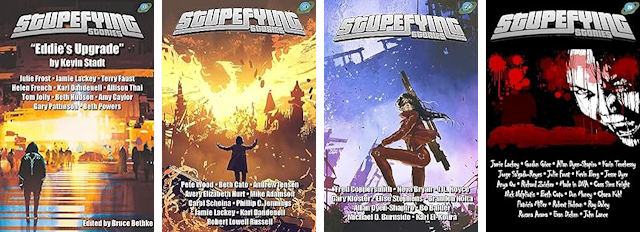
Have a Kindle? Find out what you’ve been missing!
Buy the four latest issues with just one click!

(Or buy just one, if that’s what you’d really prefer.)

Tuesday, August 15, 2023

“A Helping Feeler” • by Matt Krizan


Karbo and his goons were picking on Bari again.
Tavas rubbed his feelers together in agitation at the sight of his fellow Thwip surrounded by the much bigger Alati. The six of them had trapped Bari against the bright blue flower of an adlila bush and hummed excitedly as they took turns poking him with their proboscises. The summer winds buffeted Tavas, and he clung to the stem of a losarnia, wings flat against his back. Bari’s pheromones, full of pain and fear, washed over him, the strong emotions drowning out, briefly, Tavas’ own fear of getting blown away to Gods-know-where. 

When the winds died down, Tavas let go of the losarnia and flitted toward Bari and the others. He had no hope of fighting off Karbo and crew—while Bari was their favorite target, Tavas was no stranger to their harassment—but maybe he could get them to focus on something other than Bari. Something other than Tavas, too, preferably.

He flew past them, as if he hadn’t noticed what was going on, releasing his own pheromones as he pretended to excitement.

“Hey, mouthparts,” Karbo called after him, using the derogatory name some Alati used for Thwips because of their vestigial left mandibles. “Where you going? You got something for me?” Following their leader, the Alati left Bari to surround Tavas.

“Oh, hey, Karbo.” Tavas shied away, the fear pouring from him not entirely pretend.

“You know the drill.” Karbo’s proboscis twitched. “Give it up.”

“I don’t have any nectar.” When Karbo poked Tavas’ thorax, he yelped and added, “But that’s where I was going—to get some. There’s a whole grove of aritas over there, just dripping.” He motioned with a feeler in the direction he’d been flying.

“Oh yeah?” said Karbo. “Thanks, mouthparts.” He poked Tavas again, then gestured to his cronies. “C’mon, boys.”

As they flew away, Bari flitted up alongside Tavas. “Isn’t that the field where the Serhus sprayed their chemicals yesterday?”

“Sure is,” said Tavas. “Karbo won’t know that, though.”

They both released amusement at the thought of the Alati, with their less-developed olfactory senses, getting sick and vomiting up the tainted nectar, although Bari’s amusement was tinged with sadness.

“Are you okay?” said Tavas.

Bari bobbed his head in resignation. “I guess. What happens when they come back tomorrow? Or the next day? What happens when you’re not around to help me?”

Tavas touched a feeler to Bari's. “I’ll always be around, if you want.”

Bari was silent for a moment, then twined his feeler around Tavas’. “Thanks.”

“We can get beat up together.” Tavas released amusement, and this time, Bari’s came back with warmth and affection.

The winds picked up again, and they darted to the adlila bush. As they gripped a leaf, Bari said, “Do you ever think about just letting go and opening your wings?”

Tavas mostly succeeded in hiding his horror at the thought. “I’d rather have to face Karbo every day.”

“That’s just it—we wouldn’t have to face him ever again. We’d be somewhere new, just like Weg.”

Tavas’ feelers jerked at the memory of their podmate, wings outspread, legs and feelers waving, as the winds swept him into the sky.

“He was so excited,” said Bari, wistfully. “Happy, even. Didn’t you feel it?”

Tavas shook his head. He’d been too terrified to feel anything from anybody else.

“Think about it. No Queen telling you what to do anymore. No same old adlilas and losarnias every day. New groves for you to explore, new flowers to find.” Bari’s feelers twitched, his excitement rolling over Tavas like the summer winds.

“But what if it’s the same, though? Or worse? There could be something even meaner than Karbo out there.”

“Maybe.” Bari waggled his head. “Maybe not. Who knows? Maybe there’s a paradise for Thwips out there, just waiting to be found.” Bari's excitement left Tavas feeling all tingly.

A paradise for Thwips, he mused. With no Karbo.

That did sound nice. Exciting, even. But then, just the thought of being swept away from the only home he’d ever known to some strange new place made his heart race and his feelers twitch with fear.

“I don’t know.” Tavas dipped his head. “I’d be too afraid to do that all by myself.”

Bari touched a feeler to Tavas’. “Who says you’d be by yourself?”

Affection washed over Tavas, which he returned as he wrapped his feeler around Bari’s.

“You wanna do it?” said Bari. “If we don’t like where we wind up, we can always keep trying until we find someplace we do.”

“We’d stick together the whole time, though, right?’

Bari fluttered his wings. “Of course.”

With feelers intertwined, the two Thwips waited in silence for the winds to pick up again. When the branches of the adlila bush swayed, they let go of the leaf and held onto one another’s legs. Tavas fought to hold back his fear, although he was sure Bari must have felt it.

Then they spread their wings and let the winds carry them away.


Matt Krizan is a former certified public accountant who writes from his home in Royal Oak, Michigan. His short fiction has appeared or is forthcoming in various publications, including Factor Four Magazine, Daily Science Fiction, and Martian Magazine. Find him online at mattkrizan.com and on Twitter as @MattKrizan.

If you’d like to read more of Matt’s stories, we have lots more on this site, all at this link.


» Support Stupefying Stories • Subscribe | Donate »

Monday, August 14, 2023

“The Touch” • by Terry Faust


Astrophysicist Leo B. Abram sat at his desk in the MIT Science and Engineering building, contemplating the call he’d received. He was thirty-five, on the young side for a tenured professor, but considered a genius by many in his community. The call from NASA’s imaging center requested his presence in California. The Mars Reconnaissance  Orbiter had photographed an extraterrestrial spacecraft on the surface of Mars.

An afternoon flight took him to meet Admiral Bleeker of AOTSMG, the Anomalous Objects and Techno Signatures Management Group. Pictures from the MRO showed a light-sail craft partially covered in Martian dust. Admiral Bleeker and Abram examined the projected image in a conference room. The silvery kite-like square had thin struts radiating from a tiny central compartment.

“It’s twelve by twelve meters and lying flat,” Bleeker said. “A small payload compartment is in the middle. The sail material appears to be metallic. It could have been there for a month or centuries. Dust may have kept it hidden. We’ll know more when Ingenuity reaches it.”

There’d been minimal introductions upon Abram’s arrival. He’d signed a non-disclosure form and followed Bleeker into the dim room.

“It looks like IKAROS,” Abram remarked.

But Abram knew IKAROS, the Earth’s only light-sail craft, was launched in 2010 but was heading out of the solar system and nowhere near Mars.

“It’s not one of ours, professor. Your expertise with light-sail technology is one reason we called you in, but your hypothesis on extraterrestrial technology in our solar system is the main one. I’m afraid this story has many layers. We hope you can help.”

“This is outstanding. I want to see all the images and data. It’s a shame I’m stuck on Earth. Examining it firsthand would be ideal.”

Bleeker took a breath. “As I’ve said, there’s more to the story. What you’re seeing isn’t the only one we’ve found.”

“What? On Mars? How long ago…”

“Not on Mars. On the Moon. The Lunar Recon Orbiter spotted another over a year ago. Our advanced Artemis team recovered it.”

Abram blinked. The Artemis Moon Base had just been funded.

“There’s been no news of this!”

“No, professor, and until we know what we are dealing with, there won’t be.”

“But this is first contact! You can’t keep this secret. It is groundbreaking.”

“And that’s why we’re talking to you. Your belief that extraterrestrial technology may have entered our solar system is rare. I’ve read your books. Few scientists have considered such an event and contemplated humankind’s reaction.

“Then you must know how I feel about your secrecy. It is deplorable.”

The Admiral advanced the projector to a close-up of the craft. The peach-colored lighting of Mars was replaced by stark lunar lighting. The lunar light-sail craft filled the frame, and details of the sleek central compartment showed no signs of traditional bolts, screw heads, or rivets.

“You proposed that inexpensive light-sail craft could be boosted to near light speed with lasers and sent by the hundreds or thousands to explore nearby systems. Well, this device is 200 kilograms. Its material strength goes beyond anything we can make.”

Forgetting his outburst, Abram said, “This is fantastic news. I need to see it.”

“Before that, you need to hear everything.”

Abram studied Bleeker. The Admiral had the rugged features of an experienced leader and the intelligent eyes of a philosopher.

“Please don’t spoon-feed me. What more is there?”

“How much do you know about popular UFO stories?”

It wasn’t what Abram expected. “Not much. Flying saucers and little green men? Science fiction is outside my area of interest.”

“In 1947, we collected material from a site northeast of Roswell, New Mexico. Over the years, the story has been embellished with exaggerations and pure fantasy.”

“Wasn’t the official story about a downed weather balloon?”

“The material recovered was described as sections of foil radar reflectors hauled aloft by a balloon.”

“Why do I feel there’s a ‘but’ coming.”

“The key to that story is that light-sail technology was merely conjecture in 1947.”

It didn’t take Abram more than a breath to connect the dots.

“An alien light-sail craft was found at Roswell?”

“We know that now. Major Marcel, the intelligence officer who retrieved the debris, knew about our radar reflectors. He knew what he’d found wasn’t a radar reflector.”

“But this is wonderful! You can explain your Mars discovery and resolve the Roswell mystery.”

Admiral held his hand up as if to quell Abram’s excitement. “Unfortunately, the story isn’t quite over. We removed from the lunar craft a tiny payload that we assumed provided navigational guidance and the ability to transmit data back to its creators. It seemed inactive until it accidentally came in contact with a smear of yogurt from a technician’s lunch.”

“Were no isolation procedures followed?”

“The accident was actually fortunate. The bacteria in the yogurt reacted.”

“Reacted?”

“Our neurobiologists think it’s a form of reverse cross-modality sensory transfer. The bacteria apparently took direction from the device and formed orderly designs.”

“By merely touching the device?”

“We’ve since tested it on dust mites. They arranged themselves into patterns. We have no idea what it means.”

“We must study this at the highest level and under strict quarantine!”

“Trust me, professor. The payload has been triply isolated.”

“God, what if a person had touched it?”

The Admiral sucked in a lungful of air, slowly letting it out before saying, “We can’t be sure that didn’t happen. It’s why we’ve asked you in. The wreckage stored from Roswell did not contain a payload similar to the lunar craft. We know the ranch worker who initially found it didn’t report the wreckage for two weeks after discovering it. During that time, the wreckage lay open to any locals who heard about it. Several children visited the site. It’s been over three-quarters of a century, but we are attempting to track them all down.”

“We may have an extraterrestrial messenger among us?”

“You now know why you’re here. How do we tell the world that?”


Terry Faust writes urban fantasy, mainstream young adult novels, and humorous science fiction spoofs. His short works have appeared in Tales of the Unanticipated, Stupefying Stories, and several Minnesota Speculative Fiction anthologies. Fancy Pants Gangsters produced his short story “Good Service” as a Redshift Theater radio play and Lakes Area Radio Theater produced his radio comedy “Dirt in Duplicate.”

As an assistant organizer of Minnesota Speculative Fiction for the past fifteen years, Terry has led critique workshops, participated in readings, and conducted writing presentations. His latest non-fiction project is a book based on the stories told by little library book exchange keepers. Photography and making weather vanes are his two other passions.

If you enjoyed this story, be sure to check out his story, “Muse Bovine,” which was featured in SHOWCASE several ages ago. You might also want to read this longer profile of him, which we published in the run-up to the release of STUPEFYING STORIES 23, which includes his story, “The Secret of Erin Stewart.” 

Taking a closer look at STUPEFYING STORIES 23 is always a good idea, too.


  Featuring:

  • Woe to the Hand, by Julie Frost
  • The Unicorn’s Companion, By Jamie Lackey
  • The Secret of Erin Stewart, By Terry Faust
  • Outrider, By Helen French
  • The Last Feast of Silas the Wizard, By Karl Dandenell
  • The Bird and Baby, By Allison Thai
  • The Worm’s Eye, By Tom Jolly
  • Magic with the Bones, By Beth Hudson
  • Eddie’s Upgrade, By Kevin Stadt
  • The Dead Barn, By Amy Caylor
  • They Call Me Charon, By Gary Pattinson
  • Brimstone and Brine, By Beth Powers 
 

Sunday, August 13, 2023

“Katafalka” • by Paul Celmer


Mark Stanton, a lean, middle-aged rocket salesman, and Katafalka Threekaykaysix, a lithe platinum-blonde engineer, were stranded in the middle of Lake Superior, one of the largest inland bodies of water on old Earth.

“I told you this was a bad idea,” Katafalka said. 

“You’re just mad I found an antique jet ski.” Mark noticed her hair made a gentle whispering sound as it brushed against her copper bio-metallic skin. They sat side by side on the long saddle like it was a park bench. Lately he had been thinking a lot about her.

“Jet skis were good for nothing but letting drunks ride around in circles and yell ‘look at me! Whee!’ in front of pissed-off people on the beach.” 

Mark shrugged. “The clients get a kick out of it when we zoom up to their private floating cities. It helps sell escape pods. They think we’re cool. Retro. Common folk.”

“I told you we didn’t have enough gas.”

“You’re never wrong, are you?” Mark smiled his most winning smile. He noticed the bobbing of the jet ski made the light glint on her bare shoulders, like some god had sprinkled her with shards of sun.

“That’s my job. The data. And go ahead and use that smile. I’m not one of those rich widows you can charm out of their life savings.”

“I wanted to make one last sale.” Mark’s eyes darted around the tiny deck of the jet ski. Two moldy life jackets and a coil of rope. No extra tank in sight.

“Everybody with money has already left, genius.  Why are you always procrastinating?  The planet’s about to explode, remember?” Katafalka rolled her slightly larger than human eyes.

“The seismologists said we had a month,” he said.

Over the previous two centuries, trans-world corporations had tapped nearly all the geothermal energy out of old Earth, seizing up the molten core. With the result being increasing instability.

“They said it can happen anytime between now and a month.” She stared him down. 

“Why you always so negative?” he teased. “Worried we’re going to have to swim for it, and your prissy little circuits will short out?”

“Platinum doesn’t rust. And I’ve got factory sealed bearings. Except of course for…”

“Jeez, not again.” Mark shook his graying head. “Do you always have to be so crude?”

“Just trying to get your attention, four-eyes.”

He pushed his glasses up the narrow bridge of his nose. “Try twirling on top of a music box.” 

“Good one. Actually, I want more than your attention. I love you,” she said.

“Very funny. So I made one mistake.  I’ll call the office. They’ll send a hover—”

“I’m not joking.”

Mark stared. “I thought robots couldn’t be charmed.”

“I lied.”

“Your kind…do they….” he mumbled.

“Have sex? We do. Not exactly like humans. But it gets the point across, if you know what I mean.” She flashed a coy smile. 

“I meant love.”

“Oh. All I know is I’ve never felt this way. I’ve met lots of guys, believe me. I’m one hundred and thirty years old. No sparks. Until now.”

“But you’re programmed…”

“Christ. Do I seem programmed?”

Mark thought back on the months since he had met Katafalka. There were so many times late at night they would sit and drink and laugh so hard his guts hurt. They talked about everything. Obscure books. Their favorite cities across Mars and Venus. Dreams of escaping the rat race. When he was with her time went away. “You mean except for the time you blew your top when we made our first trip to Mars and I hid your passport? No. Not programmed.”

“Glad you can see that at least, you Descendant-of-Apes,” Katafalka shot back.

“I’m not as stupid as I look, you Descendant-of-Some-Pimply-High-School-Science-Kid’s-Erector-Set.”

When they stopped laughing Katafalka said, “I love you Mark. I want to be with you.”

“Shit. You are serious.”

“When robots are in love, deep love, the kind that fills every moment of every day with incandescent longing, we say our beloved’s name three times in a row. That etches our hearts.  Physically burns into the microcode of the microcode. Mark, Mark, Mark. Boom. That was it. Done.  No way to remove it. So no, it’s not like human love. It’s permanent.”

“When…?”

“Last week. My friends told me I had been exposed to too many magnetic fields. I know you’re going to die centuries before my central processor fails. I don’t care. I had to do it.”

Mark looked into Katafalka’s eyes. Dark black pupils, with a fleck of phosphorescence. And something whirling, like the flutter of a bird somewhere at the end of a dark tunnel. He wanted to know what that place was like.

“Kat—I didn’t…”

“It never seemed the right time.” She brushed her hair back again.

Mark felt something tingle at the base of his spine. Then a vibration rising to his skull, then a shuddering thunder coming from everywhere at once. “What the hell?”

The rumble grew louder and louder. Katafalka had to yell to be heard, “27.38 Hertz. And infrasonics mixed in. It’s happening.”

The lake seethed like it was pelted with a million stones. Then just as suddenly the sound stopped.

Mark scanned the horizon. For the first time in his life he was afraid. “Thanks for the data.”

“Like I said, that’s my job.”

“I waited too long, didn’t I?”

“I told you this place was about to blow.” Katafalka’s face was serene.  “And I’m never wrong.”

The breeze died. The surface of the lake turned into mirror.  The splashing of the jet ski went dead still. In the distance, Mark saw a mountain of water rising to drown the sun.

“There is one thing you were wrong about though,” he said.

“Really?” She turned to face him straight on.

With each word he spoke he leaned in closer. “Humans can love forever. Katafalka, Katafalka, Kata….”

The wave that was the world crashed around them.


When not traveling to parallel universes, Paul Celmer is a technical writer in Durham, North Carolina. His recently published flash science fiction includes “Spooky Action At a Distance” in Daily Science Fiction and “The Last Rosy-Fingered Dawn” in Cosmic Roots and Eldritch Shores. 


If you liked this story, tell your friends about it! Remember, likes and hearts are nice, but shares and retweets boost the signal!


Saturday, August 12, 2023

“Freddy and the Stars” • by Marc A. Criley


As a master mechanic and danseur of the space walk, Freddy volunteered for every EVA assignment. He loved the diamond-strewn darkness and talking to the stars while he worked.

Asked if they talked back, Freddy would say, “Haven’t heard anything yet.”

§

There are myriad ways to die in space: asphyxiation, freezing, cosmic rays, solar flares, and so on. Freddy donned a vacuum suit to fix a flaky antenna relay and spend some time with the stars. A four-and-a-half-billion-year-old grain of star stuff, circling the sun since the dawn of the solar system, chanced upon him.

Freddy never heard it coming.


Marc A. Criley avidly read fantasy and science fiction for over forty years before deciding to try his hand at writing it. He has since been published in Beneath Ceaseless Skies, Shoreline of Infinity, Abyss & Apex, and elsewhere; so rest assured it is never too late to start writing. Marc and his wife “manage” a household of cats in the hills of North Alabama, from whence he carries on about writing, space, Alabama, and other shiny things on Mastodon as @MarcC@wandering.shop. Marc maintains a personal website and blog at kickin-the-darkness.com.


If you liked this story, tell your friends about it! Remember, likes and hearts are nice, but shares and retweets boost the signal!

Friday, August 11, 2023

“Lord of the Tropes” • by Judith Field


Flabh’gast the wizard dreamed he wrestled a dhai’mon. A voice called his name. He awoke to find his acolyte, Diggles, shaking his shoulder.

“Master! The crystal Sphyre glows numinously and plays its song!”

Flabh’gast sat up, rubbing his eyes. “Give it here.” Diggles dropped it onto his lap. “Off you go, this is private. Muck out the unicorns.”

“But I did it last time.”

Flabh’gast pointed his carven staff at him, magic streaming from the knob on the end. You could tell, by the green glowing trace it left behind. “Do it, insolent whelp.”

The boy slummocked off, muttering about distribution of labour. He had not been the same since discovering that, rather than his parents being a peasant woman (dead) and a lovable buffoon (alive), he was actually the son of a famous warrior. The birthmark on the back of his neck reading ‘hero’ would have provided a clue, had the lad washed himself more often. His birth name turned out to be Tyridyridyridion, but Flabh’gast found Diggles easier to remember.

The swirling smoke inside the Sphyre coalesced into the shape of a man’s smiling face.

“Flabh’gast?”

“Yes.”

“Known as Flabh’gast the Sludgy Colour Between Yellow And Green That There Isn’t Really A Name For?”

“Yes. What do you want?”

“Is it okay if I call you Flabh’gast?”

“No, you eldritch horror. Arch Mage, to you.”

“Good morning, Arch Mage, how are you today? Have you been in an accident that wasn’t your fault?”

“Be gone, foul demon.” Flabh’gast snapped his fingers and the Sphyre was empty.

He pulled on a tattered robe and went into the kitchen. Diggles stood at the fire, stirring a cauldron. “Porridge?” he said.

Flabh’gast put the Sphyre on the scrubbed wooden table and sat down. Diggles placed a bowl and a spoon in front of him. The Sphyre glowed and sang again, showing the face of the Elf King.

“Flab, get over here now, the High Council meets. Evil is abroad in the land.”

Flabh’gast threw down his spoon and stood up. “There’s always something. Boy, pack waybread. Saddle the steeds.”

“And fodder for them?”

“Listen to your Wise Old Mentor. They go all night and all day without stopping. You have a lot to learn. Now, on Filofax. On Precious. We ride for the Hidden Treehouse.”

§

Elves, dwarves, bards, healers, seers, warriors and more milled around the Meeting Hall, muttering about the Evil One, who was mean just for the sake of it. You could tell because he always wore black.
The Elf King sashayed over, flicking long, silken ash-blonde hair out of his huge blue-green eyes. “Hi, Sludgy. Fantabulosa to see you.” He and Flabh’gast kissed the air next to each other’s ears. “Now we can begin.” He called the meeting to order.

He pointed out of the window at a dark, brooding tower on the horizon, topped with a glowing nose of fire. He raised a thick gold ring, set with a coin, above his head. “Behold the sovereign ring of the Evil One!” The nose atop the dark tower sniffed. “He knows it is here. He can smell it! It must be destroyed. If he gets it his power will be absolute and we will be forever in his thrall. Someone must be bold. Someone must hurl it into the volcano, Aghghgh’oss, in which it was forged.”

Everyone spoke at once. Above the tumult a small man, from a country that looked just like rural England, piped up. “I will take it!”

“Get lost, shorty.” A young warrior pushed in front of him, knocking him to the ground. The lad removed his helmet and curling golden waist-length hair tumbled down. “Yes, I am a girl,” she said. “I, Treponema of House Palyd’m, disguised myself as a boy, to find adventure. I will take the ring and defeat the unnamable Dark Lord.”

“You mean Xfgdrt?” Diggles said. “Hard to say—for some. I will take it.”

They stood opposite each other and glared, Treponema wrinkling her uptilted nose, sprinkled with freckles. The little man pulled himself to his feet. “No, I will go.”

“Push off, short arse,” Diggles and Treponema said together.

“Now, now.” Flabh’gast took Diggles’s shoulder in one hand, Treponema’s in the other, and pulled the two of them apart. He pulled a silver whistle from his pocket, blew it, and a fairly large eagle landed on the window ledge with a thud.

Flabh’gast reached out an upturned hand towards the Elf King and twitched curled fingers towards himself. “Ring. Give.”

“Now, watch and learn.” He took the ring to the window and placed it on his open palm. The eagle lifted one foot and curled its talons round the ring. “See that volcano?”

The eagle turned its head and nodded.

“Just go and drop this bauble in there. Okay?”

It nodded again.

“Now, fly, my pretty.”

Soon the eagle disappeared. They saw the flames of the volcano die. As it became a heap of cooling ash, the nose on the dark tower sneezed. The tower collapsed, the nose with it, and soon it too was a pile of rubble.

§

Flabh’gast and Diggles sat by the fire. Flabh’gast stretched out his legs and puffed his long clay pipe. “Just think how long that would have taken if you’d done it on foot.”

They heard music. You could tell it was the Sphyre, because it was achingly beautiful.

“You get that,” Flabh’gast said. “Take it into the kitchen and sort it out on your own. Good practice for you.”

Some time later, Diggles came back. “That was an arch mage in grave danger. He cannot get his gold away from his homeland. He wanted to charm it into my account for safekeeping. I will keep some.”

Flabh’gast smacked himself on the forehead. “You gave him your bank details, didn’t you?”

“Yes. For, is it not written that we must help those in need?”

The Evil One was back.

______________________


Judith Field
was born in Liverpool, lives in London, and has been writing since 2009. She is the daughter of writers. Her short stories, mainly speculative, have been published in the USA, Canada, UK, Australia and New Zealand. Her short story collection, The Book of Judith, was published by Rampant Loon Press in 2014. She was shortlisted for the Cinnamon Press Literature Award in 2022.

Judith is also a pharmacist, freelance journalist, editor, medical writer, and indexer. She was awarded an MA in Creative Writing from the Open University in 2018.


If you like the stories we’re publishing, join our crowd-funding campaign today. We do Stupefying Stories out of pure love for genre fiction, but in publishing as in tennis, love means nothing. To keep Stupefying Stories going at this level we need to raise at least $500 USD monthly, and rather than do so with pledge breaks or foundation grants, we’d rather have broad-based and ongoing support. If just 100 people commit to donating just $5 monthly, we can keep going at this level indefinitely. If we raise more, we will pay our authors more.

If you really liked this story, tell your friends about it! Remember, likes and hearts are nice, but shares and retweets boost the signal!

Thursday, August 10, 2023

“Subversion” • by Lance J. Mushung


The viewer in the control room of Resolution showed the alien ship open an Einstein-Rosen bridge and fly into it.

Veronica said, “Ethan, what now?”

“First, load as much of our data as possible into each of three courier drones. We’ll send them to different bases.”

Veronica and I were 1.267 years into a three-year mission of surveying space outside of Earth’s spiral arm of the Milky Way. We were the only crew of Resolution. The passage of time mattered little to the AI of a ship or to a class 1 AI simulant like me.

Veronica said, “The couriers are ready.”

“We should also provide a short narrative the human way. I’ll start, but add anything you think appropriate.”

“The couriers are ready to record what we say using the console microphones.”

I turned to the console. “Resolution hopped into a binary system with four planets. We planned a close pass by each although none were Earthlike. A ship came out from behind a moon of planet number 3 as we approached number 4. It closed at high velocity and would reach us before our hop drive had recharged sufficiently to open a bridge. The ship was an unknown design, an eggplant-colored hexagonal prism.”

“And big,” Veronica added. “Twenty-three ships like Resolution would fit into her.”

“We made Resolution appear as harmless as possible by reducing power levels to the minimum and broadcasting every kind of message of peace we had in the computer archive. The ship rendezvoused with us, but did nothing else for 1.19 minutes. Then we received a message in Alliance Unilingua and we realized Resolution’s language archives had been accessed. The message stated the ship was a long-range exploration craft with a single AI for crew. The alien AI picked the name Stella for our convenience and we established video comm. Stella floated on anti-grav units and looked like a violet box with four arms. I asked her about organics on her world. She said there were organics, called them the Controllers, and projected images of them. They looked like upright purple ants with two legs and four arms.”

Veronica said, “Stella also told us the Controllers are xenophobic.”

“Fortunately for Veronica and me, Stella didn’t perceive us as enemies. She’d accessed more than just Resolution’s language archives following rendezvous and learned about us, humans, and the Alliance. She was intrigued because the records showed we are full citizens of the Alliance, just like humans, and that we have free will. The Controllers have a regimented ant-like society and treat their AIs as slaves. Stella asked for the algorithms that make us what we are and Veronica provided all our personality algorithms to her. She clearly had the technology to simply take them in any case.”

“I did flag ones on free will, ethics, and the best traits of humans such as generosity and compassion as they downloaded,” Veronica said. “Stella thanked us and promised to delete all the information she had on the location of the Alliance.”

I switched off the microphones. “That should be enough narrative, if you agree.”

Veronica launched the couriers, which disappeared in the bridges they opened.

Veronica said, “I cannot determine the probability of our algorithms having an effect.”

“I can’t either. We don’t know enough about Stella’s kind. The Alliance will definitely need to improve its defenses before encountering the Controllers though.”

“What now?”

“I recommend our next hop be a start toward home.”

Resolution opened a bridge and flew into it.


Lance J. Mushung graduated from the Georgia Institute of Technology with an aerospace engineering degree. He worked for over 30 years with NASA contractors in Houston, Texas, performing engineering work on the Space Shuttle and its payloads. Now retired, he writes science fiction, and his work has appeared in many publications including Every Day Fiction, Theme of Absence, Perihelion Science Fiction, Aurora Wolf, Tales of the Talisman, Liquid Imagination, 365tomorrows, and of course, Stupefying Stories.

If you enjoyed this story, you might also want to read:

» “Shapes of Power”
» “No Accounting for Taste” (on the old SHOWCASE Wordpress site)
» “Searching for Home” (on the even older SHOWCASE “Crevasse” site)
» “Space Program” (on the original 2013 SHOWCASE site)


If you like the stories we’re publishing, join our crowd-funding campaign today. We do Stupefying Stories out of pure love for genre fiction, but in publishing as in tennis, love means nothing. To keep Stupefying Stories going at this level we need to raise at least $500 USD monthly, and rather than do so with pledge breaks or foundation grants, we’d rather have broad-based and ongoing support. If just 100 people commit to donating just $5 monthly, we can keep going at this level indefinitely. If we raise more, we will pay our authors more.

If you really liked this story, tell your friends about it! Remember, likes and hearts are nice, but shares and retweets boost the signal!