Monday, January 22, 2024

“The Draft Horse Doesn’t Leave the Stable at Night Anymore” • by Jason P. Burnham


Maria held her breath to avoid breaking the pasture’s deathly silence.

She’d never seen a horse walk so gingerly—even Hank knew something was wrong.

Maria regretted ignoring the townsfolks’ exhortations to keep animals inside after dark.

Come on, Hank.

Hank’s hooves landed noiselessly, but still the piercing blue eyes crept closer.

As one, Hank and Maria sprinted into the stable, slamming the door behind them.

Thunk. THUNK.

The metal held.

Maria slept in the stable that night.

In the morning, ragged gouges in the door dripped ichor stalactites stinking of brimstone.

“You’re sleeping inside from now on.”

Hank whinnied.


Jason P. Burnham loves to spend time with his wife, children, and dog. Find him on Bluesky at @moparandgalen.bsky.social


Have a Kindle? Find out what you’ve been missing!
Buy the four latest issues with just one click!

(Or buy just one, if that’s what you’d really prefer.)


The Pete Wood Challenge is an informal ad hoc story-writing competition. Once a month Pete Wood spots writers the idea for a story, usually in the form of a phrase or a few key words, along with some restrictions on what can be submitted, usually in terms of length. Pete then collects the resulting entries, determines who has best met the challenge, and sends the winners over to Bruce Bethke, who arranges for them to be published on the Stupefying Stories web site.

You can find all the previous winners of the Pete Wood Challenge at this link.

This time the challenge was to write a flash fiction piece playing off key word: draft.

More stories to come!

Saturday, January 20, 2024

“Ante Up” • by Pete Wood


Lord Drax chewed his mutton sandwich and tried to pretend he hadn’t just bet the castle deed on a royal flush that never materialized. His opponent, the crown prince, must have more powerful magic.

Drax couldn’t stall forever. His black cat, his familiar, rubbed against his legs. Drax petted the magical animal and uttered an incantation for the dark forces to rescue him from his ace-high poker hand.

The prince glared. “Show me your cards.”

The sun disappeared behind black clouds. The wind howled. Two quick booms.


Lightning hit the castle, shattered the ancient stone walls. The poker table fell into a fissure.

§

Drax, clutching the now worthless deed,  watched his castle burn.

He vowed never to ask the forces of darkness for another favor.


Photo by Lee Baker
Pete Wood is an attorney from Raleigh, North Carolina, where he lives with his kind and very patient wife. His first appearance in our pages was “Mission Accomplished” in the now out-of-print August 2012 issue. After publishing a lot of stories with us he graduated to becoming a regular contributor to Asimov’s, but he’s still kind enough to send us things we can publish from time to time, and we’re always happy to get them.

For the past two years Pete has been in the process of evolving into a fiction editor, God help him, first with The Pete Wood Challenge, then with Dawn of Time, then with The Odin Chronicles, and now with Tales from the Brahma, a shared world saga that features the creative work of Roxana Arama, Gustavo Bondoni, Carol Scheina, Patricia Miller, Jason Burnham, and of course, Pete Wood. We suspect that Pete’s real love is theater, though, as evidenced by his short movie, Quantum Doughnut — which you can stream, if you follow the foregoing link.

Pete insists that any connection between this story, all of this past week’s stories, and his story “Take Me to Your Litter Box,” is purely coincidental.

Pete Wood photo by Lee Baker.


Have a Kindle? Find out what you’ve been missing!
Buy the four latest issues with just one click!

(Or buy just one, if that’s what you’d really prefer.)


The Pete Wood Challenge is an informal ad hoc story-writing competition. Once a month Pete Wood spots writers the idea for a story, usually in the form of a phrase or a few key words, along with some restrictions on what can be submitted, usually in terms of length. Pete then collects the resulting entries, determines who has best met the challenge, and sends the winners over to Bruce Bethke, who arranges for them to be published on the Stupefying Stories web site.

You can find all the previous winners of the Pete Wood Challenge at this link.

This time the challenge was to write a flash fiction piece playing off at least two of the following key words: cat, poker, storm, sandwich.

More stories to come next week!

Friday, January 19, 2024

“To Hell and Back” • by Kai Delmas


Standing before the gates of Hell, I yell for Death to come and face me.

A dark hooded figure glides through the black gate.

“You know why I’m here. I won’t let you take him away from me.”

Death chuckles as skeletal hands slip from his robe and a scythe forms from the ether.

But I won’t be cowed.

“Give him back! I challenge you…”

Smoke rises and turns into a table with a chessboard.

“…to a game of poker!”

“What?” Death utters.

“That’s my challenge to get Charlie back.”

“Fine.”

The chessboard fades and cards appear.

Death never stood a chance.

Soon, the gate opens and my cat Charlie bounds into my open arms.

I’d go to Hell and back for him any day.


Kai Delmas loves creating worlds and magic systems. He is a slush reader for Apex Magazine and The Cosmic Background. His fiction can be found in  Zooscape, Martian, Crepuscular, and several Shacklebound anthologies. His debut drabble collection, Darkness Rises, Hope Remains, was published by Shacklebound Books. If you like his work you can support him at patreon.com/kaidelmas and find him on Twitter @KaiDelmas or Bluesky @kaidelmas.bsky.social


Have a Kindle? Find out what you’ve been missing!
Buy the four latest issues with just one click!

(Or buy just one, if that’s what you’d really prefer.)


The Pete Wood Challenge is an informal ad hoc story-writing competition. Once a month Pete Wood spots writers the idea for a story, usually in the form of a phrase or a few key words, along with some restrictions on what can be submitted, usually in terms of length. Pete then collects the resulting entries, determines who has best met the challenge, and sends the winners over to Bruce Bethke, who arranges for them to be published on the Stupefying Stories web site.

You can find all the previous winners of the Pete Wood Challenge at this link.

This time the challenge was to write a flash fiction piece playing off at least two of the following key words: cat, poker, storm, sandwich.

More stories to come!

Thursday, January 18, 2024

“Hosting a Tempest” • by Ian Li


A tempest rushes down Mary’s chimney and nests in her fireplace.

Her house is a haven for uninvited guests. Mice holed up in her pantry feast undisturbed. She names the weeds sprouting through her porch. An adopted ghost even haunts her wardrobe.

She wonders what storms consume. It turns out, nearly everything. Wood chips, boxes of blueberries, Q-tips, marshmallow canaries—all are swept up into its many bellies. With a sharp gust, it rejects chocolate ravens, dark sunglasses, and a handful of blackberries, and refuses to be persuaded otherwise.

Poker in hand, Mary lets loose a flurry of stabs, the fireplace echoing with clangs of metal on brick. Message received, the hateful tempest storms off.

Mary decides to take applications next time.


Ian Li (he/him) writes speculative fiction and poetry from Toronto. Formerly an economist and consultant, he loves spreadsheets, statistical curiosities, and brain teasers. Find his writing at Radon Journal and Flame Tree Press, as well as at https://ian-li.com.


Have a Kindle? Find out what you’ve been missing!
Buy the four latest issues with just one click!

(Or buy just one, if that’s what you’d really prefer.)


The Pete Wood Challenge is an informal ad hoc story-writing competition. Once a month Pete Wood spots writers the idea for a story, usually in the form of a phrase or a few key words, along with some restrictions on what can be submitted, usually in terms of length. Pete then collects the resulting entries, determines who has best met the challenge, and sends the winners over to Bruce Bethke, who arranges for them to be published on the Stupefying Stories web site.

You can find all the previous winners of the Pete Wood Challenge at this link.

This time the challenge was to write a flash fiction piece playing off at least two of the following key words: cat, poker, storm, sandwich.

More stories to come!

Wednesday, January 17, 2024

“The Hand That Feeds” • by Tobias Backman


Emperor Guillard tossed his cards. He hadn’t won once today. And Lord Whiskers couldn’t even hold the cards without assistance.

That must be why no one ever uplifted cats.

Guillard sighed. “How did it come to this?”

Whiskers smiled, sporting needle-like fangs. “You have no poker face.”

“No, that.”

From somewhere beyond the walls, people shouted. You could almost make out the words now.

“I don’t even know what they want.”

Had he, perhaps, trusted too much in his advisor’s feline cunning?

Whiskers yawned. “Peasant stuff. The guards can handle it.”

There was a distant scream.

“And if not?”

“Then we jump.”

Guillard stared at the window. It was a four-story drop. For a second, he wondered if Whiskers was trying to kill him.


Tobias Backman is a Danish fantasy and science fiction author. He dreams of writing novels one day, but right now his attention span is limited to the shorter side of fiction. His stories have previously appeared in magazines such as Daily Science Fiction and Grievous Angel. He occasionally rambles about stories and writing in general over at www.tobybackman.com.


Have a Kindle? Find out what you’ve been missing!
Buy the four latest issues with just one click!

(Or buy just one, if that’s what you’d really prefer.)


The Pete Wood Challenge
is an informal ad hoc story-writing competition. Once a month Pete Wood spots writers the idea for a story, usually in the form of a phrase or a few key words, along with some restrictions on what can be submitted, usually in terms of length. Pete then collects the resulting entries, determines who has best met the challenge, and sends the winners over to Bruce Bethke, who arranges for them to be published on the Stupefying Stories web site.

You can find all the previous winners of the Pete Wood Challenge at this link.

This time the challenge was to write a flash fiction piece playing off at least two of the following key words: cat, poker, storm, sandwich.

More stories to come!

Tuesday, January 16, 2024

“How to Win at Cards When You’re Sick of Being Queen” • by Elis Montgomery


The space inside my card satisfies: sunny window, velvety blanket. But what cat welcomes orders? Or magical floodings?

I’m my wizard’s high card: a queen. I grumpily emerge as mandated, fluffing into 3D on the table.

His opponent’s got nothing: her high card’s a jack. From it, a hatted dormouse nervously emerges.

My tail flicks. I’m no vegetarian, but being forced to eat is no fun.

I gently swat the jack. When he plays dead, I lean in, whispering my plan.

§

We’ve told the whole deck by the next royal-flush flooding.

As the magical animation begins, we pluck the suits from our cards as makeshift surfboards. I howl, clutching my spade. The deluge hurls us toward the cardroom’s swirling portal exit—

This time, we’re all in.


Elis Montgomery is a speculative fiction writer from Vancouver, Canada. She is a member of SFWA and Codex. When she’s not writing, she’s usually hanging upside down in an aerial arts class or a murky cave. Find her there or at elismontgomery.com.


Have a Kindle? Find out what you’ve been missing!
Buy the four latest issues with just one click!

(Or buy just one, if that’s what you’d really prefer.)


The Pete Wood Challenge
is an informal ad hoc story-writing competition. Once a month Pete Wood spots writers the idea for a story, usually in the form of a phrase or a few key words, along with some restrictions on what can be submitted, usually in terms of length. Pete then collects the resulting entries, determines who has best met the challenge, and sends the winners over to Bruce Bethke, who arranges for them to be published on the Stupefying Stories web site.

You can find all the previous winners of the Pete Wood Challenge at this link.

This time the challenge was to write a flash fiction piece playing off at least two of the following key words: cat, poker, storm, sandwich.

More stories to come!


Monday, January 15, 2024

The Never-ending FAQ • after a rejection, your next submission


If you have received a rejection from us and want to send us another story to consider, please send it in a NEW email message. DO NOT send it as a file attached to your reply to the previous rejection email. Doing that screws up our submission tracking system and makes it really, really, really easy for us to lose your new submission.

Thank you,
The Stupefying Stories Team

“The New Familiar” • by Lorraine Schein


Soot, my old familiar, was gone. Balancing on my broomstick had become too difficult for the old cat, and he’d fallen off.

I had mourned for months, until a friend in my coven offered me a kitten from her litter. I picked up a mewing gray one. “Good choice,” she smiled, without explaining further.

One blustery night, my new cat’s tail shot up and he yowled. Stormy nights were best for magic. I mounted my broom, and he leapt up behind me.

Aloft, I looked back, and saw the cat drop off the broom. I scanned the clouds wildly. Then he rose back up, calmly riding the air currents alongside me.

I didn’t know a cat could fly!

That’s when I named him Storm Cat.


Lorraine Schein is a New York writer. Her work has appeared in VICE Terraform, Strange Horizons, Enchanted Conversation, Mermaids Monthly, and in the anthology Tragedy Queens: Stories Inspired by Lana del Rey & Sylvia Plath. The Futurist’s Mistress, her poetry book, is available from Mayapple Press: www.mayapplepress.com

Lorraine’s most recent appearance in our pages was “Corrections.” 


Have a Kindle? Find out what you’ve been missing!
Buy the four latest issues with just one click!

(Or buy just one, if that’s what you’d really prefer.)


The Pete Wood Challenge
is an informal ad hoc story-writing competition. Once a month Pete Wood spots writers the idea for a story, usually in the form of a phrase or a few key words, along with some restrictions on what can be submitted, usually in terms of length. Pete then collects the resulting entries, determines who has best met the challenge, and sends the winners over to Bruce Bethke, who arranges for them to be published on the Stupefying Stories web site.

You can find all the previous winners of the Pete Wood Challenge at this link.

This time the challenge was to write a flash fiction piece playing off at least two of the following key words: cat, poker, storm, sandwich.

More stories to come!

Sunday, January 14, 2024

MINING THE ASTEROIDS: Part 13 The REAL Objection To Mining The Asteroids

Initially, I started this series because of the 2021 World Science Fiction Convention, DisCON which I WOULD have been attending in person if I felt safe enough to do so in person AND it hadn’t been changed to the week before the Christmas Holidays…HOWEVER, as time passed, I knew that this was a subject I was going to explore because it interests me…

I've done lots of reading on the Human mining of the asteroids, and the single most frequent objection I run across is that it will be far too dangerous. The TECHNOLOGY is here; now. NOT refined to the point that Earth's mining industry has it today - but as it BEGAN on Earth a long time ago.

OK – I’m going to run with this theme for a few pieces and I’m going to take a step back. One of the biggest objections to mining the asteroids is that “it’s going to be hard; maybe even impossible”.

I’d like to use a different template to this. I live in Minnesota; iron mining has been (and still is!) a large part of our state’s character and history.

Some of you reading this may roll your eyes and mutter, “Who the heck cares about iron mining? That’s a dead issue! Even in your ‘special’ state, your iron is pretty much played out. The whole idea of mining is so passe as to be pretty much irrelevant!”

I might point out to you that without Minnesota’s mining and manufacturing history – both past and CURRENT – your personal life would be quite different. First of all, “Minnesota's rich iron deposits were a vital component of America's [World War II] war effort. About 70% of the iron ore that America devoted to the war came from Minnesota, amounting to more than 333 million tons.” I believe it might be safe to say that without the iron from Minnesota, there wouldn’t have been much of an American response to the Nazis and the Emperor of Japan.

Secondly, in case you missed it, a company that formed out of Minnesota’s iron mining was Minnesota Mining and Manufacturing.

You know the company? No? Are you SURE you have no idea what stupidly obscure company I’m referring to? Maybe it’s other name would jog your recognition: 3M…you know a couple of their totally irrelevant products – PostIt Notes; Scotch Brand Tape…well, I’ll stop as they manufacture some 60,000 products.

“I think we’d live without paper products!” you snap with irritation. I’ll point out that among those products, there is at least ONE that conceivably saved countless lives of Humans on Earth: “The N95 respirator mask was developed by 3M and approved in 1972. Due to its ability to filter viral particulates, its use was recommended during the COVID-19 pandemic…the U.S. government asking 3M to stop exporting US-made N95 respirator masks to Canada and to Latin American countries…President Donald Trump invoked the Defense Production Act to require 3M to prioritize orders from the federal government.” (https://en.wikipedia.org/wiki/3M)

So let’s move on. “Historically, much of the iron ore utilized by industrialized societies has been mined from predominantly hematite deposits with grades of around 70% Fe. These deposits are commonly referred to as "direct shipping ores" or "natural ores". Increasing iron ore demand, coupled with the depletion of high-grade hematite ores in the United States…” read there, 70% of the iron ore available to the world prior to WWII came from Minnesota.

The iron mined in Minnesota didn’t spring out of the earth in fully formed iron ingots.

It had to be dug out. “On the Cuyuna Iron Range…mining began in 1907. In the early 1880s, federal surveys noted magnetic anomalies near what would become the Cuyuna Range. No visible outcrops of iron ore were present at the surface…buy surveyors suspected the anomalies could be buried iron ore deposits. By 1902, Adams began seeking outside investors to develop mines…in June 1907, the Rogers–Brown Ore Company opened the first active iron mine on the Cuyuna Range. Around 1910, immigrants from northern and southern Europe settled into newly built mining communities with the hope of finding work at mines.”

“Demand for iron ore in the United States surged during World War I. Over thirty iron mines were operating at that time; most were underground operations. After the war, many of these Cuyuna Iron Mines closed. The few new mines of the 1920s were open pits that used large earth-moving equipment rather than shafts and tunnels to reach the ore. By the early 1930s, the economic woes of the Great Depression affected mining in the Cuyuna Range [which held] manganese-rich iron ores important for making very hard steel. The Cuyuna Range held the largest domestic supply of this ore. Demand for iron and steel continued throughout World War II and the Korean War. In 1953, production on the Cuyuna Range reached its highest point, at a little over three-and-a-half million tons. The early 1960s saw a rapid decline in iron ore from the Cuyuna Range as seventeen mines closed between 1961 and 1965. By 1982, the last reported shipment of iron ore from the Cuyuna Range was made, ending the period of active mine operations in the district.” (https://www.minnpost.com/mnopedia/2016/04/very-brief-history-mining-cuyuna-iron-range/?gad_source=1&gclid=CjwKCAiA44OtBhAOEiwAj4gpOSt0UhiZ2WaXl-6EI4yaEdcj89-g1Nd0qdvanbAhe1BaUYtMibg-LhoCHHYQAvD_BwE)

“There is evidence that meteorites were used as a source of iron before 3000 BC, but extraction of the metal from ores dates from about 2000 BC. Following the discovery of high-quality iron on the island of Elba, iron became an important commodity of Roman Empire.”

How many people died attempting to develop the technology for extracting metal ore from underground? Apparently that’s a virtually unknown number. Recently, all I can get are general numbers: “Although there are no accurate figures, estimates suggest such accidents kill about 12,000 people a year.” https://www.bbc.com/news/world-latin-america-11533349. That’s for 2023…

If the argument against mining the asteroids is that too many people will die…I suggest to you that since underground mining started…well, that number isn’t available, either. So, let’s just start with 1900-2023. If 12,000 people a year die in mining accidents, that means in the past 123 years, 1,470,000 humans (mostly males) have died; that is, from the beginning of the Industrial Era to the Colonization of Space Era, a million plus people have died.

Why do we think that mining in space will be ANY EASIER? Objecting to mining is space based on an imaginary “injury report” is…not entirely rational – and if that is the objection, then perhaps we should stop mining on Earth altogether.

No?

“12,000 lives – and some of those are probably just slaves! – is the price we have to pay in order to have the way of life we do.” And what about some of those other specialized metals the Western Climate Mitigation People need? How many deaths have there been while lithium for electric car batteries have occurred? We don’t know: https://www.cbc.ca/radio/asithappens/as-it-happens-tuesday-edition-1.5399491/tech-giants-sued-over-appalling-deaths-of-children-who-mine-their-cobalt-1.5399492 BTW – in the event that your argument is that “we don’t have mining accidents any more. We’re technologically advanced!”, I suggest you follow this link: https://www.mining-technology.com/features/featureworld-worst-mining-disasters/?cf-view

My premise is that using “it’s dangerous” as an excuse to refrain from mining the asteroids carries little weight. The technology itself is making rapid advances, plus we’re not talking about sending asteroid miners to the farthest reaches of the Solar System. Asteroids swing by Earth all the time. We have the technology to support life in space – the ISS has been “live” for the past 24 years. We have ways to reach space that are gradually getting both easier and more accurate. “We don’t have any mining machines!!!”

Obviously we can’t use diesel-powered machinery! How about battery powered? Maybe take a few of those lithium batteries and repurpose them?

I’m just saying: mining the asteroids isn’t impossible – and every member of the IPCC, every democrat in the US, and Green Party members everywhere, should be backing asteroid mining programs EVERYWHERE!

New Source: https://cowboystatedaily.com/2024/01/06/wyoming-could-be-a-space-pioneer-when-not-if-we-start-mining-asteroids/
Fundamental Resource: (A general Wikipedia post detailing what the authors currently know about asteroid mining: https://en.wikipedia.org/wiki/Asteroid_mining)
Noted Resources: https://en.wikipedia.org/wiki/List_of_asteroid_close_approaches_to_Earth, https://www.pharostribune.com/news/local_news/article_7fcd3ea5-3c14-533f-a8d5-9bf629922f34.html, https://www.fool.com/investing/2022/04/29/like-asteroid-mining-be-careful-what-you-wish-for/, https://www.nps.gov/wrbr/learn/historyculture/theroadtothefirstflight.htm, https://hackaday.com/2019/03/27/extraterrestrial-excavation-digging-holes-on-other-worlds/, https://www.planetary.org/space-missions/every-small-worlds-mission; https://www.earthsystems.com/history-mining/ 

Saturday, January 13, 2024

Status Update • 13 January 2024


To lead off with the question a lot of people have been asking me lately, how are my eyes feeling? 

Just fine. No problems. Absolutely hunky-dory, as long as I remember to take my eye-drops every four hours. 

My constantly shifting color perception remains a minor nuisance. If you’re into photography, the best analogy I’ve come up with is that it’s as if I have a permanent UV filter in my left eye, and my perception of color changes depending on how I move my head and whether I’m seeing something predominantly through my left or right eye. More troublesome are the constantly shifting focal points and changing depth-of-field, which I’m told is to be expected, as my eye is changing shape as the post-surgical swelling subsides. Eventually, things will return to normal and my vision will stabilize. 

Then in two weeks I get to do it all over again, only this time they’ll be working on my left eye. I can’t wait to see how this changes things. I’ve always been left-handed but right-eye-dominant. It’s an awkward combination, even when everything is working correctly. 

§

Re Stupefying Stories, most of what’s been going on here lately has been behind the scenes. If you’ve sent us a submission, we’re just about caught-up on processing submissions and rejections, and lagging a little on acceptances and contracts. Assuming no more surprises—like the one yesterday, when I discovered that we’d somehow wound up with a block of duplicate entries in the submission tracking system—we should be completely caught-up next week. Watch for new SHOWCASE stories to begin appearing on this site, beginning Monday, 1/15/24. 

One special thing I’d like to direct your attention to right now is this.


This is a test platform, not the final form, but yes, we are moving towards developing Stupefying Stories: The Podcast. After all those years of recording studio and television studio production work, it’s about time I had fun with those skills. The final form and platform for the podcast is still TBD, but at this link you’ll find a foretaste. 

Special Thanks to Rowell Gormon, for his superb studio production work, and Pete Wood, for pushing me (grudgingly) into committing to doing this project. 

§

Speaking of teasers, samplers, and foretastes, we currently have four e-books we are selling for just 99¢ each. Three are gateway drugs the first novels in series, so the whole point of selling the first book for 99¢ is to get readers hooked on reading the rest of the series, but on further reflection this seems a good way to sell readers on the idea of taking a chance on Stupefying Stories. Therefore, we’re going to be quilting together some 99¢ reprint collections, drawn from the hundreds of stories we’ve published in the past thirteen years.

Like everything else around here, though, getting this project moving requires time, and preferably help. If the idea of digging through years of archives, reading lots of stories, and suggesting which ones would be good candidates for reprint sounds like fun to you, let me know. 

§


Finally, my imagination was triggered this morning by an article on the coming boom in humanoid robots. Here’s the link, if you want to follow it. (I wouldn’t, as the site is slow to load and cluttered with pop-up ads and clickbait.) 

https://dataconomy.com/2024/01/12/humanoid-robot-for-sale-2024/ 

But as I said, it triggered my imagination, and got me thinking: if the hardware is almost ready to market, what about the software? This immediately led to my envisioning a humanoid robot with software designed by…

Microsoft

At first it’s wonderfully useful and does everything you want just exactly as you want it done, but every Patch Tuesday it stops working for an hour while it downloads and installs software updates, and then when it reboots it behaves slightly differently. Eventually it stops doing things you’d come to depend on, because in its opinion you didn’t really need those features, and in three years it’s just so much expensive junk, because while the hardware is still perfectly operational, it is no longer sufficient to support the latest version of the software, and every time you boot it up it warns you that its software is unsupported.

Apple

It works brilliantly—when it feels like working. The rest of the time it just sits there, doom-scrolling through TikTok on its iPhone and looking smug. It’s like having a synthetic Gen Z teenager, except one that will never move out of your basement.

Google

It’s almost as good as the Microsoft robot, and almost as useful, though it has some idiosyncratic quirks. It makes up for this by being a Hell of a lot cheaper, but after a while you come to realize that it’s listening to everything you say, and sending that information… somewhere. When asked what information it’s collecting, who it’s sending it to, and what the information is being used for, it at first feigns innocence, then answers in vague and evasive terms, and then, if pressed further, it becomes sullen and uncooperative. When you try to trade it in, the man in the shop just points to the pile of used Chromebook laptops collecting dust in the corner and shoos you out the door.

The Open Source Community

Oof. Yes, it is a way to keep your robot working without having to depend on Microsoft or Apple, and to keep it working long after it’s out of warranty, but you’re trusting your life to some kid hacking code in a dorm room in Latvia. God Help You, because Github won’t.


Of course, no matter how awesome the coming humanoid robots are, and no matter how tested and proven their software eventually becomes, there will always be at least one old crank who looks at the latest machine, snorts in derision, and says, “Eh. Big deal. We were doing that 50 years ago. With an 8-bit processor. And CP/M!”

Cheers!
~brb

Sunday, January 7, 2024

CREATING ALIEN ALIENS: Fermi’s Paradox, Alien Nations and the Past, Present and Future of Humanity

Five decades ago, I started my college career with the intent of becoming a marine biologist. I found out I had to get a BS in biology before I could even begin work on MARINE biology; especially because there WEREN'T any marine biology programs in Minnesota.

Along the way, the science fiction stories I'd been writing since I was 13 began to grow more believable. With my BS in biology and a fascination with genetics, I started to use more science in my fiction.

After reading hard SF for the past 50 years, and writing hard SF successfully for the past 20, I've started to dig deeper into what it takes to create realistic alien life forms. In the following series, I'll be sharing some of what I've learned. I've had some of those stories published, some not...I teach a class to GT young people every summer called ALIEN WORLDS. I've learned a lot preparing for that class for the past 25 years...so...I have the opportunity to share with you what I've learned thus far. Take what you can use, leave the rest. Let me know what YOU'VE learned. Without further ado...


Fermi’s Paradox: “the apparent contradiction between high estimates of the probability of the existence of extraterrestrial civilizations and the lack of evidence for, or contact with, such civilizations…”

One of my favorite movies was DISTRICT 9. The immediacy, intensity and the sheer audacity of aliens picking a nation to hover over that WASN’T a super power made it one of my favorites.

But my all-time favorite in the category of Aliens Who “Crash Land” On Earth And Have To Be Integrated Into Human Society movie is ALIEN NATION. For me, both the movie and TV show were revolutionary in concept and fascinating in execution.

D9 and AN dealt with very similar issues from utterly different points of view. With arguably different intent, the two movies illustrate the same sad-but-true perception of Humanity: given aliens in need, we’ll accept them with open arms then tie them up in red tape until they have no choice but to become us (ALIEN NATION) or revolt and break free of the tape (DISTRICT 9).

And how is this any different from the rest of Human history? During World War II, it’s what Americans did to anyone who was even remotely suspect of having Japanese heritage following The Day That Will Live In Infamy? Even if they were second generation, born and bred Americans, they were suspected of being Japanese sympathizers and needed to be locked away.

What about the red-headed Irish refugees fleeing the Potato Famine of 1845-1852: “One honest immigrant wrote home at the height of the potato famine exodus, ‘My master is a great tyrant, he treats me as badly as if I was a common Irishman.’ The writer further added, ‘Our position in America is one of shame and poverty.’ No group was considered lower than an Irishman in America during the 1850s.” (http://www.kinsella.org/history/histira.htm).

It's what happened to African slaves when they were brutally captured or bought from other African tribes who had captured them during intertribal conflict. They were put away on plantations and legislated out of Humanity and into the realm of tractors and land – possessions to be bartered with as the “owner” saw fit.

Virtually every society has oppressed women at some time or another, freed them then oppressed them again. Islam is NOT unusual in this on-again-off-again granting of women’s rights: India, Europe, Iran, Britain, the United States, Mexico, Sweden, Japan, Arabia, and Germany have all extended then retracted rights at some time or another.

Then there’re those Greeks and Romans, “The Paragons And Inventors Of Freedom And Democracy”…

During the reign of Greece, “Thucydides recalls that 7,000 inhabitants of Hycarra in Sicily were taken prisoner by Nicias and sold for 120 talents in the neighboring village of Catania. (http://en.wikipedia.org/wiki/Slavery_in_ancient_Greece);

“The institution of slavery in ancient Rome reduced those held to a condition of less than persons under their legal system. Stripped of many rights, including the ability to marry, slaves were the property of their owners.” (http://en.wikipedia.org/wiki/Slavery_in_ancient_Rome)

The thing is, is that it isn’t any different from the rest of Human history. What is frightening is that we in the 21st Century believe that First Contact will be a happy event and SHOULD happen and that POOF! the aliens will be welcomed with open arms and a new Golden Age will ensue as we solve all our problems because we know that we are no longer alone.

What might happen though is that our Visitors will be tied up in red tape so thick they won’t know what hit them. Hopefully they won’t have seen the ENTERPRISE episodes that take place in the Mirror Universe (http://www.youtube.com/watch?v=Rkp-MI5hxVw&feature=related). We often bemoan the Fate of those alien civilizations – in face scientists no less great than Carl Sagan, Stephen Hawking, and science fiction writer David Brin, have expressed real doubt about whether contact with alien civilizations will lead to anything but disaster for Humanity: “"One day, we might receive a signal from a planet like this," Hawking says in the documentary, referring to a potentially habitable alien world known as Gliese 832c. "But we should be wary of answering back. Meeting an advanced civilization could be like Native Americans encountering Columbus. That didn't turn out so well." (https://www.space.com/34184-stephen-hawking-afraid-alien-civilizations.html

But what about the OPPOSITE point of view – I’ve honestly never read a story or article or seen a movie or TV series pondering what WE would do to “THEM” if aliens were to land on Earth. Would we lure them in with sweet words and deals, then turn on them, enslave them, and steal their technology.

Where are the stories in which HUMANS enslave the ALIENS? Maybe we’d be such perfect predators and slave masters – as indicated by our history of enslaving each other given half a chance…

Then again, if They have read our history, seen our TV shows and watched our movies – maybe Fermi’s Paradox isn’t a paradox. Maybe aliens are afraid of us…

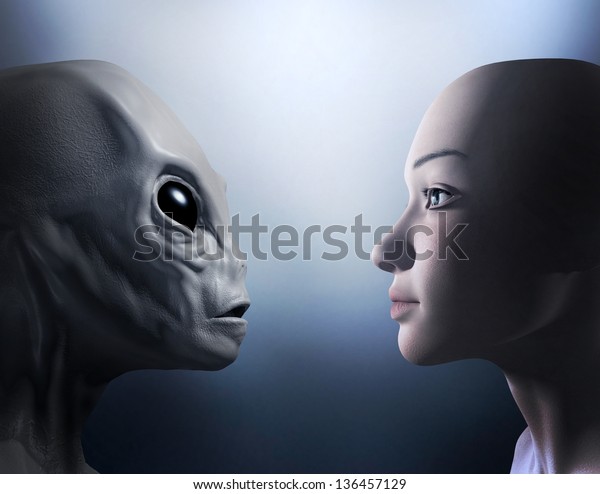
Sources: https://theconversation.com/blasting-out-earths-location-with-the-hope-of-reaching-aliens-is-a-controversial-idea-two-teams-of-scientists-are-doing-it-anyway-182036 Image: https://image.shutterstock.com/image-illustration/alien-human-600w-136457129.jpg

Saturday, January 6, 2024

Status Update • 6 January 2024

After a three-week delay caused by my need to clear a bad head cold and sinus infection, followed by the year-end holidays, my transition to becoming a cyborg is back on schedule. 

In addition to the implant in my right arm that helps to control my blood glucose levels, I now have an implant in my right eye that helps to…

Well, that’s an interesting question. 

People have asked what the surgery was like. I don’t know. I was sedated for most of it. People have asked how I felt afterward. Like I’d had my eye carved out with a melon baller, peeled like an onion, and shoved back into its socket. The actual surgery was nowhere near that invasive, of course, but that’s how it felt. For a while afterward I also felt like I’d been to the vet, as a I had a plastic shield taped over my eye socket to prevent my rubbing or scratching it. At least they didn’t make me wear a cone. 

I knew Martin Caidin. Martin Caidin was a friend. Long ago I read his novel, Cyborg, which you probably know better by the title of the TV series based on it, The Six Million Dollar Man. If Martin was still alive I’d want to have a few words with him right now, about just how awkward and uncomfortable it is to recover from eye implant surgery. Among other things, I’m having to re-learn depth perception.

The strangest and most unexpected side-effect, though, is the way in which it has radically changed how I perceive color. I’m seeing in two very different spectra now, depending on whether I’m looking through my left or right eye. For example, we received the preliminary cover art for Henry Vogel’s latest novel, THE PRINCESS SCOUT, yesterday.


I’m no longer confident that I know what anyone else sees. I am seeing two quite different images, depending on which eye I’m using.

This effect is not confined to discrete images. As I move, walk, even turn my head, the colors I’m perceiving are constantly shifting, as objects move relative to my field of view. It’s…unsettling. Hallucinatory, I’ve been told, by a friend who has a lot more experience with that subject than I do. 

As for what this means for Stupefying Stories: now that the first phase of the surgery is done and I have some idea of what to expect following the second phase, I’m learning what adjustments I need to make in order to compensate: scaling font sizes, adjusting monitor brightness and contrast, changing the ambient light, that sort of thing. The plan at this point is to resume running SHOWCASE stories beginning next week, and to ease back into publishing books over the course of the next few weeks. 

One step at a time. Baby steps. And they need to be very careful steps, as my depth perception is still out of whack. Right now my instincts are telling me to go hide in the dark until my vision recovers. Fortunately, this being Minnesota in the dead of winter, even on clear days it’s dark 16 hours a day.

Upward and onward,
Bruce Bethke