Wednesday, March 17, 2021

Punch Them in the Feels • by Eric Dontigney


So, earlier this week, Bruce put up the Dark and Gritty Reboot post. He’s not alone in giving this trend to ever-darker content the side-eye and wondering what it’s all about. It’s something I’ve thought about and written about before, not least because my own fiction trends dark. It’s tricky ground. As a writer, one of the things you can’t avoid is that you must do bad things to your characters. Conflict drives narrative action. Yet the bad things don’t automatically have to be enormous, terrible things. If you write fiction for a mainstream, non-speculative fiction crowd, you can get a lot of mileage out of something as simple as someone getting their hours cut at work.

Think I’m oversimplifying? Picture this. Abby is a single mother raising two kids. She holds her family together with her $12/hour full-time job, occasional overtime, a little extra from babysitting neighbor kids, and a budget so ruthless that it would make pre-Christmas Eve Scrooge nod in approval. Her car has 180,000 miles on it and the engine makes an unhealthy noise. Abby has socked away about one month’s rent in her savings account. One day, her boss calls her in and says he needs to cut her down to 28 hours a week. In one fell swoop, she goes from taking home about $1600 a month to about $1150 a month.

What’s the fallout? Abby has just gone from a hard situation to an impossible one. If she had health care coverage through her job, that’s gone. Let’s say she’s living somewhere cheap and shelling out $800 a month in rent for a two-bedroom apartment. Now she’s got $350 a month to cover everything. The threat of homelessness becomes immediately real. She’s got to figure out a way to pay for gas, for food, for utilities with way less than she can do it with. Sure, there are potential solutions. She can get another part-time job, but probably working somewhere in the evening. She’ll also probably end up working 50 hours a week and not sleeping enough. So, then she needs to think about the problems of childcare and being an absentee parent. If she doesn’t hire childcare, the threat of social services looms large.

In the vernacular of literature, this is all the substance of pathos. It’s the way in which you evoke an emotional response from an audience. In fact, by the end of all that, you probably felt at least a pang or two of pity for Abby, if not some empathy. More importantly, I didn’t need to say anything about her personality to make that happen. I didn’t have to make her dark and gritty. The situation is plenty grim all by itself. Yet, if this was a science fiction or fantasy film or novel, I’d be expected to make her a humorless, hard-bitten person with an allergy to smiles.

In the back of my head, I think of this as the “punch them in the feels” approach. My theory is that it originates in some form or another with something called the negativity bias. For all the people who didn’t minor in psychology, the negativity bias is the human brain’s tendency to register, note, and react more strongly to negative input. It’s why news coverage of a disaster gets better ratings than news coverage of the guy who takes his golden retriever to visit with sick kids every weekend for a decade. It’s probably also why news coverage has taken a turn for the hyperbolic negative in the last 30 years. When you apply the negativity bias to fiction in novel or film form, the punch them in the feels approach calls for making it as dark as possible.

There is also at least some level of what I call the crappy copycat effect in action here as well. People see something like Game of Thrones or Christopher Nolan’s Dark Knight Trilogy and they look for a simple explanation for why they’re successful. Now, while I personally loathe Game of Thrones, I understand enough about constructing a story to get why people like it. The fact that it’s dark and gritty is a factor, but it’s not the most compelling factor. Nolan’s Batman films, which I personally love, also upped the grit factor to 11. Again, that grittiness is not the main reason why people loved them. But dark and gritty it is the low-hanging fruit on the explanation tree.

The real secret of why things like Game of Thrones and Nolan’s Batman movies work so well is multifaceted. Game of Thrones benefited from source material that wasn’t created by a committee (except maybe that last season that everyone hated so much). The source material was the product of one person’s creative process, and the show writers apparently did a good job of carrying that story intact over into the scripts. That means you got a much more cohesive and frankly sensible story than you typically see on screen. While it’s hard to know exactly how much studio interference happened on the Nolan films, the scripts for those also appear to be primarily the product of Nolan, his brother, and prolific screenwriter David S. Goyer. The end result was, again, more coherent storytelling.

Both examples also benefited from unusually talented casts. Imagine The Dark Knight if they’d cast Jeremy Renner as Batman, Megan Fox as Rachel Dawes, and Charlie Sheen as the Joker. You’d end up with a very different and almost certainly inferior film, despite the outstanding script. Imagine the first season of Game of Thrones if they’d cast Dwayne Johnson as Khal Drogo and Jude Law as Ned Stark. Johnson and Law are both adequate actors, but neither is as good as Jason Momoa and Sean Bean. Both of these examples also display outstanding results in terms of production values. That speaks to a lot of hard work on the part of all the crew members and post-production teams that never get more than a passing nod when the accolades go around.

Unfortunately, the usual TV and film production process doesn’t enjoy all of these advantages. TV shows get written by teams of people in a writer’s room, often on a bitterly short schedule. Film scripts get written by a screenwriter, then usually rewritten with “input” from studio higher-ups, and frequently rewritten by an entirely different screenwriter or two. Can you imagine the mess you’d get if novels were written this way? The whys and hows of casting remain utterly mysterious to me. Production values on films and TV shows vary wildly. Sometimes they vary from one episode of a show to the next. I suspect this leads the people who greenlight projects to assume that factors like good writing, good casting, and high production values are simply random factors and the real secret is to make it dark and gritty.

People respond to dark stuff. Punch them in the feels, dammit!

This creates an unfortunate knock-on effect. Like it or not, every writer is influenced by the books, shows, and films they read and watch in their formative years. When my writer’s voice was first being developed, I was watching films like Seven, The Usual Suspects, The Matrix Trilogy, and Heat. I was also watching things like the excellent Granada Sherlock Holmes series with Jeremy Brett and the outstanding ITV Poirot series. This might help explain some of the darkness in my writing, as well as my tendency to unintentionally write everything like a mystery. Of course, I was also reading some top-shelf authors, like Neil Gaiman, Asimov, Bradbury, Harlan Ellison, and Stephen King. I credit King with saving my writing from descending into irreparable grit and gloom. Say what you like about the guy, he has a knack for working humor into some pretty dark stuff. If I learned the art of working in humor, I learned it from him.

For people who came along later than I did, though, their influences were things like the godawful Saw movies or Hostel. That’s to say nothing of all of the other dark and gritty, but not especially good, stuff I never saw because I didn’t know it existed. All of those writers were subconsciously learning bad lessons about storytelling and mimicking them in their own fiction. This was at the same time as the Potter books, which are pretty good storytelling. Unfortunately, it was also the time of the Twilight books and the Hunger Games books, which are both (by all reports) absurdly dark and not especially good storytelling.

So, where does this leave us? It leaves us with a generation of writers who were brought up watching and reading popular books and movies that glorified grit and darkness without the saving grace of humor. These writers, in turn, seek pathos through the wrong channels. They write dark and gritty characters into dark and gritty situations, rather than building pathos through careful construction of story and situation. It’s unnecessary and unfortunate because it violates the essential rule of writing: what you know.

What every writer knows best, whether they realize it or not, is other people. Every writer has a vast web of prior and current relationships that should teach them about how people react to situations. Yes, some people react to bad situations with stoicism or grim determination or anger. Others meet those challenges with humor or can-do pluck. Some get worn down and give up. Others rise to the occasion and shine. The amplified nature of speculative fiction doesn’t change that reality. It should simply offer a bigger imaginative canvas on which to express those variable reactions.

In short, don’t punch people in the feels.


Eric Dontigney is the author of highly regarded novel, THE MIDNIGHT GROUND, as well as the Samuel Branch urban fantasy series and the short story collection, Contingency Jones: The Complete Season One. Raised in Western New York, he currently resides near Dayton, OH. You can find him haunting obscure sections of libraries, in Chinese restaurants or occasionally online at ericdontigney.com.

Tuesday, March 16, 2021

How to Make a Really Good Scary Movie • by Pete Wood


It’s bad enough that they remade Archie comics into the dark and brooding Riverdale, where suddenly even Jughead isn’t any fun. They had to make horror movies too dark, too. Yeah, I know what you’re thinking. Horror movies are supposed to be dark.

Yeah, maybe. Unless they become so dark they stop being scary. Hear me out.

If I ran Hollywood, every aspiring horror filmmaker would have to watch two movies: Abbott and Costello Meet Frankenstein and the original The Haunting.

The 1940s comedy team of Abbott and Costello showed how seamlessly a good movie can blend horror and comedy. In 1948 Universal Studios brought an all-star lineup in with Bela Lugosi as Dracula, Lon Chaney, Jr. as the Wolfman, and Glenn Strange, later the bartender on Gunsmoke, as Frankenstein. The plot ping-pongs between scary and funny effortlessly. The monsters play it straight and some nasty things happen, but just when you think you can’t watch anymore, Abbott and Costello start doing their shtick The comedy duo relied on the horror/comedy mix to good effect in Hold that Ghost, Abbott and Costello Meet the Mummy, Abbott and Costello Meet the Killer, Boris Karloff, and Abbott and Costello Meet the Invisible Man.

There is nothing funny about The Haunting [1963, directed by Robert Wise who also directed The Sound of Music]. Based on Shirley (“The Lottery”) Jackson’s classic novel, the Haunting of Hill House, it tells the story of a group of paranormal investigators who foolishly decide to spend a few days at the most haunted house in the world. Not even the New England estate’s two caretakers have the guts to spend the night. I’m not going to give away the plot, but the movie works more by suggestion than by explicitly showing things. How scary is the movie? Well, when I popped it into the VCR many years ago while home from college, I got so spooked during the title sequence and opening narration that I hopped in the car and drove thirty miles to hang out with my Dad and his friends. At four in the afternoon.

The senseless 1999 remake is so bad it highlights the greatness of the original. Subtlety and suggestion are thrown out the window in favor of hokey special effects, very visible ghosts, over-the-top acting, and an amped-up body count. Not even Liam Neeson and Bruce Dern can save this movie. (As a side note, would you stay in a house where Bruce Dern is the caretaker? Just sayin’…)

Things have gone horribly wrong since then with the movies. Horror movies have abandoned suggestion for graphic violence that borders on torture porn. Some filmmakers don’t see the benefit of humor at all.

Consider The Night Stalker. Richard Matheson (I am Legend, Hell House, and many episodes of The Twilight Zone)  wrote the screenplays for two of the highest-rated made-for-TV movies of all time. In the Night Stalker, (1972) a wise-cracking tabloid investigative reporter (Darren McGavin, the Dad in A Christmas Story) in Las Vegas can’t seem to convince anyone that a vampire is on the prowl. Darren McGavin repeated his role as Karl Kolchak in the superior sequel, The Night Strangler, (1973), where nobody believes that a monster is murdering women in Seattle. McGavin has impeccable comic timing and some serious acting chops in the scary scenes. Simon Oakland plays his long suffering editor, Tony Vinchenzo, and he and McGavin play off each other like they’re in a screwball comedy.

Chris Carter based The X Files on The Night Stalker. He adopted the monster-of-the-week format from the short-lived ‘70s TV show (also starring Oakland and McGavin), as well as the theme of government cover-ups. He also kept the humor. David Duchovny has some pretty good comic timing himself.

Some rocket scientist had the brilliant idea to remake The Night Stalker in 2005, but without the humor. Kolchak becomes a chronically depressed sourpuss with demons in his past. The reboot went off the air quickly as viewers preferred the original.

The first Stalker was scarier for the simple reason that the characters seemed real. We can relate to wise-cracking reporters who give their bosses ulcers. We can’t relate to the second Kolchak, a stoic loner looking for his wife’s killer. He never even cracks a smile. The first series felt like horror invading real life. The second series felt like, well, a TV series.

Okay, so maybe you think horror doesn’t need humor. Fair enough. Make it too graphic and it stops being scary.

His House is a 2020 horror movie that illustrates my point. Two refugees from South Sudan seek political asylum in London. They’ve just lost their daughter in a horrible boating accident as they fled Africa. There’s enough pathos and horror right there, but then director Remi Weekes just had to make it into a horror movie.

The couple start seeing things. Their home is haunted with that gooey ectoplasm that has dominated horror movies since Alien. Everything in their new house is wet and dripping and phlegm-like. Why? I don’t know. Third base. (A little Abbott and Costello reference there for y’all.)

Then the torture porn starts. I hate seeing people tortured. I hate seeing demons and monsters that love to torture and ooze all over the place at the same time and leave a mess that they never clean up.

What could have been a great drama with a peek into the lives of political refugees becomes a paint-by-numbers horror movie with too much gore, too much phlegm, and no damned humanity. I hated the main characters. I wanted to like them. Honest, I did, but somehow the movie got me to hate two political refugees from the Sudan. The haunted house is so contrived and over the top that everything seemed unreal, even the very real political nightmare that is South Sudan.

There is a genuinely terrifying scene in The Haunting where director Robert Wise shows nothing. No monster. No jump scares. No gore. No violence. Just darkness and narration, but it culminates in the scariest moment ever on film. See the movie and judge for yourself. You’ll know the scene when you see it.

For horror to be scary, it can’t be unrelenting. There have to be quiet moments where you can imagine the monster for yourself rather than gawking at CGI. Unrelenting horror isn’t scary. It’s a cartoon. Horror that comes after a good laugh or a quiet moment or anytime that you aren’t expecting it: now that is scary.

Don’t believe me? Watch The Night Stalker or Abbott and Costello Meet Frankenstein or try to sit through The Haunting by yourself, even in the middle of the afternoon on a bright sunny day.


Pete Wood is an attorney in Raleigh, North Carolina, where he lives with his kind and very patient wife. His first appearance in our pages was “Mission Accomplished” in the now out-of-print August 2012 issue. After publishing a lot of stories with us he graduated to being a regular contributor to Asimov’s, but he’s still kind enough to send us things we can publish from time to time, and we’re always happy to get them

Monday, March 15, 2021

Stupefying Stories: The Dark and Gritty Reboot


Just kidding. Not happening. Oh, you might from time to time notice somewhat more adult language and situations in upcoming issues. There was a business reason why I was struggling to keep the magazine G rated—and it was a struggle—but that reason turned out to be invalid, so going forward I’m going to be relaxing those rules a bit.

But this whole “dark and gritty” thing: what the Hell is with that? TV and films in general, and the DC cinematic universe in particular, have turned so dark and gritty it’s as if someone was running a sale on dark blue lens filters and anti-depressants in industrial quantities. And it’s rarely a new idea, either: it’s almost universally a dark and gritty reboot of what was originally a lighthearted and fun-filled property. 

Is it simply a matter of making the CGI cheaper to do, because the audience doesn’t need to be able to see anything clearly? Are the decision-makers in Hollywood so bereft of original ideas that the only things they can think of to do are to torture the characters they once loved when they were children? What’s next: Toy Story: The Dark and Gritty Reboot? The Sound of Music: Only With More Nazis?

When I learned that The CW has greenlit a dark and gritty reboot of The Powerpuff Girls—I am not making this up—this time as a live-action TV series, with Blossom, Bubbles, and Buttercup as “disillusioned 20-somethings who resent having lost their childhood to crime fighting,” I snapped. 

Okay, it’s Dark and Gritty Week here on StupefyingStories.com. Let’s take a few days to talk it out. Dark and Gritty: necessary? Unnecessary? Merely a trendy fictional fashion statement, or clinical evidence that too many writers out there have profound unresolved Daddy issues? Is there any room left for fiction that leaves readers with a positive or at least hopeful view of the world, the future, life, and the people who live it? 

Let the arguments begin.

—Bruce Bethke


P.S. I would dearly love to run some guest posts on this topic. If you have something to say about it that feels like it should be longer than a comment, drop me a line at brb[at]rampantloonmedia[dot]com.

Sunday, March 14, 2021

The State of the Loon • 14 March 2021


With STUPEFYING STORIES 23 released and selling—not exactly rocketing up the charts with a bullet, but selling all the same—

Sorry, that “with a bullet” bit is an old BILLBOARD “Hot 100” reference. Does anyone in this century even get it anymore?

Never mind. With SS#23 released and selling, and then updated and re-released (“Now with fewer typos!”), we’re moving ahead with new work. The first thing on the stack is to select the stories for STUPEFYING STORIES 24. I’m not ready to do a cover reveal or start announcing what’s in the TOC yet, but I will say that this thing is coming together much faster than expected. In fact, we have so many good candidates in the stack for SS#24, we’re actually a fair way along the road towards SS#25. Weird as this seems to me, our process has become something very akin to putting together a fantasy football team. E.g.,

“Well, this story is too much like that story, so we can’t use them both in the same issue. And we can’t use both this author and that author in the same issue, because [reasons]. But this story and that story really do complement each other, so we must use them back-to-back.”

I’ve always compared putting together an issue of a magazine to putting together a playlist or a concert program. My wife compares it to putting together a patchwork quilt. I suspect that in different ways, we’re both right. The object remains to create a coherent whole that is greater than the mere sum of its parts.

As for a release date: initially, I was targeting April 1. However, having learned from SS#23 that we really need to build an extra week into the schedule after the thing is nominally finished in order to allow sufficient time for proofreading and making corrections, I’m now targeting SS#24 for release on April 9, with SS#25 targeted for May 1. 

Those are our goals. Now let’s see what we can actually do. 

Meanwhile, after having wasted a lot of time behind the scenes trying to redesign the Stupefying Stories web site, we’ve come to the conclusion that the blogspot engine just can’t do what we need it to do. The biggest single problem is that every newer site template we’ve tried ends up losing or hiding the sales links in the right column, and thus, our entire raison d'être: to sell books.

That’s what we’re trying to do here, you know: sell books. We have a lot of books out there right now, but when they’re not mentioned in the top six or eight posts on this site, sales taper off. For example, Henry Vogel’s Matt & Michelle series has done very well for us, selling thousands of copies on Kindle, in print, and in audio book format, and getting great reviews.


But it sells only when we’re pushing it. If I go a few weeks without plugging it here, sales dwindle.

So rather than turn StupefyingStories.com into the sort of site that is constantly in your face, shouting BUY THIS! BUY THIS! ALSO BUY THIS!, and rather than migrate to another platform and thus lose the ten years of accumulated content we have here, our current thinking is that it’s time to reboot the Stupefying Stories SHOWCASE site. SHOWCASE runs on WordPress, and from the start, it was designed to be a weekly SF/F webzine. 

The site needs a refresh. The template is dated. Now that I look at it, the ads on it are way outdated. But Stupefying Stories SHOWCASE is the kind of site that I was hoping to turn this site into but can’t, because of the limitations of the blogspot engine. If you have some time to spare this afternoon, why don’t you pop over to SHOWCASE, give it a look, and tell me if you think this seems like a reasonable idea or a dilution of effort. There are close to 200 stories sitting out there on the SHOWCASE site, all free to read, and if those stories could speak they would tell you that they would just love to get a little attention.

For example, this story: “Bully,” by Peter Wood. Why don’t you give it a look right now?

—Bruce Bethke

Saturday, March 13, 2021

Science Fiction Never Saw This Pandemic Coming • by Pete Wood


I’m still waiting for the flying cars. Let’s face it. Science fiction is entertaining, but not always prescient. Transporters and ray guns and time travel might come eventually, but I’m not holding my breath.

Some science fiction can’t come soon enough. We all want to journey into space, or have robots clean our homes, but nobody’s looking forward to the Apocalyptic stuff. I don’t want to go through a real alien invasion.

In 2020 the world had the chance to live an end-of-the-world scenario that’s been played out countless times in print, movies, and film. And I’ve been continually surprised by how wrong every writer turned out to be about a worldwide pandemic. 

I’m not an epidemiologist. For all I know, Anthony Fauci loves Outbreak and The Walking Dead. I dunno. Or maybe he got two chapters into The Stand and let out a blue streak and heaved it across the room in disgust. Who knows?

I’m a lawyer and I can’t watch lawyer or cop shows. They get it wrong time after time. Law and Order would have us believe that cases are fast-tracked for trial and that judges open court for one motion on one case and then adjourn for the day. No crowded dockets on television. In the TV world, prosecutors tackle one  case at a time, conduct all discussions about cases in person—never over the phone or email—and are highly confrontational with the other side. The truth is we all get along. It’s a job, y’all. I don’t get into fistfights with the D.A. if I see him at a local bar. But that’s not good television.

My favorite lawyer movie is My Cousin Vinny. Many of my colleagues agree. It gets a lot right. Vinny’s summary of contract law in the pool hall is spot-on and would have saved me a semester of law school.

But back to the pandemic. I don’t profess to be an expert on pandemic literature, but I have noticed a couple of things in fiction.

In the vast majority of fiction, the pandemic is unstoppable. The worldwide pandemic kills almost everone in works like Station Eleven and Earth Abides. People survive by going off the grid until the plague burns itself out.

Nobody takes any remedial measures. In Station Eleven, I can recall exactly one character wearing a face mask. There are no public service announcements, no talk of hygiene. The viruses in the Scarlet Plague, Earth Abides, and The Stand are able to cover vast distances and travel through walls.

Government does nothing in these books. Characters live in a libertarian nightmare where it’s every man for himself; an Ayn Rand utopia. No CDC, no local health departments. Just people trying to get the hell out of the city.

Government isn’t present or it’s incompetent or somehow responsible for the virus. In Stephen King’s The Stand, the government created Captain Trips and the only public policy is to cover it up. The military doesn’t do shit, except things like gunning down media who try to talk about the virus.

Don’t even get me started on 28 Days Later and 28 Weeks Later where Rage, a virus that shouldn’t have made it out of London, somehow takes over the entire British Isles and then eventually all of Europe. How the hell did that even happen? The infected get the disease in under a minute and become crazed zombies. Are zombies driving to other cities? Did Parliament fund a zombie relocation program?

Say what you want about the response of governments to COVID-19, but they at least had a response. Very simple rules for dealing with the virus have been broadcast constantly. Wash your hands, wear a mask, social distance. I can’t recall anything of that sort in fiction.

The pandemic in fiction rages out of control and overwhelms everybody. Don’t get me wrong. I love The Stand, Station Eleven, and Earth Abides. But the response of government in those works is highly unlikely and reality has proven me right.

No work of fiction anticipated  the deep political divide caused by the pandemic. People in Station Eleven or The Stand might not be doing much to counter things, but nobody in those books pretends that things are normal.

There are riots and traffic jams and street crime in fiction. Four Horsemen of the Apocalypse stuff. Not so in the real world. Oh, we had riots all right. Plenty of them. But they weren’t about the pandemic.

Who could have predicted that?

If I had read a book with the plot of the past year, I would have pulled a Fauci and tossed it across the room myself. Oh, come on! They’re not heading for the hills or escaping the city. They’re heading to the city to protest the election? Who the hell would do that?

Don’t go back in the haunted house. Stay out of the City!

I’d like to think that maybe the reason the coronavirus pandemic wasn’t like The Stand is because people have read that book. I’d like to think that we’re learning from the mistakes of characters in a Stephen King novel.

Maybe these great fictional apocalypses have taught us something. We didn’t get it wrong. When intelligent apes pop up, we won’t be stupid enough to enslave them as maids and hairdressers and janitors. Then maybe, just maybe their takeover won’t be quite so easy. I’d like to think that if the apes end up running the joint, they won’t flip up humanity and drag the Statue of Liberty up to the rocky beaches of New England. “We’re don’t want your huddled masses, you damned dirty humans!”

I like to think that if we do develop time travel and stupidly give it to the U.S. Congress to regulate, unlike Time Cop, we won’t put the sleaziest and stupidest two senators in a room and let them decide who’s going to control the technology. For the love of Isaac Asimov, I hope that if there is a one-line allocation in Joe Biden’s COVID-19 relief bill for a multimillion-dollar grant to Cyberdyne Systems to fund the development of something called Skynet, I pray that we notice it.

I’m not holding my breath.


Pete Wood is an attorney in Raleigh, North Carolina, where he lives with his kind and very patient wife. His first appearance in our pages was “Mission Accomplished” in the now out-of-print August 2012 issue. After publishing a lot of stories with us he graduated to being a regular contributor to Asimov’s, but he’s still kind enough to send us things we can publish from time to time, and we’re always happy to get them

Friday, March 12, 2021

Ask Dr. Cyberpunk • with your host, Bruce Bethke


Today’s question comes from Lars, who leads into his question with a quote from what someone else had written about me: 

“When coining the term for his 1983 story “Cyberpunk,” Bruce Bethke reportedly matched up words for technology and words for troublemakers until he found a pair that seemed right, rather than singling out punks as a crucial countercultural group for the new genre.”

Any chance you could enlighten us about the origin of the term? She is arguing that “punk” did not specifically and politically reference the “punk movement” (connotations of anarchy, anti-establishment, etc.) but [you] needed a term that generally referenced something “troublemakers.” We would love to hear how this came about.

Yeah, that looks like a translation of a paraphrase of something I’ve said many times in many interviews, and used to have posted on my website in an article entitled, “The Etymology of ‘Cyberpunk’.” I took the article down because I got tired of dealing with science fiction fans who wanted to talk, and talk, and talk about cyberpunk fiction without paying any attention to what I’ve been doing in the 40 years since I wrote the story. I’d re-post the article if I could find it now, but the file—well, it’s somewhere around here, buried in about 4TB of poorly organized data.

When I came up with the title: first off, I was just trying to come up with a catchy one-word title for my short story. I really wasn’t thinking about anything beyond that. So the way I came up with the title was by experimentation, by putting together various terms for technology—cyber, techno, und so weiter—and terms for “socially misdirected youth,” until I came up with a word that just plain sounded right. 

That was my critical consideration: that it sounded right. I tried a lot of word combinations, and even experimented with Japanese borrow-words—for example, bōsōzoku got really close to my concept—but there’s no way to turn that into an English-language expression without making it sound silly. “Cyberbozos?” Sounds like an Alan Dean Foster novel.

The other key thing to know is that I didn’t set out to become a science fiction writer. I am by training and inclination a musician, which is why how the word sounded was extremely important to me.

Note the photo. That thing behind my head is my ARP 2600, and that, as we musicians say, is my axe. And I keep writing and rewriting and deleting this part of my reply, but let’s just leave it at: if you go to the wikipedia articles on Contemporary Classical music, electronic music, and computer music—well, a lot of the names you’ll see there are people I met, knew, studied, or worked with. Some were even friends. An important part (to me) of my bio, that flies right over the heads of most people in the science fiction world, is that I spent a couple of years working for Passport Designs and was on the design team that developed MIDI and the Finale music notation engine, among other things. If you really want to understand me, go find and watch the movie, I Dream of Wires.

So yes, in the latter part of the 1970s, I was acutely aware of the punk rock music scene. And that is where the “punk” part of cyberpunk came from.

“...punks as a crucial countercultural group...”

Seriously? Countercultural? Hell no. In the US, punk was mostly just counterdisco.

I get the impression that at the time, punk meant something very different in the UK and Europe than it did in the US. In the UK, there seemed to be an authentic working class/proletariat/anarchist/revolutionary thing going on. (Though let’s face it, the Sex Pistols were the Monkees of punk.) There may even have been something authentically political about the New York punk rock scene, circa'76~'77. But by the time punk hit the rest of the US I was living in Los Angeles, trying to break into recording studio work, and the LA punk scene was entirely about affecting the look, the pose, and the fashion. For a year or three there anyone could get a record contract, no talent required, if they just had a lead singer with a mohawk and a guitarist who wore lots of black leather, studs, and chains. (The studs and chains scratch the hell out of the backs of guitars, by the way.)

That is what the American punk rock scene was all about: not James Dean’s “Rebel Without a Cause” but Tom Petty’s “Rebel Without a Clue.” There may have been a few specimens of the real thing in the wild, but at least 90% of American punks were poseurs, pure and simple: affluent white suburban kids, dressing in punk style and going downtown to dance and get drunk on Saturday night, and then back to school or work on Monday. They were McPunks, and that is why Billy Idol became the quintessential “American” punk rock star. He had the hair, the clothes, that little bit of a snarl in his voice, and made great-looking music videos that played well on MTV. But if you close your eyes and listen to his music, and especially to the arrangements and the studio production values in the recordings, you could be listening to any arena rock band of the time. There is nothing threatening—absolutely nothing “countercultural”—in a Billy Idol single. 

Which is why Billy Idol’s songs live on forever in FM airplay, while bands like The Clash, The Buzzcocks, Television, and Siouxsie and the Banshees are for all practical purposes forgotten now.

Except for “Rock the Casbah.” That one comes back on the radio on a regular basis, every time our government is trying to start another war with Iran.


About Bruce Bethke: In the early spring of 1980 Bruce wrote a little short story about a gang of teenage hackers. From the very first draft the story had a one-word title—a new word, one that he’d made up in a deliberate attempt to grok the interface between the emerging high technology scene and teenage punk attitudes, and this word was—

Oh, surely you can guess. 

Half a lifetime later Bruce is still getting questions about this story, so rather than answer them privately and one at a time, he’s decided to make answering questions about cyberpunk a regular feature on this site. If you have a question you’ve always wanted to ask him, post it in the comments here, IM him on Facebook, or email it to brucebethke.cybrpnk@gmail.com. He can’t guarantee that he’ll answer, but he’ll certainly give it a good try.

Thursday, March 11, 2021

THE SALVAGE CREW • Review by Eric Dontigney

Title: The Salvage Crew

Author: Yudhanjaya Wijeratne

Publisher: Aethon Books, LLC

Length: 302 pages

Audiobook Publisher: Podium Audio

Audiobook Length: 8 hours and 21 minutes

Sales Link: https://www.amazon.com/Salvage-Crew-Yudhanjaya-Wijeratne-ebook/dp/B08J977YVQ


Note: This is a review of the audiobook version, so it will include references to the performance.

In Yudhanjaya Wijeratne’s, The Salvage Crew, we get dumped right into the action with an AI describing the sub-par and psychologically damaged crew for a salvage mission. Oh, a space adventure with a snarky machine intelligence, Murderbot-style. Cool. Wait, wait, no. That’s not a machine intelligence. It’s a digitized human consciousness that’s been loaded into this dropship/temporary habitat. I guess it’ll be a rumination about the nature of consciousness set against the backdrop of this salvage adventure. Wait, wait, no. There’s stuff on this planet that’s dangerous. I guess it’s a man and digitized consciousness vs nature survival story. Okay, I’ve got a handle on this thing now.

Wait, no, there are hostile cyborgs here as well. Oh, the company that launched this mission is constraining life-saving activities to keep costs down. Maybe this is a cleverly disguised deconstruction of capitalism and bureaucracy set against a multilayered backdrop of salvage adventure, rumination on consciousness, man and digitized human consciousness vs nature and cyborg bad guys? I can work with this. Wait, is that an alien structure I see in the distance?

You’d think that with all of this going on, The Salvage Crew would read like a hot mess of mixed themes, motifs, and tropes that will eventually collapse under the weight of all its pretentiousness. In the hands of a lesser writer, it would. Yet, Yudhanjaya Wijeratne sits before his keyboard and binds these disparate elements together like a master weaver at the loom. While it seems like this thing shouldn’t work, it does, and it works quite well at that.

Of course, the heart of the story is that of the digitized human consciousness who is at least nominally in command of this salvage operation. Unlike so many machine consciousnesses in science fiction literature, this digitized human consciousness retains much of his humanity. He spends a disproportionate amount of his time trying desperately to keep the human crew alive in the face of a mission that has gone wildly, catastrophically wrong. At one point, he even rules-lawyers the AI of the orbiting company ship into doing what he wants, even though the company would normally forbid the expensive action.

Despite his near-constant efforts to preserve the lives of his crew, the escalating despair of the digitized consciousness grows palpable as the situation deteriorates. This despair is mirrored in the increasingly erratic behavior of the human crew who are all too well aware they are likely screwed and never getting off the planet. And just what the heck is going on with the alien structure?

Adding to all of this is the vocal performance of science fiction fan favorite, Nathan Fillion. While the production values are a little uneven in places, Fillion brings his trademark combo of snark and empathy to the reading to excellent effect. If you’re one of those people who find listening to books easier than blocking out time to physically read them, Fillion’s performance won’t disappoint.

The Salvage Crew is heir to an older tradition of science fiction that you don’t see much these days outside of authors like Neal Stephenson, David Brin, and William Gibson. It is science fiction that marries adventure with serious philosophical considerations, science realism with scientific speculation, and an abiding belief that humanity means something more than a human body. If this book isn’t already on your TBR list, you should put it on there immediately. 

—Eric Dontigney


Eric Dontigney is the author of the Samuel Branch urban fantasy series and the short story collection, Contingency Jones: The Complete Season One. Raised in Western New York, he currently resides near Dayton, OH. You can find him haunting obscure sections of libraries, in Chinese restaurants or occasionally at ericdontigney.com.

Wednesday, March 10, 2021

In the meantime...


And especially for those of you with Kindle Unlimited subscriptions, here’s a reminder that PRIVATEERS OF MARS would also benefit from some attention by the Fearless Bug Hunters of the Stupefying Stories Typo Patrol. (Really, I’m beginning to think we need a badge. And a t-shirt. And coffee mugs.)

I’ve been focused on SS#23 lately and missed the three latest reader reviews. All of them warm my hard and leathery publisher’s heart.

• “This was a perfect before-bed page turner. Hilarious and witty, it got me laughing aloud multiple times which is sorely needed right now. Great little sci-fi adventure with action and intrigue! I especially loved the spectrum of diverse characters. Enbys in spaaaaace!”

• “This was so much fun to read! The worlds the characters travel to are each exciting and creative, as is each character. I seriously could not decide which character I liked the best (side bonus: no sexist tropes of female characters!) and the end twist was super unexpected. I’m not the biggest fan of sci-fi as a book genre, but this blends genres into an adventure that I think everyone would enjoy. Great for all ages too!”

“Do you miss Firefly? Do you like The Expanse? If so, then Privateers of Mars is exactly what you need. Castleman combines the down-on-their-luck-crew feel and humor of Firefly with the kind of near system space travel and background politics that drive The Expanse. Structured as three loosely interconnected short stories, it reads like three episodes of a great science fiction show that you wish someone would make.

Emphasis added. And no, I did not pay Eric to write that last review. He did that on his own.

Introducing Typo Patrol

There is a time-honored rule in publishing: “No matter how many times it’s been proofread by no matter how many people, there is always one more stupid and embarrassing typo that will slap you right in the face the moment you open the finished and printed book.”

STUPEFYING STORIES 23 is no exception to that rule. Dammit.

Fortunately we no longer need to wait until the next print run to fix such things; we can do so fairly easily and quickly. Rather than try to keep quiet about our mistakes, then, we’ve decided to make this an audience-participation feature. If you find a typo in one of our books, please post it in the comments here, along with sufficient information to help us find it and fix it in the next upload. 

We will be watching who makes the most and best comments. The winner(s) will receive free ARC copies of our next book, so that they can get a head start on proofreading that.

I’ll kick things off with the typo that smacked me in the face the moment I opened up SS#23.

“A few words from the editor...” paragraph 3, Still, it’s been so long since we released Stupefying Stories 22 that is seems like

D’oh!

—Bruce Bethke


Tuesday, March 9, 2021

While you're waiting...

While you’re waiting for your paperback copy of STUPEFYING STORIES 23 to arrive—you did order it in paperback, didn’t you? Seriously, even I am impressed with how well the paperback turned out, and I built the thing.

While you’re waiting, I’d like to remind you that we do have other books for sale as well. For example, if I was looking for something inspirational to read today, I would go for “Finding Spring,” by Sipora Coffelt, which you’ll find in SHOWCASE. It’s just $0.99 for the Kindle edition, or FREE if you’re a Kindle Unlimited subscriber.

As a special added unintentional bonus, SHOWCASE also features “The Carpetbaggers Ball,” by Karl Dandenell. Read “The Carpetbaggers Ball” in SHOWCASE, then his story “The Last Feast of Silas the Wizard” in STUPEFYING STORIES 23, and we think you’ll understand why we’ve tagged Karl Dandenell as a Writer To Watch!


Monday, March 8, 2021

The State of the Loon • 8 March 2021


With STUPEFYING STORIES 23 finally out the door and selling, it’s time for us to take a deep breath and then begin to clean up the mess in the office. It’s not quite as bad as it was in the old days, when we actually had to paste-up pages on Bristol board and courier them over to the printer’s shop to be photographed and turned into lithographic plates. (And then switch on the fans and air out the office, because the 3M Spray Mount fumes were so thick they could make you dizzy.)

Still, a new book release always leaves us with a surprising amount of clutter in the office, mostly in the form of paper that needs to be sorted into three piles: that which needs to be saved and filed, that which needs to go into the recycling bin, and that which needs to go into the shredder.

Likewise, a new book release also leaves us with a certain amount of mental clutter, so this is a good time to reflect on lessons learned: what worked well, what didn’t work so well but can be improved for the next project, and what really needs to go into the cognitive shredder so that we never try to do it that way again. For those of you familiar with Agile development methodology: yup, it really does apply here.

Next thing you know I’ll be setting up a Kanban board to track all the moving pieces of every book project in progress.

Oh, wait…

Actually, that would work. Dammit. Why didn’t I see that before? A Kanban board would in fact be a really good way to address the most noisome thing on my “never do that again” list. Before I begin to explain why Agile is the more applicable development model here even though a book would seem to be a natural candidate for using Waterfall methodology, let me just shut that off right now and get on to the good, the somewhat less good, and the fugly. 

What worked well:

• Going big. SS#23 is the biggest, most ambitious, and most expensive project we’ve done to date. It contains 40% more fiction content than SS#22. Putting the two books side-by-side, SS#23 just plain looks like a thing to be taken more seriously. 

• Upgrading our cover art. Much as I’ve enjoyed commissioning original cover art, what was quirky, original, and eye-catching a few years ago leaves much to be desired now. The new approach to cover art we took for issues #22 and #23 has been getting far more positive responses.

• Interior illustrations. Including interior illos for every story in the issue was kind of a last-minute decision, but it works. I really didn’t think it would add to the pleasure of reading a story until I saw it. It’s like the difference between slapping some food on your plate and paying just a little more attention to how it’s presented and served.

• Paying the authors earlier in the cycle. We’ve always been a pays-on-publication market, simply because we can’t afford to pay on acceptance. Paying the authors when they signed off on their copy-edits, though, took a major source of stress out of the usual release week panic. We’ll have to keep doing this.

• Sending the authors copies of the almost final PDF galleys. By getting these into the hands of the authors earlier in the cycle, we got extra proofreading done and caught some embarrassing mistakes while there was still time to fix them easily. We’ll have to keep doing this. 

• Getting the stories copy-edited much earlier in the cycle. This was an accidental virtue, resulting from our attempt to get the book out last November. But starting the build with stories that were already copy-edited and approved by their respective authors worked much better than trying to build the book while also working through copy-editing.

What worked but needs improvement: 

• Early copy-editing. This also became a problem. We’ve had so many false starts and failures to launch in these past two years, we actually got stories copy-edited, signed-off on by their authors, and then lost track of the stories and forgot that they’d been approved and were ready to go. Here is where a Kanban board would actually come in very handy. On a positive note, having all these stories in the queue gives us a good head start on Stupefying Stories 24.

• Interior illustrations. I’ve been working from a web perspective for too long. Some of the illos I picked look great in the ebook but are dark and muddy in the print edition. Others run afoul of the matter of page orientation. For example, consider this illo that I picked for Helen French’s “Outrider.”


Looks pretty good online, right? But squish it down to the four-inch wide image that we can use in the print edition and a lot of the energy is lost. Wouldn’t it have looked better if it had been cropped down to the core of the concept and run as a vertical image instead?

We’ll have to put a lot more thought and care into our use of interior illos, going forward. 

• Cover art. We need to start thinking about the cover story and image long before we’ve fully populated the issue. There is risk in doing this. The cover can start to drive the entire rest of the editorial process, if you let it. One of the things that irked me about Jim Baen was that he would buy art because he thought it would make a great cover, and then look for a story to go behind it. That’s one step short of buying a piece of art and commissioning a writer to write a story to go with it, which is one of those things I swore I would never do. 

But then, consider this:

Admit it. Knowing absolutely nothing else about it, doesn’t that cover pull you in and make you want to take a closer look at the book?

• Author’s copies. This is an area where we must find a better way to do things. Amazon no longer lets us order print copies before the book is live for sale on Amazon, so so much for having copies in the author’s hands on release day. Coupled with this, the Kindle ebook creation tools no longer generate a .mobi or .epub file, so we can’t send viable ebook files directly to authors; we must send them through Amazon. But to further complicate matters, Amazon won’t let me, from an account in the U.S., send ebooks directly to Kindle users in the U.K., nor will it let me order them on amazon.co.uk. This problem needs to be solved.

What didn’t work at all:

• Having half the book-building processes running on a Windows 7 machine and the rest running on a Windows 10 machine. This caused serious problems with Kindle Create in particular, as the versions got out of sync. By the time we’re ready to build the next book, we need to have everything on Windows 10. (No, not on the Mac. That’s just begging for trouble.)

• Creating the TOC and front matter in Word just confused Kindle Create. Don’t do it. Import the source and then let Kindle Create do its thing with generating the TOC and front matter.

• Put illos after section headings. Don’t nest page breaks inside section breaks. Trying to get fancy-shmancy with page layouts in Word just confused Kindle Create. Don’t do it.

• Trying to generate the cover art for the print edition as a print-ready PDF file using the process specified by Amazon is a time-consuming exercise in frustration and futility. Instead, download the template, create and save the cover as a PNG file, and then (here’s the tricky part): use Amazon’s cover creator wizard. One of the templates lets you upload your own PNG as the “background” image, which it then overlays with all sorts of ugly auto-generated text, but that text can all be deleted. Voila! A workaround to get the cover art uploaded and validated without going through all that tedious PDF business.

• And this is the fugly one: I must stop talking about projects that are in development before we are actually within reach of executing on those plans. My doing so just frustrates and annoys authors, especially when some external event forces us to change plans and I don’t notify all the authors affected, often because I don’t remember which authors are affected. This is one place where having a Kanban board would really help.

Upward and onward to SS#24.

—Bruce Bethke


Friday, March 5, 2021

IT'S ALIVE!


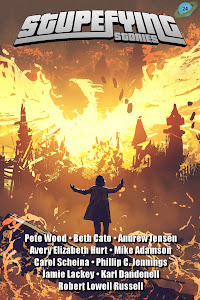
Rampant Loon Press is excited to announce our biggest and most ambitious project yet: STUPEFYING STORIES 23. Twelve new stories, covering a range of genres from contemporary horror, to urban fantasy, to science fiction so hard it clanks. Twelve authors, ranging from names you probably know and love already to new voices we believe you'll be hearing a lot more from very soon. A nice balance of previous contributors and new friends; a good mix of lengths and tones, from a novelette set on a generation ship gone terribly wrong ("Outrider") to the delightful little confection that is "Brimstone and Brine," STUPEFYING STORIES 23 features:

Woe to the Hand, by Julie Frost
The Unicorn’s Companion, By Jamie Lackey
The Secret of Erin Stewart, By Terry Faust
Outrider, By Helen French
The Last Feast of Silas the Wizard, By Karl Dandenell
The Bird and Baby, By Allison Thai
The Worm’s Eye, By Tom Jolly
Magic with the Bones, By Beth Hudson
Eddie’s Upgrade, By Kevin Stadt
The Dead Barn, By Amy Caylor
They Call Me Charon, By Gary Pattinson
Brimstone and Brine, By Beth Powers

From magic to mystery to science fiction, from the mythic past to the dystopian future, here are twelve tales to chill, thrill, excite and amuse you. Always fresh and entertaining, never formulaic or predictable, Stupefying Stories is the terrific new reading you've been looking for!


Thursday, March 4, 2021

A few words from the editor...


[DRAFT]

Hello, I’m Bruce Bethke, editor of Stupefying Stories magazine and executive cat-herder-in-chief here at Rampant Loon Press. You hold in your hands Stupefying Stories 23, a book that was beginning to approach The Last Dangerous Visions in terms of its quasi-mythic “Will that damned book ever be released?” status.

Yet here it is at last: the biggest and most expensive project we’ve done to date. Twelve stories, covering a range of genres from contemporary horror, to urban fantasy, to science fiction so hard it clanks. Twelve authors, ranging from names you probably know and love already to new voices you haven’t heard before, but who we believe you’ll be hearing a lot more from in the not-too-distant future. A nice balance of previous contributors and new friends; a good mix of lengths and tones, from a novelette set on a generation ship gone terribly awry (“Outrider”) to the delightful little confection that is “Brimstone and Brine.”

Still, it’s been so long since we released Stupefying Stories 22 that is seems like a longer introduction is needed. Therefore, since author’s and editor’s bios are always written in third person, it’s time to shift into third-person and tackle two questions: who is Bruce Bethke, and why should you care about the stories he’s presenting in Stupefying Stories 23?

#

To answer the second question first, consider this review quote from Dave Brzeski at SFcrowsnest Magazine. Writing about Stupefying Stories 22, he said [emphasis added]:

“This is perhaps not a publication for those whose tastes fall within narrow boundaries, as the stories can fall pretty much anywhere within the broad scope of speculative fiction. It's fairly obvious that Bruce Bethke's only criteria for the magazine is that the work should be of a uniformly high standard.

To coin a phrase: Dave Brzeski gets it.

To answer the first question, then, we need to add a qualifier: when? In the 1980s Bruce Bethke was a successful short story writer, with a list of professional publication credits so long he quit counting new sales after a while. In particular some of the science fiction stories he wrote and sold in the 1980s are considered “significant” now, by people who feel themselves qualified to judge such things. (And if you want to talk about any of those old stories, there’s a feature called “Ask Dr. Cyberpunk” on the StupefyingStories.com web site where you can do just that.)

By the 1990s, Bethke had realized that writers cannot live on short story sales alone, so he graduated to writing novels and became an award-winning novelist. He also served a few terms on the board of directors of a certain famous science fiction and fantasy writers association, and took a contract job as an anthology editor at a major publishing house. In the process of doing these things he gained a great deal of experience and insight into how the commercial publishing industry really works, although he has difficulty describing that experience now—at least, not without using a great deal of profanity.

By 2000, fed up with the way the publishing industry grovels before a small handful of bestselling authors and treats all the rest of their original content creators like fungible contract workers, he walked away from fiction publishing and went off to do something else. Again, he has difficulty describing that experience now, but in this case it’s because of NDAs he signed that are still in effect.

In 2010, aided by a terrific crew of friends and volunteers, Bethke founded Rampant Loon Press and launched Stupefying Stories, with the goal of using the attention people wanted to pay to him, because of all those stories and novels he wrote back in the 1980s and 1990s, to help boost the careers of new up-and-coming writers. Since then Stupefying Stories has had its ups and downs, and more than a few times when things went completely sideways, but along the way Rampant Loon Press has published dozens of books, hundreds of stories, and given a hand-up to hundreds of newer and younger writers.

Judging simply by the number of writers who got their start here and then moved up and on, to become award-winning authors, successful novelists, or recognized names on the covers of major magazines, that part of the original goal has been a success. And with the backstory thus established, it’s time to shift back into first person and talk about Stupefying Stories 23.

#

As we turn the corner into the third decade of the 21st Century, it’s tempting to issue a manifesto, to declare that Stupefying Stories has made a fresh start, or in some other hubris-laden way to make a statement, laying out our ambitions and plans for the coming year. However, I’ve become gun-shy about doing that. For the past ten years we’ve been experimenting, learning, and making mistakes galore. Too many times, when I thought we finally had everything all figured out, the Fates decided to throw a new spanner in the works, just to see how we dealt with it. 2020 in particular was a year in which absolutely nothing went as planned or expected, for us as well as for everyone else. Frankly, if 2020 was a car, I’d call it a total write-off and call someone to tow it away to the scrapyard.

Therefore, rather than make a statement, allow me to present to you Stupefying Stories 23. Consider this the prototype for the direction in which I want to take Stupefying Stories, God willing and the creek don’t rise. As I said at the start of this introduction, this is the biggest, most ambitious, and most expensive project we’ve done to date. We’re even using interior illustrations in SS#23, for the first time since our 2010 debut issue. (Although the illos didn’t turn out quite as planned: some look much better in the ebook than in the print edition.)

We’re still learning. We’re still evolving. Stick with us. Stupefying Stories 24 will look even better.

Per aspera ad astra,
Bruce Bethke 

Sunday, February 28, 2021

JUST TWELVE HOURS LEFT!


Stupefying Stories #19 and Stupefying Stories #20 have both reached the end of contract life of go out-of-print at midnight tonight. To go out with a bang we've dropped the price to just 99-cents each. If you’re looking to add these two to your Kindle collection you’ll never find a better opportunity—but act now, because as of midnight, they're gone forever. 
 
 
COMMUNION • by Fi Michell
SUBMISSION GUIDELINES FOR THE FAIRYLAND GAZETTE • by Effie Seiberg
HORNS OF A PARADOX • by Julie Frost
THE BONE MERCHANT • by Robert Luke Wilkins
SOULLESS MACHINE • by Jennifer R. Povey
BEHEMOTHS IN THE PARK • by Henry Fields
THE INVASION WILL BE ALPHABETIZED • by Ryan Harvey
MORE CRACKLE THAN MUSIC • by RM Graves
A RAINFOREST, THE WATER CYCLE, AND FIFTY PREGNANT TIGERS • by W. Winward-Stuart
THE OLD MAN AND THE C • by Ronald D. Ferguson
DOGS AND MONSTERS • by Harold R. Thompson
 
 
ZOMBIE LIKE ME • by Clancy Weeks
THEIR NOSTALGIA WILL BE VERY MUCH LIKE OUR NOSTALGIA • by Eric Cline
HOW TO BUILD A TRAIN • by Brandon Kempner
ENDEAVOR TO DREAM ON BROKEN WINGS • by AJ Finley
PILES OF DUST AND BERRIES • by Sadie Bruce
ALIEN WHISPERING • by Bo Balder
LUCKY FIND • by Lance Young
SECRET SEED, by Shannon Norland
 
Remember, “likes” are nice, but “shares” help spread the word.

Saturday, February 27, 2021

Review: Reverse Engineering and Behind Her Eyes • by Pete Wood

Arr, ye scurvy dogs, major spoilers ahead. Ye be warned, ye landlubbers!

Here’s my beef. The entire Netflix series and Sarah Pinborough’s source novel are geared towards reaching that head-scratching double twist. Nothing the characters do matters. The genre doesn’t matter. The only goal is to reach that twist. Plausibility and tone be damned.

The story is reverse engineered. Instead of having characters behave logically, the glorified chess pieces are manipulated to reach a preordained conclusion. The story works as tense psychological thriller, but there is an abrupt genre change that had me crying foul.

It’s all about the twist. And that’s a real shame. Exquisitely acted, it’s compelling with some innovative cinematography. The first three—maybe four—episodes, at least, are top-notch. Then everything goes off the tracks.

Louise (Simona Brown), a London secretary with a young son, has an affair with her psychiatrist boss, David (Tom Bateman). She strikes up a friendship with Adele (Eve Hewson), David’s lonely wife. We also see, through flashbacks, Adele ten years ago in a rehab center with Rob (Robert Aramayo), a heroin addict from Glasgow. There is something in the past of David and Adele that allow her to blackmail him into staying in a loveless marriage.

Here’s the twist. Adele isn’t really Adele. She’s Rob. Rob is gay and jealous of rich beautiful Adele and her hunky boyfriend, David. He switched bodies with her, murdered Adele in his own body, told David “Rob” died of a drug overdose and convinced David to hide the body. Flash-forward to the present where “Adele” switches bodies with Louise and murders the new Adele in a house fire.

This works only because of reverse engineering.

Rob’s really stupid plan

Yeah, his plan succeeds, but only because the other characters are stupider than he is. Rob’s farfetched scheme has to work perfectly. First, when Adele teaches him to astral project, we accept that he in one day becomes better at it than Adele to the point where he can manipulate her. Um, okay. Then we have to accept that his plan to teach Louise astral projection works to the point where he can switch bodies with her. So, she has to want to be friends with the obviously disturbed wife of her lover, buy into the astral projection mumbo-jumbo, and then become a pro. Those three links are all pretty unlikely. What would you do? Would you become friends with your boss’s wife under those increasingly bizarre situations? Would you hang out with a clingy person with no friends and no life who wanted to teach you astral projecting?

David has to be both an asshole and deliberately vague.

David does an exceptional job of acting like a complete asshole around Louise so that we and Louise can buy into “Adele’s” story that he’s an abusive husband. He’s really the good guy, but instead of just bringing Louise up to speed on his wife’s mental health problems and penchant for committing assault, breaking and entering, and other crimes, he fires Louise and gives cryptic warnings about being involved with his wife that come across as threats. When he’s alone with Adele, he still talks in vague unhelpful terms that shed no light on what happened in the past that binds him to his wife. Even his notes in his voluminous secret Adele file that Louise steals are vague and unhelpful, often resorting to open-ended questions. Why? Because it hides the ball and preserves the twist

Louise and David must act like complete morons.

David, when Adele tells him that Rob has died of a drug overdose, doesn’t just call the cops, because that would make too much sense. Why not? Because he has to hide the body so “Adele” can blackmail him in the future for Rob’s murder. When Adele begins to act more and more disturbed, Louise keeps talking to her, despite the warnings of everybody she knows to cut the friendship off. She continues to take phone calls from a sociopath. She gives her key information which help set up the fait accompli.

And then in that twist that really got under my skin, when “Adele” texts her that she’s going to kill herself, Louise doesn’t call the cops, like any sane person would. Nope. She runs over there and, seeing the house is on fire, she astral projects inside. Why? Because we have to have the twist. She can’t help Adele as a spirit. She’s still locked out of the house. Somehow fake Adele knows this is going to happen and leaps into Louise’s body, because, you know, that was the only logical result from the plan. No chance that the cops come or Louise breaks down the door or smashes a window or Adele dies in the fire. And one more thing, at this point it’s not even clear to “Adele” that Louise has even pulled off astral projecting. Louise claims she has, but, a lot of people claim to have astral projected. Would you stake your life on it?

Astral Projecting

There are no rules to astral projecting unless they lead to the twist. Either there is a mind-body connection or there isn’t. When Louise astral projects for the first time, she is yanked back to her body when she hears her son screaming through her body. So, the soul is tethered somehow to the body. Except it isn’t, because it can jump into any body and survive. So the soul is a free agent. Except it isn’t, because it needs a body or it dies or something? Huh? So, the spirit is independent of the body until the body dies then the soul is up shit’s creek, but it can be any body that dies, not the original body? I gave up trying to figure out the rules.

Look, I’m not against unhappy endings. I’m not anti-twist either. I just ask for the ending and the twist to flow logically from the premise.

The original Planet of the Apes, On the Beach, and Colossus: The Forbin Project all have unhappy endings. Those work, because the characters follow the rules. The actions taken by Taylor, the astronaut in Planet of the Apes, make sense. He is smart and logical. The President and scientists in Colossus come up with some pretty good plans to defeat the supercomputer that has control of our nuclear arsenal. These plans fail, because the computer is smarter or due to the hubris of the characters. They don’t behave stupidly for stupid’s sake. On the Beach, about the last survivors of a nuclear war, has the bleakest of bleak endings, but we don’t get there because of the stupidity of the characters.

I found the shift in genre jarring in Behind Her Eyes. Shifts can work. Take Psycho and Rosemary’s Baby. Psycho works, I think, because it’s obviously a mystery, it’s a Hitchcock movie, and it’s titled Psycho for God’s sake. It doesn’t become a monster movie or science fiction or fantasy. It’s still grounded in the real world. We know Rosemary’s Baby is a horror movie going in. We just don’t know exactly what’s going on and gradually find out like the protagonist. Behind Her Eyes just careens from tense psychological thriller—like Jagged Edge or Fatal Attraction—to mediocre poorly explained horror about two-thirds of the way in.

In You Can Count on Me (2000) Laura Linney has an affair with her boss played by Matthew Broderick. When he tells her she’s fired she flat out refuses to leave the office, because she’ll have the sexual harassment lawsuit from Hell. He backs down. That’s what real people do. When David, conveniently acting like an asshole to reach that damned twist, fires Louise instead of talking to her and explaining about his wife, she becomes a doormat and leaves her job. She’s not a doormat. She’s assertive and resourceful when it doesn’t interfere with the twist.

I’ll be frank. I am no fan of the body-switch trope. The victim of the swap seldom behaves rationally and the perpetrator seamlessly adjusts to the new body. The Outer Limits in “The Human Factor” and The Prisoner in “Do Not Forsake Me My Darling“ made it work with the victim still having his wits about him. But those are the exceptions.

I wonder how Behind Her Eyes would have been if the characters had behaved logically. What if the fake Adele had ended up hoisted on his own petard? What if the real Adele was still lurking out there in the spirit realm and helped out somehow? That would not have been against the fast and loose rules of Astral Projection which shift, like the characters, as the story demands. Instead of asking how can I shock the viewer, why not ask how would people respond to a mind-swapping bad guy?

Stephen King is a successful writer, not just because of his horror, but also due to his characters. King sticks his characters in a supernatural situation and tries to figure out how they would respond. The mother and son get out of the Overlook hotel in The Shining. They aren’t victims of some cruel shocking twist at the end. King doesn’t reverse engineer. He doesn’t force his characters to stay in the haunted house. He lets them figure a way out.


Peter Wood
is an attorney in Raleigh, North Carolina, where he lives with his kind and very patient wife. His first appearance in our pages was “Mission Accomplished” in the now out-of-print August 2012 issue. After publishing a lot of stories with us he graduated to being a regular contributor to Asimov’s, but he’s still kind enough to send us things we can publish from time to time, and we’re always happy to get them.