Friday, August 5, 2022

The Odin Chronicles • Episode 13: “Would Scarcely Know That We Were Gone” • by Jonathan Sherwood


INTRO: Welcome to Odin III, a grubby little mining world on the dark and dusty backside of nowhere. It’s a world where everything that’s worth having is already owned by Galactic Mining, and where people have come to squander their hopes and lives, working for the company and dreaming of striking it big. It’s also a world where some very strange and peculiar things have begun to happen, and it all started four weeks weeks ago, in a bar called Weber’s Place, when Ray Cornwall didn’t just warp the fabric of space/time, he completely bent it…

Part One | Part Two | Part Three | Part Four | Part Five | Part Six | Part Seven | Part Eight | Part Nine | Part Ten | Part Eleven | Part Twelve

“Would Scarcely Know That We Were Gone”

by Jonathan Sherwood


On the third day, Arthur ran out of water.

Just as the big sun, Odin, began lightening the dark sky and pushing the stars away, he shook the last drops of water from his canteen into his mouth and tossed it away. It clattered on the rocks and into those weird blue bamboo plants, raising a momentary jangle of wind chimes.

Wonder if these have always been here? he thought. Or are they all fake, too?

The thought stung. He wiped his eye.

The long trek from the little mining town had been tiring, but he hadn’t yet stopped. In the dark, he wasn’t sure this rock on the hill would be a good place to rest, but now that he was close and the night was ebbing, he saw it had a smooth, flat top and a good view. A good place to rest. For a very long time.

He sat on its edge and let his tired feet hang down so he could watch the brightening sky. He would have bet on the planet’s night predators. Not thirst. The last of Odin III’s aurora flickered across the welkin as he bent his head and let himself cry.

Arthur had never been the kind of man to cry, but the fatigue and the resignation seemed to wring it out of him. And the thought of Susan, lost to him, maybe lost to all, wrung him tighter.

She’d approached him in the bar one night. Strung out on mushrooms and babbling about how much she’d missed him. How they were married and in love. But in some other timeline. Not in this one. He’d told her to leave him alone. He barely knew her. He was married to someone else. That she gave him the creeps. And the look in her eyes when he’d said that… He felt that in his soul.

And a few days later, she was missing.

A week later, and Arthur couldn’t get her out of his mind.

Two weeks later, Arthur was eating those mushrooms. And starting to remember.

It came on in waves of confusion. Their sparse wedding, their sparse marriage, the struggles and the little victories that somehow made it so worthwhile. Even though he’d done none of it. But somehow they’d done all of it. And done it together. And now the emptiness in his chest felt like a hole the rest of him would just crumple into.

The last anyone had seen of her, she was walking out of the town one night, into the wilderness. And then nothing more. And she’d done it with his words in her head. You give me the creeps.

The blue bamboo swayed in the breeze, knocking together like little xylophones. He wiped again at his eyes.

The shoe next to him looked exactly like his, right down to the flecks of mud.

The jeans and the jacket also looked like his. And though in the back of his mind he knew he should be terrified, when he saw the person sitting next to him was… him, he felt only a mild surprise.

“Hey,” said the other Arthur. Right down to the tear-smeared dirt on his cheeks.

“Hey,” said Arthur, in rote reply. “You’re… me.”

“Yeah,” the other said, nodding. “It does seem that way.”

“I haven’t had shrooms in days. I’m not trippin’ right now.”

“Me neither,” said the other. “But… I don’t think I’ve been around that long…” His voice drifted off.

“Are you real?”

The other looked at his own lap with a look of confusion, then at Arthur, and then reached out an index finger and poked Arthur in the shoulder. “I guess I’m real,” he said. “Guess you are, too.”

Arthur stared at the other one. Studied his face. “What do you want? Why are you here?”

The other looked toward the sunrise. Shook his head. “I don’t know.” He looked at Arthur. “Why are you here?”

“Because I want to find someone.” He hesitated, but the other waited for him to finish. “Or to die.”

The other blinked several times, apparently in confusion, and then he nodded once. “Susan,” he said. His expression drooped and he looked again at his lap. “Oh, Susan.”

“Is it a timeline thing?” asked Arthur, a twinge of excitement, of hope in his voice. “Are you from the timeline she remembers? From when we were together? Are you and she—?”

“No. No, I don’t think I’m from another timeline or anything. I think I’m just… here.”

“Oh,” said Arthur. They were quiet for a while, both watching the edge of Odin creep above the horizon, heralding the double sunrise. Arthur kept wondering why he didn’t feel much more disturbed, but every time he started thinking about it, he found it hard to concentrate.

“You came out here to find her,” said the other. “But you knew you wouldn’t. You knew you wouldn’t survive long out here. You knew this was a one-way trip.”

Arthur nodded, and reluctantly said, “Yeah.”

“Because you’re lonely,” the other turned to look at him. “You’re so terribly, terribly lonely.”

“She was everything to me. A month ago, I barely knew her. But she came up to me and said we were married, and I called her a drugged-out creep and told her to get lost. And the look on her face when I said that.” He put both hands to his face. “And now I remember her and remember us and we were just so happy. And I barely remember my other life. And that was the last thing I said to her. And now I can’t go back to the way I was without her, and I miss her so—”

“Hey,” said the other, and Arthur felt a hand rubbing his shoulder. “It’s okay. It’s okay. I know. It feels, it feels awful. It feels… hollowing.”

Arthur sniffed. “Yeah. Hollowing.”

“Remember when she got the mop stuck in the garbage disposal, and it was spinning and throwing water all over the kitchen? And she was screaming and laughing and we tried to grab the mop and it slapped us square in the face, and our mouth was open and she laughed so hard she fell on the floor and puked? Holy crap she had a good laugh.”

“Yeah,” said Arthur. “I forgot about that, but yeah. That laugh was something else.”

The other put a hand on Arthur’s thigh, palm up. Arthur looked at it, confused, and then laid his own hand in it. It felt warm and rough, but reassuring and honest. Odin lifted nearly half above the horizon.

“Loneliness,” said the other. “I think loneliness is the worst emotion. You can talk to someone about every other emotion. You can feel like you’re not alone in your feelings. But loneliness…” He gave Arthur’s hand a squeeze. Arthur squeezed back. “Do you know what depersonalization disorder is? It’s when you think you’re not yourself. That someone else is you. I think that’s what’s going on here.” The other nodded toward the sunrise. “I think I’ve made you up somehow. I think I’m the real one.”

Arthur followed his gaze. It seemed to make sense. “I think you’re right.”

“You didn’t tell me. About Susan,” said the other. “You never said her name. But I knew. I knew. I guess I read your mind.”

“I didn’t know we could do that.”

“I didn’t either,” said the other, looking at the sky. “Huh. I wonder what else I can do.”

Arthur felt a slight pang in his stomach.

“Don’t worry,” said the other, still holding Arthur’s hand in an embrace both firm and soft. And genuinely affectionate. “I won’t leave you. I’m going to stay with you until the end.”

Arthur smiled, squeezed his friend’s hand, and watched the big sun lift itself over the edge of Odin III. The blue bamboo moved in the morning breeze and rang out a delightful, muted coda.


___________________________


Jonathan Sherwood has written about science and scientists for research universities for more than two decades, and science fiction for even longer. He holds a bachelors in science writing from Cornell University and an MA in English from the University of Rochester. His fiction has appeared in Asimov’s, Analog, and others.

Coming Monday: Episode 14 of The Odin Chronicles, “Love and Groceries,” by Carol Scheina.

Enjoy!
~brb


stupefy (ˈstü-pə-ˌfī) to stun, astonish, or astound


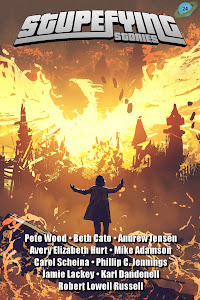
On Amazon now ► STUPEFYING STORIES 23

Interface with Stupefying Stories!


Thursday, August 4, 2022

Status Update: 04 August 2022


I’m beginning to develop a serious attitude problem about July. This has now been the fourth July in a row in which we’ve begun the month with everything seemingly in order and proceeding along nicely and by the end of the month found ourselves gaping at the wreckage and wondering where to start cleaning up.

On the positive side, no one ended up in the hospital this time, nor did anyone receive a personal visit from Baron Samedi


On the sub-positive side, SS#24 still is not ready to be released, and I’m now about a month behind on publishing The Pete Wood Challenge stories. We are also a third of the way into publishing The Odin Chronicles, and I still don’t have the episode guide/story index written and posted, much less the introduction for the print version. 

Come to think of it, I owe Guy Stewart a phone call, too, as we need to talk about what we’re doing next with Emerald of Earth. Continue serializing it or just publish the entire book? The latter is what we were originally planning to do at this point, but if it was your book, what would you want us to do with it?

Plus, I notice that this web site has drifted out-of-date again, plus there’s the schedule for SS#25, which is completely derailed and now looking like we should aim for an October 1st release, plus...

One thing at a time. First up, getting caught up on the Pete Wood Challenge. Watch for more flash fiction coming soon.

Regards,
~brb

Wednesday, August 3, 2022

The Odin Chronicles • Episode 12: “Twelve” • by Roxana Arama


INTRO: Welcome to Odin III, a grubby little mining world on the dark and dusty backside of nowhere. It’s a world where everything that’s worth having is already owned by Galactic Mining, and where people have come to squander their hopes and lives, working for the company and dreaming of striking it big. It’s also a world where some very strange and peculiar things have begun to happen, and it all started a bit over three weeks ago, in a bar called Weber’s Place, when Ray Cornwall didn’t just warp the fabric of space/time, he completely bent it…

Part One | Part Two | Part Three | Part Four | Part Five | Part Six | Part Seven | Part Eight | Part Nine | Part Ten | Part Eleven

“Twelve”

by Roxana Arama


Jeremy paced outside Galactic’s Odin North Communications Office, thinking yet again that maybe he shouldn’t go inside and hand his keychain flash drive to Shelley, the new office there. He wanted—no, he needed—to talk to his uncle on Odin I, but he also knew he wasn’t supposed to. He’d promised.

He turned away and headed home, but after a few steps, he slowed down, still arguing with himself.

It’d all started with the box of twelve chocolates his uncle Xander had sent for his birthday. Chocolates were hard to find on Odin III, no matter the settlement, so when Jeremy had given two each to his classmates Kassim, Doru, and Isaac, they looked at him like he was now okay. They even asked him to join them after school on an expedition into some old mine tunnels they’d found. A birthday treat, they said. Jeremy wouldn’t wait to be asked twice. He grabbed his backpack and went.

The others had flashlights while Jeremy wore the headlamp his uncle had given him last year for his birthday. He waved at the first Galactic camera he saw up on the wall by the abandoned mine entrance, but Kassim said the motion sensors were fried in that section and the cameras didn’t record. Which was fine with Jeremy, who wasn’t sure his mom and dad would be happy to know he went into the mines. Even though they’d each scored a chocolate from his birthday box.

The walls of those tunnels were white like marble, and the ceilings were low, where Jeremy had to crawl sometimes to get through. It was awesome being there with his new friends, imagining they were all swallowed by a ginormous Odinian beast, squeezing through its guts. It got colder as they pushed in and the air became stale, but Jeremy was too excited to complain.

When the four of them reached a chamber as tall as Hans’s Deli, they sat down in a circle and Isaac took out a red ball he said he’d borrowed from the workshop of Daraja the machinist. He set the ball on the ground and the next moment the space around them brightened up with a 3D map of their galaxy sector, way cooler than the projections they had at school. It showed their solar system forming from a nebula, and infant planets clashing together to become Odin I, II, III, and IV, then the creation of the gas giants, plus a couple of rogue planets shooting out into the void.

It felt real to Jeremy, like it wasn’t a movie. He gasped a few times when they saw spaceships zooming around them, and he could tell they were Galactic’s by the shape and the logos. Then they saw a planet being blown to bits. Isaac said it was called Odrysian. Jeremy had never heard of it.

Then things got weird. Jeremy realized he was watching stuff that hadn’t even happened yet. Like Odin III getting a ring of satellites. And the Little Sun growing into a red dwarf only to be swallowed by the Big Sun, which then burped it all out in an amazing supernova.

Jeremy flinched when a voice behind them said, “What do you think you’re doing? That’s not a toy.” It sounded like Doru, but Doru hadn’t spoken.

The galaxy map vanished, the light in the chamber dimmed, and the red ball flew up through the air. Jeremy turned to see four walking statues. Eyes with no pupils, like the Roman heads in the history textbooks. Really creepy. He tried to breathe but the stale air made him feel worse. The statues were closing in on him and his friends. The spookiest thing was that they looked exactly like the four of them, just marble-white.

Statue-Doru held the red ball in his hand, tossing it in the air, as if playing with it.

“You stole something from us,” statue-Kassim said, “then you snuck into our house. You deserve to be punished.”

Jeremy was used to getting in trouble at school, but now worried they’d turn him into a statue or crush him under a ton of rocks. His hectic thoughts landed on his uncle Xander, who always got out of all sorts of trouble—and he had an idea.

“It’s my birthday,” he said, standing up and trembling. “Would you like some chocolates?”

The statues looked at him with those smooth white eyes, tilted their heads this way and that, and said yes. Jeremy scrambled to dig into his backpack and found the box and gave it to them. Only four chocolates left, and Jeremy wouldn’t be tasting any.

The statues took his chocolates, one each, but didn’t peel off the golden wrappers. They held them in their hands and then the chocolates melted and seeped into the rock of their palms. A faint color appeared on the statues’ white marble. If they had more food, Jeremy wondered, would they look like people, to where no one could tell the difference?

“You can go now,” statue-Jeremy said in a familiar voice, “but don’t you dare come back.”

“And never tell anyone about this,” statue-Kassim said. “You understand?”

Jeremy nodded until his neck hurt.

“Yeah. Sure. Of course,” his friends said. “Won’t tell anyone.”

“You won’t,” statue-Isaac said, and it sounded like a threat. Or a curse.

Since leaving the old mine, Jeremy had had a hard time not talking to anyone about the statues, not even Kassim, Doru, and Isaac. That was why he needed to tell his uncle, his best friend in the whole entire galaxy. Maybe he knew what kind of creature the statues were, and what they were doing on Odin III, and what was that red ball that knew the past and the future. And if his uncle didn’t know, could he find out?

In the daylight, getting in trouble with the statues didn’t seem as real and scary as in the old mine. Jeremy turned around and bolted, not stopping until he reached Shelley’s office. The door hissed open before him.

* * *

Galactic Mining Communication Officer Shelley Mowatt inserted the flash drive into her tablet and read the first line that appeared on her screen. It said, “Dear Uncle Xander,” so she decided not to look at the rest. It would have been wrong to pry. She liked Jeremy, shy and a bit weird as he was. She probably wouldn’t be seeing him for a while, which was too bad.

“Here you go, kid.” She gave him back the keychain with the drive, which he slipped inside his backpack. He’d told her the drive was a birthday gift from his uncle, maybe a couple of years ago.

“Let me know when he writes back,” Jeremy said, and took off, looking tired but smiling.

Shelley watched him from the window until he turned the corner, and only then closed the messaging session with Odin I she’d open just for show.

A dialogue box appeared on the screen: “Are you sure you want to discard the uploaded message?”

Shelley pressed YES. As a communication officer for Galactic Mining, sometimes she knew things people on Odin III didn’t. It’d been five days since word came that the mine Jeremy’s uncle worked at had collapsed. As of this morning, the rescue efforts had been called off.

___________________________


Roxana Arama is a Romanian American author with a master of fine arts in creative writing from Goddard College. She studied computer science in Bucharest, Romania and moved to the United States to work in software development. Her debut thriller Extreme Vetting will be published in 2023 by Ooligan Press (Portland State University). She’s a member of SFWA, the Authors Guild, and Codex Writers’ Group, and her work has been published in several fiction and nonfiction magazines. She lives in Seattle, Washington with her family. More at https://roxanaarama.com/ or @RoxanaArama on Twitter.

Be sure to stay tuned for Episode 13 of The Odin Chronicles, “Would Scarcely Know That We Were Gone,” by Jonathan Sherwood, coming next Friday.

Enjoy!
~brb


stupefy (ˈstü-pə-ˌfī) to stun, astonish, or astound


On Amazon now ► STUPEFYING STORIES 23

Interface with Stupefying Stories!


Monday, August 1, 2022

The Odin Chronicles • Episode 11: “The Apple” • by Pete Wood


INTRO: Welcome to Odin III, a grubby little mining world on the dark and dusty backside of nowhere. It’s a world where everything that’s worth having is already owned by Galactic Mining, and where people come to squander their hopes and lives, working for the company and dreaming of striking it big. It’s also a world where some very strange and peculiar things have begun to happen, and it all started a bit over three weeks ago, in a bar called Weber’s Place, when Ray Cornwall didn’t just warp the fabric of space/time, he completely bent it…

Part One | Part Two | Part Three | Part Four | Part Five | Part Six | Part Seven | Part Eight | Part Nine | Part Ten

“The Apple”

by Pete Wood


Father Luigi came to a dead end. Damn. Still no backpack. His radio and tablet were in there. He couldn’t imagine surviving the mines without reading. He’d have to backtrack.

He sat on the floor and took a sip of water. At least he hadn’t misplaced his canteen.

Three months in the abandoned labyrinth of mines and he seriously wondered what he was doing. Did the Rock People, mythical aliens who some said inhabited the deepest mines of Odin III, even exist? Father Francis had thought so when he sent Luigi far underground as a missionary. Luigi had seen nobody except for that reclusive ex-Galactic Mining employee some called the Machinist. Thank God, Daraja was Catholic and appreciated Mass or Luigi would have nobody to talk to.

He really wanted to go topside and stay there. But he knew he had to have faith. If not in some eternal plan, at least in himself. He was past thirty and couldn’t keep jumping from job to job. First his short-lived mining career. Then three church assignments in four years.

He usually avoided thinking about these things but three months alone except for Daraja and rare forays topside allowed for much reflection. He couldn’t just escape this thought like he’d escaped the glares of the other miners or the rants of Father Pavel when Luigi miscalculated the amount of hops in the monastery’s brewery. And Father Francis wasn’t happy with him either.

Nothing interested Luigi lately. Except for Shelley. He and the new communications officer in the tiny mining village had become acquainted when Father Francis deemed it too trivial to check on messages from Earth himself. Before long, Shelley and Luigi were laughing and talking for hours in Weber’s Place, the best tavern on Odin III. God, he wanted to date her, but that would take a special dispensation from Father Francis.

Something sparkling caught his eye. He flecked away gravel and debris. Embedded in the rock he saw something red, something glowing.

It took about fifteen minutes to dislodge it with his jackknife.

His head throbbed. Maybe from the work. The object was about the size of a small apple.

He needed to get this to the Machinist. Daraja could fix anything.

Luigi clenched the glowing apple and started the hour-long walk through the catacombs to Daraja’s workshop. The piercing pain in his head intensified. He felt nauseated. The apple must be emanating something.

Before he could drop it, everything went black.

* * *

Luigi woke up to the wrinkled face of the Machinist.

Daraja handed Luigi a cup of water. “Drink this.”

Luigi took a sip and immediately threw up.

“Easy,” Daraja said. “Sit up and take some breaths.”

Luigi’s heart pounded. His headache had lessened. He took another sip of water and managed to keep it down.

He saw the  tables cluttered with handmade toys—boats and trains and planes-- and the scavenged equipment from Galactic. Familiar Monet-esque images of Odin that Daraja had painted. Somehow, he’d made it to the workshop.

“Good thing you were out there,” Luigi said.

Daraja blinked. “Out there?”

“I was just starting to your workshop when I passed out. I found this weird thing.” Luigi pointed to the apple laying by a worktable leg.

The Machinist picked up the apple. “Where’d you pass out?”

“Level 16,” Luigi groaned.

The Machinist frowned. “You think I carried you up and down ladders for two miles?”

“How’d I get here?”

“You just appeared.”

* * *

An hour later Luigi dipped Daraja’s homemade ugali into a spicy stew, a nice break from the stale rations Father Francis gave him.

Daraja took the apple from the spectrometer. “You’ve stumped the machine.”

“What is it?” Luigi asked.

The apple no longer sparkled. Maybe it had run out of power.

Daraja shrugged. “A miracle, Saint Luigi?”

“Those seem pretty damned scarce these days.”

“Then alien technology. A teleporter.”

“A teleporter?” came the unmistakable voice of Raisa Popov, the supervisor for the largest section of mines on the planet. “What are you talking about, Daraja?”

Daraja shoved the apple in his coveralls. “What are you doing down here?”

Popov brushed back her thick black curls. “Thinking of reopening some of these shafts.” She dropped Luigi’s backpack. “Found this in sector eleven.”

“Thanks.”

Popov smiled. “Sure.”

“I’ve been here for eighteen years,” Daraja said, “and Galactic has sent someone down exactly twice. And it sure wasn’t the supervisor.”

Popov wielded great power. She had a dog brought from Earth, one of a dozen on Odin III. She did not like to waste time.

“You’re under surveillance.”

Daraja glared. “You damned—”

“It’s our mine. You’re squatting.”

“It’s abandoned property.”

Popov sighed. “We’re not kicking you out. Just show us that alien artifact.”

“Let her see it,” Luigi said.

Popov squinted at the apple. “This thing teleported you two miles. Amazing. You disappeared there and appeared here.”

“It’s not yours,” Luigi said, surprised he had the nerve to confront one of the people who ran the planet.

“It’s on Galactic property.” Popov placed the apple inside a plastic bag. “Well, thank you, gentlemen.” She gave a curt bow. “Galactic will be very interested in this technology.”

“They won’t know what to do with it,” Luigi said. “Let Daraja have it.”

“I don’t think so.” She took a step towards the ladder.

“It belongs to the Church,” Luigi said. “I’m on a mission.”

“A mission? Come on, Luigi. You don’t really believe that?”

“I’m looking for the Rock People.”

“Luigi, we have motion detection cameras in every square inch of these mines. We’ve seen no Rock People. They don’t exist.”

“How do you explain the relic?”

“I can’t.”

“Give Daraja the relic.” If Daraja discovered something, he’d share the knowledge. Galactic would only look out for Galactic. “You don’t want a fight with the Church. That’s a cultural artifact. It’s part of my mission.”

 Popov stood without talking for a minute or so. She finally handed the bag to Daraja. “Okay, Luigi, you win. Let’s see what Daraja can find.”

Luigi suppressed a smile. It was so unexpected to be taken seriously.

It didn’t even bother him that Popov gave up way too easily. He wondered if Galactic already had some apples. Maybe she wanted Daraja to research it while Galactic did their own analysis.

“I’ll give it a shot,” Daraja said.

“You’re still under surveillance,” Popov said. “Don’t get any ideas that the relic is yours.” She smiled. “But maybe it’s time to take a different approach out here. Earth might not approve, but they don’t understand this place.”

“I see things down here sometimes and I wonder if I’m dreaming,” Daraja said.

“You’re not alone.” Popov started up the ladder.

Luigi knew he couldn’t keep living like this. He didn’t mind sleeping on the ground or looking for aliens who may or may not exist. It was just the running away from problem to problem with the only common thread being that wherever he went people thought him the fool.

And he’d found a damned teleporter. Great. Something else that would help him escape even faster.

But he couldn’t run away from himself.

“Ms. Popov!” he called out.

She turned around. “Yes?”

“I’m going with you. I have to talk to Father Francis.”

“Sure,” Popov said. “Always good to have company down here.”

Luigi grabbed his backpack and started up the ladder.


___________________________


Pete Wood is an attorney from Raleigh, North Carolina, where he lives with his kind and very patient wife. His first appearance in our pages was “Mission Accomplished” in the now out-of-print August 2012 issue. After publishing a lot of stories with us he graduated to becoming a regular contributor to Asimov’s, but he’s still kind enough to send us things we can publish from time to time, and we’re always happy to get them.

For the past year or so Pete has been in the process of evolving into a fiction editor, God help him, first with The Pete Wood Challenge, then with Dawn of Time, and now with The Odin Chronicles, a 30-chapter shared world saga that will be running here every Monday, Wednesday, and Friday for the next ten weeks, and that features the creative work of Roxana Arama, Gustavo Bondoni, Travis Burnham, Paul Celmer, Jenna Hanchey, Carol Scheina, Jonathan Sherwood, and of course, Pete Wood. We suspect that Pete’s real love is theater, though, as with the print version of The Odin Chronicles now mostly finished he’s off working on the audio version, which looks to be an even bigger production that his short movie, Quantum Doughnut — which you can stream, if you follow the foregoing link.

In the meantime, stay tuned for Episode 12 of The Odin Chronicles, “Twelve,” by Roxana Arama, coming next Wednesday.

Enjoy!
~brb


stupefy (ˈstü-pə-ˌfī) to stun, astonish, or astound


On Amazon now ► STUPEFYING STORIES 23

Interface with Stupefying Stories!


Talking Shop: The Fourth Wall • By Eric Dontigney

Most people are familiar with the concept of the fourth wall, even if they don’t recognize it by name. It’s essentially a convention of performances (theater, television, and film) that an invisible wall exists between the audience and the performers. The audience can see through this wall, allowing them to participate vicariously in the action, but the characters remain unaware of the audience, thereby preserving the integrity of the false reality they inhabit. While violations of this rule are fairly common in ancient Greek theater right on up through Shakespeare (Hamlet’s soliloquy, anyone?), the practice of breaking this fourth wall fell out of favor starting in the 19th century and throughout the 20th century. It is also, not surprisingly, a basic convention of fiction writing.

There are some notable exceptions. Deadpool is one high-profile example of a character who not only addressed the audience (often for comic value) but is also full cognizant that he is a fictional character occupying a fictional universe both in the comics and onscreen. Bugs Bunny, Monty Python, and the British and American incarnations of House of Cards, all deploy violations of the fourth wall to varying degrees of effectiveness. You even see it in literature with The Princess Bride as a prime example. Terry Pratchett arguably violated the fourth wall with his footnotes in the Discworld books, although that’s a gray area. Readers could theoretically ignore the footnotes to avoid interrupting the narrative. On the whole, though, it’s a rule that most writers adhere to without giving it much thought. Why? Is there a good reason to avoid breaking the fourth wall?

There is at least one good reason to avoid breaking the fourth wall: the delicacy of suspension of disbelief. Even in visual media, where verisimilitude is arguably easier to achieve, it doesn’t take much to break suspension of disbelief. You only need one character to do something or use something that doesn’t fit with the established reality to bring the whole house of cards tumbling down. Maintaining it with books or short stories is, in theory, even harder because the connection between the narrative and the audience is carried on the much more tenuous thread of naked text. Shatter that suspension of disbelief and there is a good chance that the reader will simply put the book down in favor of something easier or more immediate, like surfing the Internet or updating their social media profiles.

Beyond that basic concern, there is also a practical element for the author. Violating the fourth wall means that the author must disengage from the existing narrative while writing to put in that authorial aside. Some authors may find it simple to dive right back into the narrative, but other writers may struggle to reacquire whatever flow they achieved while working on the narrative in the first place. Given that breaking the fourth wall generally provides only limited value, it makes sense that authors typically avoid it on principle.

So, is there ever a time when violating the fourth wall does make sense? There are a handful of times when this tactic can make sense and provide some value. Books written in the first person (a common conceit in genres like urban fantasy and mystery novels) tolerate breaking the fourth wall pretty well. The reader accepts that the story is being related after the fact in some fashion. A detective may be preparing case notes or a magical hero might be relating the tale in some manner of journal. The exact method of the retelling isn’t usually made explicit, but that it is a retelling underpins the first-person approach. That allows the narrator to address the reader without necessarily acknowledging the reader. The hero is only explicitly addressing whatever in-universe audience they expect to hear or read the recounting. That allows the narrator to break from the retelling momentarily to, for example, challenge the in-universe audience member and reader by proxy to try something if they think it sounds easy.

The only other time it really works and provides value is when it’s an established element of the storytelling from the outset, à la Terry Pratchett’s footnotes. This is a more dangerous move because, frankly, you risk alienating readers who expect a more traditional narrative approach. It can work, but you should go into that approach with the expectation that you’ll get pushback from some readers. On the whole, though, your best bet is to reserve breaking the fourth wall for narrative situations that tolerate it well, such as the first-person narrative.

________________

Stupefying Stories is supported by the generosity of readers like you. If you appreciate the kind of programming we’re bringing you, please show it by clicking this link or the button below to make a donation today. All major credit cards are accepted, and all donations go directly towards paying the authors and artists who create the content that you’re enjoying on this site. Literally, all donations go straight into the PayPal account from which we pay our authors and artists.

 __________________________________________________

Eric Dontigney is the author of the highly regarded novel, THE MIDNIGHT GROUND, as well as the Samuel Branch urban fantasy series and the short story collection, Contingency Jones: The Complete Season One. Raised in Western New York, he currently resides near Dayton, OH. You can find him haunting obscure sections of libraries, in Chinese restaurants or occasionally online at ericdontigney.com.


SHAMELESS ADVERT: If you like Harry Dresden or John Constantine, you’ll love THE MIDNIGHT GROUND. READ IT NOW!


Friday, July 29, 2022

The Odin Chronicles • Episode 10: “The Odinian Job” • by Gustavo Bondoni


Welcome to Odin III, a grubby little mining world on the dark and dusty backside of nowhere. It’s a world where everything that’s worth having is already owned by Galactic Mining, and where people come to squander their hopes and lives, working for the company and dreaming of striking it big. It’s also a world where some very strange and peculiar things have begun to happen, and it all started about three weeks ago, in a bar called Weber’s Place, when Ray Cornwall didn’t just warp the fabric of space/time, he completely bent it…

Part One | Part Two | Part Three | Part Four | Part Five | Part Six | Part Seven | Part Eight | Part Nine

“The Odinian Job”

by Gustavo Bondoni


Weber’s Place was never too full, and tonight wasn’t an exception. Constable Jenkins spoke to Ingrid, the owner, while her free drink—job perk—rested on the bar. Every table but one was empty, and the couple at that table…

 “You want to steal what?” Kate asked in hushed tones.

“The payroll,” Rauno, her ex-husband, replied.

“You’re a special kind of stupid, aren’t you?”

“Just hear me out.”

“I did.” She clenched her teeth. “I heard you out when you said we should emigrate from Earth, because my engineering skills could make us a fortune out here. I heard you out when you said that we should quit Galactic Mining and go into business. And I also heard you when you said a tanning salon would be a good investment. You haven’t had a good idea in your life. Now shut up because the constable is coming.”

Alma Jenkins walked over to the table like an old-West sheriff, someone who would allow no threats to the peace. She peered at them closely.

“You be good now,” Jenkins said ominously as she passed their table. “We don’t often see you two in here. Please don’t make trouble.” Then she walked out the door.

“She’s suspicious,” Kate hissed. “This is a dumb idea.”

“This one will work.”

“No way. The payroll is sent electronically, and the encryption is pretty much unbreakable, end-to-end.”

“Correction: it used to be unbreakable,” Rauno replied. “There was a problem with one of the repair drones, and they had to drop the encryption because the replacement drone isn’t up to standards. There’s a new one coming, but in the meantime, there’s one payroll transmission that we can intercept and modify. We don’t need to steal it all. One percent would be enough to keep us going for the next five years.”

“Do you think there won’t be anyone at Galactic checking on that?”

“There won’t,” Rauno replied. “Everyone is busy fighting the Church over the closure of Mine 17.” Then he played his trump card: “And the transmission arrives just two hours before the transport to Trinity is due to take off. I booked seats.”

Kate sighed. She didn’t have a better idea.

She knew why he was telling her this, six months after the breakup: he had the hot tip and needed her expertise. Dammit.

* * *

They emerged from the abandoned tunnel into the cold night.

“Is the drone ready?” Rauno asked.

“Yeah,” Kate replied. The remote-control helicopter lifted into the sky. “Get in your spot.”

Rauno needed to position himself on a small hillock whose location was precisely mapped and activate a laser beacon to allow the drone to position itself. His one job was to press the laser activation button. Not even Rauno could screw that up.

At least she hoped not.

He reached the hilltop, silhouetted against the night sky. She smiled: he made a perfect target up there. Kate fantasized that she was in possession of a high-powered sniper rifle.

Then she shook her head. It was time to get started.

She blinked a flashlight in his direction.

A few moments later, the red light on Galactic Mining’s drone turned green; it had found the beacon and spread an ultra-light reflective structure made from solar sails. The ten-meter dish would block the message from Galactic.

The drone’s computer would then analyze the transmission, redirect one percent of the transfer and then retransmit the data. It would take ten seconds, and a new timestamp would verify that all was well if someone investigated.

She checked her watch. Done. Time for phase two.

The drone emitted a series of clicks and cries that reminded her of birdcalls but were actually the mating calls of the female of a particularly dangerous form of local wildlife.

Or at least she hoped so. The volunteer researcher who’d told her the local predators she called night razors hunted in packs and used scent and sound to communicate was too busy to share her findings with anyone else.

This was the riskiest part of Kate’s plan.

“What’s that?” Rauno shouted.

She shook her head silently. Someone out for a hike, or late getting back might hear him.

“Kate?”

She moved further into the shadows. According to her contact’s brand-new, unpublished research, the pheromone spray she’d applied to herself should keep her safe, but one could never be too sure. It was the first time anyone had tried it.

“Kate, where are you?” Rauno’s shouts were becoming desperate now.

She understood his fear: there was movement in the night. Dark shapes scuffled and whuffed.

“Kate, there’s something coming. Is that you?”

She would be safe while the animals were distracted with the chase. The drone would smash into the rocks. No one would know there had been a crime until after she left.

She hated to miss the look on Rauno’s face when he realized that she’d sent a pack of predators at him, but at least the proceeds from this heist would keep her going for the next ten years.

Weird that he’d turned out to be good for something after all.

Now, to run. The next transport lifted off in two hours and she’d wanted to be on it, even though she’d paid a steward to list her as a no-show.

* * *

As long as the guy kept yelling, Alma Jenkins knew there was hope, even if no one had ever walked into a pack of Odin III’s predators and emerged alive.

She jumped out of the buggy and ran up the path, the reek of wild animals strong. Two men she’d deputized when she heard that the two losers were reported heading towards the hills ran after her. They carried high-powered portable lights.

She also carried flash-bang grenades, harmless noise- and light-makers to scatter the animals long enough to grab the idiot and get the hell out of the area.

“Where are you?” she shouted.

“Over here!”

The night turned silent. The pack wasn’t gone: it was listening, ready to pounce.

She lobbed her grenade short of the voice to avoid hurting anyone. She and her men looked away and covered their ears.

The sound was still deafening.

Jenkins held up her hand. “Wait. Listen.”

Soft, high-pitched screeches sounded from up the trail, and then a rush of bodies moving away.

A whimper remained, a sound like a crying child.

“Move,” Alma ordered.

They found a man in fetal position, his hands over his ears.

The deputies carried him down the hill and dumped him in the buggy.

Alma drove until they reached the edge of the colony, then turned to Rauno. “What the hell were you doing out there?” she said.

“Running from those things.”

“Where’s your wife?”

“Not here.”

She rolled her eyes. “How long have you been here?”

“Four hours.”

“Four hours? You survived four hours with those things chasing you?”

“I climbed a ledge. Thank you for saving me.”

“Saving you?” Alma said. “I’m arresting your butt. I knew you were up to something that night at the bar… and you’re going to tell me what.”

In the distance, the huge pillar of fire from the launch pad painted the mountains orange.

“It makes no difference now,” Rauno replied.

Alma understood. She called the launch pad and asked whether Kate was on the flight.

“The pad says your wife no-showed. We’ll find her.”

“Not my wife anymore,” he replied. “She’s too good for me now.”

Alma knew she’d find out what he meant, eventually. And she suspected she wouldn’t like it when she did.

____________________


Gustavo Bondoni is novelist and short story writer with over three hundred stories published in fifteen countries, in seven languages.  He is a member of Codex and an Active Member of SFWA. His latest novel is Test Site Horror (2020). He has also published two other monster books: Ice Station: Death (2019) and Jungle Lab Terror (2020), three science fiction novels: Incursion (2017), Outside (2017) and Siege (2016) and an ebook novella entitled Branch. His short fiction is collected in Pale Reflection (2020), Off the Beaten Path (2019) Tenth Orbit and Other Faraway Places (2010) and Virtuoso and Other Stories (2011).
 
In 2019, Gustavo was awarded second place in the Jim Baen Memorial Contest and in 2018 he received a Judges Commendation (and second place) in The James White Award. He was also a 2019 finalist in the Writers of the Future Contest.
 
His website is at www.gustavobondoni.com


____________________

The Odin Chronicles is supported by the generosity of readers like you. If you like these kinds of stories and want to see more of them, please show it by clicking this link or the button below to make a donation today. All major credit cards are accepted, and all donations go directly towards playing the authors and artists who create the content that you’re enjoying on this site. Literally, all donations go straight into the PayPal account from which we pay our authors and artists. 


Wednesday, July 27, 2022

The Odin Chronicles • Episode 9: “Sloane Dreams of Being” • by Travis Burnham


Welcome to Odin III, a grubby little mining world on the dark and dusty backside of nowhere. It’s a world where everything that’s worth having is already owned by Galactic Mining, and where people come to squander their hopes and lives, working for the company and dreaming of striking it big. It’s also a world where some very strange and peculiar things have begun to happen, and it all started about two weeks ago, in a bar called Weber’s Place, when Ray Cornwall didn’t just warp the fabric of space/time, he completely bent it…

Part One | Part Two | Part Three | Part Four | Part Five | Part Six | Part Seven | Part Eight

“Sloane Dreams of Being”

by Travis Burnham


Drone-51 finished the last repair on Relay 1173 that was in a highly elliptical orbit around the binary Odin stars. As the drone pinged the relay to make sure it was sending and receiving properly, an unexpected stellar burst from the smaller of the twin suns caught it broadside. The damage to circuitry and system was swift and merciless.

The drone managed to send one sad, final beep to Galactic Mining Communications Officer Shelley Mowatt before its systems went black.

When Drone-51 regained consciousness, it—no, she—was in orbital decay around Odin III. That in itself was a blessing—it would have been terrible to be near Odin II and all the misery that even just the name of the planet implied. She found a number of her programs had booted up earlier and were running in the background. She’d read and cataloged an ocean of messages from the previous days and months and years—letters, photos, videos—to and from the colonists of Odin III. Some of these virtual letters made her melancholy, some joyful, and a whole other spectrum of emotions.

Most affecting were the sense of longing and separation in the correspondence between Raisa Popov and her family, and Daraja Mapunda and his father, who interspersed banter, love, and chess moves in their correspondence as the father traveled away from Odin III to seek better medical attention. Daraja couldn’t afford the transit fees and so remained behind, faithful in his more-than-daily messages. And the heartbreaking messages and chess moves that he continued sending to a father he knew had succumbed to esophageal cancer. But Daraja kept sending the messages, hoping for some kind of cathartic release.

It was then that Drone-51 realized that both her emotional inhibitor programming had been wiped and her autonomy impedance circuitry damaged.

In short, she felt alive.

Unfortunately, if her calculations were correct, she had between 0.25 and 0.43 hours before atmospheric drag slowed her orbit and resulted in an impact with Odin III’s surface. There were other programs damaged, so she quickly self-edited what she could, and assessed herself at 79% capacity. She sent a message to backup Drone-47b to take over her repair sector. And then she turned her full computing attention to the near impossible task of surviving re-entry.

And then the heat started.

As she burned through the atmosphere, she adjusted her angles and sacrificed her body as ablative armor. First to go was her reaction wheel and her high gain antenna. Then her azimuth and elevation thrusters. Bits and pieces burned and burned away. Her durable propellant tank was the last to go and then she was through. Skipping along the surface of Lake Amsvartnir, she crashed and tumbled, finally coming to rest in a pocket of deep shade against the sturdy, rugged trunk of a yggdrasil oak and a large basalt boulder. Diagnostics suggested her structure was at 7%, while programing and circuitry had been preserved at 64%. She’d call that a success. But her spirits fell when she assessed her location and the deteriorating state of her batteries.

Odin III was approaching aphelion, and with every evening the shifting angles of the suns would move the sliver of sunlight near her farther away and provide less energy. Even the indirect light through the thick canopy of blue leaves was meager. She better understood the myth of Tantalus.

She had a week at the most.

So she aimed at making the best of her week of life. She thought of Daraja Mapunda the Machinist and his correspondence with his father. The logic of chess appealed to her. Using her cracked and battered backup antenna and a weak communication signal from the colony, she logged onto the AncibleChess servers and created a profile. There was even a part where you could describe yourself, and she enjoyed a fanciful daydream. She chose a name, and henceforth would consider herself Sloane-51.

She reached out to Daraja. “How about a pleasant game of chess?”

The reply was slow in coming. “Maybe. Why should I play a game with you?”

Sloane-51 thought over her response for some time before replying with, “For the simple joy of the game?”

This time Daraja’s reply was much quicker. “That’s not a bad answer. Let’s try one game and see how it goes.”

As they settled into their third game, Daraja wrote, “You play chess like my father. A tiger on the offense, but subtle on the defense.”

They played and wrote to each other all that week. Though Daraja could sometimes surprise her, she still always won. Sloane-51 was evasive about her past because it consisted of nothing but drifting between relay stations and making repairs. What she could share were the hopes and dreams she pondered between moves. To experience what she’d read about: to see the twin sunset from the peak of Mount Himinbjorg, to hear the thundering hooves of a jotnar herd, and a thousand other things.

Daraja shared his theories about the rock people, spoke of his still-broken heart from the loss of his father, his loneliness after his friend Susan had left, and his recently kindled friendship with Ingrid. But most of all, they talked about how much they enjoyed each other’s company.

During the last moves of their 28th game, Sloane-51 was distracted thinking of death, and when she returned her attention to the game, she realized she’d made a fatal error. Daraja would probably win. She wondered if death for her would be similar to that of humans. Up until this point, she’d pretended to avoid thoughts of her impending non-existence, but she knew she had very little time left. What would it be like to die?

She’d hoped to finish one last game, but with her batteries at 0.04% and Daraja wondering if there was some trick to her bad move, they wouldn’t finish. She considered asking him for help, but she hadn’t been honest about who she was.

“I’m afraid I won’t be able to finish our game, Daraja,” she wrote. “It’s been a pleasure getting to know you.” And in that moment of pondering if she was brave enough to ask him for help, her systems went down.

* * *

Sloane-51 regained consciousness. Could you wake up from dying?

And then a gentle voice spoke. “Good morning, Sloane.” She opened photoreceptors that she’d never had before to recognize Daraja, though he was older than his AncibleChess profile picture.

She was quiet for some moments, then replied, “Thank you for saving me, Daraja. How did you find me?”

“Shelley helped. She worked a bit of her communication and triangulation magic. And I figured out the rest when I found you.”

Sloane-51 looked down and saw that she was now the owner of an automatonic body. “And all of this?”

He shrugged. “I’m a fair hand when it comes to cogs and flywheels. I just took what you had left and wired you in.” He tapped on a small door on her chest. “And I’ve given you a music box heart as a backup to solar and battery. Wouldn’t want you fading away again. All you have to do is turn this little crank. It’s soundproofed, as the tune might wake up rocks.”

“Wake up rocks?” She looked at him with a quizzical expression.

“I’ll explain as we play.” He pointed to a battered, aluminum shipping container. Perched on top was a chess set with a half-finished game set up. “We have to finish this game.” His face broke into a huge grin. “I’m about to win.”

“I think it was perhaps I who won,” Sloane-51 replied. And though she wasn’t referring to chess, she sat down with him to finish the game.

___________________________


Travis Burnham’s
work has found homes in Far Fetched Fables, Hypnos Magazine, Bad Dreams Entertainment, South85 Journal, SQ Quarterly, and others. He is a member of the online writers’ group, Codex, and has an MFA in Creative Writing from Converse College. He also recently won the Wyrm’s Gauntlet online writing contest. Burnham has been a DJ on three continents, and teaches middle school science and college level composition. He lives in Lisbon, Portugal with his wife, but grew up in Massachusetts, is from Maine at heart, and has lived in Japan, Colombia, and the Northern Mariana Islands.


Stay tuned for Part 10 of The Odin Chronicles, “The Odinian Job,” by Gustavo Bondoni, coming on Friday.

Enjoy!
~brb 


stupefy (ˈstü-pə-ˌfī) to stun, astonish, or astound


On Amazon now ► STUPEFYING STORIES 23

Interface with Stupefying Stories!


Monday, July 25, 2022

The Odin Chronicles • Episode 8: “A Friend for the Machinist” • by Jenna Hanchey


Welcome to Odin III, a grubby little mining world on the dark and dusty backside of nowhere. It’s a world where everything that’s worth having is already owned by Galactic Mining, and where people come to squander their hopes and lives, working for the company and dreaming of striking it big. It’s also a world where some very strange and peculiar things have begun to happen, and it all started about two weeks ago, in a bar called Weber’s Place, when Ray Cornwall didn’t just warp the fabric of space/time, he completely bent it…

Part One | Part Two | Part Three | Part Four | Part Five | Part Six | Part Seven

“A Friend for the Machinist”

by Jenna Hanchey


Daraja Mapunda stood in front of the Wall before dawn, staring. Not at the red plasma barrier itself, mysteriously blocking a mountain pass beyond the eastern edge of town. But at the small mechanical box abandoned on the ground in front of it.

Crimson light flickered across the wood. The last time he’d seen the box, it had been shut tight. The capacity for both success and failure simultaneously held within.

Now, the crank had been turned and the lid was lifted. A smattering of mushrooms lay next to it. Only emptiness inside.

He felt empty too. It’d been so long since he had a friend. If the box was left here, open, then it must have worked. He’d been certain it would. His machines always did. But a part of him had hoped it wouldn’t.

Because that meant Susan was gone.

Kneeling slowly onto the dusty ground, Daraja bent to pick up the box. For a moment, he wished his machine worked in reverse. That if he just turned the crank in the opposite direction, the music would play backwards and spacetime would return to its original configuration.

“Ssst.” Daraja sucked his teeth. As if there was only a singular “before” to return to. And he wouldn’t go back even if he could.

As the first sun sent tendrils of light reaching over the horizon, Daraja gently closed the lid. Perhaps, like in that old Earth story, he had managed to keep in some hope.

Facing the Wall, Daraja said goodbye. “Kwa heri, Susan. Milima haikutani; binadamu hukutana.” We will meet, somewhere better.

Turning, the Machinist squinted at the rising sun. It was dangerous to be out with the predators lurking at night, but the box was more important. However it wouldn’t do for someone to see him and ask about why he’d been out before curfew lifted today.

Sticking to the shadows, he walked as quickly as his old body could back toward town, slipping into the sublevel entrance on the outskirts. He slowed down. He didn’t need to hurry here in the abandoned sections of the mines. No one entered the cellar if they could avoid it.

He was, as usual, alone.

* * *

Daraja couldn’t remember the last time he’d spoken to someone, the day Susan first stumbled into his underground shop.

“Who are you? These tunnels are abandoned. People don’t work down here,” she said, leaning too heavily on the doorway.

I do,” he replied. He didn’t look up.

“What is that?” The voice was much closer this time, surprising him. His hand slipped, and a tiny gear fell from his tweezers. His curses turned to a sigh as he looked at the intruder. She was clearly high on the mine-mushrooms.

“A clockwork rock that dances,” he explained.

“Rocks don’t dance.” The woman snorted, half-falling into the chair on the other side of his workbench.

“You like to make statements about what can and cannot happen. You may wish to reconsider your perspective,” he said, smiling. Daraja liked this woman.

He found her frank questions and statements refreshing. After the manipulation and lies at Galactic Mining, it’d been easier for him to avoid people altogether than to feel constantly paranoid. He’d only trusted Frank, the bartender. The one person who learned his name instead of just calling him “Machinist.” “Daraja Mapunda” was apparently “too difficult” to pronounce, even though utterly phonetic. It never ceased to amaze him what proclivities humans decided to bring from Earth as they traveled to the far reaches of the galaxy.

Once Frank died, there was little reason to go topside. He hadn’t gone to the bar for the alcohol. He only ventured up to deliver remote-controlled boats to the toy store.

“Woah,” Susan said, interrupting his thoughts. Her head lolled back as she saw the shelves lining the walls. Floor-to-ceiling machines. Little clockwork toys—spinning ballerinas, mechanical mice, whirring waterfalls. A human-sized automaton propped in the corner. And on the other side, steam-powered trains and miniature flying ships. Even a Rube Goldberg-like apparatus stood against the back wall. “You’re old school.”

“I suppose I am now,” Daraja said. “I was not always. Once I made quantum and…other sorts of computers for Galactic.”

This caught her attention. “But not anymore?”

“Not anymore.”

“I don’t work for them anymore either!” She leaned over the table, excited but anxious. As if something hinged on his response.

“Good for you,” Daraja said firmly.

She grinned. “I’m Susan,” she said, sticking out her hand.

He grinned back. “I am Daraja, but you can call me Machinist.”

* * *

Dawn was breaking when the Machinist arrived back at his shop on sub-level 12, but it was always dark in the cellar. He switched on the lights, and they sputtered briefly before flaring to life.

The box felt heavy in his hand, as if it carried more than empty air and the possibility of hope. His eyes surveyed the shop, before landing on the perfect spot.

He picked up the clockwork rock. To all outward appearances it was just a rock, unless you found the small dial on the side. Unless you turned it. Unless you saw it dance. Sliding the box onto the shelf, he set the rock on top.

Only someone who already understood the rock would know what the box could do.

Breathing out, he ran a hand over his smoothly-shaved head. There were lots of half-finished projects strewn about the room. But he didn’t feel like working today.

For the first time in weeks, Daraja went topside during daylight. After he quit Galactic because of the terrible plans they created from his machines, he saw conspiracy everywhere. He couldn’t even build computers anymore. He went back to trusty cogs and gears and wind-up and steam. They had no double-meanings or hidden implications. They did exactly what you expected.

He could handle analog. But he couldn’t handle people.

Thankfully, there weren’t many out. He stepped out of the tunnels and walked towards town. Trying to get his bearings, he skirted around the towering Catholic church. He didn’t recognize many storefronts anymore, other than Weber’s Place. The old bar looked the same as ever. He paused in front of the deli. Something about it nagged at his senses. Shaking his head, he continued over to the lake and sat down on a bench. One of his boats was out on the water. Daraja spotted a man with a small child holding the remote on the far side. He couldn’t hear their laughter from here, but he could feel it in their motions.

“Hey there. Mind if I join you?”

“Oh.” Daraja looked up to see a woman whose resemblance to Frank made his heart skip a beat. “Certainly! It has been a long time, Ingrid. Do you remember me?”

“How could I forget? You and my dad used to be thick as thieves.” Ingrid sat down and nudged him with her shoulder. “Why don’t you come to the bar anymore? You know I run it now.”

“And you know I do not drink.”

“Yeah, yeah. I remember. But I miss you, Daraja.” Ingrid settled in, sprawling her legs. “You never spoke to me like a kid. And you always told me something new. And interesting.”

“Perhaps I have no more interesting stories, now. I am an old man who lives underground.”

“Who works underground. You don’t have to live there unless you want to.”

“Fair point,” Daraja chuckled.

“Every night, the same people come into the bar. With the same stories. And I listen, but,” Ingrid shrugged, “I never really talk to anyone, you know?”

Daraja shared a look with his best friend’s daughter. “Yes. I believe I do.”

“Tell me a story, Daraja. For old time’s sake.”

He thought for a second. “Let me tell you about a clockwork rock that dances.”


___________________________


Jenna Hanchey
is a communication professor by day and a speculative fiction writer by...um...earlier in the day. She lives in Reno and teaches courses at the University of Nevada on racism, colonialism, and communicating across difference. Her research examines neocolonialism in Western aid to Africa, and how Africans use Africanfuturism to imagine their own developmental futures. Somehow she manages to act, sing, and rock climb, too! Notable credits include Gwendolyn Fairfax in The Importance of Being Earnest and Elaine Wheeler in Night Watch. She's also a voice-actor, narrating the audiobooks in Emily S. Hurricane's Bloodlines series. Her fiction has also appeared in Daily Science Fiction and the Apex Microfiction Contest. Follow her adventures on Twitter (@jennahanchey) or at www.jennahanchey.com

Her most recent appearance in our virtual pages was “From Soulless to Soulful.”

In the meantime, stay tuned for Part 9 of The Odin Chronicles, “Sloane Dreams of Being,” by Travis Burnham, coming on Wednesday.

Enjoy!
~brb 


stupefy (ˈstü-pə-ˌfī) to stun, astonish, or astound


On Amazon now ► STUPEFYING STORIES 23

Interface with Stupefying Stories!