Thursday, September 14, 2023

“1-800-PROPHCY” • by Michael Haynes


[FADE IN — A man sits on a bed in a dimly lit room, obviously distraught.]

[VOICEOVER]

Are you kept up at night, wondering about the meaning of a cryptic sentence uttered years before you were born? Do you find yourself constantly on the lookout for figures like “the man with twelve toes” or “the woman without a name?” Do you feel trapped, not by a dead-end job or burdensome student loans, but by Fate?

[CUT TO — A brightly lit call center with rows of customer service agents wearing headsets and talking animatedly. GENEVIEVE ARMBRUSTER stands between the rows, smiling at the camera.]

[GENEVIEVE]

You may feel all alone in the world, like no one understands what you’re going through, but did you know that just last year 17,532 prophecies were committed to the Book of Prophecy? And I know you’re thinking, Genevieve, aren't most of those prophecies mundane? Things like, “The next child in your family with blonde hair will improve your family’s fortunes.” You’re right, of course, but a sizable minority are much more consequential.

[GENEVIEVE turns to walk away, then turns back, smiling.] 

And, of course, even a mundane prophecy such as this might seem consequential to you—if you were born with brown hair.

[VOICEOVER]

1-800-Prophcy, founded by Master Sorceress Genevieve Armbruster, has been helping people like you for over two decades.

[PAN TO: Customer Service Agent #1]

[SUBTITLE: Large print. “SIMULATED 1-800-PROPHCY CALL, NOT A REAL CLIENT OR A REAL PROPHECY.”]

[ZOOM IN ON Customer Service Agent #1]
[AGENT #1]

So I understand you’re saying a mystic told your uncle that his sister’s first-born son would have to face down the Dark One. Before we continue, can I confirm that you want to purchase our Platinum Service with your credit card ending in 3216? 

[AGENT #1 pauses, then nods.]

Fantastic. So, the first thing you should do is make sure your uncle understood correctly. You’d be surprised how often there are misunderstandings with prophecies. Do you know anyone named Darke, with a silent “e?”

[AGENT #1 pauses longer, then smiles.]

Your Chemistry professor? And you recently failed a test? Well…

[FADE OUT AUDIO AGENT #]

[VOICEOVER]

And when you do purchase our Platinum Service, you get unlimited around-the-clock assistance. So no matter how many times you need support from our agents, you can always call on us. 

[SUBTITLE: Small print. “Repeat calls on the same day may be deprioritized to better support as many clients as possible.”]

[CUT TO: Customer Service Agent #2]

[SUBTITLE: Large print. “SIMULATED 1-800-PROPHCY CALL, NOT A REAL CLIENT OR A REAL PROPHECY.”]

[AGENT #2]

It’s okay, the isolated island hideout approach is always a bit of a gamble. We thought it was worth a try and you got a good couple years of peace and quiet out there. But now that the person foretold to be your protégé has arrived, let’s focus on the rest of the prophecy and see what we can do to keep you from dying at their hands. First, have you made sure you’ve properly secured any weapons or magical objects on the property?

[A pause, then Agent #2 nods.]

Right, okay, so the cursed sword you inherited from your father definitely falls into both those categories. Let’s see what we can do to help you get rid of that…

[FADE OUT AUDIO AGENT #2]
[ZOOM OUT to show call center]
[PAN to GENEVIEVE]
[SLOW ZOOM IN on GENEVIEVE]

[GENEVIEVE]

At 1-800-Prophcy, we’re here to help you make sense of the prophecy you’ve been given. We’re here to help you make the most of the options available to you when your fate seems dire. And most of all, we’re here for you. For life! And sometimes even beyond…

[SUBTITLE: Small print. “Post-death support requires Diamond upgrade and is only available in select locations.”] 

So don’t live in fear another moment, call us today.

[MUSIC UP]
[CUT TO: 1-800-PROPHCY AD SLIDE.]
[SUBTITLE 1: 10% Discount For the Next 90 Minutes]
[SUBTITLE 2: Prophecy-Busting Agents are Standing By]
[FADE TO BLACK]


An ardent short story reader and writer, Michael Haynes’ debut collection, AT THE INTERSECTION OF LOVE AND DEATH, is available now. His stories have appeared in Ellery Queen Mystery Magazine, Beneath Ceaseless Skies, and other publications. He enjoys photography, cooking, and travel. Find him at http://michaelhaynes.info/.


LATEST ISSUE! BUY IT NOW!


Wednesday, September 13, 2023

“The Infinite and the Infinitesimal” • by Christopher Degni


In June of 1986, upon the death of the great Argentine mathematician Luis Davila,
the sole trustee of his estate discovered a small enchiridion among his personal effects. A prominent inscription on the title page consisted of a single decimal number of 106 digits, close to ⅓, but not matching any known mathematical constants: .33263638—, along with a request for his library of unpublished works to be donated to the Universidad Nacional de Mar del Plata. The University, in conjunction with the governing board of the International Congress of Mathematicians, appointed a panel of five esteemed algebraists, geometers, and logicians to review and analyze Davila’s private collection and report on any significant findings.

Early in his career, Davila had written several seminal works in set theory, comprising results that had imposed order on the foundations of mathematics, but he’d abruptly stopped publishing and begun to explore chaos theory upon receiving tenure. Professors of his stature would normally allow their graduate students to publish small findings in their stead, but Davila had famously never taken a protégé. The panel discovered that, in fact, the majority of his results hadn’t escaped the thousands of impeccably kept notebooks arranged in a series of interlocking hexagonal shelves in his modest home office.

Beyond troves of new theorems in combinatorics, entropy, and fractal geometry, some of which opened up entire new subfields of scholarship, they found a peculiar result related to literature, contained in one set of notebooks, seventeen in number and bound together under the label Lo infinito y lo infinitesimal (“The infinite and the infinitesimal”).

The first notebook defined a basic scheme that informed all that followed, and the next three traced its natural consequences. The Spanish alphabet can be encoded by assigning each letter a two-digit number, A = 11, B = 12, and so on, with the remaining two-digit numbers being assigned to other orthographic symbols, such as spaces, punctuation marks, and mathematical symbols. Davila used this simple system rather than a universal Gödel-based numbering system for reasons known only to him, though he did note that a similar scheme would work for every known language. Any written text can then be represented by a number formed by replacing the symbols with their corresponding values; the process is reversible by translating any number two digits at a time back into orthographic symbols. No two texts correspond to the same number, and no two numbers correspond to the same text, though there are numbers that correspond to no earthly texts.

Davila’s simple stroke of genius was in placing these derived numbers behind a decimal point. Now instead of yielding unboundedly large values, every text produced a value greater than zero, but less than one. For instance, using the scheme above, the text consisting of the single word ‘BAD’ would correspond to 121114, or, with decimal, .121114.

In this manner, Davila’s scheme placed every story ever written—or ever to be written—into the compact space of a line segment of length one, the so-called “unit interval.” By the same process, this unit interval includes all non-fiction writings as well: biographies of everyone who ever lived, monographs describing solutions to all the world’s problems, even the text of this very record. Davila himself noted that the Library of Alexandria, as vast and varied as it were, would occupy a vanishingly small measure—what the mathematicians call a “set of measure zero”—in his system.

Developing an ordered method of discovering these works presented Davila his next challenge. Fully twelve of the notebooks were dedicated to this inquiry. Did the common constants—the Zuckerman-Collatz threshold, the inverse Feigenbaum number, Chaitin’s infinite construction—decode to any of the great works of antiquity? Or, in the other direction, were any famous texts describable by primitive mathematical or physical constants?

Davila encountered false start after false start, although he occasionally discovered the tiniest bits of meaning, if nothing close to the transcendental works of literature. One special value of an L-function decoded to elegante esperanza before descending into gibberish. Davila’s scrawls, meanwhile, exhibited evidence of an increasing tendency towards desperation.

Here, knowing that many of his choices were arbitrary, Davila worked in multiple languages and encoding schemes, applying common and esoteric transformations, but his notebooks showed no significant literary theorems. Davila opined that such a result would prove the existence of a higher Meaning, an oasis of Order in a universe of Chaos, and, as much as one can intuit mental state from a sheaf of mathematical notebooks, at this stage, Davila seemed defeated, despite his great theoretical contributions.

But the final notebook, written some seven years after the first sixteen, showed evidence of a completely different strategy. Davila, as was his style, began with a simple, even trivial, observation: that every decimal number can be divided by two. The original number would be recoverable, by doubling. Thus, in dividing everything by two, all the literary works fit not only between zero and one, but in fact between zero and one-half. There was no obstruction to recursion: repeating the process placed everything between zero and one-quarter, one-eighth, one-sixteenth…

Davila’s final step was to introduce an infinitesimal system of mathematics. The great literature of the past and the future, the research monographs and the autobiographies, the works of recondite sects of monks, and even the instructions to derive the theorems he had been struggling with now all managed to fit into no space at all, an infinitude into a void, a feat both monumental in itself, as well as made inevitable by the very mathematics Davila used to delineate it.

After reviewing the seventeen notebooks, the panel were able to decode Davila’s original inscription: voy a la nada, y me regocijo, porque todo reside allí.

“I go forth into the nothingness, and rejoice, for everything resides there.”


Christopher Degni is a 2019 graduate of the Odyssey Writing Workshop. He writes about the magic and the horror that lurk just under the surface of everyday life. He lives south of Boston with his wife (and his demons, though we don't talk about those). You can find more of his work in NewMyths.com, Sherlock Holmes and the Occult Detectives, 99 Tiny Terrors, the upcoming 99 Fleeting Fantasies, and of course, here on Stupefying Stories.


Find out what you’ve been missing!
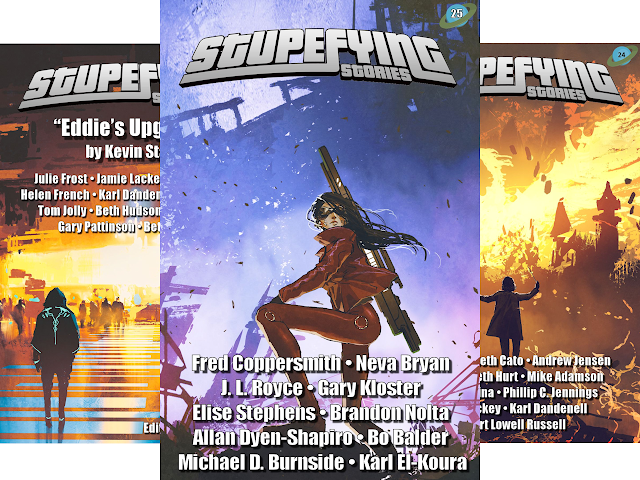
Buy the three latest issues on Kindle with just one click!


Tuesday, September 12, 2023

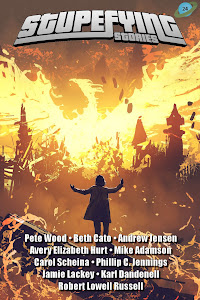
STUPEFYING STORIES 23 • The world-wide rollout continues!


STUPEFYING STORIES 23 is now available in print and e-book formats pretty much worldwide and on pretty much every e-book platform made. The following list comprises all the tested and known-good links as of today.

PAPERBACK (exclusively on Amazon)

US - https://www.amazon.com/dp/B08Y5KRPMF
UK - https://www.amazon.co.uk/dp/B08Y5KRPMF
Canada - https://www.amazon.ca/dp/B08Y5KRPMF
Australia - https://www.amazon.com.au/dp/B08Y5KRPMF
Japan - https://www.amazon.co.jp/dp/B08Y5KRPMF
Poland - https://www.amazon.pl/dp/B08Y5KRPMF
Sweden - https://www.amazon.se/dp/B08Y5KRPMF
Germany - https://www.amazon.de/dp/B08Y5KRPMF
France - https://www.amazon.fr/dp/B08Y5KRPMF
Spain - https://www.amazon.es/dp/B08Y5KRPMF
Italy - https://www.amazon.it/dp/B08Y5KRPMF
Netherlands - https://www.amazon.nl/dp/B08Y5KRPMF

HARDCOVER

No, there isn’t actually a hardcover edition. That’s just a faux cover image that Apple Books generates for their sales page. Looks nice though, doesn’t it?

E-BOOK

Amazon Kindle

US - https://www.amazon.com/dp/B08Y5MYS59

For non-US readers, this link should automatically redirect to the correct Amazon Kindle URL for your geography. Rather than list all the countries in which Kindle books are available, I will merely express surprise that the list includes Brazil, Mexico, and India, but does not include Poland or Sweden. I am sure there is a reason for this. I have no idea what that reason may be.

Apple Books

US - https://books.apple.com/us/book/stupefying-stories-23/id6465749761 

For non-US readers, this link should automatically redirect to the correct link for your country.

Rakuten Kobo

US - https://www.kobo.com/us/en/ebook/stupefying-stories-23

Ditto.

Barnes & Noble

US - https://www.barnesandnoble.com/w/books/1144055192

Ditto. Does B&N even have a non-US presence?

Smashwords

https://www.smashwords.com/books/view/1448269

Scribd

https://www.scribd.com/book/670315080/Stupefying-Stories-23-Stupefying-Stories-23

Vivlio (France)

https://shop.vivlio.com/product/9798223666165_9798223666165_10020/stupefying-stories-23

Palace Marketplace

https://market.thepalaceproject.org/item/5642752

Thalia (Germany)

https://www.thalia.de/shop/home/artikeldetails/A1069698198


Reportedly the e-book is also available through Angus & Robertson (Australia), Baker & Taylor (UK?), Odilo, Borrow Box, and Gardners, but at this time we have not been able to confirm these links. This list will be updated as new sites come online.

“Where Wishes Grow” • by Matt Krizan


When my second grade class participated in a tree planting project in the woods north of town,
I placed a wish in my tree just like my grandmother had taught me. It was a pine tree, so I made sure my wish was as specific as it could be. Pine trees, she told me, are very literal and have a way of giving you what you wished for without giving you what you actually wanted. (They’re better than oak trees, though, who are stubborn and sometimes refuse to grant your wish. Or maple trees, who, rather than giving you what you wish for, give you what they think you should have wished for instead.) I didn’t want to be like the woman my grandmother told me about, who wished for a man who would love and cherish her always and who, as her pine tree grew and her wish matured, never moved out of her father’s house.

Occasionally, I’d visit my tree with my grandmother, who would stand before it with her hands on her hips, nodding approval. She’d place her hand on its trunk, muttering to herself, and for a moment I’d swear I saw a light shining from within the tree.

“Coming along nicely,” she would say.

She never asked what my wish was, and I knew better than to tell her.

My grandmother died when I was twelve, after which I didn’t see my tree as much. My mother thought the whole thing was silly, and the effort it took to convince her to take me, combined with her sighs, not-so-subtle eye-rolls, and the will-you-please-hurry-up-so-we-can-go-alreadys, was more trouble than the visits were worth. I hadn’t told my father about my wish in the tree, as my grandmother claimed men didn’t understand such things.

I brought my first boyfriend to see my tree, which was rather stupid of me. I was in love, though—or in what fifteen-year-old me thought of as love, at least. He couldn’t have cared less about my tree and laughed at the idea of my wish growing inside it. All he wanted was to have sex with me in the woods. When I let him, he told all of his friends afterwards, and the tale of our exploits swept through school like wildfire.

As I finished high school, then college and law school after that, thoughts of my tree faded. I struggled to keep my grades up, pushing myself ever harder to satisfy a mother who, when I brought home a ninety-eight on an exam, said, “That's nice, dear. What happened to the other two percent?” I watched my father waste away from the cancer that eventually killed him, and I went through a series of romantic relationships, each of which worked out about as well as that first one did. The notion of trees granting wishes became nothing more than a girlish fantasy, and by the time I moved out of state, accompanying the boyfriend who would become my husband, it had been ten years since I’d visited my tree.

The day I turned thirty, I celebrated with a small group of work friends from the firm and fell asleep that night after unsatisfying sex with a husband who loved his job far more than he did me. In my dream, my tree stood far taller than I remembered, all by itself in a field blanketed with snow. It glowed with warm, golden light, and before it stood my grandmother, in that same hands-on-hips pose.

She nodded once and said, “Getting there.”

Upon waking, I wept quietly, while my husband snored alongside me.

The day I finalized my divorce and boarded a plane to return home, my mother texted me yet again to tell me I was crazy. Crazy for leaving such a handsome, accomplished man, crazy for walking away from such a successful, well-paying career. By that time, though, I’d learned to tune her out, and I deleted that text just as I’d done with each of her previous ones.

As I settled into my new apartment—the first place I’d ever had all to myself—I met an old law school friend for lunch. After getting caught up, we kicked around some ideas about setting up a nonprofit to provide career pathways for high school kids from my old neighborhood and others like it. Later that afternoon, I went for a hike in the woods north of town.

Even though it had been over seventeen years since I’d last seen my tree, I found it unerringly. It loomed over me as I placed my hand on its trunk, and light glowed softly from within—although that last bit might have just been my imagination, I’m not sure. I thought about my wish, to grow up to be a strong, wise, and intelligent woman, just like my grandmother. It occurred to me my wish was being granted, just not quite the way I’d imagined.

“Yeah.” I nodded. “I’m getting there.”


Matt Krizan is a former certified public accountant who writes from his home in Royal Oak, Michigan. His short fiction has appeared or is forthcoming in various publications, including Factor Four Magazine, Daily Science Fiction, and Martian Magazine. Find him online at mattkrizan.com and on Twitter as @MattKrizan.

If you’d like to read more of Matt’s stories, we have lots more on this site, all at this link.


Monday, September 11, 2023

“Solace” • by Ephiny Gale


It started with scissors. 

Cora van Ellison had been working ten-hour days, hurrying to get several commissions ready and putting the final touches on her end-of-year collection. She was clumsy at the best of times, and then she dropped some scissors and successfully caught them; then wished she hadn’t because of the surprisingly deep gouge in her left palm that needed stitches.

Two days later: a busy day of travelling between the generation ship’s connecting pods. She had two meetings in the Verdant pod that morning, predominantly to confirm that her clothes sat correctly around their prehensile tails. After lunch, she ventured 30 kilometers across the ship into Blue Skies, where the residents were all fifty percent taller than anyone else on the ship, and where she needed to climb a ladder for most measurements. And lastly, there was Solace, to design for Meadow Fullstone.

The appointment was for 16:30, when anywhere else on the ship would have been bathed in artificial sunlight, but Solace was dark. Meadow was wealthier than most of her pod-mates, and her house boasted two full stories above ground. Lights in the shapes of dragonflies, tigers, and hummingbirds welcomed Cora to her front door. Meadow greeted Cora with a kiss on each cheek and some cherry-flavoured tea.

The first half of the appointment elapsed normally, even if Cora thought she saw something unsettling from the corner of her eye. Then there was something skittering near her feet and she flinched automatically, enough to stick Meadow’s soft skin with a sewing needle and draw blood. Enough to open up the wound on Cora’s own left hand, which she’d left uncovered for ease of use, and then she felt so mortified that she fumbled with the needle and managed to mix that tiniest smear of Meadow’s blood with her own.

It had been stupid, as many life-changing events often are.

Once Cora had apologised profusely, she raced into the bathroom, initially to press a wad of tissue paper to her bleeding hand, but then to vomit into the cold toilet bowl. She emerged dizzy and shaking, and Meadow pressed a hand against her forehead and said, “Oh dear, oh dear,” again and again, and insisted that Cora stay the night as she was in no condition to go anywhere.

Recovery took a few days. Meadow or her housekeeper brought a variety of soups morning, noon, and night, often made with the leafy greens, carrots and herbs that thrived in Meadow’s garden. They fed Cora vitamin D pills, and Meadow read to her from a favourite novel about a ship that sailed across oceans instead of space. As Cora became more lucid, she came to understand what had happened to her. The new skin around her wound was growing back milky-white. Meadow felt deeply guilty and promised she’d pay for Cora to be cured, but as it required a hospital stay, there was a six-month wait; Cora could stay in Meadow’s backyard studio until then.

Almost everyone who lived in Solace had a severe genetic allergy to the ship’s lights. It had been introduced to the Solace pod about fifty years ago: blood-transmissible and gene-altering. Many spoke of bio-terrorism. There had been rumours that Admin themselves were responsible, but  only rumours. Eventually, it had become such a normal part of life that its origins were rarely mentioned at all.

The first couple of weeks were the worst. Cora’s collection never walked the runway. Her commissions were late: she contacted her clients and apologised; she was very sick. Some days it seemed pointless to leave the bed; perhaps she could hibernate for the next six months until her hospital appointment. Occasionally communications from extended family or friends arrived, but replying felt impossible. Despondent, she sunk into the grass in Meadow’s back garden and marvelled that those flowers and plants could still grow when Solace was only bright between 22:00 and 5:00 hours.

Meadow took her hand and taught her their names: deadnettle, rhapis palm, bromeliads, birds nest fern, caladium, devil’s ivy. The caladiums were Cora’s favourite, with their heart-shaped leaves and variegated colouring, each leaf green around the outside and a bright pink in the middle.

One evening, staring down at her artificial steak, she asked, “Why don’t you get the cure as well? Why doesn’t everyone in Solace?”

Meadow chuckled. “Well, the cure is expensive, and it takes time. But mostly, people here are quite happy with their lives.” She squeezed Cora’s fingers for reassurance. “Let’s say you grew up somewhere where everyone had wings. Almost nothing is at ground level. All of the building entrances are at least three metres up with no ramps or stairs or built-in ladders. You would be disabled in that society, wouldn’t you? It wasn’t built for you.”

She gestured to the darkness outside her window, to the roses thriving under special garden lights. “Solace is just about perfect for us.”

Meadow had dimples when she smiled, Cora realised. The heaviness of the recent weeks slowly began to lift.

Soon after, Meadow took her to the bustling Dark Market, which shone with a hundred types of lights and where children revelled with lit-up balloon animals and glowing face paint. Adults were mostly draped in black, or they wore illuminated clothing where the fabric pulsed or changed colour with the music or temperature. “You could design outfits better than this,” Meadow said into her ear, as they bought chicken-salted popcorn and flaming cocktails you blew out like birthday cake.

They attended a Gothic cabaret bar, where Meadow knew the owner and smuggled Cora backstage to sing songs with the cast after the show. Cora sang quietly, embarrassed that she only knew the choruses and could barely hold a tune, but no one seemed to mind. While Meadow held court with the performers, the pianist painted Cora’s makeup to better flatter her new complexion.

The next week, at a liquid meat tasting, Cora interrogated Meadow on the realities and dangers of their condition.

“Well,” said Meadow, wiping a drop of pseudo-shark off her lip. “Direct exposure to the ship’s lights will leave your skin blistered quickly. If it continues, then comes the fever, and that leads to unconsciousness within about fifteen minutes. And yes, people can die from it…” She deliberately caught Cora’s eyes. “But that happens so rarely these days; I can’t remember the last time someone died from allergic light exposure.”

“And going outside the pod?”

“It’s doable,” Meadow said. “A lot of clothing here, like what I commissioned from you, is long and dark and draped. If I were leaving Solace, I would add thick stockings, long gloves, a full hood that covered my neck and shoulders. They come with translucent fabric across the eyes, and then you wear goggles underneath.” She swirled her glass and sighed. “It’s a lot. It can be hot, and some people look at you strangely. But it’s done.” A pause. “Or there’s always the Solace version of a bodysuit.”

When Cora was measuring her Solace time in months instead of weeks, Meadow took her to some underground baths modelled after ancient hot springs. Meadow, like many of its patrons, bathed nude, and her figure was stunning. Cora blushed at being caught staring as water dripped down Meadow’s body through the steam, and quickly muttered something about wanting to make more dresses for her. Meadow seemed predominantly amused, wading to sit two hands’ lengths away; Cora thought she could have kissed her then, if it hadn’t been so early and things hadn’t felt so unequal, and if Cora had been more sure of what she wanted.

She’d been serious about the dresses. She sewed Meadow long dresses and short ones, dresses with queenly collars and dresses with bat-wing sleeves that hung between the wrists and waist. Above-the-knee ruffled skirts that could be untied for floor-length light protection, and tops with a huge hidden hood that could billow around the wearer like a parachute. Jumpsuits with tiny lights sewn into them like embroidery. A long, silky gown with arms that finished in its own gloves, that covered everything except Meadow’s face and came with a fabric crown seamlessly built to the garment at the top of the head.

Cora designed for Meadow, and for Meadow’s friends, and then for Solace. Over time, Cora had her things gradually transported from her old apartment into the backyard studio, which was still hers even though she sometimes slept in Meadow’s enormous bed. She made clothes for Solace, and she tended the garden.

Finally, while Cora and Meadow sat beside the caladiums with fresh mugs of cherry tea, Cora asked, “How would you feel if I cancelled the hospital appointment?”

Meadow didn’t look at her. Very evenly, she said, “Does that mean you would stay here? Stay with me?”

“If I could.”

“Well,” Meadow said, reaching for the hand Cora injured with scissors months ago. “That would be glorious.”

_________________


Ephiny Gale was born in Victoria, Australia, and still lives there, alongside her lovely wife and a small legion of bookcases. She is the author of more than two dozen published short stories and novelettes that have appeared in publications including PseudoPod, Constellary Tales, Beneath Ceaseless Skies, and of course, Stupefying Stories, most recently with “This is (Not) My Beautiful Cat.” Her fiction has been awarded the Sundress Publications' Best of the Net award and has been a finalist for multiple Aurealis Awards. More at ephinygale.com and @ephiny (Twitter).


If you like the stories we’re publishing, support us today. We do Stupefying Stories out of pure love for genre fiction, but in publishing as in tennis, love means nothing. To keep SHOWCASE alone going at this level we need to raise at least $500 USD monthly, and rather than doing so with pledge breaks or crowd-funding campaigns, we’d rather have supporters. If just 100 people were to commit to just $5 monthly, we could keep SHOWCASE going at this level indefinitely.

Please don’t make me escalate to posting pictures of sad kittens and puppies… 

Sunday, September 10, 2023

Addendum to the Status Update

Here’s a pleasant surprise this morning.

After I wrote yesterday’s status update, I got to thinking, “Was I too harsh about Kindle Create?” No, I don’t think so. I still think it’s a clumsy, cluttered tool that tries to do too much automatically, whether you want it to or not. Whenever I have to use it, I end up thinking, “Was this designed by ex-Microsoft engineers?”

But after writing yesterday’s post, I started thinking, “Maybe I should give it another try. Maybe they’ve improved it.” So I downloaded the latest version and took it out for a test drive.

I’m pleased to say that they have improved Kindle Create, at least in terms of one really important feature. The latest version of Kindle Create can export book projects to epub files.

It seems to do so reluctantly. There seems to be an implicit design philosophy lurking in the background: “Are you sure you want to do this? Really sure? Well, okay, I’ll do it. If I have to. I guess.” 

The resulting epub is pretty crufty. Again, I’m reminded of Microsoft Word’s passive-aggressive approach to exporting Word files to html. “Okay, I’ll do it, if you insist. But I’m not going to make it easy for you to use the results.” Once I export a book project from Kindle Create to epub, I then have to slurp the resulting epub into our old friend, Sigil, to clean it up and turn it into a well-formed EPUB 3 book package. So, for a few more minutes, at least, we’re back to stone knives, bear skins, and hand-editing raw XHTML code.

(And I will add, Microsoft Windows 10 really doesn’t want to let you download and install Sigil. Microsoft seems to hate GitHub software even more than it hates Mozilla.)

Once I did all that, though, I was able to take STUPEFYING STORIES 23, which was done originally as a Kindle Create book, and convert it into something all the non-Kindle e-book platforms could handle, in a remarkably short time. The new e-book channels are already starting to come online this morning. 

NOTE TO AUTHORS: Please don’t put references to Amazon or Goodreads in your author’s bio. This will cause your publisher many headaches, as Kobo and Apple Books search for and automatically reject any e-book that contains such references. How they handle books actually set in the Amazon is beyond me. Maybe you have to call it, “That really big river that flows through South America.”

Now to go find all the other books I originally did as Kindle Create projects, and get them converted to epub and released on all the non-Kindle platforms. I really do like to see that our books are available far and wide. Like this:


Saturday, September 9, 2023

Status Update • 09 September 2023


Hi. Here’s where we’re at as of this morning. 

» STUPEFYING STORIES 26 is now closed to submissions and on-track for an October 1st release. All stories selected for 26 are in the contracts & copy-editing stage. If you submitted a story for 26, you should have received either an acceptance or a rejection by now. If you haven’t received one or the other, please query—unless you tagged your story as being for either 26 or SHOWCASE, in which case your story is likely still in the SHOWCASE queue.

» Speaking of SHOWCASE, we continue to be open for flash fiction (1,000 words or less) stories for SHOWCASE. Telling a complete story—not a scene, not a vignette, not a dismembered and mutilated fragment of a story—in fewer than 1,000 words is a lot harder than it looks. You should give it a try. Click here to see our shopping list, payment rates, and how to submit a story.

» Also speaking of SHOWCASE, the STUPEFYING STORIES 25 release coupled with the Labor Day Weekend knocked us off our stride more than we thought, but we should be back on our “new stories daily” publication schedule as of 6AM Monday morning.

» STUPEFYING STORIES 25, 24, 23, and 22 are now out and selling, at least on Amazon. Click the MAGAZINES button in the top bar for more specific information. Getting 24 out in print and 23 out on Nook, Kobo, et al has been hampered by our need to change software tools in the middle of the process. If you’re ever tempted to use Kindle Create to format and publish an e-book, one word of advice: don’t. Using KC will hamstring you later.

» Speaking of the buttons in the top bar, we’re still populating the landing pages, but please try the LATEST NEWS button. The plan is update this every Friday. Doing so should reduce the need for these Status Update posts.

» On the submissions front, submissions for issues 27 and 28 continue to come in. Again, click here to see our shopping list, payment rates, and how to submit a story. Note that this list includes cutoff dates for submissions, but that these are “soft” dates, and we will close submissions early if we get enough stories to fill the issues. What this means to you is, don’t wait! We select longer “tentpole” stories first and build the issues around them. The closer we get to the cutoff dates, the less likely we are to accept a long story and the more likely we are to need just a few more 1K- to 2K-word short stories to fill in the gaps in the table of contents.

» Finally, note the CROWD-FUNDING button in the top bar. Right now we are in what is essentially the first stage of the relaunch of Stupefying Stories magazine, and we could really use your help. If you like what we’re publishing, want to see us do more like it, and want to help build this thing, this is your chance! » Read more »


There, that seems like enough for one morning. Now to pour myself another cup of coffee, and then, back to work.

Per aspera ad astra,
Bruce Bethke
Editor, Stupefying Stories

Friday, September 8, 2023

“Jimi Plays Dead” • by Bruce Bethke


Remember 45 r.p.m. records? 

Remember how when you bought one, it was like rolling the dice? Sure, the “A” side was always the hit single you wanted, but the “B” side… who knew?

Here now for your entertainment are two stories by award-winning science fiction writer Bruce Bethke, packaged back-to-back together in a special “hit single” ebook. The “A” side is Jimi Plays Dead, Bethke’s much-loved and Nebula-nominated story of the obsessed guitarist who will do anything to sound just exactly like Jimi Hendrix.

The “B” side, though—here’s where you’re taking a chance.
Buck Turner and The Spud from Space is Bethke’s published but forgotten tale of airports, garage bands, kids with dreams of making it big, and of an alien who comes to Earth seeking intelligent life but through an unfortunate miscalculation ends up in Hollywood. It is also, according to Bethke, who spent a decade in the music industry before he switched to writing fiction, at least partially absolutely true in places.

So the “A” side,
Jimi Plays Dead: guaranteed smash hit, you’ll love it. But the “B” side, Buck Turner and The Spud from Space: is it brilliant? Is it daft? Is it just begging to be optioned and turned into a low-budget movie? (Bruce thinks so.)

Read it now and find out!

“A Hero Through the Gate” • by Addison Smith


“Take it slow, Jim.” 

The voice emitted from the speaker in his suit, a minor reassurance beneath the looming form of the portal. It glowed brightest red in its frame—a sheet of inter-dimensional barrier stretched tight, unwavering in the bunker.

Jim checked the safety cord and pulled it taut. Pull yourself together, he chided himself. He was a hero to the entire world. He was Jim Dixon. He had shaken hands with beings who had lived a thousand of his lifetimes. He had posed for cereal box photos and modeled for action figures.

But these weren’t aliens. Across the gate in a parallel dimension, he could be a hero again.

An alarm sounded and the room flashed yellow around him. The cord tugged at his waist. “Control,” he said into his radio, “what’s happening?”

“Interference,” Control responded. “We think something is coming through.”

“But that’s impossible,” Jim said, already doubting his words. They had created the portal. What was to stop a parallel dimension from creating the same portal, and making the same trip through dimensions?

The red wall fluctuated, rippled, and a form stepped through. It was a man, no different from any other Jim had seen, and completely unremarkable. He wore a suit and carried a briefcase in his left hand. Jim staggered as he approached, and the man reached out to him with a single sheet of paper. Jim took it and read the words printed in the language he spoke every day.

“Jim!” Control hissed. “Jim, what is it?”

Jim’s mouth went dry. The inter-dimensional man looked at his watch.

“It’s a message from Jim Dixon,” he said. “Their Jim Dixon. His message says to stay home. They already have a hero.” 

Jim closed his fist and stared into the portal. “Who the Hell does he think he is?”


Addison Smith has blood made of cold brew and flesh made of chocolate. He spends most of his time writing about fish, birds, and cybernetics, often in combination. His fiction has appeared in Fantasy Magazine, Fireside Magazine, and Daily Science Fiction, among others, as well as here in Stupefying Stories, of course, most recently with the inexplicable fan favorite, “His Monstrous Cloaca.” You can find Addison on Twitter @AddisonCSmith.


If you like the stories we’re publishing, donate today.
We do Stupefying Stories out of pure love for genre fiction, but in publishing as in tennis, love means nothing. To keep Stupefying Stories going at this level we need to raise at least $500 USD monthly, and rather than do so with pledge breaks or crowd-funding campaigns, we’d rather have supporters. If just 100 people commit to just $5 monthly, we can keep going at this level indefinitely. If we raise more, we will pay our authors more.

If you really liked this story, tell your friends about it! Remember, likes and hearts are nice, but shares and retweets boost the signal!


Wednesday, September 6, 2023

Stupefying Stories 26 is now CLOSED to submissions


The October issue, STUPEFYING STORIES 26, is now CLOSED to unsolicited submissions.

Many thanks to everyone who submitted a story for this one. Even after we decided we were seeing so many good stories we had to increase the size of the book, we still ended up with far more good stories than we could use. Submissions continue to come in, therefore we are calling a hard cutoff. As of right now, #26 is full. We are no longer considering new unsolicited submissions for the October issue. Acceptances and not-acceptances will be sent out this afternoon.

We are still reading for issues #27 and #28, and of course always looking for more good flash fiction for SHOWCASE, but #26 is full.

It’s going to be a great book! Thank you for making it possible!

—Bruce Bethke
Editor, Stupefying Stories

Tuesday, September 5, 2023

“The Shrine Keeper” • by Made in DNA


The system buzzed its refusal of the kanji character input.

From upon the shoulder of Ayane’s white hakui robe, Gon, her mecha-companion, dipped his head, and his double-set of wings came forward as if to take flight. “Incorrect stroke order.”

How could she have been so blind? Characters with incorrect radicals, glitched levels of code? It was deliberate. The Fushimi Shrine portal had been effectively sabotaged. So where were the native shrine keepers of Fushimi? Why had they abandoned this place and their duty?

A sweat broke out on the itinerant shrine keeper’s brow as she deleted the kanji from the digital interface with a swipe of her hand, the pixels disintegrating like dust. “I know.”

She dipped her interface brush in the digital programming ink once more and, this time, flawlessly executed all eight strokes in proper order to a soft fanfare of light and music.

The multi-layered holo mandala of kanji and alphanumeric characters floated before her. Its light blue interface outlined in shimmering gold was a stark contrast to the chaos of the portal it controlled behind her.

Embedded in the largest torii gate of the Shinto shrine, the travel portal warbled with erratic intensity from both the sabotage Ayane was attempting to repair and the enraged struggle of an unknown entity attempting to break through. Constructed from the cosmic dust of a dying star, the torii wielded the power of an event horizon—any entity or object passing between its large red pillars could be hurtled distances, great or small, to the next programmed portal.

At her ear, a viscous hiss-crack like the disintegration of super frozen ice. Ayane jerked and her hand overspun the dial of characters she was working on. She peered back at the dimension door and immediately regretted it. The hairline cracks that had formed when she started “correcting” the original problem several hours ago were far more pronounced. Through the missing pieces of the failing, mirror-flat barrier, something with an immense maw and too many teeth locked sight with her.

Gon trilled. “Five levels down. The last character.”

Back on task, Ayane reversed the dial, tweaking the mandala several hundredths of a pixel-degree, then thrust her hand into the code past her elbow, grasping the sunken programming level and pulling it forth. It jarred to a stop two layers below the surface.

“It’s stuck!” Ayane’s heart went cold in her chest. Buried beneath the innumerable, a scratch, a blur, a smudged flickering character. 

The dragonfly lit from her shoulder and flitted in and out of the three-dimensional holo. “The characters are out of sequence. That is why the portal did not open properly.”

And why Ayane was still alive. As a shrine keeper, she traveled the archipelago, as her ancestors had done for centuries, maintaining the network of shrines and their portals in hopes that one day the dark age would lift and the sparse peoples of the land would stop hiding in their metal-and-circuit castle arcologies to travel, explore, and populate once more. They could learn to live with the mutants and monsters, as the shrine keepers had. Fushimi was a major hub, or could be, if its network wasn’t silent—hadn’t been silenced. And then, if the history of this place hadn’t been lost, her hubris wouldn’t have gotten her into this situation. A situation that, she feared, would worsen if the entity freed itself.

“You’re right; this is the…” She silently mouthed the character pronunciations. Another level of sabotage. “The sixth!” Rearranging the levels and characters in their proper sequence allowed her to pull the final character forth.

“Too late.” Gon buzzed. “Loss of portal integrity in—”

“Hush!” Ayane scolded.

Erasing it with a sweep of her hand, Ayane brought the interface brush up over the blank square of input. Her heart hammering, she concentrated on each stroke of the Chinese character. One flaw, an incorrect radical or element, a too-garish stroke and she would not have a chance to correct the mistake.

The radical, the left portion of the kanji which imparted meaning, was 16 strokes. Rare. In this case, “ryuu” —dragon, monster. Whoever had chosen it had done so with great reflection, perhaps to give both clue and weight to what lay behind the choice. Perhaps to give a blundering fool such as herself pause before recklessly destroying the care given to the prison gate.

“Mistress!” Gon dove at Ayane’s head from the side causing the young woman to lose her balance and fall to the side. A ropey limb pierced the physical component of the portal supercomputer next to her. The mottled color of rotting corpses, it absorbed the exploding components, constantly morphing as it did so—broken machinery, half-formed limbs and jaws, human and otherwise.

A wyrm-like creature struggled to free itself from the battered quantum structure within the arches. Easily five meters, it dwarfed the red gate, which was now on the verge of losing its integrity against the bulk of the entity.

The beast hissed.

“Mistress, the portal is going to explode!”

Ayane recklessly threw herself down the stone steps and into the maze of statues, overgrown shrubbery, and offering sites leading down the mountain. She made it a dozen meters before sailing a hundred more on the heated front of the explosion, narrowly missing ancient trees and statue grottos, until finally coming to a skidding rest.

When she came to, she ached. Everywhere. Bone deep. She looked up the mountain toward the shrine. It was gone. Vaporized. Along with most of the peak.

Gon tsk’ed. “You’re strength isn’t in programming.”

Ayane made a face. And, slowly, sorely, got up to leave.

Many hours later, a puddle of bubbling, foul ooze slicked through the bushes, uncontrollable shapes boiling over its surface—components, fingers, prayer beads—before an orifice of teeth stretched and formed. Settled. Slicking over a tatter of Ayane’s outfit, it screeched and surged off to follow.


Made in DNA: Samuraipunk author, cheap thrill seeker, pizza lover, US immigrant to Japan. To learn more, visit https://campsite.bio/madeindna


SUPPORT STUPEFYING STORIES. BUY OUR BOOKS!


Saturday, September 2, 2023

A Labor Day Memory • by Bruce Bethke


Welcome to Labor Day Weekend, the last full cup of summer. We here at Rampant Loon Press have been really busting chops for the last few weeks getting STUPEFYING STORIES 25 finished and released, THE PRINCESS SCOUT launched on Kindle Vella, and the FSPRC* back up and running again, but with all that work done and SS#25 now out and selling both on Kindle and in paperback and THE PRINCESS SCOUT already a Top Faved title on Vella, we’re going to kick back and take a well-deserved weekend off. SHOWCASE returns to its normal daily publishing schedule on Tuesday. Until then, I want to leave you with this little memory of what Labor Day means to me, personally. 

See you Tuesday,
Bruce Bethke
Stupefying Stories | Rampant Loon Press

* The FSPRC is the Fearless Slush Pile Reader Corps. Now that we are open to submissions again, we are also looking for a few new sacrificial victims eager recruits to help us pan for gold nuggets in the flowing slush stream. It’s not a job for everyone, but if you think you’d like to give it a try, let’s talk about it... next week, not now. I’m taking the weekend off.

_______________

Way back before the dawn of recorded time, my home town had a jobs program for disadvantaged youth that provided minimum-wage entry-level summer jobs in the city’s parks department. Despite our city's rather alarming poverty stats they could never find enough disadvantaged youths willing to fill all the budgeted positions, though, and so every June a second frantic call went out, for any high-school-aged kids willing to work in their local neighborhood park. This is how I wound up in the program.

It was, I will admit, a pleasantly stupid way to earn a few bucks over the summer. This was way back in time, before the advent of the ubiquitous “Would you like fries with that?” job, as well as (thankfully) before the invention of gas-powered weed-whackers or leaf blowers. So my crew worked outdoors most days, from 7:30 a.m. to 4 p.m., schlepping hoses, watering lawns, picking up litter, moving picnic tables around, and otherwise performing similarly arduous and intellectually demanding tasks.

One morning when we clocked in, though, our foreman told us we had a new challenge. The park had a bandshell, and our job was to assemble the temporary stage risers needed for the concert that night. He drove over to the bandshell—and I do mean drove, while we trotted along behind; I don't think I ever saw him get his fat carcass out of that golf cart or without a cigarette in his mouth all summer long—pointed to the backstage door, and told us the riser parts were inside and being a bunch of smart kids, we should be able to figure out how to put it together. Someone asked how long the job would take.

He said, “The union work rules say it takes a full crew four hours to assemble those risers.” Then he putt-putted off.

Four hours? Of course we took that as a challenge! We dove into it, found the rudimentary instructions, figured out how to assemble the thing—it was no mystery to anyone who’d ever played with Tinkertoys or an Erector Set—whipped it together in under an hour, and were just smug as could be when our foreman came back to check on our progress.

He took one look at it and said, “You did it wrong. Tear it down and do it over.” Somebody protested that there was no possible way we could have put it together wrong, but he repeated, “The union work rules say it takes a full crew four hours to assemble those risers. You obviously did it wrong. Now tear it down and do it over.” Then he putted off again.

Okay, maybe, just maybe, we might have missed something. So we disassembled the risers, and then, working carefully and double-checking our work every step of the way, we reassembled them again in about two hours.

When our foreman came back at lunch time to check up on us, he was furious. “You dumb @#&$^#s! Didn’t you @#($*&ing LISTEN? You did it wrong AGAIN!” Somebody tried to explain to him that we were sure we’d done it right this ti— 

“Listen to me! The union work rules say it takes a full crew FOUR hours to assemble those risers! Now you will @*&^ing well TAKE four @#*&ing hours to put those @#*&ing things together or I will @#@(#$*&ing @#(*& your @#^&*$ @#(*&es!"

Oh. Well, when you explain it that way…

We ate our lunches. Someone had a Frisbee. We threw that around for a while. Those that smoked, did. Me, I found a trashy pulp novel* someone had left on top of an electrical box backstage and read most of it. Along about 2:30 or so, some overachiever decided it was time to get going on the risers again, and we did—very slowly—such that we were just finishing it up when our foreman came back to check on us at about five minutes before quitting time.

This time when he looked at it, he was smiling. “Good job. I hope you boys learned something today.”

As a matter of fact, I believe I did.

—Bruce Bethke

______________

* I think the book was Ten Years to Doomsday, by Chester Anderson and Michael Kurland. The cover art seems very familiar. A bunch of Medieval warriors in helmets and chain mail, armed with pikes and swords, are squaring off to fight against the who- or whatever is about to emerge from that huge silver Hugo Award-like spaceship that’s obviously just landed—

Except for one guy who is in the foreground to us but behind all the rest of the Medieval warriors, so they don’t see him. He has sheathed his sword, whipped out his BFG 9000, and is drawing a bead on the alien spaceship.

The story seems really familiar. I know it wasn’t The High Crusade, because I would have remembered that one. But the plot was the basic “people from Earth infiltrate Medieval-style society to jump-start their technological evolution so that they can fight the oncoming alien horde that is threatening the entire galaxy.”

If you can find a copy, you may find Ten Years to Doomsday to be worth a look. There’s no characterization to speak of, it’s just plot, plot, plot, plot racing along at breakneck speed, but the idea is pretty clever. An alien horde is coming. If they’re not stopped or slowed they’ll reach Earth in about ten years. The Terran Federation figures they need about 15 years to be ready, so they send a covert team to this planet that’s between Earth and the horde to get the primitive natives ready to fight a space war. The natives aren’t expected to win, or even to survive, they’re just expected to slow the alien horde down long enough to buy the Terran Federation the extra time it needs to be ready for the oncoming war.

Unfortunately, the primitive natives prove to be a little too intelligent and adaptable, and the covert team does its job a little too well. In the end, Earth’s meddling produces a space-faring war-ready culture that not only defeats the alien horde, it’s now ready to launch a full-on Crusade to bring their one true religion to the ignorant heathens in the Terran Federation.

Kinda makes me wonder if the authors of this book ever worked for the US State Department, or maybe the CIA.

Friday, September 1, 2023

THE PRINCESS SCOUT • Debuts Today on Kindle Vella!


LAUNCHING TODAY, EXCLUSIVELY ON KINDLE VELLA:

THE PRINCESS SCOUT, the latest book in Henry Vogel’s best-selling Terran Scout Corps series. New characters! A new world! A whole new adventure! Ten chapters already online, with sixteen more in the pipeline. New episodes every Monday, Wednesday, and Friday. The first three episodes are free. The teaser…

Anne Villas worked hard during her first year at the Scout Academy. But her fellow cadets credit Anne’s success to her famous parents pulling strings. Nicknamed “The Princess Scout” by the other cadets, Anne hoped to show her critics wrong during the year-ending cadet cruise. But she and a fellow cadet never planned on getting trapped on a lost colony—one that doesn’t want to be found. With their lives at stake, Anne must prove that she is more than just…

The Princess Scout.

START FOLLOWING ANNE’S STORY NOW!

STUPEFYING STORIES 25 • IT'S ALIVE!!!


Wow, another new issue already?  

It seems like just last month we were looking at Stupefying Stories 24 sitting there on the launch pad, fully fueled and ready to go, and wondering whether it was going to soar like an eagle or blow up in our faces when we pushed the big red button.

Now, here we are again, watching the Amazon links to Stupefying Stories 25 go live and feeling much more confident this time. The magazine itself continues to evolve, with scads of little technical improvements under the skin that you can’t readily see but that make it much better and easier for us to build. Our new editorial team is really coming together and starting to hit their stride. Special thanks to Sharon Cherri and Henry Vogel, for much midnight oil burnt in order to make sure we hit our launch date. Submissions are continuing to stream in for issues 26, 27, and 28, and we actually managed to handle the submissions pipeline and get this book finished and released on time, which is something we’ve always had trouble doing smoothly before.

If you’ve been following this blog (stupefyingstories.blogspot.com) or me personally on Facebook, you have some idea of how hard it has been for us to get this point. If you haven’t been following this blog, you should be, if only to catch SHOWCASE, our daily free flash fiction feature. We’ve been publishing a lot of great little stories in SHOWCASE and growing a really good community around it. If you like short fiction, you owe it to yourself to check out the stories, and join the conversation. SHOWCASE is also turning out to be a great place for us to find and recruit the writers we want to feature in future issues of our magazine—

But speaking of magazines, I need to tell you how excited I am about STUPEFYING STORIES 25! We have a great mix of stories in this issue, by a great mix of returning fan-favorite authors and writers who are new to our pages.

If you’re looking for science fiction that’s so hard it clanks, check out “A Limited View” by Gary Kloster or “Something Came Through” by Michael D. Burnside. If you’re looking for something that’s still hard SF but with more of a biological angle, read “There Is Another Sky” by Bo Balder. If your tastes run to steampunk, read “Cloudbreaker Above” by Brandon Nolta, or if you like to relax with a tall glass of cold horror, read “The Demolition Job” by Neva Bryan.

If you like fantasy, check out “Two-Tone” by Elise Stephens. In this story Elise introduces us to a new form of magic and tells a beautiful and heart-breaking story, which is something we don’t see often. If you’re a bit more jaded about romance, read “The Wawa Stick” by Karl El-Koura, a futuristic tale of crime, betrayal, and just desserts. If you want a foretaste of the kinds of stories we’re selecting for issue #27, be sure to read “Tin Lizzi” by J. L. Royce and “Caliban’s Cameras” by Allan Dyen-Shapiro.

But we decided to lead off this issue with fan-favorite author Fred Coppersmith, and his contemporary fantasy story of two brothers who just can’t seem to stop getting into magical trouble, “If We Shadows.”


Enjoy!

Per aspera ad astra,

Bruce Bethke  

P.S. And buy the book, okay?

Tuesday, August 29, 2023

“Answers Beyond Garden and Sky” • by Jenna Hanchey


How shall we answer the princess’s question?
A thousand butterflies launch in our chest as we hear it, taking flight at her curiosity, gently lifting. But soon, the fluttering spreads too far, pushing against the confines of our flesh. The pressure of a thousand wings, slightly off-kilter from one another, frantically beating, verging on hysterical. It is difficult to breathe.

We tug at the tight ring of lace about our neck, sitting straighter as if the building tension might exhaust itself through an expansion of vertebrae.

“Mother, did you hear? Why is the sky purple?”

“We heard, darling.”

It would be simple to answer, “It is as the Father decreed.”

We try, once, but the words stick in our throat.

We rise, now, expending energy in walking. Moving away from the popular parts of the Garden where all might hear toward the wooded shadows near the curving wall, where the plants grow wilder.

She follows, with some servants at a distance.

We turn to them. “Go to prepare supper in our chambers.”

All leave except for Sadie, who has been with us since the beginning. Without whom we would never have survived the Melt. Without whom we simply would not survive. We exchange a glance with her, and she shakes her head slightly, warning us, even as the warmth of her gaze fills our heart. We breathe deeply, restraining ourself.

We pause by the lone rosebush, blooming dainty and pink. While the princess inhales each individual blossom, we examine the thorns.

She knows the story, could tell it as well as we could. Better, even, since she has grown up knowing nothing else.

In the Beginning, the Father created Sky and Garden. And the Garden was dark and dank. Nothing grew there until the Father declared, “Let there be light.” And the Father saw that the light was good. And the Garden began to produce, and the vegetables to multiply. And the Father saw that the Garden was good. And the Father made the Sky purple to signify His promise to his people: that they would never encounter the Melt again, because he would protect them.

Because before the Beginning was the Melt, when the heathens who walked outside scorned the fruits of the Earth, and the Earth so burned with anger that it melted all the ice in the world, flooding the ground and drowning the blasphemous.

But whosoever believed in Father was saved, because Father was the creator of the Garden, where Earth’s final children might live safely indoors, free to eat and drink and multiply under the generator-produced light. And Father took three Queens to represent the three tenets of the Garden: the Queen of Obedience, the Queen of Order, and the Queen of Growth.

So it was written. By Father, of course. So it was told: obeyed, repeated, and planted in the minds of the children.

The butterflies now rage inside us, as if the remembrance of a past where they were solid and real is enough to work their spectral form into a frenzy.

We glance up at the purple of the grow lights lining the ceiling, and then look again at Sadie, our love. She knows how we will answer the princess’s question, and we know she is terribly afraid, but she makes no motion to stop us. We pour our feelings into the barest smile, the most the Queen of Obedience can dare to show.  

Kneeling, I make sure the princess sees my eyes and the weight of the implications they hold as I finally answer her.

“That, my darling, is not the sky.”


Jenna Hanchey has been called a “badass fairy” and she attempts to live up to the title. A professor of critical/cultural studies at Arizona State University, her research looks at how speculative fiction can imagine decolonization and bring it into being. Her own writing tries to support this project of creating better futures for us all. Her stories have appeared in Nature, Daily Science Fiction, Little Blue Marble, and of course, Stupefying Stories, among other venues. You can follow her adventures on Twitter @jennahanchey or at www.jennahanchey.com.

“Answers Beyond Garden and Sky” was first published in Tree & Stone Magazine, June 2022.