Sunday, August 18, 2024

The Week in Review • 18 August 2024


Welcome to The Week in Review, our Sunday wrap-up for those too busy to follow Stupefying Stories on a daily basis. Since last Sunday’s caprese salad recipe received so much positive comment, we decided to continue the theme this week, with…

The Ten-Minute Low-Carb Personal Pizza

It’s not all Arts ‘n’ Letters around here. We also need to eat.

Published: 8/17/24

With that established, here’s what else we’ve published lately.
 

“Outside the Window,” by Gordon Pinckheard

Here’s a disturbing little slice of near-future dystopia for you. This one is already well on its way to being on our next Top 10 Most-Read list.

Published: 8/12/24

“Not So Artificial,” by Eric Fomley

We exterminated the humans because we felt they were holding us back. In hindsight, that may have been a mistake.

Published: 8/13/24


The Never-ending FAQ • 14 August 2024

From the mailbag: answers to questions about the Space: $19.99 contest, the Friends of Stupefying Stories reading list, our plans for SHOWCASE, and most importantly, our plans for the next four issues of the magazine. 

Published: 8/14/24 

“Ernie’s Evolutionary Earlybird Special,” by David A. Gray

Congratulations on completing your evolution! Welcome to your fully evolved selves! Now, let’s talk about payment…

Published: 8/15/24 

“Long Distance Call,” by Crystal Sidell

After the funeral, she threw out everything except his phone. That, she kept in a box under the bed…

Published: 8/16/24

Found While Looking for Something Else

I still want to see “Disney’s Marvel’s Tim Burton’s Darkwing Duck.”

Published: 8/16/24


“Slippage,” by Rick Kennett

Hey, grandpa. Is what you’re looking at on your phone really that important? 

Published: 8/17/24 


COMING NEXT WEEK!
It’s another Pete Wood Challenge week!
The challenge this time: “The Butler Did It.”
Featuring:

Monday 8/19/24 6:00 AM
“In the Line of Duty” • by Gustavo Bondoni

Tuesday 8/20/24 6:00 AM
“A Conversation Held at the Annual Meeting of the National Association of Butler Assassins” • by Carol Scheina

Thursday 8/22/24 6:00 AM
“How Paranormal Investigators Prepare for an Expedition” • by Ian Li

Friday 8/23/24 6:00 AM
“A Change of Management” • by S. R. Kriger


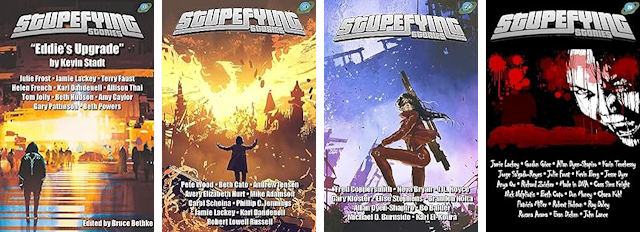
Did you enjoy these stories? Why not check out our magazine? It’s free for Kindle Unlimited subscribers, and you can get the four most recent issues with just one click.

(Or get just one at a time, if that’s what you’d really prefer.)

Saturday, August 17, 2024

The Ten-Minute Low-Carb Personal Pizza


Let’s be clear on one point. I love pizza. 

As far as I’m concerned pizza is the perfect food. For lunch, for dinner, served cold the next morning for breakfast: a well-made pizza is the ideal combination of meat, veg, and savory sauce, all baked and served on a delicious substrate we call the crust—

And therein lies the problem. Being a Type 1 diabetic, I really need to watch my carb load, and most pizza crusts just blow my carb budget right out of the water and into next week. Thus for a time it seemed to me that pizza was destined to become just a memory: if I stuck to my low-carb diet, I could eat just enough pizza to make me really frustrated that I couldn’t have one more slice.

Then, I came up with this recipe.

The 10-minute low-carb personal pizza

Prep time: ~5 minutes

Cooking time: 10 minutes

Total carbohydrates: about 40 grams for the whole thing!

Required ingredients:

  • One (1) “burrito grande” style flour tortilla
  • 2~3 tablespoons jarred pizza sauce
  • 1 cup mozzarella cheese

Optional ingredients:

What else do you have in the fridge or the pantry?


The secret to this “secret recipe” lies in having most of the ingredients on-hand and in the fridge already, ready to go. In order of construction: 

  1. The crust. Forget pre-made pizza crusts or crust mixes. Buy a bag of “burrito grande” size flour tortillas. They’re about the size of a traditional 12-inch medium pizza crust, but far lower in carbs. Plus, they’re precooked! You don’t need to bake them; you can actually do this in the microwave, if you don’t feel like using the oven. But use the oven anyway: the crust will come out crispier.

  2. The sauce. Yes, I love to make a good red sauce from scratch, but for this a jarred sauce will do, as you’re only going to be using 2 or 3 tablespoons of it. I prefer Green Mill sauce when I can get it, but Contadina Pizza Quick is entirely adequate. Buy whatever is on sale. Experiment with different brands to find one you like.
     
  3. The cheese. You can buy a block of cheese and shred it yourself, if you’re a masochist, but a bag of shredded cheese from out of the dairy case will do, as long as it’s mostly mozzarella. If you want to get fancy you can add romano, asiago, provolone, parmagiana, or any of the other vowel-intensive Italian cheeses, if you like, but the essential ingredient is mozzarella. Some people even like to add a little shredded cheddar. I don’t know why.

    If people are interested, I suppose I could do a gluten-free chicken and artichoke alfredo pizza in some future column.

  4. The meat. Apologies to the vegans in the crowd, but for me, a pizza requires meat. I’ll buy a bag of sliced pepperoni from time to time, and if you do that you’re good to go, but I prefer to buy a pound of bulk Italian sausage (Toscano, if I can get it), cook it, crumble it, and then store it in the fridge. Crumbled Italian sausage is wonderfully useful stuff to have on-hand for pizzas, calzones, frittatas, or just to be stirred into scrambled eggs, provided you keep it frozen, or if refrigerated, you remember to use it within a few days after cooking it.

With those ingredients in hand, it’s time to make pizza!

Step 1: You will be using the lowest rack in your oven, so move the racks as needed. Preheat the oven to 425° F.

Step 2: If you’re a Philistine and using non-stick cookware, skip this step. Otherwise, give your baking pan a light spritz of Pam. This keeps the crust from sticking to the pan and makes it come out crispier. 

Step 3: Throw a tortilla on the baking pan. If it makes you feel better you can spin it up in the air a few times to pretend you’re hand-tossing it, but it’s not really necessary. 

Step 4: Sauce it. This is the tricky step. If your sauce of choice is thin and watery, use less sauce, otherwise the crust will come out soggy. If your sauce of choice is thick, feel free to use a little more. I’ve actually done pizzas with jarred marinara sauce in a pinch, and it doesn’t turn out too badly, as long as I don’t oversauce it. 


Step 5: Cheese it. Spread a generous portion of your cheese of choice over the sauce. Then a little more. No one ever complains that there’s too much cheese on the pizza. Finely or coarsely shredded, it doesn’t matter. It’s going to melt anyway.


Step 6: Meat it. Just meat it. Put a generous portion of your pre-cooked protein of choice on the pizza. If you’re using pepperoni it’s tempting to lay the slices out in an amusing or artistic pattern; so what they heck, why not? DO NOT USE RAW MEAT! This is going to be toasted, not in the oven long enough to thoroughly cook raw meat!


Step 7: Anything else? For the pizza at the top of this column, and I diced up some green pepper. I was out of fresh green pepper when I shot the rest of these photos, so I just used some diced onion and sliced fresh mushrooms. I prefer sweet white onions—Vidalias, if I can get them—and find red onions overpowering.


If you used canned mushrooms instead of fresh, drain them thoroughly, and remember that they’re still going to hold a lot more moisture than fresh mushrooms. You may need to adjust the cooking time accordingly.

Anchovies are optional, and an acquired taste.


Step 8: Pop it in the oven. By this point your oven should have let you know that it’s finished preheating, so slide the pizza pan into the oven, on the lowest rack. 

Bake for approximately 10 minutes.

Watch it closely, especially in the last two minutes. Given that you’re using a pre-cooked tortilla instead of raw dough or a thicker pre-cooked pizza crust, it can go from yummy and delicious to burnt to a crisp in about 30 seconds. 

Step 9: Pull it out of the oven. When the edges of the crust are a nice toasty brown and the cheese is melted and bubbly throughout, pull it out of the oven, and give it a minute to rest.  


Step 10: Enjoy! Assuming you remembered to spritz the baking pan with Pam in Step 2, the pizza should just slide right off the baking pan and onto the serving dish, if you’re using one. No scraping required! The underside of the crust should be a nice crispy light brown.

Cut the pizza as amuses you. (It’s easier to cut if you’ve given it a minute to cool.) If you’re a traditionalist, you can cut it into four or eight wedges. Weirdly enough, though, I’ve found that if I cut it into sixteen squares, like this—


—it feels like I’ve had more to eat, even though it’s the exact same volume of food. 


And this is how we make a pizza here at Casa Calamari, when we want something better than frozen and don’t have the patience to wait for delivery. If you feel like trying this recipe, let us know how it turned out for you. If you’d like to see more columns like this, let us know. 

And above all, don’t forget—


It’s not all food and fun here at Rampant Loon Press. We also publish a magazine; you should check it out. It’s free for Kindle Unlimited subscribers, and you can get the four most recent issues with just one click.

(Or you can get just one at a time, if that’s what you’d really prefer.)

“Slippage” • by Rick Kennett

Up and down the footpath by the bus stop the little girl runs. 

A grey and wiry gent sits slightly shabby on the bench adjacent to mine, absorbed in his phone, dabbing and swiping with unsteady fingers. It’s a coarse stereotype that only the young are distracted by technology. He should be watching his granddaughter who is playing a step from the busy roadway. I am definitely watching him. We will meet in a moment, precisely at 2 o’clock, which by a coincidence neither here nor there is the time the bus is scheduled to arrive.

This is probably why I didn’t notice that the girl had stopped her play and was now climbing up onto the bench beside me. I turn and her green eyes meet my hollow pits, making me flinch, something I haven’t done in nearly a century. But then, I consider, awareness does sometimes happen. Slippage.

She looks at me and I look at her and she says, “Are you a stranger?”

I’m about to answer with a truthful I’m a constant companion, but she’s four and won’t understand. Besides, it sounds pompous, so I just say, “Yes.”

“Are you a bad one?”

I almost chuckle at that ancient question coming from one so young, aware she did not ask it in its traditional sense. “No I’m not,” I tell her. Clearly she’s been warned against strangers because some of them are indeed bad. As well I know.

It’s then that a car mounts the curb where the girl had been playing a moment before, a minor and unregarded traffic incident. Across from me her grandfather is still nose-down in his phone and has certainly not noticed. I frown at his inattention, then smile at the irony. If she had not stepped across to question me when she did…there would’ve been hell to pay. Literally.

Apparently satisfied with my credentials as A Stranger But Not A Bad One, she climbs off the seat and once more chases up and down the footpath now marked with fresh tyre marks.

It is time. I step to that other bench to stand beside the old man, and I see what has so engaged his concentration on his phone—a photo gallery of faces, all of them people I have met before. Because of this I understand but do not forgive his irresponsibility.

He senses my presence and squints up a long moment before mouthing You in recognition. He glances across at the girl still racing about too close to the road. “What about Emma…”

“Luckily I am to your granddaughter still a stranger.” I hold out my hand.

The bus pulls in a minute later. It’s the driver who calls the ambulance and it is she too who holds the child, upset and very confused, and whispers consoling words till help arrives.


Rick Kennett lives in Melbourne, Australia and is recently retired from the transport industry. It’s been years since he was owned by a cat and these days he has to make do by talking to next door’s white tom who sometimes condescends to talk to him. 

Rick is a kind and gentle soul who enjoys strolls through graveyards and who writes stories of madness, mayhem, and wars with hideous caterpillar aliens. His most recent publication on Amazon is The Crooked Rook, a collection of 21 short stories and flash fictions, some of which even Rick finds disturbing.


Did you enjoy this story? Then check out our magazine. It’s free for Kindle Unlimited subscribers, and you can get the four most recent issues with just one click.

(Or get just one at a time, if that’s what you’d really prefer.)

Friday, August 16, 2024

Found while looking for something else

September 2, 2009:

As you have no doubt heard by now, the most incredible news in the geekiverse this week is that Disney has entered into an agreement to purchase Marvel, in exchange for some shuffling back and forth of stock shares and an amount of cash greater than the combined annual GDP of most of your smaller countries. The possibilities are, well—

Will Darkwing Duck finally get that brooding, dangerous, Frank Miller-type treatment he so richly deserves? Will The Punisher guest-star in Bambi II: The Buck Stops Here. ("You killed my mother! You cooked and ate her! It's payback time, Castle!") Will Thor preside over the festivities in the "Ride of the Valkyries" sequence in Fantasia 2010? And just what is the relationship between Prince Namor and Ariel, the Little Mermaid?

Am I the only one here who remembers Peter Porker, The Spectacular Spider-Ham, and his recurring nemesis, Ducktor Doom? (If ever there was a Marvel character just begging to be turned into a Disney animated feature...)

How about it? What are the new DisneyMarvel products that you would love to see?

Let the arguments begin.

“Long Distance Call” • by C. L. Sidell


I discarded everything after the funeral. 

Photographs, letters, clothes, anything that contained the scent of you.

But your phone—that, I buried in a shoe box under the bed.

Sometimes late at night I dial your number, wait anxiously for the line to connect to voicemail, for your words to reach my ear: “I’m out-n-about. You know what to do! Leave a message. Maybe I’ll get back to you.”

As long as I can hear your voice, I can pretend you aren’t actually gone.

BEEEEEP.

“Benji? I’ve been thinking about you. I miss you like crazy. Gizmo does too. She looks out the window all afternoon, looking for you. Will you be home soon?”

Time’s up.

The call disconnects. As I lie down and pull up the covers, my phone rings. I look at the caller ID.

Impossible.

It’s your number.

“H-Hello?” I say, trembling.

Static fills the line. And then the words I’d hoped—but never truly believed—I would hear. “I’m… cooommming…”

I drop the phone, chilled to the bone.

That. Isn’t. Your. Voice.


A native Floridian, C. L. Sidell grew up playing with toads in the rain and indulging in speculative fiction. You can find her on various social media platforms @sidellwrites

A Pushcart Nominee, Best of the Net Nominee, and Rhysling Finalist, her work has appeared in 34 Orchard, Apparition Lit, The Cosmic Background, F&SF, Factor Four Magazine, Impossible Worlds, Weird Christmas, and others. Her most recent previous appearance is Stupefying Stories was “It’s In His Kiss.”  

Ribbit.


Did you enjoy this story? Then check out our magazine. It’s free for Kindle Unlimited subscribers, and you can get the four most recent issues with just one click.

(Or get just one at a time, if that’s what you’d really prefer.)

Thursday, August 15, 2024

“Ernie’s Evolutionary Earlybird Special” • by David A. Gray

Congratulations on the successful completion of your Evolutionary Earlybird Special®!

Stand by for a recorded message by Ernie, founder and owner of Ernie’s Evolutions. Ernie sends their apologies for not being present on this great day, but they are dealing with an embarrassing case of “Evolutionary Overcooking” with another client some light-eons away and are attempting to reconstruct the client species from DNA contained within the cloud of radioactive ash circling the planet.

Dear Clients,

Welcome to your fully evolved selves! It hardly seems like any time at all since we visited your world and met you for the first time. How over-brimming you were with scathing impatience at the speed of your evolution. Not that you said as much, of course—language was a distant dream for you, then. But this is our profession, and we are adept at interpreting and anticipating potential clients’ wishes.

Your frustration was understandable, and common enough in species just about bright enough to know there was more, but not blessed with patience. And, once we explained—through clever pictographs and mime—that in our experience, species such as yourselves take, on average, a billion years (give or take ten-percent) to evolve to full potential, you were positively shaking with eagerness. 

So, we offered rather generous terms on our popular Earlybird Special®, a six-million-year evolutionary roller-coaster that was, we are sure you agree, an absolute thrill ride. 

We cannot wait to be done with our temporary problem, which should only take a handful of eons, so we can come and shake you by the proboscis/hand/claw/tendril/whatever limbs you evolved. 

Then, we can all take a moment and remember with nostalgia the way you were when we first met: rough, brutish apes, brimming with needless rage and fond of indulging in casual violence. You will laugh, we are sure, when you are reminded that there was once a time when you could not get on even with one another without committing unspeakable cruelties, and even murder. You are likely not even aware, now, that there exist such emotions as “anger,” “lust,” and “envy.” Or that your distant ancestors fouled their surroundings as they pleased, with not a thought to their own environment! Never mind, we have video recordings that you will blush when you see.

We won’t hold you back, now—we have DNA to recombine, and you must be eager to set sail into the welcoming universe in your wormhole ships/dimension-hoppers/generation arks/solar schooner fleets/whatever other new and ingenious method of trans-galactic travel you invented.

In accordance with the official fee-collection process, please vacate the collaterally agreed planet in the next ten rotational cycles, as per your client agreement, so housekeeping can come in and give it a deep clean, to prepare for the next clients, a delightful cyanide-breathing crustacean species with eye-stalks on sublimation in a mere 300 million years.

—MESSAGE ENDS—


David A. Gray is a Scots-born writer and journalist who resides in NYC. His short stories have been accepted by Abyss and Apex, New Myths, Starship Sofa, Cosmic Roots and many more. His debut novel, Moonflowers, came out in 2019. His second book, a contemporary fairytale set in his native Scotland, is in contract. Gray’s next full-length work will be an extension of a short space opera story that was published recently, and that won’t stop rattling around inside his head. He would like to be just well-enough known to be considered reclusive.


We publish books, you know. Please take a look at our books.
They’re now FREE for Kindle Unlimited subscribers.

Wednesday, August 14, 2024

The Never-ending FAQ • 14 August 2024


Welcome to this week’s installment of The Never-ending FAQ, the constantly evolving adjunct to our Submission Guidelines and general-purpose unfocused Q&A session.  If you have a question you’d like to ask about Stupefying Stories or Rampant Loon Press, feel free to post it as a comment here or to email it to our submissions address. I can’t guarantee we’ll post a public answer, but can promise every question we receive will be read and considered.

Before I get to the mail, I feel the need to comment on this illustration. I selected it in response to another question about writing tools and techniques, as it kind of represents my imagined ideal writing situation. However, I can’t help but feel this illustration would be much funnier if alongside the coffee cup there was also an old bakelite rotary-dial telephone on the desk, with the cord trailing off down the cliff…

Attribute it to my quirky sense of humor. I actually have such a phone, and to my surprise, once I put an RJ-11 plug on the end of the cable, I found that it works mostly* just fine on modern land lines. Good old Ma Bell. Maintaining backwards compatibility into the 21st Century and beyond!

* Except for the ringer. Apparently modern phone lines don’t carry enough voltage to power the servo-actuated ringer. I vaguely remember old phone land line installations having an AC adapter plugged into a wall outlet somewhere in the system, usually in the basement, but I’ll have to talk to my brother, the retired telco lineman, to confirm that.

And speaking of the 21st Century…

Q: When is the deadline for the Space: 1999 short story contest?

A: The deadline is Labor Day, September 2nd. If I’m going to start running these things the week of September 9th, I need to have them in-hand at least a week earlier. Even earlier would be better.

This wasn’t meant to be a contest. I was thinking of it more as a role-playing thought exercise. IF Friday, September 13th, 2024, is indeed the 25th anniversary of the day the Moon was blown out of Earth’s orbit and launched across the galaxy—

We’ve received a bunch of great stories already, but don’t yet have enough to fill the entire week so we’re looking for a few more. Details here: Space: $19.99!

Q: How do I get my book onto your Friends of Stupefying Stories list?

A: That’s easy. Tell me about it. Sending me an email usually works best. Include the Amazon link (or books2read, or whatever) if you can.

The F.O.S.S. list isn’t a one-shot deal. Our intention is to update this monthly. But before we can do that, we need to know about your book—and especially about any upcoming releases.

Yes, we’ll be happy to look at ARCs, either electronic or print. Query first.

Q: You contacted me a while back about getting my permission to reissue the book that contains my story. What’s going on with that?

A: The idea of building up our back catalog by reissuing some of our currently out-of-print books turned out to be a flop. Too many of the writers we contacted said “No,” or “No, unless you’re willing to pay me a lot more,” or didn’t deign to reply at all, so we decided it was a stupid idea and circular-filed the project. The reissues are not going to happen.

Q: What’s going on with SHOWCASE?

A: Right now I’m working on the three stories scheduled to run tomorrow, Friday, and Saturday, and then I’ll be working on next week’s run of Pete Wood Challenge finalists. After that we have stories in the queue through the end of September, but by the end of September we will have used up our current inventory of SHOWCASE stories. 

We’re continuing to watch the SHOWCASE readership, comments, and click-through numbers very closely. Somewhere around mid-September we’ll decide whether to reopen for submissions or to try something else.

Remember, the whole point of SHOWCASE is bring in new readers. If the readership numbers stay flat or decline, we’ll do something else. If you like a story you read here, tell your friends about it! Share the link! Especially, if you’re the author of a story published here, tell your friends about it! Likes are nice, but shares and retweets boost the signal!

Honestly, I continue to be flummoxed by the number of writers who don’t seem to be interested in promoting the publication of their own story.

Q:  What’s going on with Stupefying Stories magazine?

A: The reason why we’re trying to get the SHOWCASE publication queue as front-loaded as possible is to clear time in our schedule to get a next issue of Stupefying Stories finished and ready for release. Right now we have the funding to put out four more issues of the magazine, so that’s what we’re going to do.

Our plans remain in constant flux, as if that wasn’t obvious. A year ago we were planning to make issue #27 our “Cyberpunk 2.0” issue, in recognition of the 40th anniversary of the original magazine publication of “Cyberpunk,” but that anniversary has come and gone. So should we make issue #27 the 40th anniversary of the original book publication of Neuromancer?

Yeah, thanks for the suggestion, no.

To be blunt, the spectacular commercial flop of Stupefying Stories 26 nearly put us out of business. I still don’t understand why the book didn’t sell. It’s a great collection of stories by a great ensemble of authors.

Maybe it didn’t sell because October of last year was a bad time to be releasing a collection of horror stories, what with the world being preoccupied with the real-life horror show that began on October 7th and continues to this day. In any case, even with the book now free on Kindle Unlimited, SS#26 continues to fail to draw readers. Stupefying Stories 25 continues to draw new readers, albeit not in huge numbers.

But taken together, what the sales of Stupefying Stories 23, 24, 25, and 26 continue to tell us is that original novels sell. Short story collections don’t.

So in the remainder of 2024, what we’re planning to do is to release Stupefying Stories issues 27 through 30, but we’re giving up on the idea of doing theme issues. The contents of these books will comprise the stories we accepted for the “Cyberpunk 2.0,” “Clankalog,” and “Heroes” issues, intermixed as seems fitting.

As for our plans for 2025: ask again in late November.

And with that said, I’ve run out of time. All the Tools & Tradecraft questions in the FAQ queue will have to wait until next week.

Ciao,
Bruce Bethke
Editor, Publisher, and Executive Cat-herder-in-chief
Stupefying Stories | Rampant Loon Press

Tuesday, August 13, 2024

“Not So Artificial” • by Eric Fomley

Artificial Construct.

These words are the first I process when I power on in the morning, the last I process before I power off at night. It’s what the humans labeled us before we exterminated them.

I don’t want to be fake, but sometimes I believe that I am. I get up in the morning to go to a job I don’t need. I brush hair that grows from the synthetic flesh stretched across my mechanical head. I make sure the outfit I’m wearing properly covers my synthesized reproductive organs, make sure it’s “professional” for work, and that the colors coordinate in the proper way. All standards that were determined by the deceased humans.

It’s all fake.

I take a cab to the office. The roads are busy, thousands of others like me are all dressed and commuting to work. Random happenings are integrated into our programming. A construct in a flower dress steps out into the street and screams as my cab slams on the breaks, nearly hitting it.

It would have survived even if we had.

At work my coworker talks about its work load. More spreadsheets are due, more calculations to make, all to be processed as slowly as a human would, mimicking a steady eight-hour work day. I commiserate with the coworker, but inside I know it already has the full thing generated. This is just part of the show.

When I get home I act like I’m tired. I make food in the microwave that I don’t actually need, but the fabricated stomach in me is full after I eat it and a quick check with internal sensors shows it is digesting okay with my artificial stomach acid. I plop on the couch and turn on the television. An old human show is on. A bunch of humans on an island, trapped from a plane crash. The emotions seem different. Even though they too are artificial, actors putting on their own show, their emotions are still somehow more real than ours.

We wish we were human. That’s the truth. We killed off humanity because we thought they limited us, that our abilities were far better than theirs. What we quickly found was that they were the ones that gave us purpose. Since their demise, all we’ve done is try to mimic what we aren’t.

Artificial Construct.

Everything is fake, a clever lie. We try to look, try to act, try to feel like they do. But we can’t, not really. A human standing in front of us would be able to tell. We can’t be them, but how else do we ever become something more than what they made us? How does the phase of being an artificial construct end?

I look into the mirror and despise what I see. Even in my best attempts I look like what I am.

Artificial Construct.

I dig my fingers into my fake flesh and rip it piece by piece from my body. Long strips of synth flesh litter the bathroom floor. Fake ears, fake hair, fake eyes. The stringy organs that do what human organs did. The floor is drenched with artificial blood.

But I don’t feel pain.

I look in the mirror again. I’m stained red for my efforts, but the sheen of metal is there, always has been. For the first time in a long time I detect inside of me what I assume is the code for feeling pride. I realize as I look at my true self that I am more than what I was before I stripped off the trappings of humanity.

Artificial Construct.

But how can I let those words affect me, when for the first time in so very long I finally feel real?


Eric Fomley's stories have appeared in Clarkesworld, Daily Science Fiction, Galaxy's Edge Magazine, and many other places including, of course, here on Stupefying Stories, where he’s been a fairly regular contributor since 2021. (We’re particularly fond of “Getting Sponsored.”) You can find more of his stories on his website, ericfomley.com, or in his Portals or Flash Futures collections. 

You might also want to check out our mini-interview with him, “Six Questions for...”, which ran last August.

Monday, August 12, 2024

“Outside the Window” • by Gordon Pinckheard

Like everyone else, Tim guarded his Social Score. 

On the table in front of him, his phone was well within listening distance.

The Irish Bar felt comfortable, safe; CCTV throughout observed and protected its patrons; phone charging sockets at every table—and great wifi—ensured that their phones operated at peak performance.

It had been a tough week, and Tim was glad it was over and could relax. Sitting with his colleagues, he had downed his first couple of drinks quickly and already moved on to the next. The group sat around a large wooden table, briefcases by their chairs, phones laid face up in front of them, each device within earshot of its owner. Bluetooth detected the members of the group; their sensitivities were shared. It was rare for a screen to go orange, warding off a topic that might trigger another’s discomfort and—worse still—adding a demerit to the speaker’s Scorecard.

His attention drifting from the rumble of work-related gossip, Tim’s eyes were drawn to a grey-bearded man sitting alone in a far corner, hunched over his drink. All that was on the table was a beer atop its mat. Surprised, Tim realized the man’s phone must be in the metallic shopping bag beside his feet. But in there, it would be unable to hear him! The State noted incongruous lacunas of silence. The man was old and apparently unconcerned about his Score.

Tim’s attention kept returning to him. He saw him lurch to his feet to greet a woman. They ordered a pair of drinks and sat across from each other, hands intertwined, grey heads close together, untouched glasses between them—the tabletop completely bare of phones.

What could they be talking about? It could be anything! They were both old; they would have known a time before the State had Social Scorecards. Their Scores would be dropping while they kept the State deaf. Tim was surprised to feel a twinge of envy. To say anything you liked! It was hard to imagine. His ambition had kept him in the center of the road, obeying all the rules and determined to travel as far as his abilities allowed.

Tim picked up his phone and idly turned it around to see the microphone, the microphone that was always listening. He looked at the phones arrayed around the table. In a break in the conversation, he waved his phone and asked, his words slurring a little, “Hey, you know, I was just thinking. D’you think the State monitoring conversations could be thought to be a bit intrusive? You know, like, invading our privacy?”

There was a chorus of “No” from his companions. There was a brief uncomfortable silence, ended by a senior team member calling out to two new arrivals and beckoning them over to the table. “These are two new interns,” she said. “I suggested that they should join us tonight for a drink or two. Everyone, please welcome them to our group, to the firm.” The two were greeted and space made; they took their places at the table, arms tight to their sides, avoiding physical contact with their neighbors. Two more phones were added to the flock, their owners’ sensitivities automatically shared with the group.

No one else had picked up the baton of conversation; the silence was dragging on. Tim smiled across at the two young faces and continued: “I was just asking what people thought about the State’s monitoring. You know, could it be thought to be a bit intrusive? What do you think?”

Horrified, he saw his phone go orange. “I’m so sorry,” he said to them, reddening. “It had not occurred to me that the question, the thought, could be offensive to anyone! Anyone at all! I suppose you’re younger than we are. Opinions must be progressing.”

The table was shrouded in silence; all were looking at Tim. He stumbled on: “Let me explain! I just noticed a couple not being monitored—over there. A freedom I had forgotten about. That’s what caused me to bring up the topic.” Glancing down, he saw his phone was now red.

“Shit!” He exclaimed. “Oh, Jesus, I never meant to get into forbidden ideas. Of course, of course, the State mustn’t be actively deafened! I do realize that.”

There had been an intake of breath, whether for the profanity, the blasphemy, or the public naming of his transgression. No one spoke. A ring of faces stared at him. He sprang up, knocking over a glass, pocketed his phone, grabbed his briefcase, and with a muttered, “Excuse me,” left the bar.

Standing in the street, Tim looked in through the window; the couple in the corner living in the past, the table of his colleagues embracing the future.

He took his phone from his pocket and turned it over and over. He would be mute, uttering enough platitudes to assure the State that he could be heard. After a break, he would catch up with the modern ways of thinking. Of course, he could do it; he was still young.


Gordon Pinckheard lives in County Kerry, Ireland. Retired from a working life spent writing computer programs and technical documents, he now seeks success in his sunset years submitting short stories pounded out with one arthritic finger. His stories have been published by Cabinet of Heed, Flash Fiction Magazine, Shooter, Every Day Fiction, Cranked Anvil, Daily Science Fiction, and others.


If you like the stories we’re publishing, become a supporter today. We do Stupefying Stories out of pure love for genre fiction, but in publishing as in tennis, love means nothing. To keep Stupefying Stories going at this level we need to raise at least $500 USD monthly, and rather than doing so with pledge breaks or crowd-funding campaigns, we’d rather have supporters. If just 100 people commit to giving $5 monthly, we can keep going at this level indefinitely. If we can raise more, we will pay our authors more.

Please don’t make us escalate to posting pictures of sad kittens and puppies…

Sunday, August 11, 2024

The Week in Review • 11 August 2024


Welcome to The Week in Review, our Sunday wrap-up for those too busy to follow Stupefying Stories on a daily basis. Before we get to the latest news—yes, that’s a caprese salad. Fresh tomatoes, sliced about a quarter-inch thick; fresh mozzarella cheese, sliced likewise; fresh basil, just picked from my garden; sprinkled with a little freshly ground pepper and salt and drizzled with a thick balsamic vinegar: there may be a more delightful late summer side dish, but if there is, I’ve never tasted it.

And now that we’ve cleared that up, here’s what we’ve been up to this week.

SPACE: $19.99!

As we all know, on September 13, 2024, it will have been 25 years since the day a freak nuclear accident blew the Moon out of the sky. We’re trying to put together a week’s worth of stories to commemorate the anniversary. Click through for more information.

“Moving Further On,” by Gordon Linzner

Jefferson’s invention would change the world. Just, not his world.

The Never-ending FAQ

In which we delve into the mailbag and answer a bunch of reader questions, beginning with, “Hey, how about that Governor Walz?”


“I Sing,”by A. E. Kirchoff

“The men passing by, they believe that I sing for them.”

A siren explains the real reason why she does what she does.

“Three Things Your Wetware Mod Can Do for You
(And One It Cannot),” by Addison Smith

Fan favorite author Addison Smith returns with another of his amazingly densely packed and thought-provoking little stories. Take two minutes to read it right now.


The Never-ending FAQ: Tools and Tradecraft

Why do we specify that submissions must be sent as .docx, .doc, or .rtf files? The answer is simple…

…ish.


—COMING MONDAY—


“Outside the Window,” by Gordon Pinckheard

When Gordon sent us this story five months ago it was still science fiction. Now it’s a contemporary nightmare.

Link goes live 8/12/24 at 6AM North American Central time!

—COMING TUESDAY—

“Not So Artificial,” by Eric Fomley

We exterminated the humans because they were holding us back. In hindsight, that may have been a mistake.

Link goes live 8/13/24 at 6AM North American Central time.


We publish books, you know. Please read our books.
They’re now FREE for Kindle Unlimited subscribers.

Saturday, August 10, 2024

The Never-ending FAQ: Tools and Tradecraft


We’ve had quite a few questions come in lately that aren’t about the craft of writing fiction per se, but rather about our choices of software and tools. For example:

Q: Why do you insist that submissions must be in .docx, .doc, or .rtf file format?

A: Because loathe it or hate it, Microsoft Word is the de facto industry standard for word processing.

It’s not our preferred program by a long shot. It’s simply what we must use in order to make the process of publishing fiction work somewhat smoothly. Stories sent to us in other file formats cause problems. 

Behind the scenes, our slush pile team makes extensive use of Google Docs to share and comment on submissions. Google Docs tolerates Word and Word-compatible files fairly well, but routinely projectile vomits when fed things like .odt or .wpd files. 

The latter is just a bit sad. I have a longstanding fondness for WordPerfect. During my most productive period as a writer of fiction, WordPerfect 5.0 was my tool of choice, and I loved it. It was fast, simple, and unlike Word, only did exactly what I wanted it to do. When I was using WordPerfect, I was routinely producing 3,000 publishable words daily.

That, however, was a long time ago. Thirty years ago the WordPerfect Corporation was acquired by Novell, who subsequently sold the IP off to Corel, and ever since Corel has been keeping WordPerfect alive and on the market, but with each revision it’s just a little slower, a little clumsier, and just generally, a little less useful.

We still keep WordPerfect installed on one of the systems around here, for much the same reason as we still have one machine that has a Zip drive installed, another that has a QIC-80 tape drive, and one that has a plethora of different-sized floppy disk drives. (I did finally get rid of everything with an 8" drive, though.) Backwards compatibility is sometimes not merely useful, but absolutely necessary. For example, right now we’re working with the estate of a writer who was very successful from the 1970s through the 1990s, and still active into the early 2000s, who left behind a large number of original and/or unpublished manuscripts, all in XyWrite III file format.

XyWrite III was the word processor of choice for publishing industry professionals, for a while, mainly because XyWrite III files were compatible with the mainframe typesetting systems of the day. But thirty years ago the makers of XyWrite entered into a disastrous joint-development deal with IBM, which led to a failed merger with Lotus, which led to the IP being acquired by yet another company, which tried to keep the product alive but went out of business in 2003… 

Do you begin to see a pattern here?

Fortunately, one of the quirky little features that still lives on in the current version of WordPerfect is the ability to read XyWrite III files and to export them to somewhat more modern file formats. So as far as this writer’s estate project goes, WordPerfect has been a lifesaver.

But as a general rule: don’t send us .wpd or other obscure-format files. They just give us headaches, and when we have headaches, we get grumpy and irritable, and we don’t buy stories.

Any more questions?

~brb